

A good abs workout gym session isn’t 200 crunches at the end of a chest day. It’s 4 to 6 hard, loaded sets for your trunk that you can make heavier every week, just as you would for your legs or back. The gym gives you cable stacks, hanging stations and machines that add resistance in 2.5–5 kg steps. Below: every station ranked with sets, reps, rest and a form cue, a 4-week beginner plan, an advanced routine, and why visible abs depend more on your plate than your crunches.
This page covers the abdominal muscles (rectus abdominis and obliques). For carries, anti-rotation and lower-back endurance, see our core workout gym guide.
What should an abs workout at the gym actually include?
An effective gym abs workout has three kinds of movement: spinal flexion against load (cable crunch, machine crunch), hip flexion with a posterior pelvic tilt (hanging knee or leg raise, reverse crunch) and anti-extension (ab wheel, plank variations). Do 2–3 exercises, 6–10 total sets, 2–3 times a week, and add load or reps each week.
Most people pick exercises they can do for 50 easy reps, which gives the muscle little reason to grow. The rectus abdominis is a skeletal muscle like any other. A 2017 meta-analysis in the Journal of Sports Sciences found a graded dose-response between weekly sets and muscle growth: each additional weekly set was linked with about 0.37% more growth, and groups doing 10 or more sets per muscle per week trended toward the best results (Schoenfeld et al., 2017). For abs, that means 8–12 hard weekly sets spread across two or three sessions. You don’t need a separate “abs day”.
Progression is the part people skip. If your cable crunch uses the same pin in March as in January, the stimulus has stopped rising. Log load and reps on your phone.
The World Health Organization’s 2020 guidelines recommend muscle-strengthening activity for all major muscle groups on 2 or more days a week, alongside 150–300 minutes of moderate aerobic activity (WHO, 2020). Abs add to a full training week; they don’t replace it.
Abs workout gym machine and cable exercises, ranked
These stations exist in most Indian gyms, from a ₹1,500-a-month neighbourhood gym to a premium chain. They run roughly easiest to hardest.
| Exercise | Equipment | Sets × reps | Rest | Form cue | Level |
|---|---|---|---|---|---|
| Seated ab crunch machine | Selectorised ab machine | 3 × 10–15 | 60–75 s | Curl your ribs toward your hips. Don’t yank the handles with your arms. | Beginner |
| Front plank | Mat | 3 × 20–45 s | 45 s | Squeeze your glutes and tuck your tailbone so your lower back stays flat. | Beginner |
| Reverse crunch on incline bench | Adjustable bench | 3 × 8–12 | 60 s | Roll your hips off the pad. Don’t just swing your legs. | Beginner |
| Kneeling cable crunch | Cable stack + rope | 3–4 × 10–15 | 60–90 s | Keep your hips still and round your spine down, nose toward your knees. | Beginner–Inter. |
| Captain’s chair knee raise | Vertical knee-raise (VKR) station | 3 × 8–15 | 60–90 s | Press your back into the pad and lift your knees and your pelvis. | Beginner–Inter. |
| Pallof press | Cable stack + D-handle | 3 × 10 each side | 45–60 s | Press straight out and don’t let the cable twist you. | Intermediate |
| Hanging knee raise | Pull-up bar or ab straps | 3 × 8–12 | 90 s | Start from a dead hang with no swing, and curl your pelvis up at the top. | Intermediate |
| Weighted decline sit-up | Decline bench + plate | 3 × 8–12 | 90 s | Hold the plate at your chest and lower slowly over 3 seconds. | Intermediate |
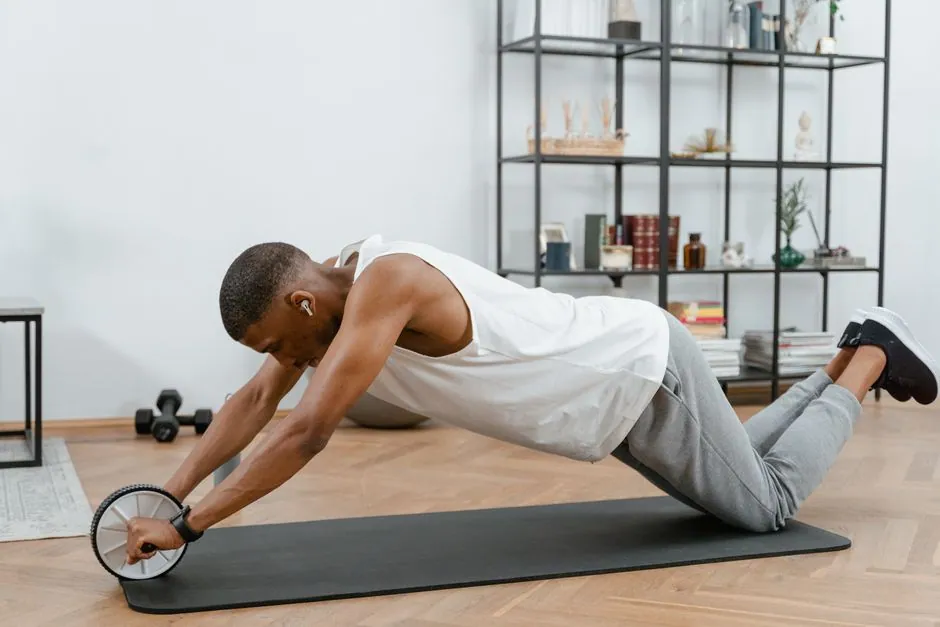
| Ab wheel rollout | Ab wheel | 3 × 6–10 | 90 s | Roll out only as far as you can without your lower back sagging. | Inter.–Advanced |
| Hanging straight-leg raise | Pull-up bar | 3 × 6–10 | 90–120 s | Bring your toes to bar height with control, then lower over 2–3 seconds. | Advanced |
| Cable woodchop (high-to-low) | Cable stack + D-handle | 3 × 10 each side | 60 s | Turn through your trunk with your arms long and your hips steady. | Intermediate |
Which of these work the abs hardest? A 2006 electromyography study in Physical Therapy tested 21 healthy adults on traditional and “nontraditional” exercises. Hanging knee-ups with straps, ab-wheel variations (pike, knee-up and roll-out) and a reverse crunch on a 30° incline produced the highest upper and lower rectus abdominis activity. They beat the standard crunch (Escamilla et al., 2006). The same study warned that some of these moves also work the hip flexors (rectus femoris) heavily, which may be a problem for people with low-back issues. Progress into them. Don’t jump straight to the hardest version.
Abs workout gym equipment worth queuing for
If you only have time for three stations, use these: the cable stack (for crunches, Pallof presses and woodchops), the captain’s chair or pull-up bar (for knee and leg raises) and an ab wheel. Together they cover every movement pattern listed above. The seated ab crunch machine is a good way to learn a loaded crunch, and useful when the cables are crowded at 7 pm. Skip the rotating “twister” discs and hip-sway machines. They add momentum, not load.
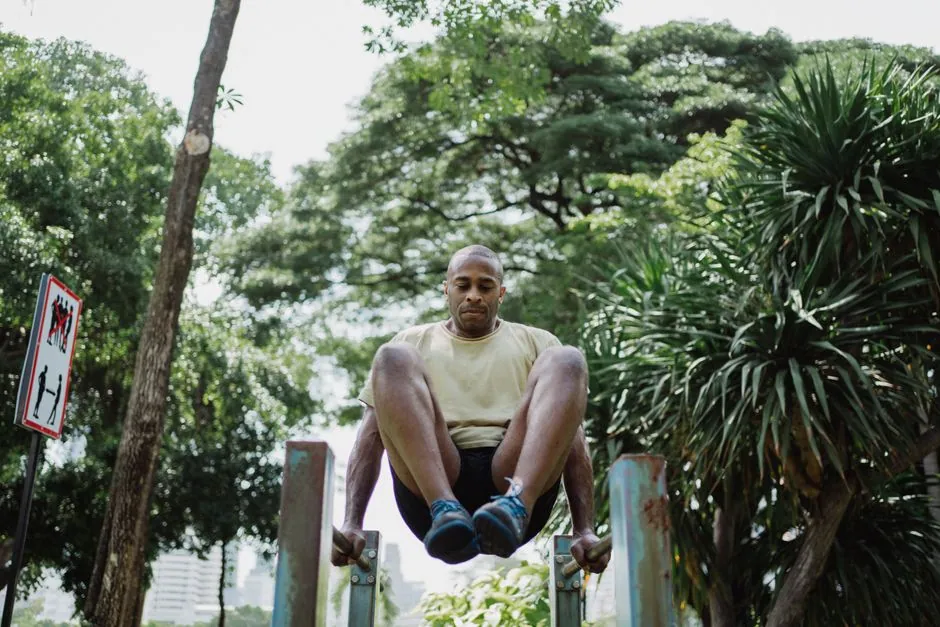
Lower abs workout gym moves: can you really target the “bottom two packs”?
You can’t completely isolate the “lower abs”, because the rectus abdominis is one muscle running from the ribs to the pubic bone. But exercises that curl the pelvis up toward the ribs, like hanging knee raises and incline reverse crunches, do bias the lower portion. EMG research from 2006 ranks them among the highest-activation abdominal exercises.
“Lower abs” usually mixes up two things: the lower part of the rectus abdominis, and the fat below the navel that is often the last to lean out. Exercise choice helps the first; only an overall energy deficit helps the second.
For the muscle, the key cue is posterior pelvic tilt. If you lift your legs but your pelvis stays still, your hip flexors do most of the work and your abs only hold you steady. Curl the pelvis up. A simple lower abs workout gym block after your main lifts:
- Incline reverse crunch (bench set to about 30°): 3 × 10, 60 s rest
- Captain’s chair knee raise with a 1-second squeeze at the top: 3 × 12, 60 s rest
- Hanging straight-leg raise (or bent-knee if you can’t control straight legs): 2 × 6–8, 90 s rest
If your lower back arches off the pad, bend your knees to shorten the lever.
Abs workout gym for beginners: your first 4 weeks
If you’re new, keep ab work short and after your main lifts; squats, deadlifts and rows already make your trunk brace hard.
| Week | Exercise 1 | Exercise 2 | Exercise 3 | Total sets / session | Goal for the week |
|---|---|---|---|---|---|
| 1 | Ab crunch machine 2 × 12 (light) | Front plank 2 × 20 s | Incline reverse crunch 2 × 8 | 6 | Learn to curl the spine and tilt the pelvis |
| 2 | Ab crunch machine 3 × 12 | Front plank 3 × 30 s | Incline reverse crunch 3 × 10 | 9 | Same exercises, more sets |
| 3 | Kneeling cable crunch 3 × 12 | Pallof press 2 × 10/side | Captain’s chair knee raise 3 × 8 | 8 | Move to cables and free hanging |
| 4 | Kneeling cable crunch 3 × 12 (+1 plate) | Pallof press 3 × 10/side | Captain’s chair knee raise 3 × 12 | 9 | Add load or reps each session and write it down |
Two sessions a week at 6–9 sets each puts you at 12–18 weekly sets by week 4, comfortably in the “10+ sets” range linked with the best hypertrophy results. Rest 60–75 seconds between sets. Stop each set with about 2 good reps left in the tank. Sharp or neck pain isn’t normal soreness; see the troubleshooting table below.
One common mistake: doing abs before squats or deadlifts. Tired abs brace poorly under a loaded bar. Abs go last.
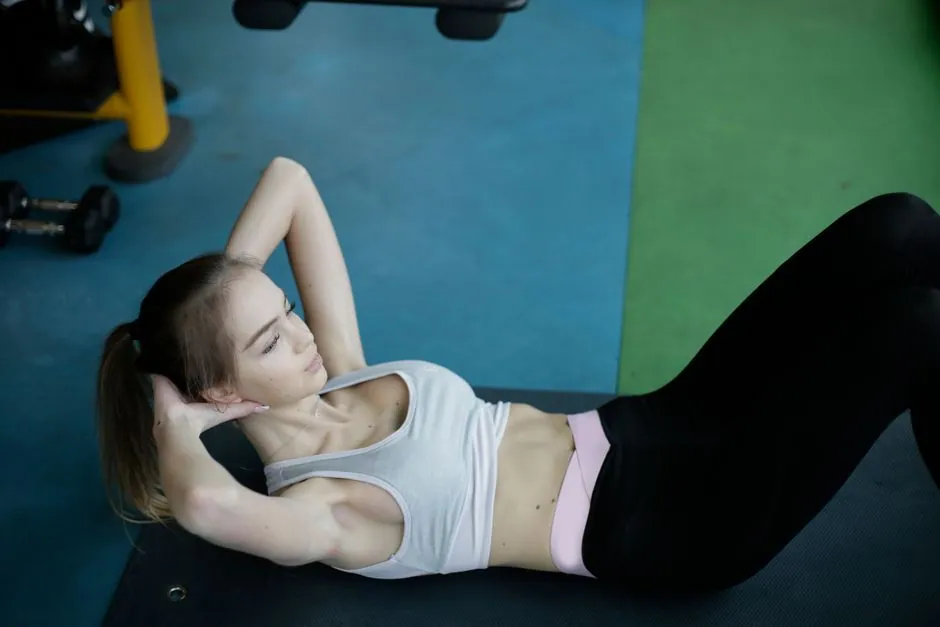
An advanced abs workout gym routine
Once you can do 3 × 12 strict captain’s chair knee raises and a cable crunch with a decent stack, switch to the routine below. It hits each movement pattern once per session. Run it twice a week, with at least 48 hours between sessions (for example, Tuesday and Friday).
- Hanging straight-leg raise: 3 × 6–10, 2 s lowering, 90–120 s rest
- Heavy kneeling cable crunch: 4 × 8–12, 90 s rest. Add weight whenever you hit 12 reps on every set.
- Ab wheel rollout from the knees (then from standing, over months): 3 × 6–10, 90 s rest
- Cable woodchop: 2 × 10 each side, 60 s rest
That’s 12 sets per session and 24 a week. If your trunk still feels fatigued at your next squat day, drop the woodchops.
Loading an abs workout gym with weights safely
Adding load is how abs get thicker. Three safe ways:
- Cable crunch: the easiest to load in small steps. Go up one pin (usually 2.5–5 kg) at a time.
- Decline sit-up: hold a 2.5 kg or 5 kg plate at your chest (not behind your head). Increase the bench angle before you increase the plate.
- Hanging knee raise: hold a light dumbbell between your feet only when 3 × 15 strict reps feel easy. Ab straps help if grip fails first.
Rep ranges of 8–15 work well for abs. Heavy sets of 3–5 add little, and they raise the risk of pulling with your hips and back instead of your trunk.
Myth check: “Crunches burn belly fat”
No. Training a muscle doesn’t burn the fat directly over it. In a 2011 randomised trial, 24 adults did 7 ab exercises (2 × 10 reps, 5 days a week) for 6 weeks with no diet change. Their abdominal fat, waist circumference and body fat percentage didn’t change significantly. Their ab endurance did improve.
That trial (Vispute et al., J Strength Cond Res, 2011) is small, but a 2013 Chilean study makes the point even more clearly. Eleven young adults trained one leg only on the leg press, 960–1,200 reps per session, three times a week for 12 weeks. They lost fat mass, but the loss came from the upper body and trunk (down 10.2% and 6.9%), not from the trained leg (Ramírez-Campillo et al., 2013). Your body chooses where it draws fat from. Your exercise choice doesn’t.
So what is ab training for? Mayo Clinic describes it clearly: aerobic activity and an overall calorie deficit burn abdominal fat, while core exercise strengthens the muscles underneath (Mayo Clinic). Thicker abs show sooner as fat comes down, but the ab workout alone won’t reveal them. Our guide to the diet to lose belly fat covers that in detail.
How much does diet matter for visible abs?
For visible abs, diet matters more than exercise choice. You need a modest calorie deficit to lower overall body fat, plus enough protein to keep and build muscle while you do. A 2018 meta-analysis of 49 trials found that gains in muscle from resistance training levelled off at about 1.6 g of protein per kg of body weight per day.
That meta-analysis (Morton et al., Br J Sports Med, 2018) pooled 1,863 participants. It found that protein intakes above roughly 1.62 g/kg/day brought no further gain in fat-free mass. Treat it as a practical upper target, not a minimum. If you have kidney disease or another medical condition, ask your doctor before increasing protein.
| Body weight | Moderate target (1.2 g/kg) | Upper useful target (1.6 g/kg) | Per meal if split into 4 |
|---|---|---|---|
| 50 kg | 60 g | 80 g | 15–20 g |
| 60 kg | 72 g | 96 g | 18–24 g |
| 70 kg | 84 g | 112 g | 21–28 g |
| 80 kg | 96 g | 128 g | 24–32 g |
| 90 kg | 108 g | 144 g | 27–36 g |
In a typical Indian diet, most people can’t reach 100 g of protein from dal and roti alone. The practical fix is to build protein into each of your three main meals and one snack: paneer or tofu bhurji at breakfast, a bigger katori of dal or rajma plus curd at lunch, eggs, chicken or soya chunks at dinner, and roasted chana or sprouts in the evening. Vegetarians should see our high-protein vegetarian foods list for per-serving numbers.
On calories, a slow deficit protects muscle; crash diets take muscle with the fat. How lean you must be before abs show varies with genetics and fat distribution, so track your waist and progress photos every two weeks rather than chasing one “abs number”.
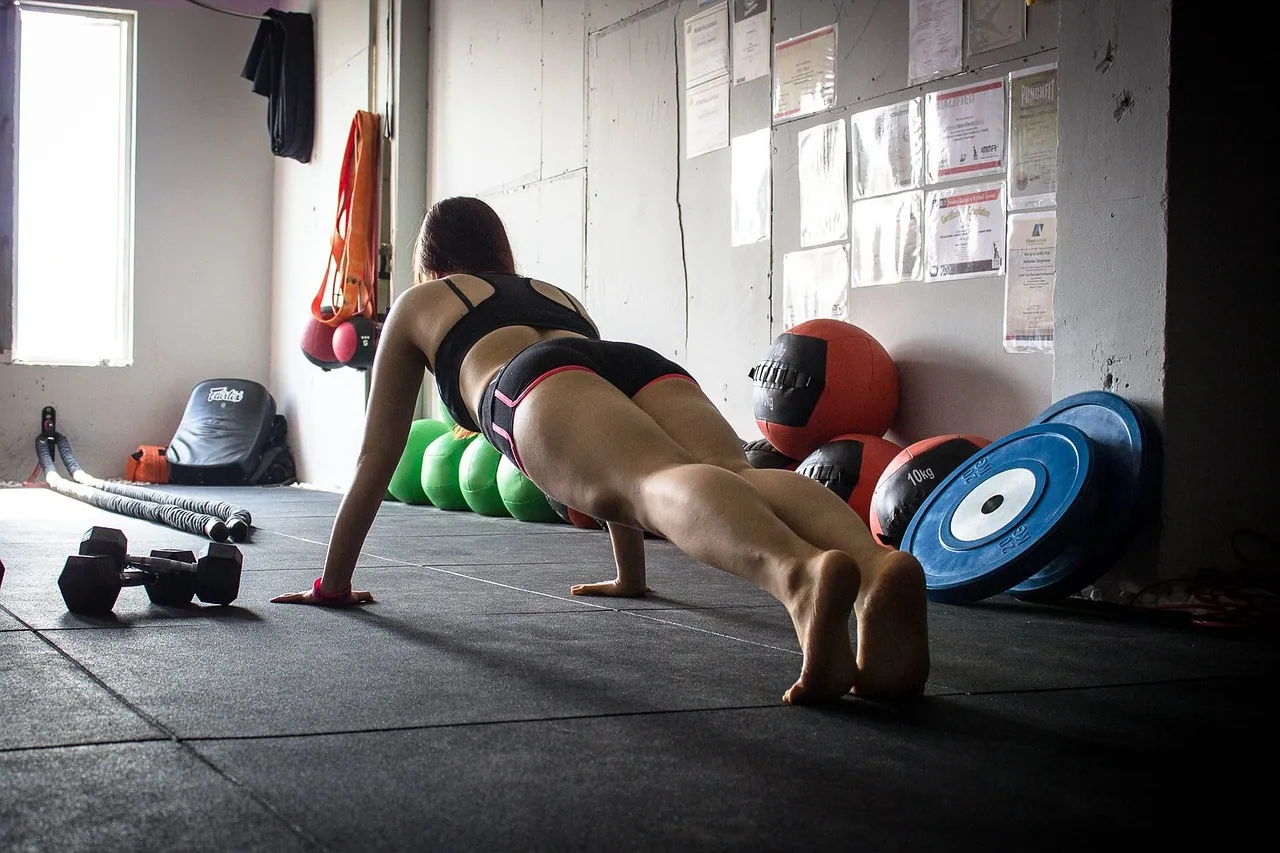
Men, women and desk workers: adjusting the plan
The exercises barely change by gender; starting points and some health factors do.
Abs workout gym male
Men often have the strength to overload cable crunches early and then turn them into a hip hinge, bowing forward from the hips while the spine stays straight. If the cable stack keeps going up but you don’t feel your abs, lower the weight by a third and focus on rounding your spine. Men tend to store more abdominal fat, so the diet section matters most. Keep to 2–3 sessions a week.
Abs workout gym female
Women can follow exactly the same programme and progress loads the same way; there’s no reason to stay with light “toning” circuits. If grip limits hanging moves, use ab straps or the captain’s chair. If you’re pregnant or have given birth in the past year, or you notice a ridge or doming along the midline when you crunch (a possible sign of abdominal separation), get checked by your doctor or a women’s-health physiotherapist before doing crunches, hanging raises or rollouts.
Desk workers and people with back pain
If you sit 8–10 hours a day, your hip flexors are probably tight. Harvard Health notes that sit-ups push the curved spine into the floor and rely heavily on the hip flexors, which can pull on the lower back and cause discomfort. That’s why planks are now seen as the “gold standard” for the core (Harvard Health Publishing). Start with planks, Pallof presses and cable crunches, and add hanging leg raises and decline sit-ups later. If you have diagnosed disc problems or back pain that spreads down a leg, see a doctor or physiotherapist before loading your trunk.
Neck strain, hip-flexor burn, no progress? Troubleshooting your abs workout
Most problems come down to a few fixable technique faults.
| What you feel | Likely cause | Fix |
|---|---|---|
| Neck ache during crunches or decline sit-ups | Pulling your head forward with your hands | Cross your arms over your chest or hold the plate there. Keep a fist-width gap under your chin. |
| Burning at the front of the hips, not the abs | Hip flexors lifting your legs without a pelvic tilt | Bend your knees, slow down and curl your pelvis up at the top of each rep. |
| Lower-back ache on rollouts or leg raises | Range of motion too long for your current strength | Shorten the rollout (roll toward a wall) and use bent-knee raises for now. |
| Swinging on the bar | Momentum from the previous rep | Pause 1 second at the bottom, or switch to the captain’s chair. |
| Cable crunch feels like a back exercise | Weight too heavy, hinging at the hips | Cut the load by 30%, sit your hips back on your heels and hold them there. |
| Abs stronger, but no visible change after 8–12 weeks | Body fat still covering the muscle | Review calories and protein. Track your waist, not just the scale. |
| Stuck at the same reps for 3+ weeks | Not enough recovery, or no planned progression | Take a lighter week, then add 1 set or one weight increment. |
If you train online or in a crowded gym without a coach to watch your form, film one set from the side on your phone. A coach on live video can also correct these in real time through Fitstrot’s 1-on-1 personal training.
Frequently asked questions
What is the best abs workout in the gym?
The best gym abs workout combines a loaded crunch (cable or machine), a hanging knee or leg raise and an anti-extension move such as the ab wheel. Do 2–3 exercises for 6–12 total sets, 2–3 times a week, and add weight or reps over time.
Can I do an abs workout every day at the gym?
You can, but you don’t need to, and daily hard sessions tend to hurt recovery. For most people, 2–3 sessions a week with 48 hours between them works better, adding up to roughly 8–20 weekly sets.
Do ab workouts reduce belly fat?
Not on their own. A 2011 randomised trial found 6 weeks of daily-style ab exercise didn’t reduce abdominal fat or waist size. Belly fat comes down through an overall calorie deficit, regular aerobic activity and consistent strength training.
Which gym machine is best for abs?
The cable stack with a rope is the most versatile, because it lets you add load in small steps for crunches, Pallof presses and woodchops. The captain’s chair (vertical knee-raise station) comes next for hanging-style work with back support.
How long does it take to see abs from a gym workout?
It depends mostly on your starting body fat, not on the workout. Strength and endurance improve within 4–6 weeks. Visible definition can take several months or longer of steady diet and training, especially if you start with more abdominal fat.
Should beginners use weights for abs?
Yes, once they can control the movement. Start with the ab crunch machine or a light cable crunch in week 1–2. Then add one weight increment whenever you can finish every set at the top of the rep range with good form.
Is it better to do abs before or after my workout?
After. Your abs help brace your spine during squats, deadlifts and overhead presses. Tiring them first makes those lifts less stable, so train abs at the end of a session or on a separate short day.
Want someone to check your cable crunch form and match your protein to your dal-roti routine? Book a Fitstrot nutritionist consultation and start your abs plan this week.


