
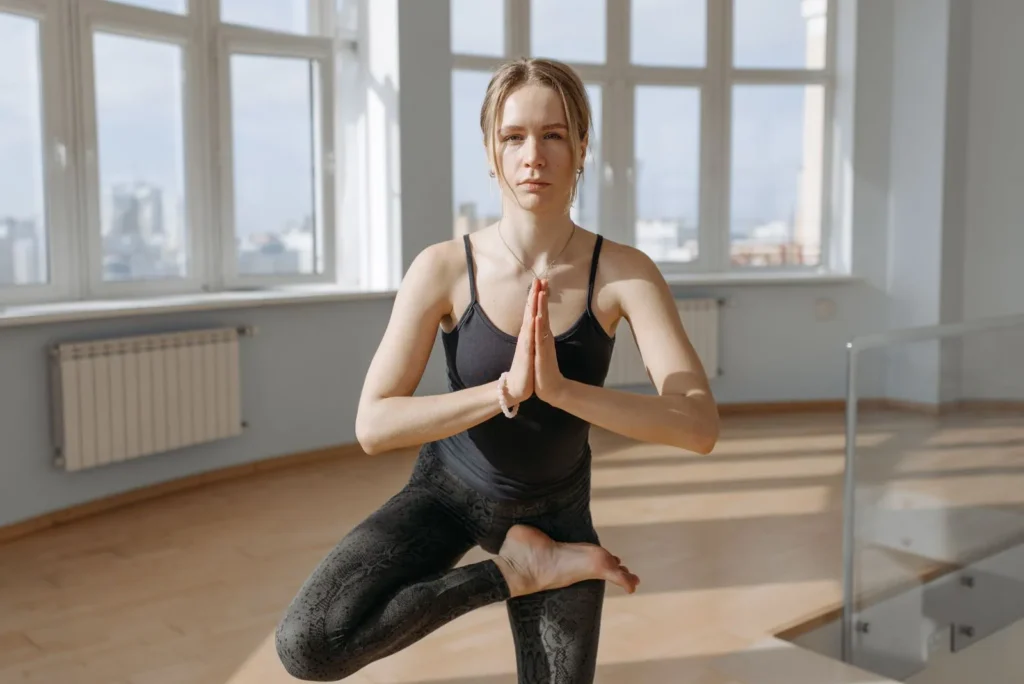
Standing yoga poses are the part of practice that builds the strength and balance you actually use: climbing stairs, carrying shopping, getting up from the floor. They load the legs, challenge the core and teach you to stand taller, and they need no flexibility to begin. This guide covers the alignment foundation under every pose, a chart of the ten most useful shapes, a 20-minute flow you can follow at home, and the cautions around balance that most articles skip. Start with the foundation, because getting the feet right fixes more problems than any advanced cue.
What are standing yoga poses and what do they train?
Standing yoga poses are asanas performed upright with one or both feet on the floor. They train leg strength, hip mobility, balance and posture at the same time. Most are held for 5 to 8 breaths, roughly 20 to 45 seconds, and can be eased with a wall, chair or block.
They fall into four groups. Strength poses such as chair and the warriors load the thighs and glutes. Balance poses such as tree and eagle train the small muscles around the ankle and hip. Folds such as triangle and pyramid lengthen hamstrings and the side body. Mountain pose sits underneath all of them as the alignment reference. A balanced class uses all four, and our overview of yoga asanas shows how standing poses fit alongside seated, backbend and twisting families.
How do you set up the foundation for every standing pose?
Stand with feet hip-width apart, spread the toes, and press evenly through the big-toe mound, little-toe mound and heel. Stack knees over ankles, ribs over pelvis and ears over shoulders, with a soft, not locked, knee. Every standing pose is a variation of this base.
- Feet. Parallel and hip-width. Imagine a tripod: big toe, little toe, heel. Lift the arches slightly without curling the toes.
- Knees. Soft, never pushed back. Keep the kneecaps pointing the same way as the middle toes in every pose.
- Pelvis. Neutral, not tucked under and not tipped forward. Think of the hip bones pointing straight ahead like headlights.
- Ribs and spine. Lengthen up through the crown, keep the ribs from flaring and the belly gently engaged.
- Shoulders. Roll them back and down, let the arms hang heavy, and keep the neck long.
- Breath. Breathe through the nose in slow, even counts. If you cannot, you are holding the pose too hard.
Spend one minute here before any practice. If you are brand new, our guide to yoga for beginners explains how to build a first month around this base, and breathing pairs naturally with pranayama.
Which standing poses should you learn first? A pose chart
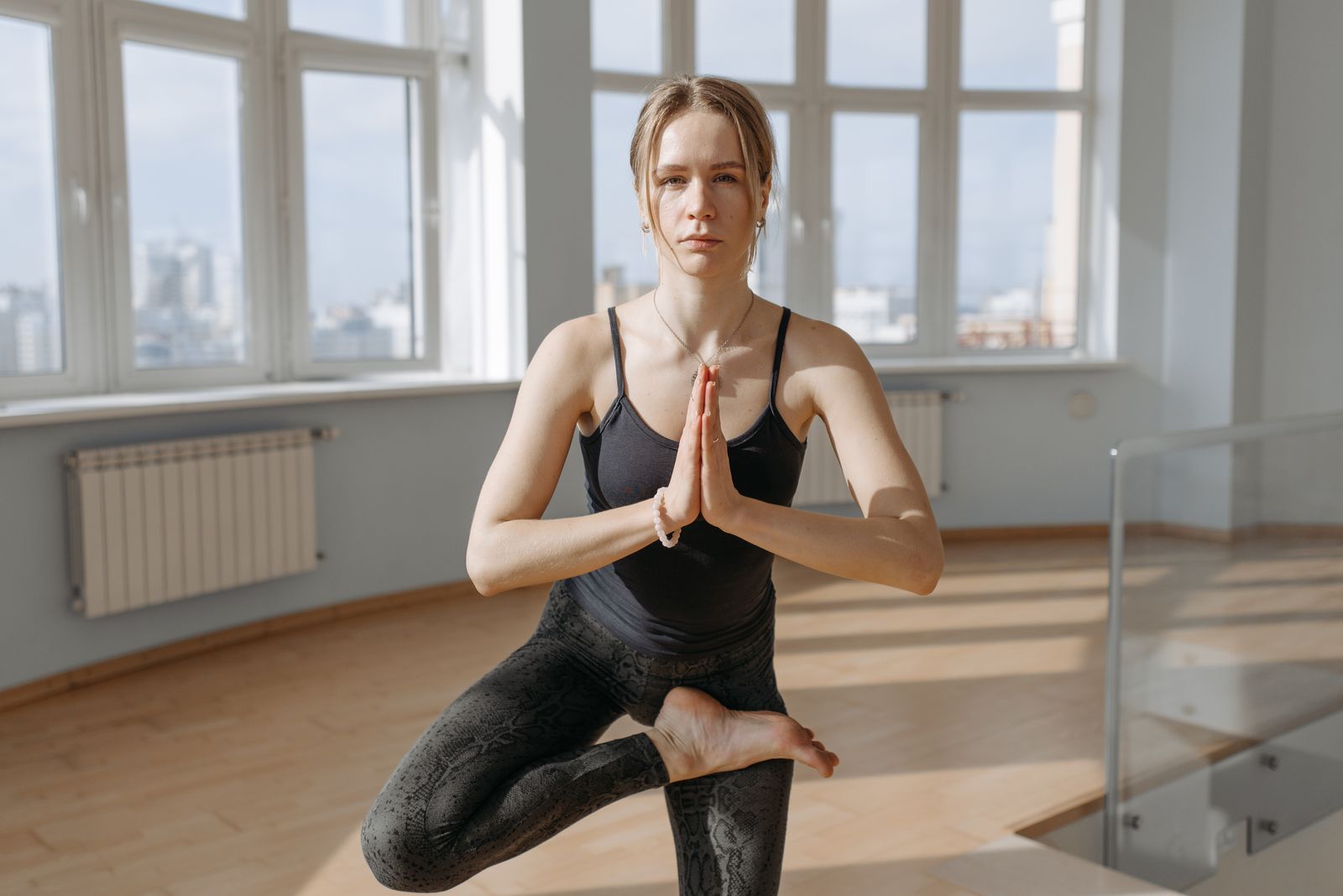
Nine poses cover almost every standing class: mountain, chair, warrior I, warrior II, triangle, pyramid, tree, eagle and half moon. Learn them in that order, from stable to demanding, and hold each for 5 to 8 breaths per side. The chart below gives the Sanskrit name, hold time and the cue that fixes the most common error.
| Pose | Sanskrit | Hold per side | Main work | Cue that fixes the usual error |
|---|---|---|---|---|
| Mountain | Tadasana | 5 breaths | Posture, awareness | Weight even across both feet, ribs over pelvis |
| Chair | Utkatasana | 5 breaths | Thighs, glutes | Sit the hips back, keep the knees behind the toes |
| Warrior I | Virabhadrasana I | 5-6 breaths | Legs, hip flexors | Back heel down, front knee over the ankle |
| Warrior II | Virabhadrasana II | 5-8 breaths | Stamina, hips | Front knee tracks over the second toe, torso upright |
| Triangle | Trikonasana | 5 breaths | Hamstrings, side body | Hinge from the hip; rest the hand on shin or block, never the knee |
| Pyramid | Parsvottanasana | 5 breaths | Hamstrings | Keep a short stance and a slight bend if hamstrings are tight |
| Tree | Vrikshasana | 5-8 breaths | Balance, ankle, hip | Foot on calf or thigh, never on the knee joint |
| Eagle | Garudasana | 3-5 breaths | Balance, shoulders | Sink slightly and fix the gaze on one point |
| Half moon | Ardha Chandrasana | 3-5 breaths | Balance, core, side body | Place a block under the bottom hand and keep the standing knee soft |
For Sanskrit and English names across all families, see our reference to yoga poses names, and for the wider library of shapes, browse yoga poses.
What does a 20-minute standing flow look like?
A good standing flow moves from grounding to warming, to strength, to stretching and finally balance. Warm the legs first, then ask for balance when the muscles are ready. The sequence below takes about 20 minutes and uses only the poses in the chart, with a bent knee wherever your hamstrings need it.
| Step | Pose | Breaths | How to move in and out |
|---|---|---|---|
| 1 | Mountain | 5 | Close the eyes, feel both feet |
| 2 | Standing forward fold, knees bent | 5 | Hinge from the hips, hang the head, rise slowly with a long spine |
| 3 | Chair | 5 | Inhale the arms up, exhale and sit back |
| 4 | Warrior I, right then left | 5 each | Step back from mountain, pivot the back heel down |
| 5 | Warrior II, right then left | 5 each | Open the hips and arms from Warrior I |
| 6 | Triangle, right then left | 5 each | Straighten the front leg and reach out before you hinge |
| 7 | Tree, right then left | 5-8 each | Shift weight first, then lift the foot slowly |
| 8 | Mountain | 5 | Let the arms fall and notice how the legs feel |
Do this three or four times a week. Once it feels easy, link the poses with breath in a flow, as taught in vinyasa yoga, or hold each longer in the slower style of hatha yoga. Students who like a set series with strong standing work often move on to ashtanga yoga.
Progress slowly. In week one, hold each pose for 3 to 4 breaths and use props freely. In weeks two and three, work up to 5 breaths per side. In week four, add the second round of warriors or hold tree and eagle longer. Adding duration before adding difficulty keeps joints happy and builds confidence, and a short daily practice beats one long weekend session.
Myth check: “Balance depends on being flexible”
Balance depends far more on where you look, how you root the foot and how firmly the standing leg works than on flexibility. Many very flexible people wobble because they hang on their joints, while stiffer students stay steady by engaging the standing thigh and holding a fixed gaze.
Three habits help straight away. Pick one still point at eye level and keep looking at it. Press all four corners of the standing foot evenly into the mat. Keep a small bend in the knee instead of locking it back. If you still wobble, put a fingertip on a wall. Ten to fifteen seconds a day is enough to build the feedback loop between foot and brain. Shaking is not a sign of failure; it is usually just muscle effort and fades as you get stronger.
When should you modify standing poses, or check with a doctor?
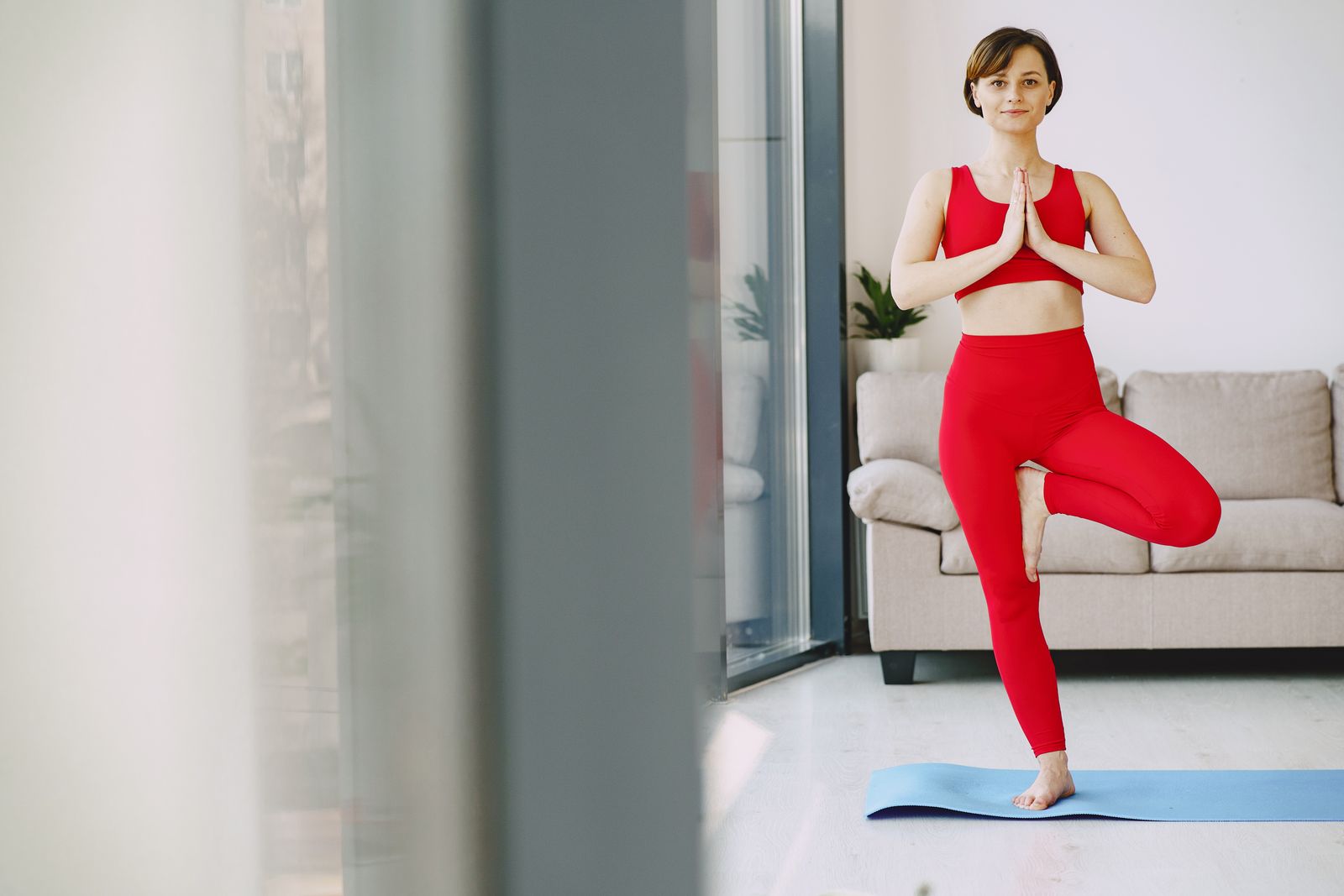
Modify standing poses when balance is uncertain, a joint hurts or you feel dizzy. Use a wall or chair, shorten the stance and avoid holding the breath. See your doctor first if you have a heart condition, uncontrolled blood pressure, vertigo, osteoporosis, a recent injury or are pregnant.
| Situation | Caution | Safer version |
|---|---|---|
| Knee pain | Deep bends and twisting under load | Shallower chair and warrior, knee over ankle, stop if pain is sharp |
| Dizziness or low blood pressure | Fast folds and quick rising | Keep folds short, rise slowly, sit if lightheaded |
| Vertigo or poor balance | Single-leg poses without support | Practise beside a wall, avoid closing the eyes |
| Osteoporosis or older age | Falls and deep forward bends | Use a chair back, keep the spine long, avoid rounding in folds |
| Pregnancy | Balance changes and overstretching | Wider stance, wall support, and guidance from a prenatal teacher |
| Recent ankle or hip injury | Weight on the injured side | Only poses cleared by your doctor or physiotherapist |
Stop any pose that causes sharp pain, numbness or tingling, and do not push through it. A good rule is that stretch and muscle effort are fine, joint pain is not.
Troubleshooting: common problems in standing poses
- My front knee caves inward. Press the knee towards the little-toe side of the foot and shorten the stance.
- My back heel lifts in Warrior I. Turn the foot out a little more and shorten the stride, or practise with the back heel against a wall.
- My hamstrings burn in folds. Bend the knees, or rest hands on blocks or a chair.
- My lower back aches in Triangle. Hinge at the hips with a long spine, rest the hand higher on the leg, and avoid dumping weight into the lower back.
- I fall out of Tree. Lower the foot to the ankle, find a gaze point and use one hand on a wall.
- My legs shake in Chair. Come up a little, hold for fewer breaths and build up over weeks.
Who benefits most from standing yoga poses?
Desk workers benefit from mountain, triangle and side stretches that counter hours of sitting. Beginners gain steady leg strength and body awareness. Runners and gym-goers use warriors and chair to build hip stability. Older adults use wall-supported standing work to keep balance and confidence.
If back stiffness is your reason for starting, pair standing poses with the routines in our guide to yoga for back pain. If tight hamstrings and hips limit you, yoga for flexibility adds seated stretches that complement standing work. For fat loss, standing flows raise the heart rate and build muscle, as explained in yoga for weight loss, but results still depend on food and consistency. Follow standing work with slower floor stretches such as yin yoga to release the hips.
Standing yoga poses FAQ
What is the easiest standing yoga pose?
Mountain pose (tadasana) is the easiest. It needs no flexibility and no balance, and it teaches the alignment that every other standing pose builds on. Standing forward fold with bent knees and chair pose against a wall are the next easiest.
How long should you hold standing yoga poses?
Most students hold standing poses for 5 to 8 breaths per side, roughly 20 to 45 seconds. Balance poses like eagle or half moon are often held for 3 to 5 breaths at first. Extend holds gradually and stop when your form breaks.
Can beginners do standing yoga poses every day?
Yes, a short routine of 10 to 15 minutes is generally safe daily because standing poses are low-impact. Rest if you feel joint pain or unusual fatigue, and alternate stronger days with gentle stretching or walking.
Do standing yoga poses build muscle?
They build muscular endurance and some tone in the thighs, glutes and core, because many poses are held isometrically. They do not replace progressive resistance training if your goal is significant muscle gain, but they are a strong base.
Why do my legs shake in standing yoga poses?
Shaking usually means the muscles are working near their limit, much like during a hard set at the gym. It is normal and usually fades as strength improves. Shorten the hold or lessen the depth if it comes with pain.
Next step: have a teacher check your alignment live in a small batch at Fitstrot online yoga classes, and ask for a standing-focused session.


