

The zumba vs dance question is slightly unfair, because Zumba is itself a dance workout. What most people really want to know is whether to join a Zumba class or pick another style such as Bollywood, hip-hop, bhangra, garba or salsa. This guide compares them on intensity, skill needed, music and calories (all rough estimates), then helps you choose and mix them. If you only want the brand-versus-category explanation, read our short piece on Zumba vs dance fitness.
How is Zumba different from other dance workouts?
Zumba is a branded fitness programme with pre-set choreography, Latin-led music and interval-style songs, so a 45-60 minute class is built like a workout. Most other dance classes are built around learning a style: you drill steps, repeat combinations and often work towards a performance, so the exercise is a by-product rather than the design.
That one difference explains most of what you will feel in a class. In Zumba the instructor demonstrates simple, repeatable moves and you follow along at your own intensity; nobody expects a perfect step. In a style class such as hip-hop or Kathak, the teacher corrects technique, and you progress through levels. Neither approach is better. They answer different needs: sweat and enjoyment first, or skill and expression first.
Zumba songs also follow a deliberate arc, with a warm-up track, a few high-energy songs, a slower toning or core track and a cool-down. If you want to know what the rhythms underneath actually are, our guide to Zumba rhythms explained breaks down salsa, merengue, cumbia and reggaeton. For a broader view of the whole category, see what is dance fitness.
Dance workout comparison matrix: intensity, skill, music and calories
The table below puts the most common dance workouts available to Indian learners side by side. Calorie figures are rough estimates for a 60-70 kg adult doing one hour at a normal class effort. A heavier person burns more, a lighter person less, and how hard you move matters as much as the style you pick.
| Style | Intensity | Skill needed | Typical music | Calories per hour (about) | Best for |
|---|---|---|---|---|---|
| Zumba | Moderate to high, interval-style | Low | Latin pop, salsa, reggaeton, Bollywood mixes | 400-600 | Fun cardio, total beginners |
| Bollywood dance fitness | Moderate | Low to medium | Hindi film songs | 300-500 | People who love filmy music |
| Hip-hop | Moderate to high | Medium to high | Hip-hop, R&B, pop | 350-550 | Coordination and attitude |
| Bhangra | High | Low to medium | Punjabi dhol beats | 400-600 | Stamina and leg strength |
| Garba / dandiya | Moderate | Low to medium | Gujarati folk, festive | 300-500 | Group fun, festival season |
| Salsa and social Latin | Light to moderate | Medium | Salsa, bachata | 250-400 | Partner dancing, social life |
| Kathak / classical | Light to moderate | High | Classical ragas, tabla | 200-350 | Posture, rhythm, expression |
| Contemporary / jazz | Moderate | High | Pop, instrumental | 250-400 | Flexibility and control |
Notice how close the top end of Zumba, bhangra and hip-hop sits. The honest conclusion is that no dance style is a magic fat burner. The best calorie burner is the one you attend three or four times a week without dreading it. If you want a deeper look at the numbers for Zumba alone, we cover them separately in our Zumba dance workout guide.
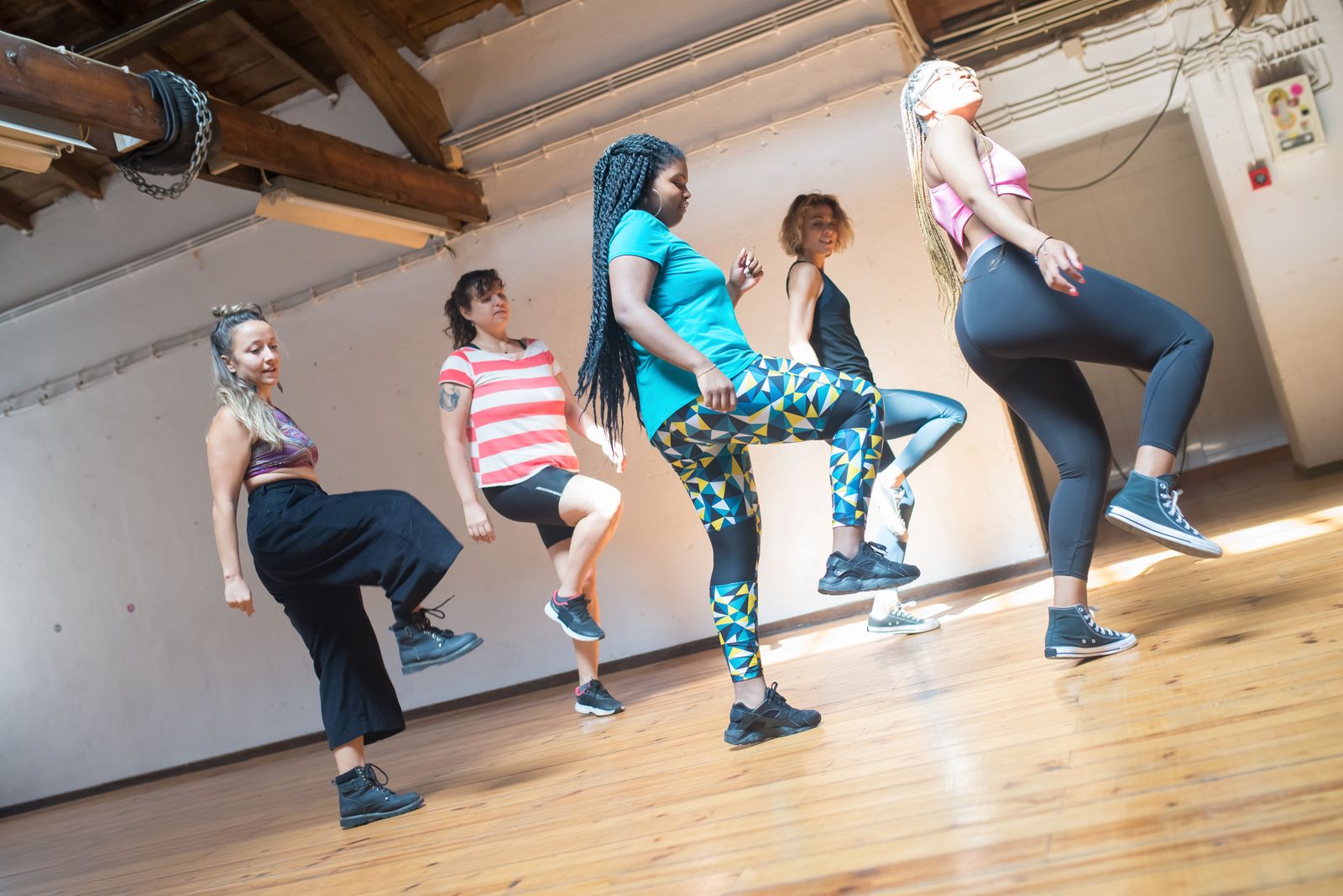
Which dance workout burns the most calories?
Among popular styles, Zumba, bhangra and high-energy hip-hop usually burn the most, at roughly 400-600 kcal per hour for a 60-70 kg adult. Garba, Bollywood fitness and contemporary sit around 250-500, while Kathak and ballroom are lighter. These are estimates; intensity, body weight and rest breaks change them a lot.
Two things move the number more than the style label. The first is continuous movement: a class where you keep stepping for 45 of 50 minutes beats one where you stand and listen to corrections for half the session. This is why style-learning classes, which pause often to teach, tend to land at the lower end. The second is how big your movements are. Bending the knees, travelling across the floor and using your arms all raise effort; marking the steps in a small space does not.
If fat loss is your main goal, remember that dance alone rarely creates a big deficit, since one hour of class is about the energy in two or three rotis with dal. Food, sleep and consistency decide the result. Our online weight loss trainer programme pairs your class schedule with a realistic eating plan, and no honest coach will promise a fixed number of kilos in a fixed number of weeks.
Myth check: you need to know how to dance first
This is the most common reason people never try either option. In a beginner Zumba class, nobody is graded, the moves repeat, and the instructor cues each change a few beats early. In a good beginner dance class of any style, the same rule holds. You are there to learn, not to arrive already skilled.
Three related myths are worth clearing up too.
- “Zumba is only for women or young people.” Men and people in their 50s and 60s attend regularly. Intensity is yours to set, so you can keep every step low-impact.
- “Style dance classes are only for future performers.” Many adult hip-hop, Kathak and contemporary classes are recreational, with no stage at the end.
- “If I do not sweat buckets, it is not working.” Sweat reflects room temperature and your body, not effort alone. Judge a class by how long you kept moving and how you recover afterwards.
Is Zumba easier to learn than Bollywood or hip-hop?
Yes, for most beginners. Zumba uses a small set of repeating moves, such as the salsa basic, merengue march and cumbia step, that you can pick up within one or two classes. Bollywood and hip-hop usually involve longer combinations, arm isolations and faster transitions, so the learning curve is steeper, often four to eight weeks before it feels natural.
That does not make the harder styles worse. Many people find the challenge of learning a full routine addictive, and the sense of progress is a real motivator. If you are unsure, a simple rule works: start with Zumba or Bollywood fitness while you build stamina, and add hip-hop or classical once you are comfortable following a beat. You can compare the actual steps in our Zumba dance moves guide.
What a first class feels like, style by style
A quick walkthrough helps you picture what you are signing up for.
- Zumba: a 5-10 minute warm-up song, then six to eight songs that alternate fast and slow, a toning track using squats or lunges, and a stretch. You follow the instructor’s mirrored moves and can drop the arms or jumps whenever you like.
- Bollywood fitness: usually a warm-up, two or three hit songs with a short routine each, and a repeat at the end. Expect more arm and expression work and a lot of smiling.
- Hip-hop: grooves and bounces first (grounded, knees soft), then a short choreography built step by step. Expect to repeat the same eight counts many times.
- Bhangra: high-energy shoulder lifts, jumps and leg work to dhol beats. It can feel like interval training with bursts and short breaks.
- Kathak or classical: posture and footwork patterns taught slowly, with a focus on rhythm cycles and hand gestures. Less sweaty, more precise.
Which one suits you: beginners, busy professionals, over-40s and men
Use this second table as a shortcut. It matches a starting situation with the style that usually fits, and gives a first target for the first month.
| If you are… | Start with | Why | First-month target |
|---|---|---|---|
| A complete beginner who hates gyms | Zumba | Simple moves, forgiving format | 3 classes a week, 40-50 minutes |
| A desk worker with low stamina | Bollywood fitness or low-impact Zumba | Moderate pace, familiar songs | 3 classes, add a 10-minute walk daily |
| Over 40 with sore knees or joints | Low-impact Zumba, Kathak basics | Gentle on joints, adjustable | 2-3 classes; check with your doctor first if you have joint problems |
| Wanting a high-sweat session | Bhangra or Zumba | Sustained high effort | 3 classes with 1 rest day between |
| Coordination-focused, likes challenge | Hip-hop | Technical, rewarding progress | 2 classes plus 1 practice session |
| Short on time | 30-minute Zumba or bhangra | Dense, no filler | 4 short sessions |
If joint pain, a heart condition, pregnancy or recent surgery applies to you, speak to your doctor before starting any new dance workout, and tell the instructor before class. No programme should be pushed through pain.
A sample week mixing Zumba with other dance styles
You do not have to choose one style forever. A mixed week keeps things fresh and spreads the load on your joints and muscles. This is one example for a beginner who can train five days a week.
| Day | Session | Time | Effort (1-10) |
|---|---|---|---|
| Monday | Zumba class | 45 min | 7 |
| Tuesday | Walk and light stretching | 30 min | 3 |
| Wednesday | Bollywood or hip-hop class | 45 min | 6 |
| Thursday | Rest or gentle yoga | 20-30 min | 2 |
| Friday | Zumba class | 45 min | 7 |
| Saturday | Bhangra, garba or social dance | 45-60 min | 6-7 |
| Sunday | Full rest | – | 1 |
Notice the recovery days. Most beginners who quit do so with sore legs in week two because they went straight to daily classes. Our Zumba vs yoga and Zumba vs gym comparisons show where strength work or yoga can fill the gaps that dance leaves.
Troubleshooting: when a dance class is not working for you
- You feel lost every class. Move to a beginner level, stand near the back for one week, and watch the instructor’s feet for the first half of each song. Mirrored cues confuse many people at first.
- Your knees or shins hurt. Reduce jumps, keep knees soft and tracking over the toes, wear proper cushioned shoes, and practise on a non-slippery mat or floor, not hard tiles. Persistent pain means stop and see a doctor.
- You are bored after three weeks. Add one class of a different style, as in the sample week above, instead of dropping dance altogether.
- The scale is not moving. Check portion sizes after class, since a bhatura or samosa afterwards can cancel the session. Our Zumba vs aerobics post also explains why format alone does not decide results.
- You cannot find a nearby class. Online live classes remove the travel and let you start in a living room with a clear patch of floor.
Trying Zumba online with a certified trainer
If you want to test the Zumba side of this comparison without a studio commitment, our online Zumba classes run live from home. They are led by Yash Pathak, Fitstrot’s lead Zumba trainer, who is ZIN Licensed, ACE Certified and Strong Nation Certified. You can see a beginner-friendly overview on our online Zumba classes page, and if you would rather have a plan tailored to your body, 1-on-1 personal training can blend dance sessions with strength work.
A fair way to decide is to try one Zumba class and one class of the other style you are curious about in the same week, then notice which one you looked forward to the next day.
Frequently asked questions
Is Zumba better than other dance workouts?
Not universally. Zumba is easier for beginners and has a workout-first design, so it is a safe default. Hip-hop, bhangra and Bollywood fitness can be equally good for fitness. The better choice is the style you enjoy enough to attend regularly.
Which is easier to learn, Zumba or hip-hop?
Zumba is easier for most beginners because it uses a few simple repeating moves and does not demand precise technique. Hip-hop has longer routines, tighter timing and isolations, so it usually takes several weeks before it feels comfortable.
Can I do Zumba and another dance class in the same week?
Yes. Many people do two or three Zumba sessions and add one different style for variety. Keep at least one full rest day and avoid stacking two high-intensity classes back to back while your body is still adjusting.
Do I need dance experience to join a dance workout?
No. Beginner Zumba and fitness-style Bollywood classes assume no experience, and most instructors are happy to simplify steps. Style-specific classes like hip-hop or Kathak may expect a little patience, but beginner levels exist for all of them.
How many calories do dance workouts burn compared with Zumba?
Rough estimates for a 60-70 kg adult are 400-600 kcal per hour for Zumba, 300-500 for Bollywood fitness, 350-550 for hip-hop and 200-350 for classical styles. Your own number depends on weight, effort and how continuously you move.
Next step: book one trial session of Fitstrot’s live Zumba classes this week, then compare it with the other style you are curious about.


