

Practising yoga for hair fall will not rewire your genes or replace a blood test, but it can calm stress, improve circulation and support sleep, which all affect how much hair you shed. This guide covers the poses worth doing, hold times, a 25-minute routine, who should skip inversions, and when to see a doctor instead.
Does Yoga for Hair Fall Actually Work?
Yoga can reduce stress-related hair fall and support healthy habits, but it cannot reverse genetic pattern baldness or fix a deficiency by itself. Expect fewer hairs in your comb after roughly 8 to 12 weeks of regular practice when stress or poor sleep is the trigger, and little change when the cause is medical.
Follicles are not muscles, so no pose trains them directly. Yoga works on the conditions around them: slow breathing lowers the stress response, regular practice improves sleep, and head-down poses temporarily increase scalp blood flow. None of this is a proven cure, so be sceptical of any page that promises one. If you are brand new to the practice, our types of yoga guide helps you pick a style before you commit to a routine.
Myth Check: What Yoga Can and Cannot Do for Your Hair
Myth: headstands push blood into dead follicles and regrow hair. A follicle shut down by long-standing pattern baldness does not restart because you are upside down.
Myth: yoga alone fixes any hair fall. If the cause is low iron, a thyroid problem, post-childbirth change or a scalp condition, yoga supports treatment but never replaces it.
Reality: stress-linked shedding is real and usually temporary. After illness, crash dieting or a punishing work quarter, many hairs enter the resting phase together and fall about 2 to 3 months later (telogen effluvium). It typically settles once the trigger is managed.
What Is Causing Your Hair Fall? A Quick Self-Triage
Most everyday hair fall comes from one of five causes: stress, nutrient gaps, hormonal shifts, scalp problems or inherited pattern loss. Yoga helps mainly with the first. The table shows which causes respond to a yoga routine and when to get tested instead.
| Likely cause | What it usually looks like | Will yoga help? | Best next step |
|---|---|---|---|
| Stress or crash dieting | Diffuse thinning all over, noticeable 2-3 months after the trigger | Yes, a good fit alongside better meals and sleep | Daily routine below plus regular meals |
| Iron, vitamin D or B12 gap | Tiredness, pale skin, thinning with weak strands | Only as support | Blood test, then follow your doctor’s advice |
| Thyroid or PCOS | Thinning plus irregular periods, weight change, or feeling unusually cold or tired | Supportive only | See a doctor for diagnosis and treatment |
| Pattern baldness | Receding temples or widening parting that slowly progresses | Little direct effect | Consult a dermatologist early |
| Scalp condition | Itching, flaking, redness, patches | No | Dermatologist visit |
Losing roughly 50 to 100 hairs a day is normal. If you are clearly above that for months, or see bald patches, get it checked.
Which Yoga Poses Are Best for Hair Fall?
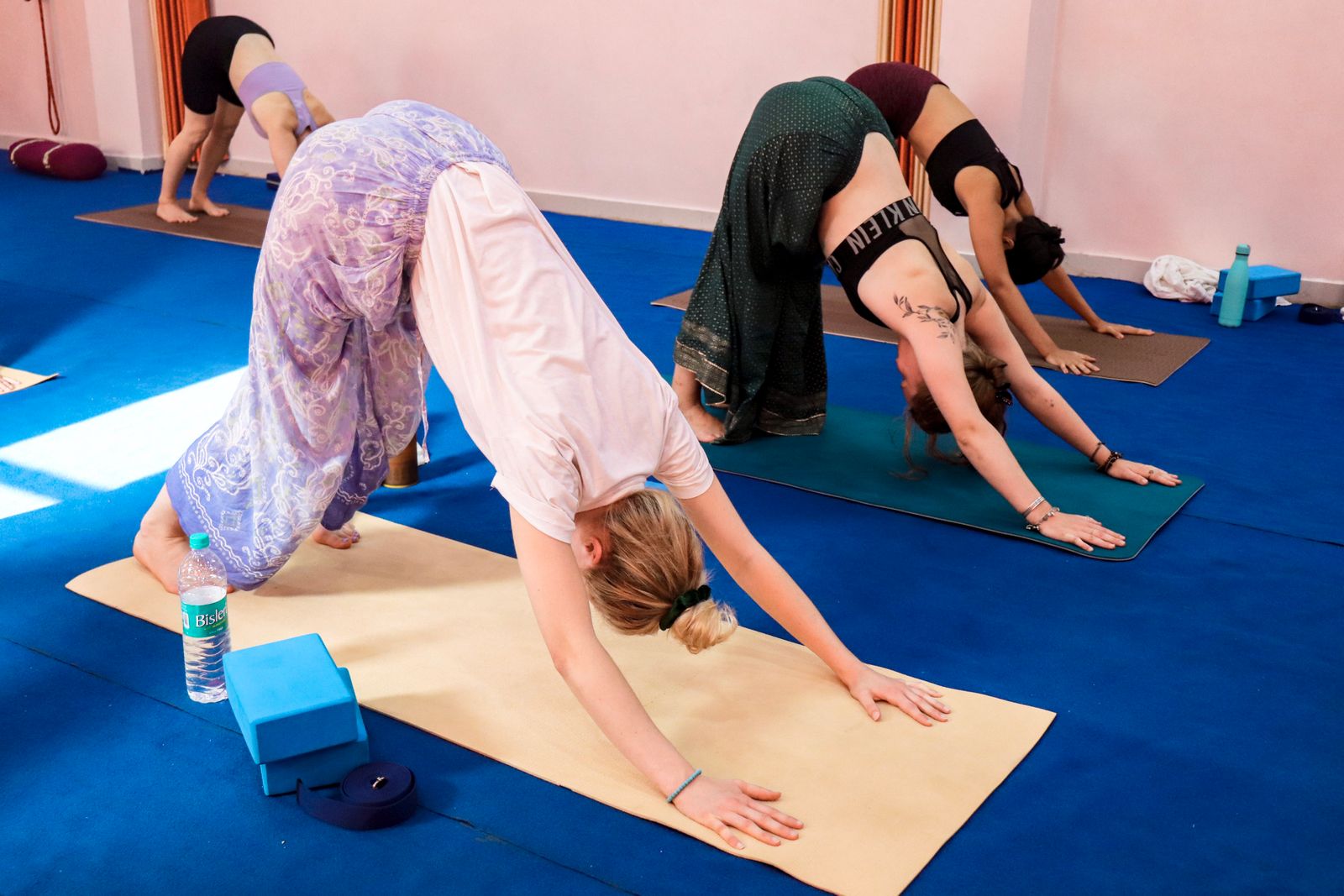
The most useful yoga poses for hair fall are gentle head-below-heart positions: Downward Dog, Standing Forward Bend, Rabbit Pose and Legs-up-the-wall. Hold each for 30 to 60 seconds, or 5 to 10 slow breaths, and add calming poses like Child’s Pose. Skip deep inversions if you have neck, eye or blood pressure concerns.
You do not need exotic poses. The table gives hold times, form cues and cautions.
| Pose | Hold | Form cue | Be careful if |
|---|---|---|---|
| Adho Mukha Svanasana (Downward Dog) | 30-60 seconds, 2-3 rounds | Press the floor away, bend the knees if hamstrings are tight, keep the neck relaxed | Wrist pain, uncontrolled high blood pressure, eye pressure issues |
| Uttanasana (Standing Forward Bend) | 5-10 breaths | Hinge from the hips, soften the knees, let the head hang heavy | Lower-back injury, dizziness on standing |
| Sasangasana (Rabbit Pose) | 5 breaths | Hold the heels, roll gently onto the crown, keep weight on the knees not the neck | Neck pain, knee pain |
| Viparita Karani (Legs up the wall) | 3-5 minutes | Hips near the wall, a folded blanket under the hips if comfortable | Glaucoma, serious reflux |
| Balasana (Child’s Pose) | 1-2 minutes | Forehead resting on the mat or a pillow, breathe into the back | Knee injury, late pregnancy |
| Vajrasana (Thunderbolt Pose) | 2-5 minutes | Sit on the heels, spine tall, shoulders soft | Knee or ankle pain |
| Ustrasana (Camel Pose) | 3 breaths, 1-2 rounds | Hips over knees, hands on lower back first, lift the chest | Neck or lower-back pain |
| Sarvangasana (Shoulderstand), optional | 30-60 seconds, only with a teacher | Folded blanket under the shoulders, never turn the head sideways | Neck problems, high blood pressure, pregnancy, eye conditions |
Shoulderstand is often sold as the “hair fall pose”, but it loads the neck, and a gentler pose done daily beats a risky pose done rarely. Vajrasana is one of the few poses you can sit in after a meal, which supports digestion and absorbing protein and iron.
Is Balayam (Nail Rubbing) Worth Doing?
Balayam, rubbing the fingernails of both hands against each other for 5 to 10 minutes a day, is harmless and free, but there is no solid clinical evidence that it reduces hair fall. Treat it as a relaxing seated habit, not a treatment, and never use it in place of medical care.
The idea comes from reflexology, which links nail beds to the scalp; do not rely on that mechanism. It does earn a place as a calm 5-minute seated habit before breathing practice, in Vajrasana or Sukhasana.
Which Breathing Exercises Help Hair Fall Linked to Stress?
Slow, steady breathing such as Anulom Vilom (alternate nostril breathing) for 5 to 10 minutes daily is the most practical breathing exercise for stress-linked hair fall. It helps shift the body toward a calmer state. Kapalbhati is more energising and not suitable for everyone, so treat it as optional.
- Anulom Vilom: Sit tall, close the right nostril, inhale through the left for a count of 4, switch, exhale through the right for 4, and continue alternating. Keep the breath soft and never strain or hold it hard. Aim for 5 to 10 minutes.
- Bhramari (humming bee breath): Inhale, then hum on a long exhale with the lips closed, for 2 to 3 minutes.
- Kapalbhati (optional): Short, sharp exhales through the nose with a passive inhale, for 1 to 2 minutes at a time. Avoid it during pregnancy, periods with heavy flow, high blood pressure, hernia, glaucoma, or after recent abdominal surgery.
With a heart condition, high blood pressure or breathing problems, learn breathing practices under qualified guidance.
What Does a 25-Minute Yoga Routine for Hair Fall Look Like?
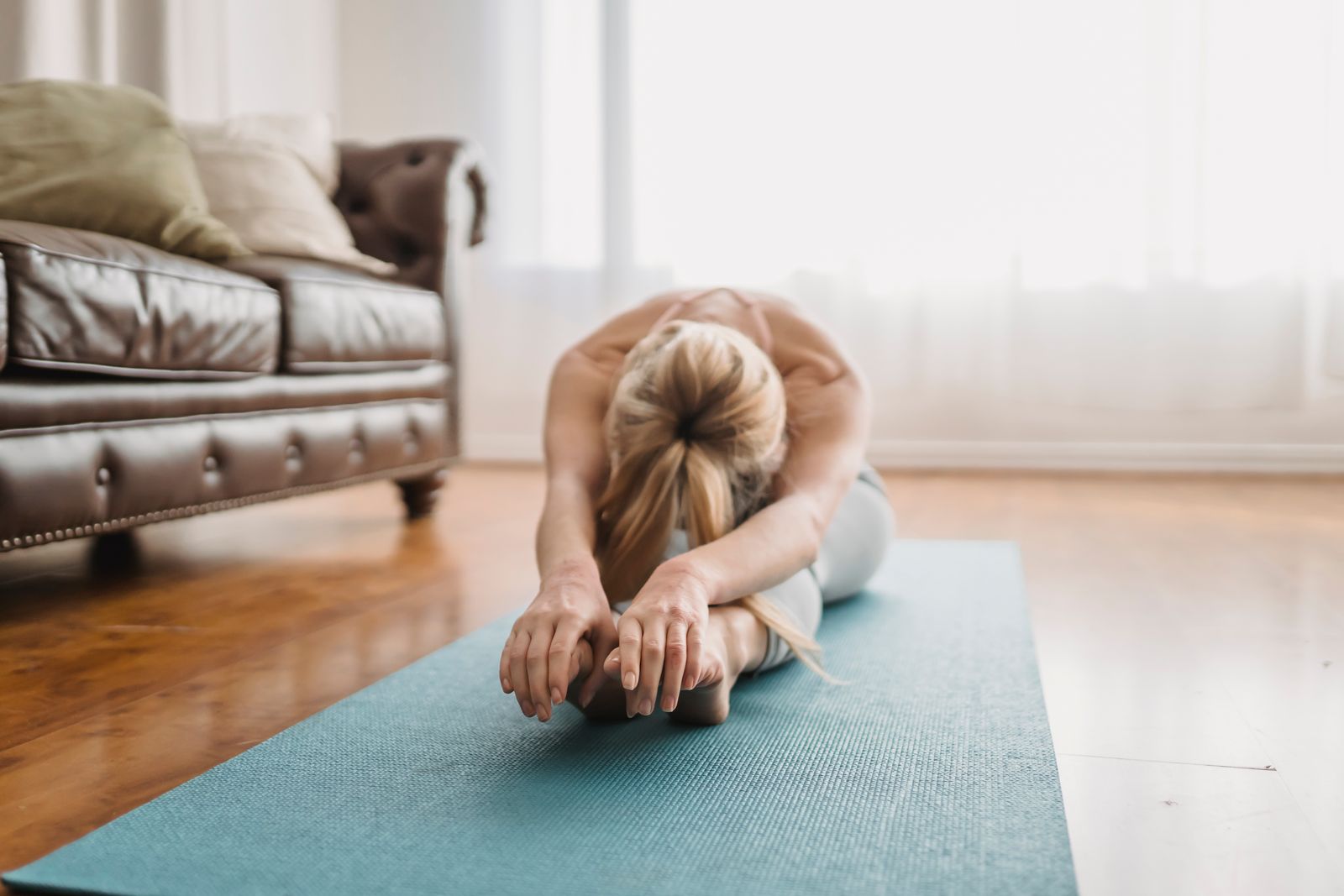
A workable routine for hair fall takes about 25 minutes: 3 minutes of settling breath, 8 to 10 minutes of gentle poses, 8 minutes of Anulom Vilom and Bhramari, and 3 minutes of final rest. Do it daily, ideally in the morning on an empty stomach, or before dinner.
| Minutes | Practice | Purpose |
|---|---|---|
| 0-3 | Sukhasana with slow breathing, optional Balayam | Settle in and slow the breath |
| 3-5 | Uttanasana, 2 rounds of 5-10 breaths | Gentle head-down position, loosen hamstrings |
| 5-8 | Downward Dog, 2-3 rounds of 30-60 seconds | Shoulder and spine stretch, mild inversion |
| 8-10 | Rabbit Pose, 5 breaths, then Child’s Pose | Neck and spine release |
| 10-12 | Camel Pose, 2 rounds of 3 breaths | Open chest and front of the neck |
| 12-16 | Viparita Karani, 4 minutes | Calm the nervous system |
| 16-24 | Anulom Vilom 5-6 minutes, then Bhramari 2-3 minutes | Stress reduction |
| 24-25+ | Shavasana, 3 minutes | Rest and let the practice settle |
Short on time? Do 12 minutes: Uttanasana, Downward Dog, Child’s Pose and 5 minutes of Anulom Vilom. For ways to structure the week, see our yoga for beginners plan, and the vinyasa yoga guide if you later want a more flowing style on alternate days.
How Long Does It Take for Yoga to Reduce Hair Fall?
Expect about 8 to 12 weeks of regular practice before you notice less shedding, and roughly 6 months for a clearer change in density. Scalp hair grows about 1 cm a month, so judging the routine after two weeks will disappoint.
Track progress with photos of your parting and hairline under the same light every 4 weeks. If shedding is unchanged after 3 months of steady practice plus better food and sleep, the cause is probably one yoga cannot fix, so book a doctor visit.
Troubleshooting: Why Is My Hair Fall Not Improving?
If hair fall has not eased after 3 months, the usual reasons are inconsistent practice, too little protein or iron, poor sleep, or an untreated medical cause. Fix the basics, then get tested rather than adding more poses.
- You practise in bursts. Five days a week for 20 minutes beats two long weekend sessions.
- You are eating too little. Crash diets and skipped meals are a classic trigger. See our yoga for weight loss guide if you are balancing weight goals with hair health.
- Your neck hurts after inversions. Drop the deep inversion and stay with the gentler poses.
Which Foods Support Hair Alongside Yoga?
Hair is mostly protein, so aim for a protein source at every meal, typically 0.8 to 1 gram of protein per kg of body weight daily for most adults. Dal, curd, paneer, eggs, sprouts, nuts, seeds and leafy greens cover most Indian needs.
- Protein: an egg gives about 6 g, 100 g paneer roughly 18 g, and a katori of cooked dal about 7 to 9 g.
- Iron-rich foods: spinach, methi, rajma, chana, jaggery in small amounts, and dates. Pair them with a vitamin C source such as amla, lemon or guava to help absorption.
Be cautious with supplements. Iron, biotin or zinc taken on a hunch can backfire, so get tested and take only what a doctor or registered dietitian recommends.
Yoga for Hair Fall in Men and Women: What Differs?
The routine is the same, but the likely causes differ. Women more often see diffuse shedding linked to stress, iron, thyroid, PCOS or childbirth, where yoga can help. Men more often see inherited pattern loss at the temples and crown, which yoga does not stop.
Women with thinning plus irregular cycles or constant tiredness should get hormones and iron checked first. Men with a slowly receding hairline should see a dermatologist early, because earlier treatment keeps more hair. If you want regrowth rather than less shedding, read our yoga for hair growth guide next, plus yoga for glowing skin and yoga for eyesight for related routines.
When Should You See a Doctor About Hair Fall?
See a doctor or dermatologist if hair fall is sudden, patchy, lasts beyond 3 months, comes with an itchy or scaly scalp, or appears alongside fatigue, irregular periods, weight change or feeling cold. Never stop prescribed treatment in favour of yoga, and check with your doctor before inversions if you have blood pressure, eye or neck conditions.
A doctor can check common, treatable causes such as low iron, vitamin D or B12, and thyroid problems. If you are pregnant, skip inversions and Kapalbhati and ask for safe modifications.
Frequently Asked Questions About Yoga for Hair Fall
Can yoga stop hair fall completely?
No. Yoga can reduce stress-related shedding and support sleep and digestion, but it cannot stop hair fall caused by pattern baldness, thyroid disease, iron deficiency or scalp conditions. Use it alongside medical advice.
Which is the best yoga pose for hair fall?
There is no single best pose. Downward Dog and Standing Forward Bend are the most practical head-down poses for beginners, held 30 to 60 seconds. Pair them with 5 to 10 minutes of Anulom Vilom, since managing stress matters as much as the pose.
How many days a week should I practise yoga for hair fall?
Daily practice of 20 to 25 minutes is ideal, but 4 to 5 days a week is enough to build the habit. Consistency over months matters more than session length, because hair responds slowly.
Is Shoulderstand necessary for hair fall?
No. Shoulderstand is optional and puts load on the neck, so skip it if you have neck problems, high blood pressure, eye conditions or are pregnant. Gentler poses such as Standing Forward Bend, Rabbit Pose and Legs-up-the-wall give similar circulation benefits with less risk.
Can I do yoga for hair fall in the evening instead of the morning?
Yes. Morning on an empty stomach is comfortable for inversions and breathing, but an evening session works too if you leave at least 2 to 3 hours after a heavy meal.
Next step: if you want the poses and breathing taught with live alignment cues, book a session in our online yoga classes and ask your teacher for a gentle, hair-fall-friendly sequence you can repeat at home.


