

Yoga for arthritis means slow, supported movement that keeps your joints moving, builds the muscles around them and softens the muscle guarding that pain creates. Practised gently, it can make stiffness easier to live with and everyday tasks, like climbing stairs or getting up from the floor, feel less daunting. It does not cure arthritis, repair worn cartilage or replace your medicines. This guide covers safe poses, chair options, a weekly plan and the signs that mean you should stop.
See your doctor first, and again if anything changes. Speak to your rheumatologist, orthopaedic doctor or physiotherapist before starting, and stop and call them, if you have:
- a joint that is swollen, red or hot to touch
- a flare, meaning pain, swelling or stiffness clearly worse than your usual
- new pain, numbness, tingling or a joint that gives way or locks
- a joint replacement, a recent surgery or an injury that has not been checked
- morning stiffness lasting more than about 30 minutes, or fever with joint pain
Never reduce or stop arthritis medicine because you have started yoga. Any change to treatment is a decision for your doctor.
Is Yoga Safe If You Have Arthritis?
Gentle yoga is generally considered safe for many people with osteoarthritis or rheumatoid arthritis when poses are modified, movements stay within a comfortable range and pain is treated as a stop signal. It is not safe to push through sharp pain, to practise on a swollen hot joint or to skip medical advice if you have a joint replacement.
The type of arthritis changes how you practise. Osteoarthritis is wear in the cartilage, most often in the knees, hips, hands and spine, and it usually responds well to gentle strengthening and range-of-motion work. Rheumatoid arthritis is an autoimmune condition that inflames the joint lining and flares unpredictably, so a pose that felt fine on Monday may need to be skipped on Thursday. Both are better handled with a doctor’s guidance and a teacher who understands modifications, rather than a fast general fitness class.
Best Yoga Poses for Arthritis: Joint-Friendly Versions
These poses move joints without heavy loading. Treat the holds as ceilings, not targets, and use a shorter hold if a joint complains. Mild stretching is fine; sharp, burning or pinching pain is not.
| Pose | Joint-friendly version | Hold or reps | Form cue |
|---|---|---|---|
| Cat-Cow | On a folded blanket, or seated in a chair with hands on knees | 6-8 slow rounds | Move from the spine, keep the neck long, no forcing at the end of range |
| Supported Bridge (Setu Bandhasana) | Block or folded blanket under the sacrum, small lift only | 5 breaths, 2-3 times | Press through the heels, keep knees in line with the hips |
| Reclined Hand-to-Big-Toe | Strap around the foot, bottom knee bent and foot on the floor | 5 breaths per side | Keep the raised knee soft and the shoulders relaxed on the floor |
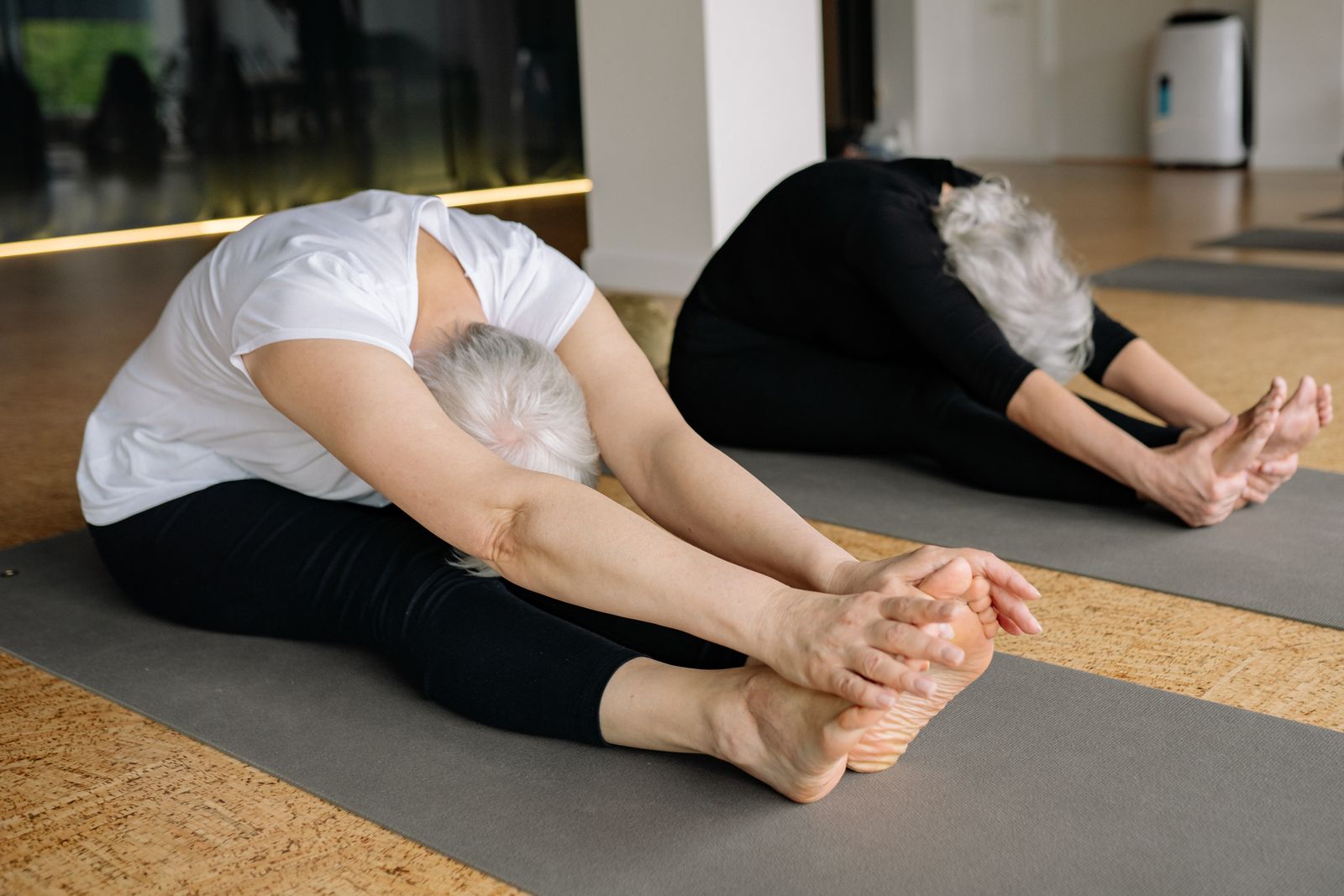
| Seated Forward Fold | On a chair or with knees bent over a bolster | 5 breaths | Hinge at the hips, stop when you feel a mild pull behind the thighs |
| Wall-Supported Chair Pose | Hands on the wall, tiny bend in the knees only | 3-5 breaths, 2-3 times | Knees track over the toes and never collapse inward |
| Legs-Up-the-Wall | Hips a few inches from the wall, bolster under the hips if comfortable | 2-5 minutes | Let the legs rest; come out slowly by rolling to one side |
A 15-Minute Chair Yoga for Arthritis Routine
Chair yoga for arthritis removes floor transitions, which are often the hardest part for stiff knees and hips. Use a sturdy chair without wheels, placed against a wall, and sit tall near the front edge with both feet flat. Move slowly, breathe steadily and stop any movement that causes sharp pain. Our chair yoga guide has more sequences.
| Minutes | Move | Reps | Cue |
|---|---|---|---|
| 0-2 | Seated breathing, hands on belly | 10 slow breaths | Exhale a little longer than you inhale |
| 2-4 | Neck turns and shoulder rolls | 5 each way | Small, pain-free range only |
| 4-6 | Seated cat-cow | 8 rounds | Hands on knees, move through the whole spine |
| 6-8 | Wrist circles and gentle finger spreads | 8 each direction | Make a soft fist, then open the fingers slowly |
| 8-10 | Seated knee extensions, alternating legs | 8 per leg | Straighten without locking; pause for a breath at the top |
| 10-12 | Seated side bend and gentle twist | 3 per side | Lengthen first, then turn; keep hips level |
| 12-14 | Seated forward fold over the thighs | 5 breaths | Hinge at the hips, hands on thighs or shins |
| 14-15 | Rest with eyes closed | 1 minute | Let the shoulders drop away from the ears |
How Often Should You Do Yoga for Arthritis?
Most people do well starting with two or three short sessions a week of 10 to 20 minutes, then building towards 20 to 40 minutes over six to eight weeks if joints stay comfortable. A short routine on most days usually beats one long session. Reduce the load, not the consistency, on difficult days.
These are general ranges, not a prescription. If you also follow a physiotherapy programme, ask your therapist how to fit yoga around it rather than adding on top.
| Weeks | Sessions per week | Session length | Focus |
|---|---|---|---|
| 1-2 | 2-3 | 10-15 minutes | Chair routine, breathing, learning which movements feel good |
| 3-4 | 3 | 15-20 minutes | Add floor poses with props, such as supported bridge |
| 5-6 | 3-4 | 20-30 minutes | Add wall-supported chair pose and longer holds |
| 7-8 | 3-4 | 25-40 minutes | Mix standing, floor and rest; keep one very gentle day |
| Flare days | Only if your doctor agrees | 5-10 minutes | Breathing and very gentle movement of unaffected joints |
A simple check helps: if pain is worse two hours after practice, or stiffer the next morning, you did too much. Do less next time, not more.
Myths About Yoga and Arthritis, Corrected
Myth: rest is always better for sore joints. Long periods of inactivity tend to make joints stiffer and muscles weaker. Gentle, regular movement is usually encouraged, except during a flare or when your doctor has told you to rest a specific joint.
Myth: yoga cures or reverses arthritis. It does neither. What it can offer is comfort, mobility, steadier balance and a calmer response to pain, alongside your medical care.
Myth: you need to be flexible to start. Yoga for arthritis beginners works best when props do the reaching for you. Nobody needs to touch their toes.
Myth: more pain means more progress. Pain is a stop signal. Never stop or change medicine because of yoga either; it is an addition to treatment, not a substitute.
What to Do If Pain Flares Mid-Practice
Troubleshooting a bad moment is part of practising safely. Use this as a quick guide.
- Sharp pain in a joint: come out of the pose at once, breathe and rest. Do not repeat that movement today.
- Dull ache that fades quickly: reduce the range, add a prop or shorten the hold, then continue if it settles.
- Pain that lingers or is worse the next morning: halve the session next time and tell your doctor or physiotherapist if it repeats.
- Swelling, heat or redness appears: stop practising that joint and contact your doctor.
Yoga for Specific Joints: Knees, Hands, Hips and Spine
Yoga for knee osteoarthritis
The knee is a hinge joint with little cushioning once cartilage thins, so the goal is to strengthen the thigh muscles that share the load. Supported chair pose at a wall, reclined straight-leg lifts and seated knee extensions build strength without deep bending. Avoid deep lunges, kneeling poses and sitting on your heels unless your doctor or therapist has cleared them. A rolled blanket behind the knee often makes seated poses comfortable.
Yoga for arthritis in hands
Slow finger spreads, soft fists and wrist circles help maintain movement. Avoid poses that put body weight through the wrists, such as plank and downward dog, particularly when hands are swollen. Forearm or fist variations can replace flat-palm weight bearing for many people.
Hips and spine
Reclined strap work and supported bridge keep the hips moving with the floor doing the holding. For the spine, favour gentle seated or kneeling-on-a-blanket cat-cow and small twists. If you also deal with lower back pain, see our guide to yoga for back pain.
Yoga for Rheumatoid Arthritis: Flares and Calm Phases
Yoga for rheumatoid arthritis needs more flexibility in the plan than for osteoarthritis. During an active flare, joints are inflamed and fragile, so the aim is rest, breathing and the gentlest movement of joints that are not affected, only with your doctor’s agreement. Props-supported restorative poses and slow breathing are the usual choices. Standing balance poses and anything that loads hot, swollen joints should wait.
In calmer phases, you can do a little more, using the same chair and prop-supported ideas. Our restorative yoga guide covers the supported poses in more detail.

Which Yoga Styles Suit Arthritis, and Which Need Care
Slower styles are usually the easier starting point. Hatha yoga uses a steady pace with time to adjust, restorative yoga uses props to hold the body fully supported, and yin yoga uses long holds, which suit some people but need extra care, as staying in a deep position for several minutes can irritate sensitive joints. Tell your teacher about every affected joint before class.
Fast styles need more caution. Power yoga and vinyasa yoga move quickly between poses and put repeated weight through wrists and knees. Heated rooms can also hide pain signals. That does not mean you can never try them, only that strength, confidence and your doctor’s view should come first. If you are brand new to yoga, start with yoga for beginners before progressing.
Props That Make Gentle Yoga for Joint Pain Easier
- Sturdy chair: supports balance poses and avoids floor transfers.
- Two blocks: bring the floor closer in forward folds.
- Bolster or rolled blanket: under the knees in reclined poses or behind the knee when sitting.
- Strap or dupatta: extends your reach so shoulders and hamstrings are not forced.
- Thick mat or folded blanket: cushions knees and wrists.
Using props does not make a practice lesser. It is often the thing that lets the practice continue week after week.
Can Yoga Replace Arthritis Medicine or Physiotherapy?
No. Yoga works as a complement to medical care, not a replacement. It cannot take the place of disease-modifying drugs, anti-inflammatory medicine or physiotherapy prescribed for you. Do not stop or change any medicine because of yoga. Ask your doctor how it can fit alongside your current treatment.
What yoga can add is a structured way to keep moving, build muscle support around joints, and manage the stress, poor sleep and low mood that often come with long-term pain.
Other Conditions That Share the Same Gentle Approach
Many people with arthritis also deal with related concerns. The same supported, slow approach appears in our guides to yoga for varicose veins, where leg-elevation poses are common, and yoga for migraine, where calm breathing takes centre stage. Carrying extra weight adds load to knees and hips, and our yoga for weight loss guide shows how gentle practice can sit within a sensible plan.
Frequently Asked Questions About Yoga for Arthritis
Can yoga cure arthritis?
No. Yoga cannot reverse cartilage damage or cure an autoimmune condition like rheumatoid arthritis. Practised gently and regularly alongside your medical treatment, it may help with stiffness, movement and how you cope with pain, but it does not replace your doctor’s plan.
What is the easiest yoga for arthritis beginners?
Chair yoga and restorative yoga are usually the easiest starting points, since most poses are seated or fully supported by a chair, wall or bolster. Begin with 10 to 15 minutes, move slowly and tell your teacher which joints are affected.
Is yoga good for arthritis in the hands?
Gentle finger spreads, soft fists and wrist circles may help maintain movement in the hands. Avoid poses that put body weight through the wrists, such as plank and downward dog, especially if hands are swollen, hot or painful, and ask your doctor if you are unsure.
How long does it take for yoga to help arthritis pain?
It varies. Some people feel looser after the first few sessions, while changes in day-to-day pain and function often take several weeks of regular practice, commonly around six to twelve. Results are not guaranteed, and pain that worsens means you should do less and speak to your doctor.
Should I do yoga during an arthritis flare?
Usually not a normal practice. During a flare, rest the inflamed joints, and do only breathing or very gentle movement of unaffected areas if your doctor agrees. Avoid weight-bearing on hot, swollen joints and return to your routine slowly once the flare settles.
Start With One Guided Session
If you would like a teacher to adjust every pose for your joints, book a trial with Fitstrot’s online yoga classes and mention your arthritis and any restrictions before the first session.


