

A skull crusher workout is a triceps session built around the lying triceps extension: you lie on a bench, bend only at the elbows to lower a weight toward your forehead, then press it back to arm’s length. The name sounds dangerous, but it describes the bar path, not the risk. With a controlled lowering phase and a sensible load, it is a safe and very direct way to add size to the back of your arm. This guide covers form, starting weights in kilograms, a full sample session, fixes for common faults and what to do when your elbows complain.
What Is a Skull Crusher and Which Muscles Does It Work?
A skull crusher, also called a lying triceps extension, is a single-joint exercise where only the elbow moves. It trains all three heads of the triceps brachii (lateral, medial and long head), and lowering the weight slightly behind your head stretches the long head most. Your abs and lats work as stabilisers to keep the upper arms still.
Because the shoulder stays fixed, the triceps cannot hand the work to your chest or front delts, which is the main difference from a close-grip bench press or dips. Those lifts are great for heavy loading, but they spread the effort across several muscles. The skull crusher exercise is the finishing tool: lighter weights, tighter control, and a deep stretch under load.
How Do You Do a Skull Crusher Step by Step?
Lie flat on a bench with feet planted, press the weight to arm’s length over your chest, then bend only your elbows to lower it in a slow arc toward your forehead or just behind it. Pause briefly, then extend back to the top. Keep your upper arms vertical throughout. Use about 3 seconds down and 1 to 2 seconds up.
- Set up: Lie back with your eyes under the bar or just behind it, feet flat, lower back in its natural curve, shoulder blades pinched lightly into the bench.
- Start position: Press the weight above your chest with elbows almost straight (do not slam into lockout) and upper arms pointing at the ceiling.
- Lower: Bend the elbows and let the weight travel in a smooth arc toward the top of your forehead. Upper arms stay still. Stop when you feel a deep stretch in the triceps, not when the joint feels pinched.
- Press: Extend the elbows by squeezing the triceps, returning along the same arc. Exhale on the way up.
The weight travels over your face, so use a spotter for heavier loads. Training alone? Choose dumbbells, which you can set down beside you if a rep fails.
Which Skull Crusher Variation Should You Choose?
For most people the EZ bar skull crusher is the best default, because the angled grip is kinder to wrists and elbows than a straight bar. Dumbbells suit beginners and anyone training alone, while a straight barbell is best left for lifters with no joint sensitivity. The table compares the options.
| Variation | Grip | Joint comfort | Best for | Typical rep range |
|---|---|---|---|---|
| EZ bar skull crusher | Semi-supinated, on the angled section | Good | Most lifters, steady progression | 8-12 |
| Dumbbell skull crusher | Neutral (palms facing) | Very good | Beginners, home gyms, side-to-side imbalances | 10-15 |
| Straight barbell | Pronated (palms toward feet) | Fair | Experienced lifters with healthy wrists | 6-10 |
| Incline dumbbell version | Neutral | Very good | Extra long-head stretch | 10-15 |
If your gym has only a fixed straight bar and heavy dumbbells, start with dumbbells. A neutral grip lets the forearms rotate naturally, which reduces strain at the inner elbow. You can also hold one dumbbell with both hands and lower it behind your head, a common alternative to the classic lying version.
Are Skull Crushers Bad for Your Elbows? Myth vs Reality
The belief that skull crushers wreck elbows is mostly a loading problem, not a movement problem. Elbow irritation usually comes from heavy weights, flared elbows, bouncing at the bottom or too many sets too soon. Moderate loads, a slow lowering phase and sensible volume make this a joint-friendly exercise for most healthy lifters.
Three ideas keep circulating in gyms, and they are worth correcting.
- Myth: heavier is better. Skull crushers reward control, not ego. Your elbow is the only moving joint, so a shaky rep has nowhere to hide. Keep the heavy lifting for close-grip presses and dips.
- Myth: you must touch the forehead. You do not. Lowering slightly behind the head keeps tension on the triceps through the whole rep and lowers the chance of losing control near your face.
- Myth: elbow pain means you are building muscle. A dull pump in the triceps is normal. Sharp or pinching pain at the inner or outer elbow is not. Stop, lighten the weight or switch variation.
If you already have elbow pain from another cause, a swollen joint or numbness in your fingers, get it checked by a doctor or physiotherapist before loading this pattern. Exercise advice online cannot diagnose an injury.
How Do You Fix Common Skull Crusher Mistakes?
Most skull crusher problems show up as elbow drift, a bar that wobbles, or pain at the joint. Each has a simple cause and fix: flared elbows mean the load is too heavy, a bouncing bottom means the lowering phase is too fast, and arching your back means you are cheating the final reps. Use this troubleshooting table.
| What you notice | Likely cause | Quick fix |
|---|---|---|
| Elbows drift outward mid-set | Weight too heavy or triceps fatigued | Drop load by 10-20%, cue “elbows to the ceiling” |
| Pain at the inner elbow | Straight bar, too much volume, or bouncing | Switch to dumbbells, slow the lowering to 3 seconds |
| Bar travels straight to the face | Vertical path with no stretch | Aim slightly behind the crown of the head |
| Back arches off the bench | Cheating the last reps | Lower the weight, brace your abs, feet flat |
| Wrists bend backwards | Grip too loose, load too heavy | Keep wrists stacked over forearms, grip firmly |
| Shoulders feel it more than triceps | Upper arms moving | Pin the upper arms vertical, shorten the range slightly |
How Much Weight Should You Use for Skull Crushers?
Start with the bar alone or light dumbbells, roughly 3 to 6 kg each, for the first one or two sessions. Add weight in small steps of 1 to 2.5 kg total only when the last two reps of every set stay clean. Pick a load that makes reps 9 to 12 hard while the elbow path stays fixed.
An empty EZ bar usually weighs somewhere around 7 to 10 kg depending on the gym, which is already a real load for a beginner. If that feels heavy, use dumbbells until you build control. Progress by adding a rep to each set before adding weight: for example, go from 3 sets of 8 to 3 sets of 10, then increase the load and drop back to 8.
What Does a Full Skull Crusher Triceps Session Look Like?
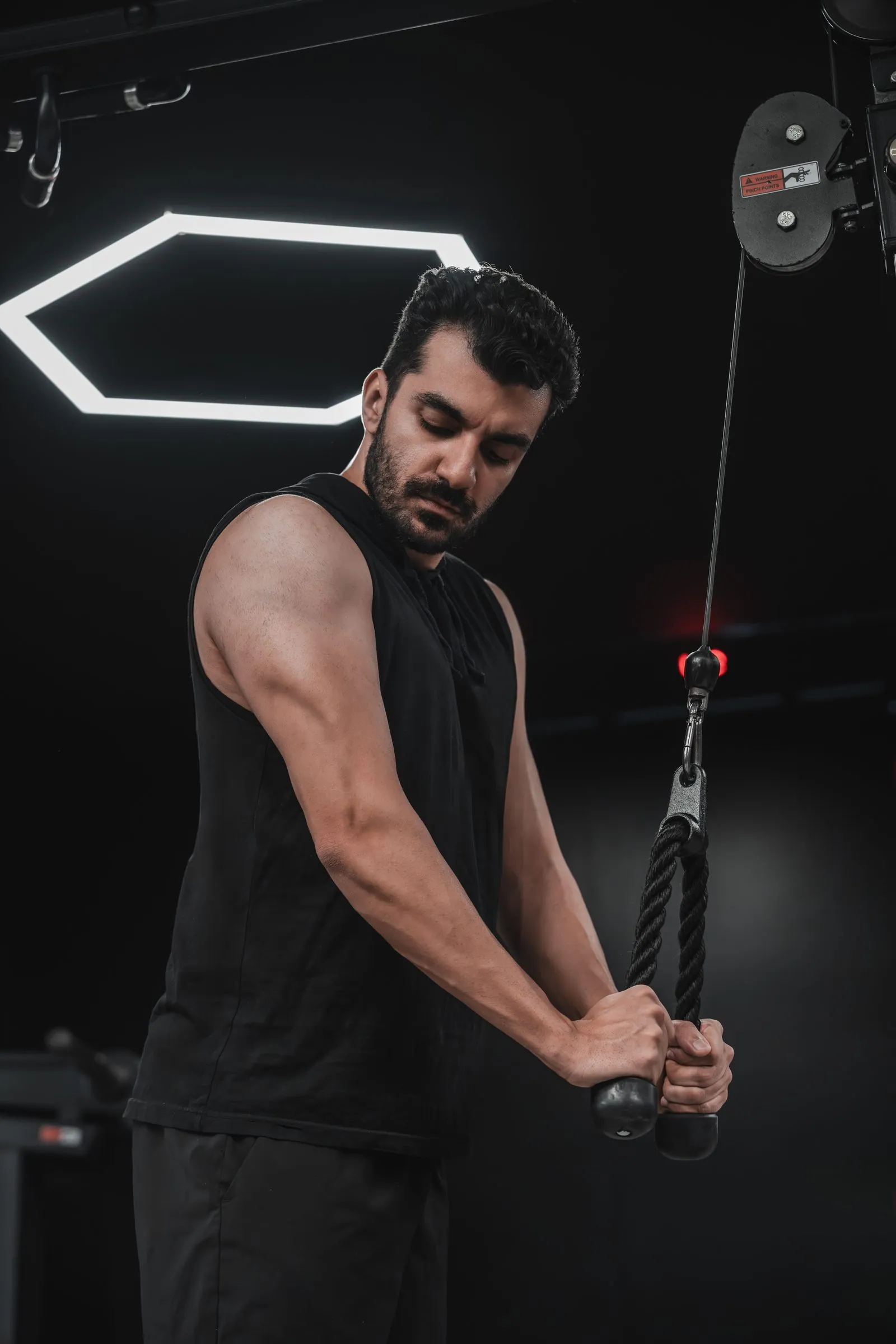
A balanced session starts with a heavy compound press, then moves to skull crushers while you are still fresh, and finishes with higher-rep cable work. The plan below suits an intermediate lifter training triceps once or twice a week and takes roughly 40 to 50 minutes including warm-up sets.
| Order | Exercise | Sets | Reps | Rest | Form cue |
|---|---|---|---|---|---|
| 1 | Close-grip bench press | 3-4 | 6-8 | 2 min | Elbows tucked, controlled touch |
| 2 | EZ bar skull crusher | 3 | 8-12 | 90 sec | Upper arms vertical, 3-second lowering |
| 3 | Dumbbell skull crusher | 2 | 12-15 | 75 sec | Neutral grip, stop short of lockout |
| 4 | Overhead rope extension | 3 | 12-15 | 60 sec | Elbows close to the ears |
| 5 | Rope pushdown | 2 | 15-20 | 45 sec | Squeeze and spread the rope at the bottom |
Notice that rep ranges rise as the session goes on. Heavier, more technical work comes first, and the lower-skill finishers come last when fatigue is expected. If time is short, drop exercise 3 and keep the rest.
How Often Should You Train Skull Crushers?
Two to three hard sets of skull crushers, once or twice a week, is enough for most lifters, as part of roughly 8 to 14 weekly triceps sets in total. Leave at least 48 hours between triceps sessions so the elbow tendons recover. Place them after your main pressing, not before.
Your triceps already work hard on bench press, overhead press and dips, so treat skull crushers as an accessory. If you follow a split, a push day or a dedicated arm day suits them. Pair them with biceps work in the same session, for example by supersetting with a preacher curl workout, to keep arm day short and balanced.
For shoulder health, add a day of stabiliser work such as the around the world workout, and if you want the core bracing that helps keep your torso quiet during lying lifts, a woodchopper workout earlier in the week is a useful companion. To see where arm days fit across a full week, our workout plan and workout routine guides lay out sensible splits.
Skull Crushers for Beginners, Women and Home Training
Skull crushers suit almost everyone who can lie on a bench and extend their elbows without pain. Beginners should start with light dumbbells, women can use the same technique with proportionally lighter loads, and home trainers can do them on a floor or sturdy bench using adjustable dumbbells or even filled water bottles for practice.
- Beginners: Spend the first two weeks learning the path with 3 to 5 kg dumbbells. Two sets of 10 to 12 reps, once a week, is plenty at the start.
- Women: Triceps training firms the back of the arm and supports pressing strength. You will not “bulk up” from moderate sets and reps. Loads of 2 to 6 kg dumbbells are a common starting range.
- Home workouts: A floor version limits the range at the bottom, which is a fine, joint-friendly option. Our home workout guide shows how to build a full session with minimal equipment.
- Older lifters or past elbow niggles: Use a neutral grip, shorten the range slightly and keep the load moderate. Stop if you feel sharp pain.
Skull crushers will not melt arm fat on their own. Fat loss happens across the whole body through calories, sleep and consistent training, so use them to build shape underneath, not to spot-reduce.
Want Skull Crushers Built Into a Plan That Fits Your Body?
If you would rather not guess your way through form fixes, loads and progression, a coach can watch your sets over video and adjust things week by week. Our 1-on-1 personal training programmes build skull crushers and the rest of your arm work around your joints, schedule and goals. Book a session and bring a clip of your current set.
Frequently Asked Questions
What is a skull crusher workout?
A skull crusher workout is a triceps session centred on the lying triceps extension, performed with an EZ bar, dumbbells or a barbell. It usually combines skull crushers with a heavy press such as the close-grip bench press and cable finishers, in roughly 12 to 14 total sets.
How many sets and reps of skull crushers should I do?
Do 2 to 3 sets of 8 to 12 reps, once or twice a week, after your heavier pressing. Finish each set with one or two reps in reserve and rest about 90 seconds between sets. If your elbows ache, reduce to 2 sets and lighten the load.
Which is better, the EZ bar or dumbbell skull crusher?
Both work well. The EZ bar skull crusher allows heavier loading and easier progression, while the dumbbell version has a neutral grip that is gentler on wrists and elbows and fixes side-to-side imbalances. Beginners and home trainers usually do better starting with dumbbells.
Why do skull crushers hurt my elbows?
Elbow pain usually comes from too much weight, flared elbows, a fast bouncing rep or too many sets too soon. Lower the load by 10 to 20 percent, slow the lowering phase to 3 seconds and try dumbbells. If pain persists or is sharp, see a doctor or physiotherapist.
Can I do skull crushers at home without a bench?
Yes. Lie on the floor with a pair of dumbbells and keep the same elbow path. The floor stops your upper arms from going behind your head, so the range is shorter, but it is still effective and kind to the joints. Start with 3 to 5 kg and 10 to 15 reps.


