

A preacher curl workout is a short, strict biceps session built around a sloped pad that pins your upper arms in place, so your biceps do the lifting instead of your shoulders and lower back. Done well, it takes about 15 to 20 minutes, uses 3 to 4 sets of 8 to 12 slow reps, and fits neatly at the end of a pull day or an arm day. Done badly, it is a quick way to annoy your elbows. This guide covers setup, form, a sample session, variations, fixes for common problems, and what to do when your gym has no preacher bench.
What is a preacher curl, and what does it train?
A preacher curl is a biceps exercise done with your upper arms resting on an angled pad, so only the elbows move. It mainly trains the biceps brachii, helped by the brachialis underneath it and the forearm muscles. Because the pad blocks swinging, you use a noticeably lighter weight than in a standing curl.
That strictness is the point. Beginners learn what a clean curl feels like, and experienced lifters use it to finish an arm session once the shoulders and back are too tired for heavier pulling.
It is also a specialised tool, not a whole programme. A seated, locked-in lift like this sits at one end of the training spectrum, and fast, reactive work such as our agility workouts sits at the other. A good week of training usually needs both.
How do you set up a preacher bench correctly?
Set the seat so the top of the pad sits just under your armpits, with your chest lightly against the pad and your upper arms flat along the slope. Hold an EZ-bar about shoulder-width apart, elbows roughly under your shoulders. If your upper arms lift off the pad mid-set, the seat is too low or the weight is too heavy.
Most preacher curl mistakes begin before the first rep, so spend a minute on this checklist:
- Seat height: too low and your shoulders round forward to reach the bar; too high and your arms cannot lie flat on the pad.
- Grip: an EZ-bar is kinder on the wrists than a straight bar for most people. Keep the wrists neutral, not bent back.
- Elbows: keep them roughly shoulder-width and avoid flaring them out to the sides.
How do you do a preacher curl with good form?
Lower the bar until your arms are almost straight but not locked, curl up by bending only at the elbow until your forearms are close to vertical, squeeze for a second, then lower slowly over about three seconds. Your upper arms stay on the pad for the whole rep, and you breathe out as you curl.
- Start soft at the bottom. Stop a few degrees short of full lockout, especially in your first few weeks. Dropping into a hard dead-hang loads the biceps tendon and elbow more than the muscle.
- Curl with the elbows only. Do not let the shoulders roll forward or the hips slide off the seat.
- Pause briefly at the top. Squeeze when the forearms are about vertical. Going much further tends to let tension drift off the biceps.
- Take the lowering phase seriously. Aim for about 1 second up and 2 to 3 seconds down.
- Stop the set when form slips. If your shoulders rise or your upper arms peel off the pad, end the set, however many reps you planned.
What does a full preacher curl workout look like?
A solid preacher curl workout runs about 15 to 25 minutes: a heavy compound pull first, then 3 to 4 sets of preacher curls at 8 to 12 reps with 60 to 90 seconds of rest, then a triceps movement and a lighter hammer curl finisher. That adds up to roughly 11 to 13 working sets.
Preacher curls work best mid-session, after a compound pull has warmed the arms but before fatigue wrecks your tempo. Here is a sample arm-day layout you can screenshot and take to the gym.
| Exercise | Sets | Reps | Rest | Form cue |
|---|---|---|---|---|
| Close-grip lat pulldown (or assisted pull-up) | 3 | 8-10 | 90 sec | Pull elbows down toward the ribs |
| Preacher curl warm-up (empty bar) | 1 | 12-15 | 45 sec | Practise the slow lowering phase |
| Preacher curl (EZ-bar) | 3-4 | 8-12 | 60-90 sec | Upper arms glued to the pad |
| Overhead triceps extension | 3 | 10-12 | 60 sec | Keep elbows pointing forward |
| Hammer curl (dumbbells) | 2-3 | 12-15 | 45-60 sec | Thumbs up, no body swing |
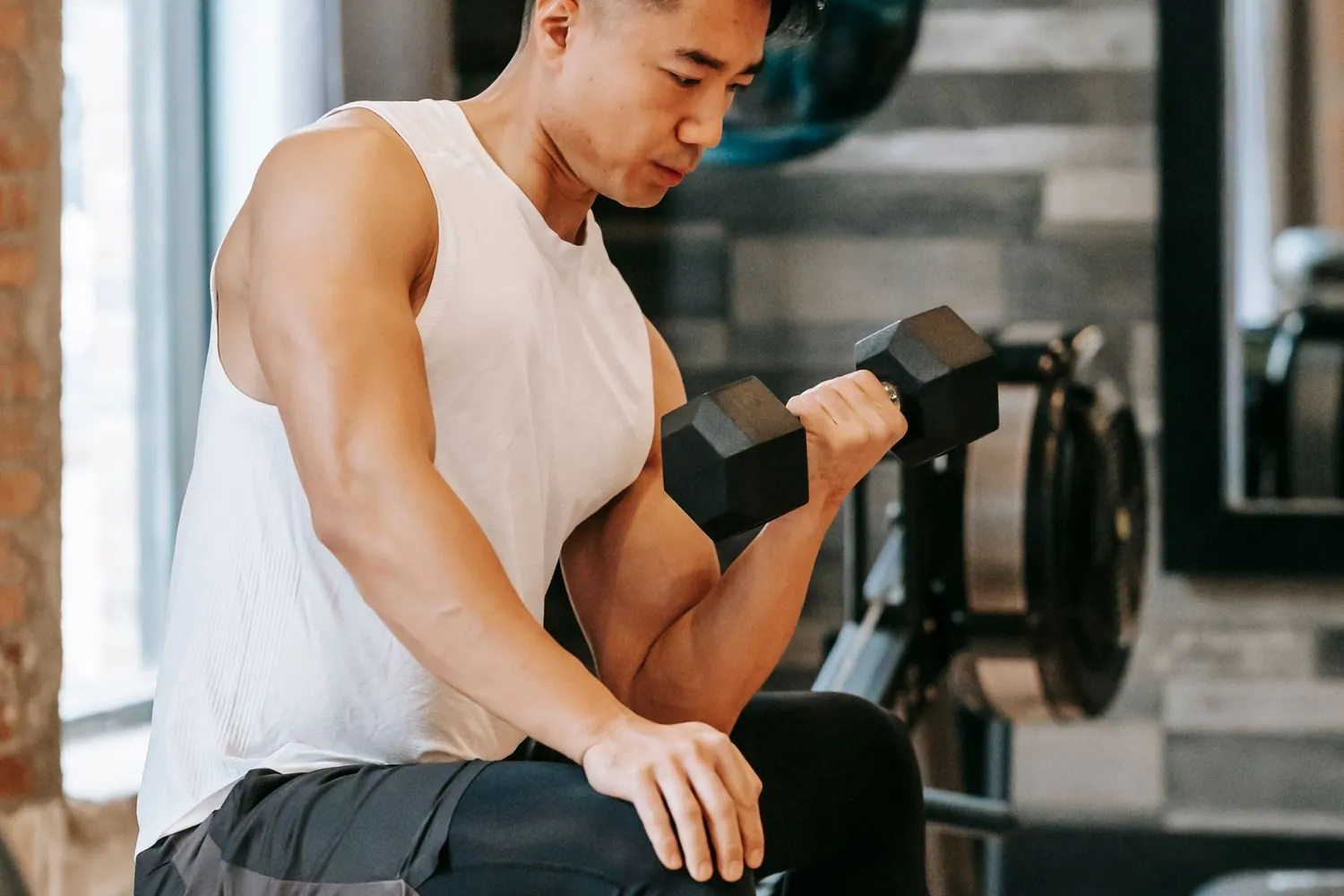
This is not the only way to build the session. Swap the hammer curl for cable curls if that is what your gym has, and the principle stays the same: compound first, isolation second, lighter volume work last.
Which preacher curl variation should you pick?
For most people, the EZ-bar preacher curl is the best default because it is stable and gentle on the wrists. Use single-arm dumbbells to fix left-right imbalances, a machine when you want smooth resistance, and reverse or neutral grips as occasional extras for the forearms and brachialis rather than as replacements.
| Variation | Equipment | Best for | Watch out for |
|---|---|---|---|
| EZ-bar preacher curl | EZ-bar, preacher bench | Default choice, easier on wrists | Uneven grip width between hands |
| Single-arm dumbbell preacher curl | Dumbbell, pad | Fixing left-right strength gaps | Twisting the torso to cheat |
| Machine preacher curl | Selectorised machine | Beginners, drop sets, smooth path | Seat set wrongly for your arm length |
| Reverse-grip preacher curl | Light EZ-bar | Forearms and brachioradialis | Needs much lighter weight |
| Neutral-grip (hammer) preacher curl | Dumbbells or rope | Brachialis, arm thickness | Elbows drifting off the pad |
Should a preacher curl replace your standard curls? No. Standing curls allow a longer range and a little body help, which suits heavier loading; the preacher version trades that for strictness and a deep stretch. Think in angles, not one best curl. The same thinking applies to the shoulder-girdle angles in an around the world workout or the rotation in a woodchopper workout.
Myth check: can preacher curls reshape your biceps peak?
Not really. Peak height depends largely on the length of your muscle belly and where your tendons attach, and that is genetic. What preacher curls can do is make the whole biceps bigger and fuller, which usually makes the peak look better. You cannot pick which part of the muscle grows.
You will hear that preacher curls build the “lower biceps” specifically. Both heads work on every curl, and position shifts the emphasis only slightly. Use the exercise because it is strict, not because it targets a magic zone.
Another myth worth dropping:
- “Curls burn arm fat.” They do not. You cannot choose where fat comes off. Fat loss comes from a steady calorie deficit across the whole body, which is what our online weight loss trainer programmes are built around.
Why does my elbow hurt, and what other preacher curl problems are common?
Elbow or biceps-tendon pain on preacher curls usually comes from jerking the bar off the bottom, locking out hard, or using too much weight. Cut the load by about a quarter, stop a few degrees short of full extension, and lower over three seconds. Sharp pain that lingers past two days needs a professional look.
| Problem | Likely cause | Fix |
|---|---|---|
| Pain in the front of the elbow at the bottom | Jerking off the bottom, hard lockout, load too heavy | Reduce weight by about 25 percent, stop short of lockout, slow the lowering phase |
| Shoulders lift off the pad near the top | Weight too heavy, seat too low | Raise the seat, lighten the load, end the set when it happens |
| Wrists ache | Wrists bent back, straight bar, grip too wide | Switch to an EZ-bar, keep the wrists neutral, narrow the grip slightly |
| Forearms burn before the biceps | Gripping too hard, wrists extending | Relax the grip, think of curling with the elbows, use lighter weight |
A dull pump and a stretch in the biceps is normal. A sharp, pinching or burning pain at the elbow, pain that wakes you at night, or swelling is not normal. Stop the exercise and see a doctor or physiotherapist, especially if you have had a biceps or elbow tendon injury before.
No preacher bench? How can you train preacher curls at home or in a crowded gym?
You can get close with a concentration curl, resting the back of your upper arm against your inner thigh, or by leaning your arm over the top of an incline bench set around 60 to 75 degrees. These are not identical to a preacher bench, but they also limit swinging and keep the load on the biceps.
Gyms get busy in the evening rush, so keep a backup:
- Concentration curl: sit on a flat bench, rest your elbow against the inner thigh, and curl a single dumbbell slowly. Start with about 4 to 8 kg and adjust.
- Incline bench variation: lie chest-down on an incline bench and let your arms hang straight down, then curl with the upper arms staying still.
- At home: a pair of adjustable dumbbells and a sturdy sloped surface are enough. Our home workout guide covers how to build a full week around minimal equipment.
Beginners should start light. An empty EZ-bar often weighs somewhere around 6 to 10 kg depending on the gym, so check before you add plates.
Muscle growth also needs fuel. Most recreational lifters do well on roughly 1.2 to 1.6 g of protein per kg of body weight daily, spread across meals. Eggs (about 6 g each), paneer (about 18 g per 100 g), curd and dal all help. If you struggle to hit your number, an online nutritionist consultation can map it to your routine and budget.
Where does a preacher curl workout fit in your week?
Train your biceps directly about two times a week with at least 48 hours between sessions. Most people grow well on roughly 8 to 14 hard biceps sets per week in total, counting rows and pulldowns as partial contributors. Preacher curls can take 3 to 4 of those sets in each session.
In a push-pull split, put them at the end of pull day. In an upper-lower split, add them to both upper days. In a body-part split, they belong on arm day after your compound work. Avoid preacher curls on consecutive days. If you want a full weekly structure around them, see our guides to a sensible workout plan and a repeatable workout routine.
Be realistic about timing. With consistent training, enough protein and 7 to 8 hours of sleep, most beginners see a visible difference in arm size and strength in about 8 to 12 weeks. Results vary with age, genetics, diet and training history, and nobody can guarantee a specific change in a specific timeframe.
Frequently Asked Questions
How many sets and reps should I do in a preacher curl workout?
Do 3 to 4 sets of 8 to 12 reps for most goals, resting 60 to 90 seconds between sets. Use a weight where the last two reps are hard but your upper arms stay on the pad. If form breaks before rep eight, the weight is too heavy for now.
What weight should I use for preacher curls?
Start lighter than you would for a standing curl, since strict form removes any help from momentum. Choose a weight you can lift for 10 to 12 reps with a slow three-second lowering phase and no shoulder lift. Beginners often start with the empty EZ-bar or small plates, then add weight in small steps.
Is the preacher curl better than a regular bicep curl?
Neither is strictly better because they do different jobs. The preacher curl offers stricter isolation and a deeper stretch, while the standing curl allows a longer range and heavier loading. Most programmes use both across a training block rather than picking one.
Can I do a preacher curl workout without a preacher bench?
Yes. Concentration curls, incline bench curls with your arms hanging down, or single-arm dumbbell curls with your upper arm braced against a sloped surface all limit swinging. They are not identical to a true preacher bench, but they train the same muscle with similar strictness.
How long does it take to see results from preacher curls?
Most beginners notice stronger, slightly fuller arms in about 8 to 12 weeks of consistent training twice a week, with enough protein and sleep. Progress varies by person, so track your weights and reps rather than relying on the mirror alone.
If you want someone watching your elbow position and adjusting your loads week by week instead of guessing from a mirror, book a session with a Fitstrot coach through our 1-on-1 personal training.


