

A shrugs workout trains your upper trapezius, the muscle shelf that runs from your neck out to your shoulders, by lifting your shoulders straight up while you hold a load. It is short, needs only a barbell or a pair of dumbbells, and adds visible thickness to the neck-and-shoulder line. This guide covers form, variations, sets and reps, a four-week beginner progression and fixes for common problems. For the wider muscle group, see our traps muscle workout guide; here we stay on the shrug itself.
What muscles does a shrugs workout train?
Shrugs mainly train the upper trapezius, with the levator scapulae helping lift the shoulder blades. The mid and lower traps and rhomboids hold the shoulder blades steady, and your forearms and grip hold the weight. The elbows never bend, so the arms are not the target. It is a focused, short-range movement.
That focus is why shrugs earn a place in a programme. Rows and pulldowns load the lats and the mid back, but they give the upper trap shelf only a little direct work. A few hard sets of shrugs fill that gap. We usually place them after the heavy compound pull of the day, because tired traps make it harder to control a deadlift or a heavy row.
How do you do a barbell shrug with good form?
Stand with feet hip-width apart, hold a barbell in front of your thighs with arms straight, lift your shoulders straight up toward your ears, pause for about one second, then lower slowly. Keep your elbows locked and your neck neutral. Aim for clean sets of 8 to 12 reps.
- Set your grip. Hands just outside your thighs, palms facing you, bar resting at upper-thigh height. An empty bar in most Indian gyms weighs about 15 to 20 kg, so check the bar before you plan your loading.
- Stand tall and brace. Ribs down, glutes lightly tight, eyes straight ahead. Do not lean back to make the lift easier.
- Lift straight up. Think “shoulders to ears”, not “bar to chin”. The bar travels only a few centimetres.
- Pause at the top. One full second of squeezing is where the muscle works instead of the momentum.
- Lower slowly. Take about two seconds down and let the shoulders relax fully before the next rep.
Everything above happens at the shoulder blades. If your knees dip, your hips push forward or your elbows bend, the load is too heavy for a true trap shrug. Take a lighter bar and rebuild the pattern.
Which shrug variations should you use, and how many sets and reps?
For most lifters, barbell shrugs for 3 to 4 sets of 8 to 12 reps plus one dumbbell or machine variation for 2 to 3 sets of 12 to 15 reps is plenty. Rest about 60 to 90 seconds between sets. Heavier work suits the barbell; lighter, longer sets suit dumbbells and single-arm versions.
| Variation | Sets x reps | Rest | Form cue |
|---|---|---|---|
| Barbell shrug (front) | 3-4 x 8-12 | 75-90 sec | Straight arms, one-second pause at the top |
| Dumbbell shrug | 3 x 10-15 | 60-75 sec | Palms facing your body, weights beside the thighs |
| Single-arm dumbbell shrug | 2-3 x 12-15 per side | 45-60 sec | Free hand on a rack for balance, no side lean |
| Behind-the-back barbell shrug | 2-3 x 10-12 | 75 sec | Light weight only, stay tall, do not let the head poke forward |
| Smith machine shrug | 3 x 10-12 | 60-75 sec | Bar close to the body, feet slightly forward |
| Incline-bench dumbbell shrug | 2-3 x 12-15 | 60 sec | Chest on the bench, which removes hip and knee momentum |
Dumbbells let the weights hang at your sides, which most people find gives a more natural shoulder path. They also help you spot a weaker side, which is common. A barbell lets you load more weight, but grip often gives out first. Neither is strictly better, and rotating both across a month is a sound plan.
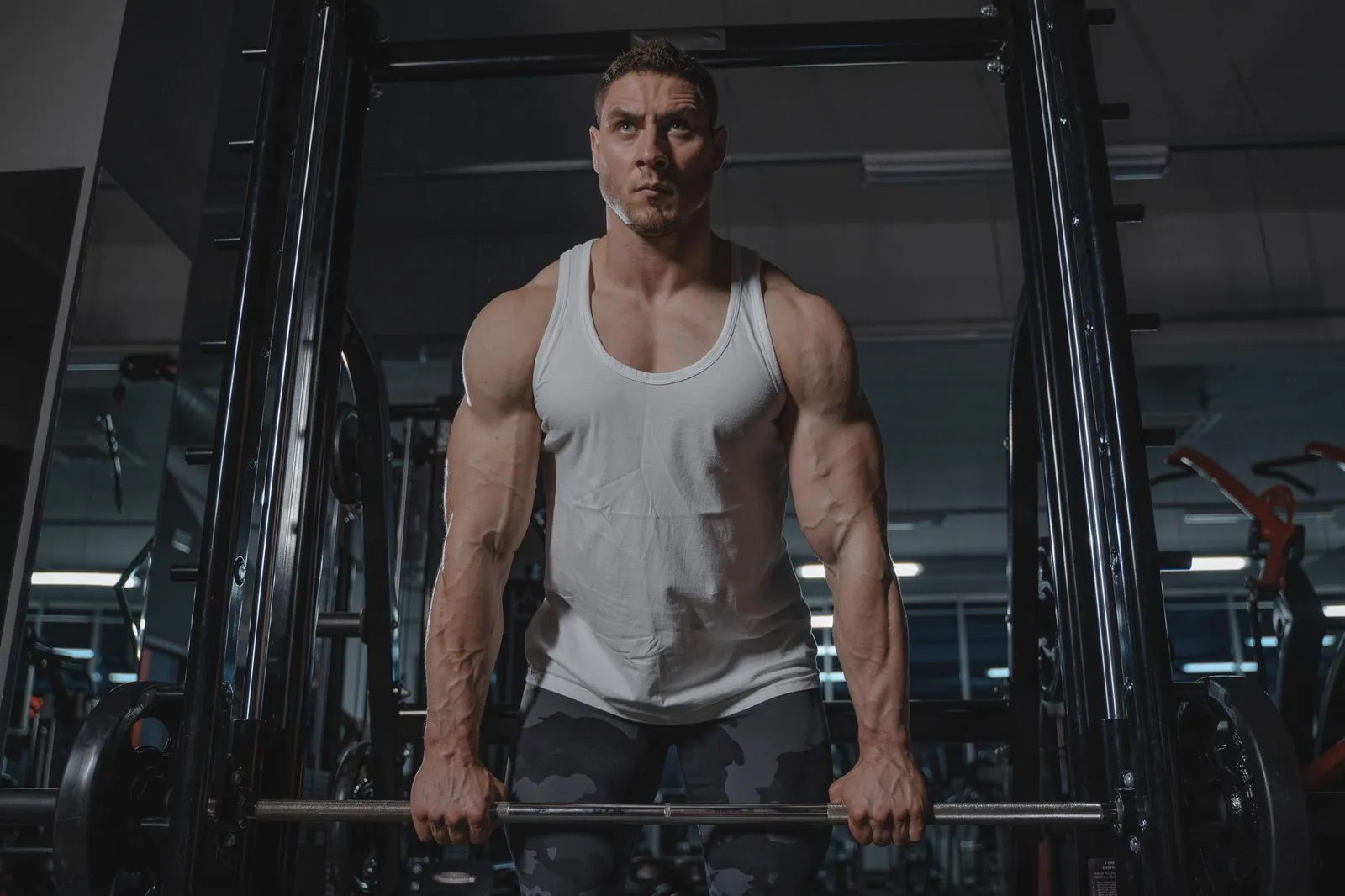
Myth check: do you need to roll your shoulders or lift huge weights?
No. Rolling your shoulders in circles during a shrug adds twisting stress to the shoulder joint under load without giving the trap extra work. Straight up and straight down does the job. You also do not need extreme weights, because clean reps and a full range beat sloppy heavy ones.
Two other myths are worth clearing up. First, shrugs will not make your neck thick overnight or “turn you into a bodybuilder” in a few weeks; trap growth is slow and depends on steady training, enough food and sleep. Second, the claim that behind-the-back shrugs are far better for the traps is overstated. They are an option, but front shrugs are simpler and safer for most people.
If you want the circular motion, save it for light, unloaded mobility work, not for a loaded set.
How much weight should you shrug, and how do you progress?
Start with a weight you can lift for 12 clean reps while pausing for one second at the top, with about two reps left in reserve. For many beginner men that is roughly 8 to 12 kg per dumbbell, and for many beginner women about 4 to 8 kg. Add weight only when every set is clean.
The traps handle heavy loads well, so you will move up faster than you might expect. Use the table below as a simple four-week starting plan for the barbell or dumbbell shrug, and treat the weights as a guide, not a rule.
| Week | Sets x reps | Tempo | Loading rule |
|---|---|---|---|
| Week 1 | 2 x 12 | 1 sec up, 2 sec pause, 2 sec down | Light. Learn the pattern, stop with 3 reps left |
| Week 2 | 3 x 12 | Same | Same weight, one extra set |
| Week 3 | 3 x 10-12 | 1 sec up, 1-2 sec pause, 2 sec down | Add about 2.5 kg total on the barbell, or 1 to 2 kg per dumbbell |
| Week 4 | 3-4 x 8-12 | Same | Add weight again only if all sets stay clean |
After week four, use a double-progression rule. Stay at the same weight until you can hit the top of the rep range on every set with a proper pause, then add the smallest jump you have. Train your traps directly one or two times a week and leave at least 48 hours between sessions. Roughly 6 to 12 hard sets a week of trap work, rows included, is a sensible range for most lifters.
Muscle needs fuel too. A daily protein intake of roughly 1.4 to 2 g per kg of body weight, spread over meals with dal, paneer, curd, eggs or chicken, supports growth. A personal plan from our online nutritionist can fit this to your food habits.
How do you fit shrugs into a trap and back session?
Place shrugs after your heavy pulling and keep the session to about 45 to 60 minutes. A deadlift, a row and a pulldown come first, then barbell shrugs and a single-arm dumbbell finisher. Finish with light arm or shoulder work if you have time.
| Order | Exercise | Sets x reps | Rest |
|---|---|---|---|
| 1 | Barbell deadlift | 4 x 5 | 2-3 min |
| 2 | Bent-over barbell row | 4 x 8 | 90 sec |
| 3 | Barbell shrug | 4 x 10-12 | 75-90 sec |
| 4 | Single-arm dumbbell shrug | 3 x 12-15 per side | 60 sec |
| 5 | Lat pulldown | 3 x 10-12 | 60 sec |
The barbell shrug comes straight after the row because your grip is warm, and the single-arm version evens out any left-right gap. On upper-body days you can round the session off with a preacher curl workout or an around the world shoulder movement. If you are still deciding how to arrange the whole week, our workout plan guide and workout routine guide show how sessions like this fit together.
Why do my shrugs feel wrong? Troubleshooting common problems
Most shrug problems come from three things: too much weight, rushing, or neck position. If you feel it in your forearms, your neck or your lower back instead of your traps, lighten the load, slow the tempo and check that your head stays over your shoulders.
- Grip gives out first. Use dumbbells, switch to a single-arm version, or finish with a few lighter reps. Using straps only on your last heavy sets is fine, but train your grip separately too.
- You feel it in the neck. You are probably pushing your chin forward. Keep your eyes level and lift the shoulders, not the head.
- You feel nothing in the traps. The weight is likely too light or the pause is missing. Add a two-second squeeze at the top and use a weight that makes the last two reps hard.
- Your hips swing. Momentum is doing the work. Lower the weight or try the incline-bench dumbbell shrug, which removes the leg drive.
- Short reps at the bottom. Stopping halfway down skips the stretch. Let the shoulders drop fully, then lift again.
- One side lags. Do the weaker side first in single-arm sets and match the reps on the stronger side.
Shrugs for beginners, home trainees and desk workers
You do not need a full gym to run a shrugs workout. Beginners can start with light dumbbells, desk workers can use shrugs alongside rows to balance a forward-hunched posture, and home trainees can use any safe, stable load they can hold with straight arms.
Beginners: follow the four-week table above and keep the weights light for the first two weeks. Learn the pause before you chase load.
At home: two adjustable dumbbells or a pair of sturdy bags loaded evenly with books or rice work well. Keep the load balanced and the handles secure so nothing slips. Our home workout guide has more equipment-light ideas.
Desk workers: a few sets of shrugs, plus rows and rear-shoulder work, help the upper back and shoulder area feel stronger. They will not fix serious posture problems alone, so add shoulder mobility. Our online yoga classes are a useful way to loosen a tight neck and chest between lifting days.
Women: shrugs will not make you bulky. The same form and progression rules apply, and lighter starting weights are perfectly normal.
When should you see a doctor before doing shrugs?
See your doctor or a physiotherapist before starting if you have neck, shoulder or upper-back pain, a disc problem, numbness or tingling in the arms, high blood pressure that is not controlled, or a recent injury. Stop a set at once if you feel sharp pain, dizziness or pins and needles.
Mild muscle soreness for a day or two after a new session is normal. Pain that is sharp, pinching or lasts beyond a few days is not. Shrugs also involve straining under load, so hold your breath only briefly, and breathe out as you lower. Nothing in this guide can promise a particular result, since trap size depends on genetics, training history, food and recovery.
Frequently asked questions
What muscles do shrugs work?
Shrugs mainly work the upper trapezius, with help from the levator scapulae. The mid and lower traps and rhomboids stabilise the shoulder blades, while the forearms and grip hold the weight. It is a focused movement, not a full-back exercise, so pair it with rows and pulldowns.
How do you do shrugs with proper form?
Stand tall with straight arms, lift your shoulders straight up toward your ears without bending the elbows or rolling the shoulders, pause for about one second, then lower under control until you feel a full stretch. Keep your neck neutral and avoid using hip or knee momentum.
What is the difference between barbell and dumbbell shrugs?
Barbell shrugs let you load more weight but fix your hands in front of your thighs. Dumbbell shrugs let the weights hang at your sides, give a more natural path and let each side work separately, which helps with imbalances. Using both across a month is a good approach.
How much weight should you shrug?
There is no universal number. Pick a weight you can lift for your target reps with a one-second pause at the top and a full stretch at the bottom, leaving about two reps in reserve. If your hips or knees help, it is too heavy. Add small jumps only after clean sets.
How often should you do a shrugs workout?
Most people do well training traps directly once or twice a week, with at least 48 hours between sessions. Three to four hard sets of shrugs per session is a good start. If you are sore for several days or your form slips, cut back one set.
Shrugs look simple, but good results come from steady load progression, a clear pause and a sensible place in your week. If you would rather not guess, our trainers can build shrug work into a plan with form checks and load changes in 1-on-1 personal training, and you can book your first session today.


