
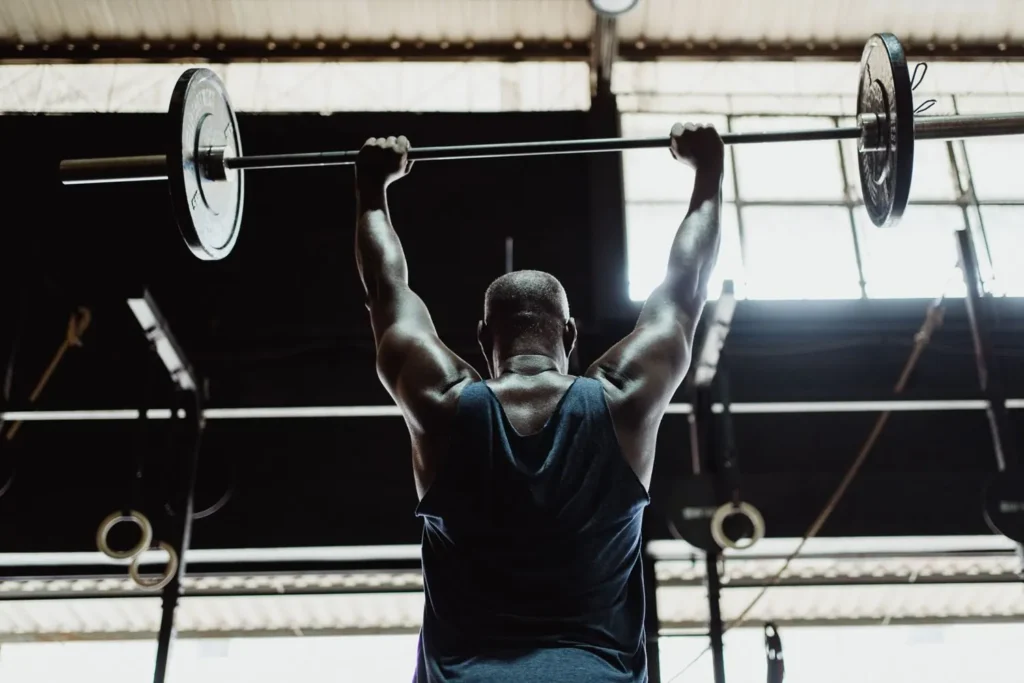
A good traps workout trains all three parts of the trapezius, the kite-shaped muscle that runs from the base of your skull to the middle of your back and out to your shoulder blades. Shrugs alone only reach the top third. This guide gives you a 45-minute session with exact sets, reps and rest, a home version for people without a gym, and fixes for the mistakes that keep traps flat.
What does a good traps workout include?
A good traps workout trains the upper fibres with a heavy shrug, the middle fibres with a row or face pull, and the lower fibres with a Y-raise, plus one loaded carry for grip and endurance. That adds up to roughly six exercises and 16 hard sets, which takes about 45 minutes including rest.
The trapezius is not one uniform sheet. It behaves like three muscles that share a name, and each one moves your shoulder blade differently. Most people who train traps only shrug, then wonder why their upper back still looks flat and their shoulders round forward after a day at a laptop. Covering all three regions is what changes both how your upper body looks and how it feels to sit, press and pull.
Trap regions at a glance: what each one does and what trains it
Use this table to check that your plan covers every region. If a row in the last column sounds like you, that region needs more attention.
| Region | Main job | Best exercises | Sign it is under-trained |
|---|---|---|---|
| Upper traps | Lift the shoulder blades (the shrug motion) | Barbell shrug, dumbbell shrug with a pause, farmer’s carry | Neck-to-shoulder slope looks flat |
| Middle traps | Pull the shoulder blades together | Seated row, face pull, band pull-apart | Shoulders roll forward, upper back looks narrow |
| Lower traps | Pull the shoulder blades down and help the arm go overhead | Prone Y-raise, wall slide, straight-arm pulldown | Shoulders hike up near your ears during overhead presses |
Notice that only one of the three regions responds well to shrugging. That is the main reason balanced programming beats heavier and heavier shrugs.
The 45-minute traps workout: sets, reps, rest and form cues
Run this once a week on its own, or split it into two halves across your back and shoulder days. Pick a weight where the last two reps of every set are hard but your form stays clean. Rest times are guides, not rules.
| Order | Exercise | Sets x reps | Rest | Form cue |
|---|---|---|---|---|
| 1 | Barbell shrug | 3 x 8-12 | 90 sec | Straight up and down, hold the top for one second, lower for two |
| 2 | Farmer’s carry | 3 x 30-40 m | 90 sec | Tall chest, shoulders packed down and back, short quick steps |
| 3 | Seated cable or chest-supported dumbbell row | 3 x 10-12 | 75 sec | Lead with the elbows, squeeze the blades together for a beat |
| 4 | Face pull | 3 x 15-20 | 60 sec | Pull the rope toward your eyes, hands finish wider than elbows |
| 5 | Dumbbell shrug with a pause | 2 x 12-15 | 60 sec | Two-second hold at the top, no bouncing |
| 6 | Prone Y-raise (light dumbbells or bare hands) | 2 x 12-15 | 45 sec | Lie face down on an incline bench, thumbs up, lift arms into a Y |
How to pick starting weights
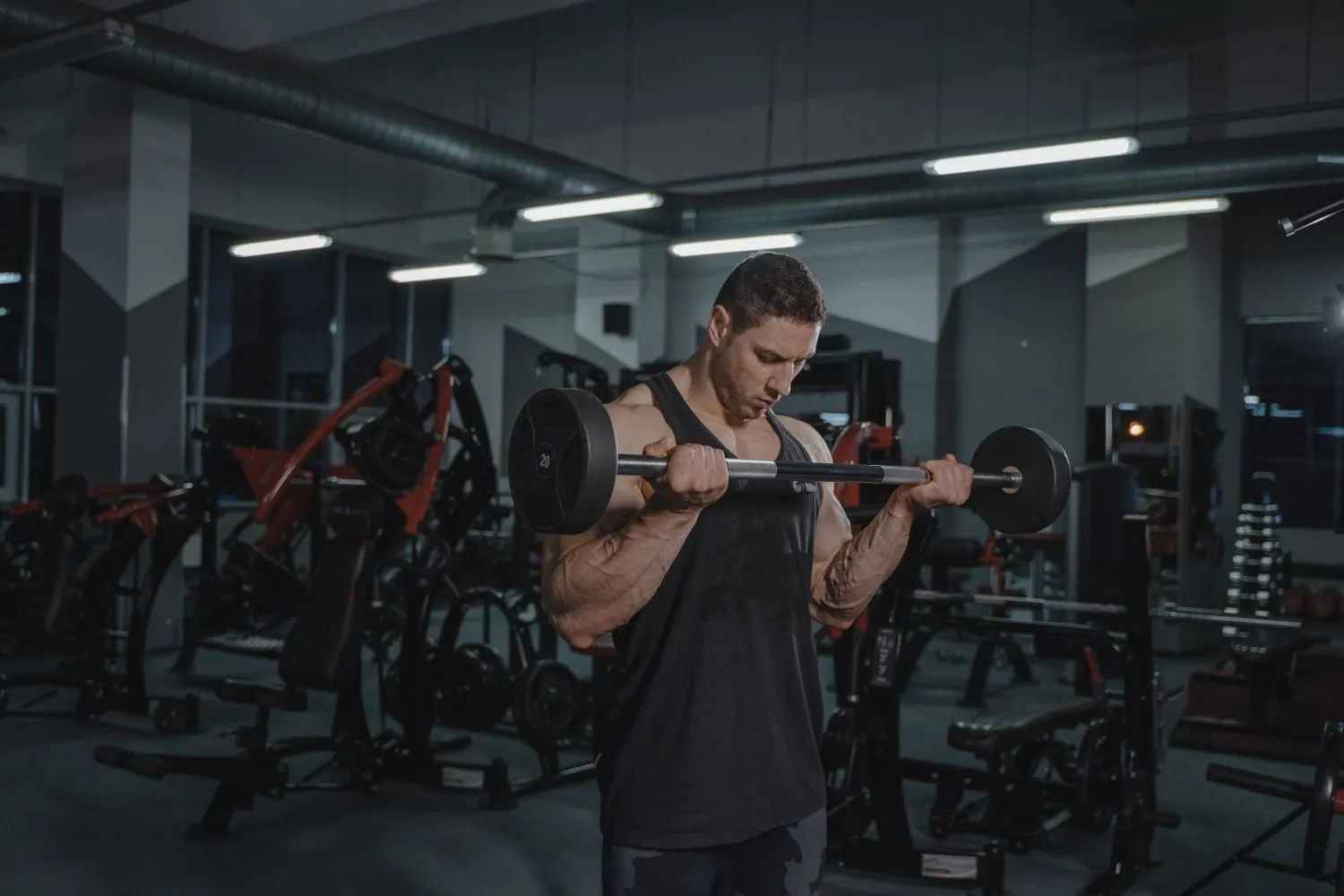
Start lighter than your ego suggests. For most beginners in an Indian commercial gym, the barbell shrug works with roughly 30 to 50 kg total and each dumbbell with about 8 to 12 kg, and the Y-raise needs only 1 to 3 kg or none at all. Add weight only when you can hit the top of the rep range on every set with the pause intact. Heavier is useful only when the trapezius is still doing the lifting.
Why shrugs alone will not build complete traps
This is the biggest myth in trap training. Shrugs load the upper fibres very well, and the barbell shrug lets you progress the weight for months. But the middle and lower fibres barely move during a shrug, so a shrug-only routine builds a bulge at the base of the neck and leaves the rest of the upper back untouched.
A second myth is that heavy deadlifts make direct work unnecessary. Deadlifts do load the traps hard as stabilisers, and heavy pulls build real strength in them. What deadlifts do not give you is a full range of shoulder blade motion under tension, particularly the lowering and retraction that the lower and middle fibres need. Treat deadlifts as a bonus, not a replacement.
The third myth is that traps respond only to heavy weight. Light, slow, controlled work (face pulls, Y-raises, paused shrugs) is what trains the fibres that heavy lifting skips. If you want to see how those pulling days fit together, our back workout routine shows where trap work sits after your main rows and pulldowns.
How often should you train traps?
Two sessions a week with roughly 4 to 8 hard sets each, so about 8 to 16 sets weekly, suits most people. Traps recover quickly, so 48 hours between sessions is usually enough. Beginners can start with one session of 6 to 8 sets and add a second after three to four weeks if recovery feels good.
These are starting points, not fixed prescriptions, so adjust them to how your neck, shoulders and elbows feel.
Beginners in their first six months do well with one or two sessions of 4 to 6 sets, focused on learning the shrug, row and face pull with light weight. Intermediate lifters can run two sessions of 6 to 8 sets and add the carry and paused shrugs. Advanced lifters can go to three sessions, adding volume only to the region that lags.
If you also train shoulders, remember that overhead presses and lateral raises already use the upper traps. Our guide to deltoid workouts covers that overlap, and the upper back workouts article shows how rhomboids and lats fit alongside your traps work.
Can you do a traps workout at home without a gym?
Yes. A backpack packed with 8 to 15 kg of books, two 5 to 20 litre water cans (a litre of water weighs about 1 kg) and a resistance band are enough to train all three trap regions at home. Use higher reps, 15 to 25 per set, and slower tempo to make lighter loads effective.
| Gym exercise | Home swap | Reps and tempo |
|---|---|---|
| Barbell shrug | Shrug holding two water cans or a loaded backpack in front | 15-25 reps, 2-second pause at the top |
| Farmer’s carry | Walk a lap of your terrace or hallway holding two cans | 3 laps, 30-40 seconds each |
| Seated row | Band row anchored to a door, or one-arm backpack row | 12-20 reps, squeeze for one second |
| Face pull | Band pull-apart at eye level | 15-25 reps |
| Prone Y-raise | Y-raise lying on the floor or over the edge of a bed | 12-15 reps, bodyweight only |
Keep loads on the carry sensible. A 20 litre can is heavy to hold for 30 metres, so start with half full and build up. If you want a wider plan around this, our home workout for muscle gain article shows how to use basic household loads across the week.
Troubleshooting: neck pain, uneven traps and grip that quits first
Most trap problems come from technique or load, not from the muscle itself. Here are the fixes we use most.
Your neck feels tight or your shrugs creep toward your ears
That usually means the weight is too heavy or you are shrugging forward with your head. Drop the load by 20 to 30 percent, keep your chin slightly tucked and your gaze straight ahead, and lift only to the point where the shoulders stop moving upward. Never roll the shoulders in a circle. Rolling adds joint stress without recruiting the traps better.
One side looks bigger than the other
Most people have a slight difference, because the dominant side often grips and pulls harder. Add a single-arm exercise such as a one-arm dumbbell shrug or one-arm cable row, start each set with the weaker side, and match the reps on the stronger side rather than exceeding them.
Your grip gives out before your traps do
Straps are a reasonable tool on heavy shrugs and carries when the goal is to train the muscle, not your forearms. Use them on the last one or two sets rather than every set so your grip still improves over time.
You feel sore for days afterwards
Some soreness two days after a new routine is normal, but sharp pain or pain that lasts more than a week is not. If your soreness feels more like a pull than a dull ache, read our guide to muscle pain after a workout and reduce load until it settles.
Who should be careful with trap training?
Stop and see a doctor or physiotherapist before loading heavy if you have neck pain that spreads into your arm, numbness or tingling in your hands, a past neck or shoulder injury, or you have been told to avoid straining because of high blood pressure. Heavy shrugs and carries involve breath-holding, which raises blood pressure for a moment. Keep breathing steadily through every rep.
No routine gives guaranteed results. Visible trap growth depends on how much you eat, how well you sleep and how many months you stay consistent. Most people see their strength numbers rise in 4 to 6 weeks and notice a visible change in shape after roughly three to six months of steady training.
Building the rest of your week around traps
Traps rarely need their own day. Fold two or three of the exercises above into your back day after the main rows, and keep face pulls and Y-raises for your shoulder day. If you are still choosing a weekly structure, the muscle workout plan shows how to spread pulling, pressing and leg days without overlapping too much.
A sensible progression over 8 weeks looks like this: spend weeks 1 and 2 learning the movements with light weight, add load or a rep each week for weeks 3 to 6, then take a lighter week and test your top sets again. Write the numbers down. What you track is what improves.
Yoga also supports the trap region, since slow shoulder-opening work counters the forward-rounded posture that tight upper traps often come with. A weekly session in our online yoga classes pairs well with this plan.
Want a traps plan built around your posture and your lifts?
A template only goes so far, because your starting strength, injury history and desk hours all change the best plan. Our 1-on-1 personal training coach builds a trap and upper-back plan around your current lifts, your posture and your schedule. Start by sharing your present routine and goal.
Frequently Asked Questions
What is the best exercise for traps?
The barbell shrug is the best single exercise for loading the upper traps heavily and progressing weight over time. It does little for the middle and lower fibres, so pair it with a row, face pull and Y-raise to build a complete trapezius rather than relying on one movement.
Do deadlifts work the traps?
Yes. The traps stabilise your shoulder blades throughout the deadlift, especially the upper and middle fibres, keeping your upper back tight as the bar leaves the floor. Heavy deadlifts build real trap strength, but they do not replace direct shrugs, rows and face pulls if you want fuller development.
How many sets of traps should I do per week?
About 8 to 16 hard sets per week works for most people, split over two sessions. Beginners can start closer to 6 to 8 sets in a week. Add sets only when your recovery, sleep and joints feel good, and cut back if your neck stays tight for days.
Can you overtrain your traps?
It is possible but less common than people assume. The bigger risk is poor technique repeated across many sessions, such as shrugging with momentum or rolling the shoulders. If your neck stays tight or your shrugs creep toward your ears, lower the load and clean up your form first.
Should beginners train traps directly?
Beginners can add two direct trap exercises a week, such as a light shrug and a face pull, once basic rows and presses feel stable. In the first few months compound lifts already give a solid trap stimulus, so direct work is useful but not urgent.


