
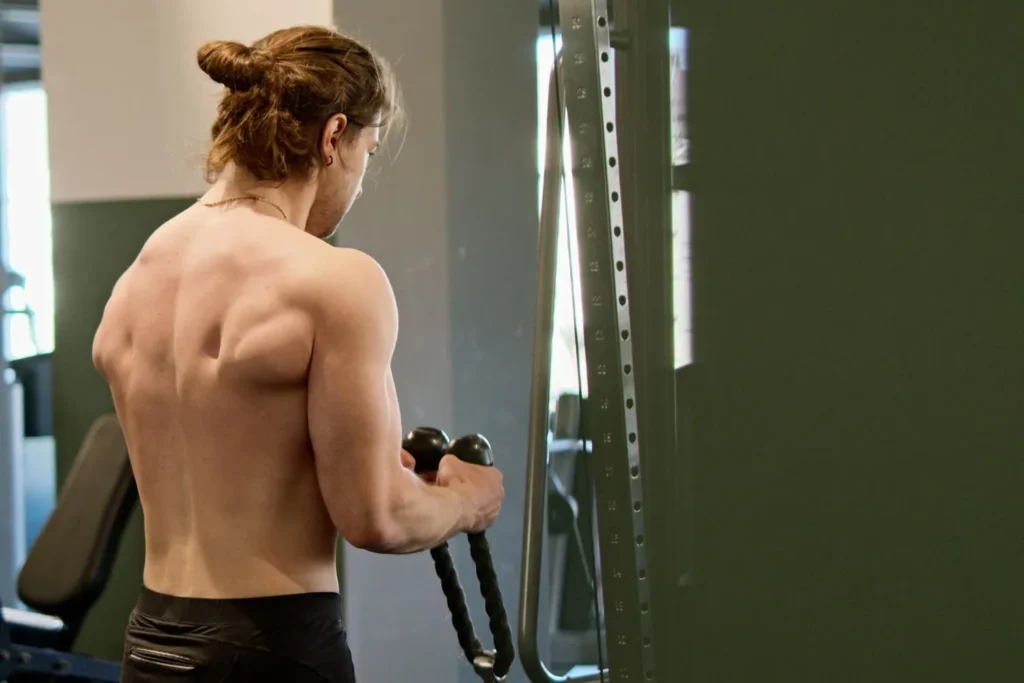
A good gym back workout routine pairs one or two vertical pulls (pull-ups, lat pulldowns) for width with two horizontal rows for thickness, plus one finisher for the rear shoulders. That is 5 to 6 exercises, about 18 to 22 working sets, and 50 to 60 minutes once or twice a week. Below you get the full session, a two-day split, a four-week progression and fixes for the usual problems.
This routine is written for people who already have a few months of gym training behind them. If you are still learning to row or pull, start with our back workout at the gym for beginners and return here when your reps look controlled and repeatable.
What should a gym back workout routine include?
A complete back session includes a vertical pull (pull-up or lat pulldown) for the lats, a horizontal row (barbell, cable or machine) for the mid-back, and a rear-delt or face-pull finisher. Aim for roughly 18 to 22 working sets in 50 to 60 minutes, using 6 to 15 reps per set.
Your back is not one muscle. The lats pull your arms down and in, which creates the V-taper seen from the front. The rhomboids, mid-traps and rear delts pull your shoulder blades together, which creates the thickness seen from the side. The spinal erectors along your lower back keep your torso rigid while you row. If your plan only has pulldowns, the middle of your back stays flat. If it only has rows, you lose width.
The full session: sets, reps, rest and form cue
This is the session we would hand to an intermediate lifter. Do it after a short warm-up of band pull-aparts or scapular pull-ups and one or two lighter ramp-up sets on the first lift.
| # | Exercise | Sets x reps | Rest | Form cue |
|---|---|---|---|---|
| 1 | Pull-up (assisted or weighted) | 4 x 6-8 | 2-3 min | Start from a dead hang, lead with the chest, pull elbows toward your back pockets. |
| 2 | Barbell bent-over row | 4 x 8-10 | 2 min | Torso about 45 degrees, flat back, pull the bar to the lower ribs, no jerking. |
| 3 | Chest-supported machine row | 3 x 10-12 | 90 sec | Chest stays on the pad, squeeze shoulder blades together for a one-second pause. |
| 4 | Wide-grip lat pulldown | 3 x 10-12 | 90 sec | Slight lean back, bar to the upper chest, do not swing. |
| 5 | Single-arm dumbbell row | 3 x 10-12 per side | 60-90 sec | Pull the elbow to the hip, keep the hips square, lower slowly. |
| 6 | Straight-arm pulldown | 3 x 12-15 | 60 sec | Arms nearly straight, push the bar toward your thighs using the lats. |
| 7 | Face pull | 3 x 15-20 | 45-60 sec | Rope to forehead height, elbows high, rotate the hands outward at the end. |
That is 24 sets, which is the top end. If you are short on time or recovery, drop the straight-arm pulldown or one set from each of the first four lifts. Quality sets beat a longer list.

How do you build back width versus back thickness?
Width comes mainly from vertical pulling, where your arms travel from overhead down to your sides: pull-ups, pulldowns and straight-arm pulldowns. Thickness comes from horizontal pulling, where you drag weight into your torso: barbell, cable, machine and dumbbell rows. Every session needs at least one of each.
The most common imbalance we see in people training alone is loading up on pulldowns because they feel productive, and skipping rows because they are harder to load and easier to cheat. The result is a back that looks wide from the front but thin from the side. Pick the exercise you like least between the two patterns and put it first in your session, when you are freshest.
Two-day version: a width day and a thickness day
If you can train back twice a week, splitting the work lets you push each pattern harder while staying fresh. Keep at least 48 hours between the two sessions. Total weekly sets stay about the same as the single full session, so you are not adding volume, just spreading it.
| Day | Focus | Exercises (sets x reps) | Approx. time |
|---|---|---|---|
| Day A (e.g. Monday) | Width first | Weighted pull-up 4 x 6-8, wide-grip pulldown 3 x 10-12, close-grip pulldown 3 x 10-12, chest-supported row 3 x 10-12, face pull 3 x 15-20 | 45-50 min |
| Day B (e.g. Thursday) | Thickness first | Barbell row 4 x 6-8, seated cable row 3 x 10-12, single-arm dumbbell row 3 x 10-12 per side, straight-arm pulldown 3 x 12-15, rear-delt fly 3 x 15 | 45-50 min |
A weekly total of roughly 10 to 20 hard sets for the back is a sensible target for most lifters. Beginners sit near the lower end and experienced lifters near the upper end. If you are unsure where your gym sessions sit in the bigger picture, our gym workout routine guide shows how a back day fits into a full week.
How do you progress this routine over four weeks?
Progress by adding one rep per set each week until you hit the top of the rep range, then add a small amount of weight, roughly 2.5 kg on rows and pulldowns, and drop back to the bottom of the range. Repeat for four weeks, then take an easier week with about 20 to 30 percent fewer sets.
| Week | Main lifts (pull-up, barbell row) | Accessories | Effort |
|---|---|---|---|
| 1 | Bottom of rep range, e.g. 6 reps and 8 reps | Start light enough to leave 2 reps in reserve | Moderate |
| 2 | Add 1 rep per set | Add 1 rep per set | Moderately hard |
| 3 | Add 1 more rep, or a little weight if you hit the top | Push the last set to 1 rep left in reserve | Hard |
| 4 | Top of range, last set close to failure | Same, keep form strict | Hardest |
| 5 (easier week) | Same weights, 2 fewer sets per exercise | Drop the finisher if tired | Easy, recover |
Myth: do you need to feel a back workout in your lower back to know it worked?
No. Lower-back soreness after rows usually means your spine was doing the pulling, not your lats. A well-done back session should leave you feeling it between and below the shoulder blades and under the armpits. Sore lower back with a tired grip is a sign to lighten the load and fix your hinge.
Two related myths are worth clearing up. First, you cannot spot-reduce fat from your back by training it; fat loss depends on your overall diet and activity, and back training mainly builds muscle underneath. Second, a bigger number on the stack is not the goal. A 40 kg row done with a controlled squeeze builds more back than a 60 kg row swung with your hips.
Why can’t you feel your back working? Troubleshooting
If your arms or traps burn before your back does, the usual causes are pulling with the hands instead of the elbows, using too much weight, or letting the shoulders shrug up. Lower the load by 20 to 30 percent, slow the lowering phase to about three seconds, and think of your hands as hooks.
- Biceps tire first: use a thumbs-over (not hooked) grip, drive the elbows down and back, and add lifting straps on heavy sets so grip stops being the limit.
- Traps take over on pulldowns: depress your shoulder blades first (move them down), then bend the elbows.
- Swinging on rows: cut the weight, brace your abs, and pause for one second at the top of every rep.
- Lower back aches during bent-over rows: switch temporarily to a chest-supported row or a seated cable row, and ease back to the barbell row once your hinge is solid.
- Shoulder pinching on pull-ups: narrow your grip slightly, stop a little short of the full stretch at the bottom, and check that you warm up with scapular pull-ups first.
- Stuck on the same weights for weeks: check sleep and protein before changing exercises. Eating roughly 1.6 to 2 g of protein per kg of body weight daily, from dal, paneer, eggs, curd, soya or chicken, supports progress.
Free weights or machines for back training?
Use both. Free-weight rows and pull-ups build strength you can carry over to other lifts, while machines and cables let you work the back to near failure without your grip or lower back giving up first. Put heavy free-weight lifts first in the session and machine work after.
Many Indian gyms are crowded at peak hours, so a rigid plan can fall apart when the cable station is taken. Keep one backup for each slot: if the lat pulldown is busy, do assisted pull-ups; if the barbell row area is full, use a chest-supported row or dumbbell rows. If you also train at home on some days, our home gym workout guide covers the swaps you can make with limited equipment.
Gym back workout routine for different people
Women: the same exercises and rep ranges work. Start with lighter loads, build up pull-up strength with assisted or band-assisted variations, and do not worry about getting bulky; a stronger back improves posture and makes the waist look smaller in proportion.
Desk workers: if you sit for 8 to 10 hours, prioritise rows, face pulls and rear-delt work. Aim for at least two sessions a week with a ratio of roughly two pulls for every one push in your overall plan.
Over 40, or returning after a break: reduce the load by about 30 to 40 percent for the first two weeks, prefer chest-supported rows to free barbell rows, and keep 2 to 3 reps in reserve until your joints settle. If you have a history of disc problems, shoulder surgery or ongoing back pain, get your doctor’s or physiotherapist’s go-ahead before starting heavy rowing.
Short on time: a 35 minute version is pull-up 3 x 6-8, barbell or chest-supported row 3 x 8-10, lat pulldown 2 x 10-12, face pull 2 x 15. It still covers both patterns.
How often and how long should you train back?
For most intermediate lifters, once or twice a week is enough, with 48 to 72 hours between hard back sessions. A single session should take 50 to 60 minutes including warm-up. Past about 75 minutes, quality usually drops and you are better off going home and sleeping.
Recovery matters as much as the session. Aim for 7 to 9 hours of sleep and spread protein across meals, for example eggs or curd at breakfast, dal and roti or rice with paneer at lunch, and chicken, tofu or sprouts at dinner. If you want a personalised daily plan around your own budget and food preferences, our online nutritionist consultation builds one with you.
FAQ: gym back workout routine
How many exercises should be in a gym back workout routine?
Five to seven exercises is enough: two vertical pulls, two to three rows, and one finisher such as face pulls. That usually adds up to 18 to 24 working sets in 50 to 60 minutes. More than seven exercises rarely adds results and mostly adds fatigue.
How many times a week should I train back at the gym?
Once or twice a week works for most people. Twice a week lets you split the work into a width day and a thickness day, with at least 48 hours between them. If you can only train once, one well-executed 50 to 60 minute session still builds muscle if you add reps or weight over time.
Should I do pull-ups or lat pulldowns first?
Do whichever you want to improve most first, since you are freshest at the start. If you can do 6 or more strict pull-ups, start with pull-ups. If you cannot, begin with lat pulldowns or assisted pull-ups, then work toward your first unassisted reps over several weeks.
Can I do a gym back workout routine without deadlifts?
Yes. Pull-ups, pulldowns and rows already train the lats, mid-back and rear shoulders well. Deadlifts add extra load for the lower back, glutes and traps, but they are optional in a back session. If you skip them, keep a hip hinge or back extension in your leg day instead.
How long until I see results from this routine?
Strength gains on rows and pull-ups usually show up within 3 to 4 weeks. Visible changes in back width and thickness typically take about 8 to 12 weeks of consistent training, enough protein and adequate sleep. Results vary with age, training history, food and recovery, so no timeline can be guaranteed.
If you want this routine adjusted for your gym’s equipment, your schedule and any old injuries, book a 1-on-1 session with a Fitstrot coach through our 1-on-1 personal training service and we will build your back days around your week.


