
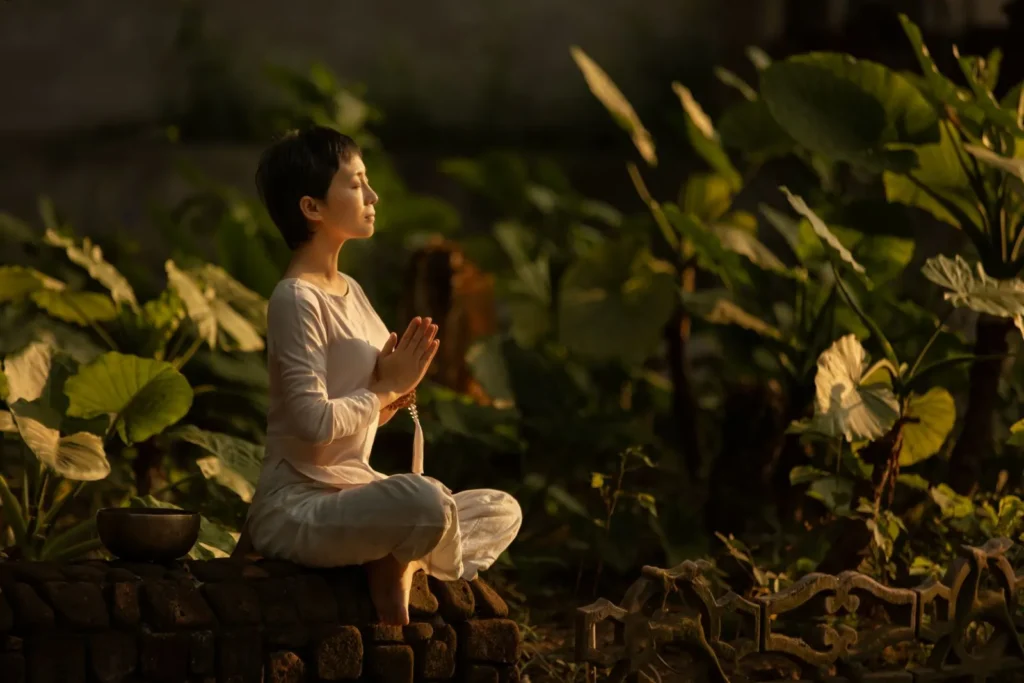
Santosha is the yogic practice of contentment: being at peace with your present situation without waiting for it to improve first. It is the second of the five niyamas in Patanjali’s Yoga Sutras, and it is one of the most misunderstood ideas in yoga, because people hear “contentment” and assume it means “stop trying”. It does not. This guide explains what santosha means, where it sits in the eight-limbed path, and how to practise it on the mat, at your desk and even inside the family WhatsApp group.
What does santosha mean?
Santosha is a Sanskrit word usually translated as contentment. It combines “sam” (complete) and “tosha” (satisfaction), so it loosely means complete satisfaction. In yoga it is the second niyama, a personal observance: the trained ability to feel settled with what is here today, without needing your circumstances, your body or your results to change first.
Yoga Sutra 2.42 is usually paraphrased as: from contentment comes unsurpassed happiness. The point is not to stop wanting good things, but to stop making your baseline depend on them. Most of us run on the opposite rule, “I will relax once the promotion or the weight target arrives”, and the finish line keeps moving.
Where does santosha sit among the five niyamas?
Santosha is the second niyama, listed in Yoga Sutra 2.32 between saucha (cleanliness) and tapas (disciplined effort). The five niyamas are personal observances: saucha, santosha, tapas, svadhyaya (self-study) and ishvara pranidhana (surrender to something larger). Together with the yamas, they form the first two limbs of Patanjali’s eight-limbed path.
| Niyama | Meaning | Everyday question it asks |
|---|---|---|
| Saucha | Cleanliness of body, space and mind | What can I clear out today? |
| Santosha | Contentment with the present | Can I be at peace with this moment as it is? |
| Tapas | Disciplined, sustained effort | What small hard thing will I repeat today? |
| Svadhyaya | Self-study and reflection | What did I notice about my own reactions? |
| Ishvara pranidhana | Surrender of the outcome | What am I gripping that I cannot control? |
Notice the neighbours. Saucha and tapas are active: you tidy, you train. Santosha is the counterweight. Without it, discipline drifts into anxious perfectionism; without discipline, contentment drifts into drifting.
Is santosha just a polite word for complacency?
No. Santosha means accepting your present reality without distress, not giving up your goals. It sits beside tapas (disciplined effort) on purpose: you can be at peace with where you are today and still train, study or save towards where you want to be. It is contentment with the starting point, not surrender of the direction.
Santosha also differs from toxic positivity, which insists everything is fine. Santosha lets disappointment, anger and grief be felt fully while you stay steady underneath them.
A simple test for avoidance dressed up as acceptance: if your “contentment” requires you to stop noticing something true, it is avoidance. If it lets you see the situation clearly and respond without panic, it is closer to santosha.
An honest limit: santosha is not a reason to tolerate mistreatment, ignore pain or sit with persistent low mood. If you feel flat, hopeless or anxious for weeks, or if a situation is unsafe, that calls for action and professional support, not more acceptance practice.
How does santosha connect with ahimsa, satya and brahmacharya?
Santosha works with the yamas as one ethical system. Ahimsa (non-harming) turns inward as refusing to punish yourself with constant dissatisfaction. Satya (truthfulness) demands an honest look at your real circumstances. Brahmacharya (right use of energy) reduces the craving that keeps the mind restless. Contentment grows from these three, not from getting more.
Ahimsa is the easiest bridge: dropping the running commentary of “I am so lazy” or “everyone else is ahead” is non-harming applied to your own mind. Satya keeps santosha honest, because if your job drains you or your health is slipping, the truthful move is to name it and decide between acceptance, action or both. Brahmacharya tackles the engine of discontent: more scrolling, shopping and snacking. For the wider picture of effort without frantic attachment to results, see our guide to the Bhagavad Gita and yoga.
How do you practise santosha on the mat?
Practise santosha on the mat by noticing the urge for a “better” version of a pose, then returning to what the body is actually doing today. A short, gentle 15-minute sequence works well: arrive, move slowly, hold simple shapes, rest fully, and close by naming three specific things that felt good. Stop at sensation, never at pain.
| Step | Time | What to do | Santosha cue |
|---|---|---|---|
| 1. Arrive | 2 min | Sit on a folded blanket. Breathe naturally, then let each exhale run slightly longer than the inhale. | Name how the body feels today without trying to fix it. |
| 2. Cat-cow | 2 min | On hands and knees, move the spine slowly with the breath. Pad the knees with a blanket if needed. | Catch the urge to do it “better” and let it go. |
| 3. Mountain pose | 1 min | Stand with feet hip-width apart, weight even, shoulders soft. | Feel what is already holding you up. |
| 4. Forward fold, knees bent | 2 min | Fold from the hips with generous bends in the knees, hands on shins or blocks. | Stop where the stretch is, not where the photo is. |
| 5. Supported reclined twist | 3 min | Lie on your back, drop both knees to one side, rest 90 seconds each side. Put a pillow under the knees if the lower back complains. | Let gravity do the work. |
| 6. Final rest | 3 min | Lie flat, cover yourself with a light cloth, let the breath be ordinary. | Nothing to achieve, nothing missing. |
| 7. Close | 2 min | Sit up and name three specific good things about this session. | Be concrete: “my breath stayed smooth in the fold”. |
Modifications and cautions: keep knees bent in any fold if your hamstrings or lower back are tight. Skip deep folds and twists, or check with a teacher first, if you have an acute back or disc problem, are pregnant, or have uncontrolled blood pressure. Contentment with your range of motion is the practice. Forcing the range is not.
Our guide to restorative yoga covers props and long holds, and yoga nidra gives discontent space to surface and pass.
What does santosha look like in everyday Indian life?
Santosha shows up in small reactions: how you respond to a cousin’s good news, a stubborn weighing scale, a delayed train or a disappointing result. In each case the practice is the same three steps: notice the reflex, feel it honestly, then choose one useful next step instead of a spiral. The table below shows how that plays out.
| Situation | Usual reflex | Santosha response |
|---|---|---|
| A relative’s promotion or wedding photos land in the family group | Compare, feel behind, scroll more | Notice the comparison, wish them well, then return to your own next step |
| The scale has not moved in two weeks | Quit, or crash-diet | Treat today’s number as information and repeat the habits that are working |
| Exam or appraisal result below hope | Harsh self-criticism | Let the disappointment be real for a day, then pick one thing to improve |
| A great workout day | Immediately raise the target | Finish, acknowledge it, rest, and only then plan the next step |
The last row matters most for active people: modern fitness runs on streaks and kilos, and satisfaction quietly becomes conditional on progress. Santosha keeps the metrics but stops them deciding whether you are allowed to feel fine.
Troubleshooting: why does santosha practice feel fake?
Santosha usually feels fake when it is forced. If you are repeating positive phrases you do not believe, practising in the middle of a crisis, or using “acceptance” to avoid a conversation you need to have, the practice will feel hollow. Start smaller and be specific.
- Problem: it feels like numbness. Fix: numbness is suppression. Real santosha lets sadness or anger be felt, then settles. If numbness persists, speak to a doctor or counsellor.
- Problem: you only try it when upset. Fix: practise on ordinary days for two minutes, so the skill is there when a hard day arrives.
Who benefits most from practising santosha?
Santosha helps anyone whose peace depends heavily on results: students facing exams, desk workers chasing targets, people on weight-loss journeys and anyone who compares themselves online. It lets you keep working towards goals while loosening the grip of constant dissatisfaction. It is a mindset skill, not a substitute for training, treatment or professional advice.
Students and early-career professionals often tie self-worth to marks and offer letters; a one-minute daily check of what went well keeps ambition from turning into dread. Office workers can pause for thirty seconds between meetings to notice posture and breath. In corporate wellness, teaching santosha beside movement softens the pressure of leaderboards.
Anyone training for a body goal can feel at home in the body they have while still changing it, and treat a slow week as normal, not a verdict. For an upbeat route, try an online Zumba class and focus on how the movement feels, not calories burned.
Which yoga styles help you practise santosha?
Any style can train santosha, but differently. Slow, long-hold styles teach the mind to stop grasping at a pose; dynamic styles teach you to stay steady as the pace and effort rise.
- Hatha yoga: steady holds give the “I should be deeper” thought time to pass.
- Vinyasa yoga: flowing movement trains contentment with each transition instead of rushing ahead.
- Power yoga: strong practice tests whether you stay calm and kind to yourself when it gets hard.
- Restorative and yoga nidra: supported rest with nothing to perform.
Does practising contentment have proven benefits?
Santosha is a spiritual and ethical discipline, not a medical treatment. Many people report calmer moods, less comparison and better sleep when they practise gratitude and acceptance regularly, but results vary and it does not replace professional care for anxiety, depression or any health condition.
For the broader picture of what a regular yoga practice can offer, read our guide to the benefits of yoga.
How can a beginner start a santosha practice this week?
Start with one minute a day. At the end of a workout, yoga session or working day, sit comfortably and name three specific things that were good, without qualifying them. Once a week, ask whether your biggest source of dissatisfaction needs acceptance, action or both.
- Day 1: Name three specific good things before bed.
- Day 2: Notice one comparison today and just label it, “comparing”.
- Day 3: Do the 15-minute mat sequence above, stopping at sensation.
- Day 4: Finish one task fully and acknowledge it before starting the next.
- Day 5: Pause for three slow breaths during something annoying.
- Day 6: Write down one area of chronic dissatisfaction and decide: acceptance, action or both.
- Day 7: Review the week. Keep what helped, drop what felt forced.
Questions people ask about santosha
What is the literal translation of santosha?
Santosha combines the Sanskrit prefix “sam” (complete) with “tosha” (satisfaction), giving a literal sense of complete contentment. English yoga texts usually translate it simply as contentment, though that single word only partly captures a settled inner peace that does not depend on outside conditions changing first.
Is santosha a yama or a niyama?
Santosha is a niyama, not a yama. The niyamas are the five personal observances in Patanjali’s eight-limbed path and concern your relationship with yourself, while the yamas guide conduct towards others. Santosha is the second niyama, following saucha (cleanliness) and coming before tapas (disciplined effort).
Can you practise santosha while still pursuing goals?
Yes. Santosha does not require giving up ambition or fitness goals. It asks you to be at peace with today while you work towards change, rather than making your peace conditional on reaching the goal first. That is why classical philosophy pairs it with tapas, so contentment never becomes an excuse for complacency.
How is santosha different from toxic positivity?
Toxic positivity suppresses difficult emotions in favour of forced cheerfulness. Santosha is compatible with honestly acknowledging pain, frustration or disappointment, which is satya (truthfulness) in action. It asks you to stay steady while seeing your situation clearly, not to pretend the situation is other than it is.
What is a simple daily santosha practice?
A simple starting practice is a one-minute end-of-day reflection naming three specific things that felt good, followed by noticing, without judgment, one recurring source of dissatisfaction and asking whether it needs acceptance, action or both. Many people do this in the closing minutes of a yoga session or workout.
Try santosha with a teacher
Reading about contentment is a starting point; the niyama is understood through practice. Book a live session with Fitstrot’s online yoga classes this week, and use the last two minutes to name three specific things that felt good, so you can feel the difference between wanting more and being at peace.


