

The link between the bhagavad gita and yoga runs deep: the 700-verse dialogue between Arjuna and Krishna treats yoga as a way of thinking, acting and living, not a set of postures. Across 18 chapters it describes four main paths, karma (action), jnana (knowledge), bhakti (devotion) and dhyana (meditation). This guide compares them in tables and shows how to use each on and off the mat.
What does the Bhagavad Gita say yoga is?
The Gita defines yoga in two famous phrases from Chapter 2: “samatvam yoga uchyate”, meaning evenness of mind is yoga, and “yogah karmasu kaushalam”, meaning yoga is skill in action. Together they describe steady, skilful living, with calm in success and failure, rather than flexibility or strength.
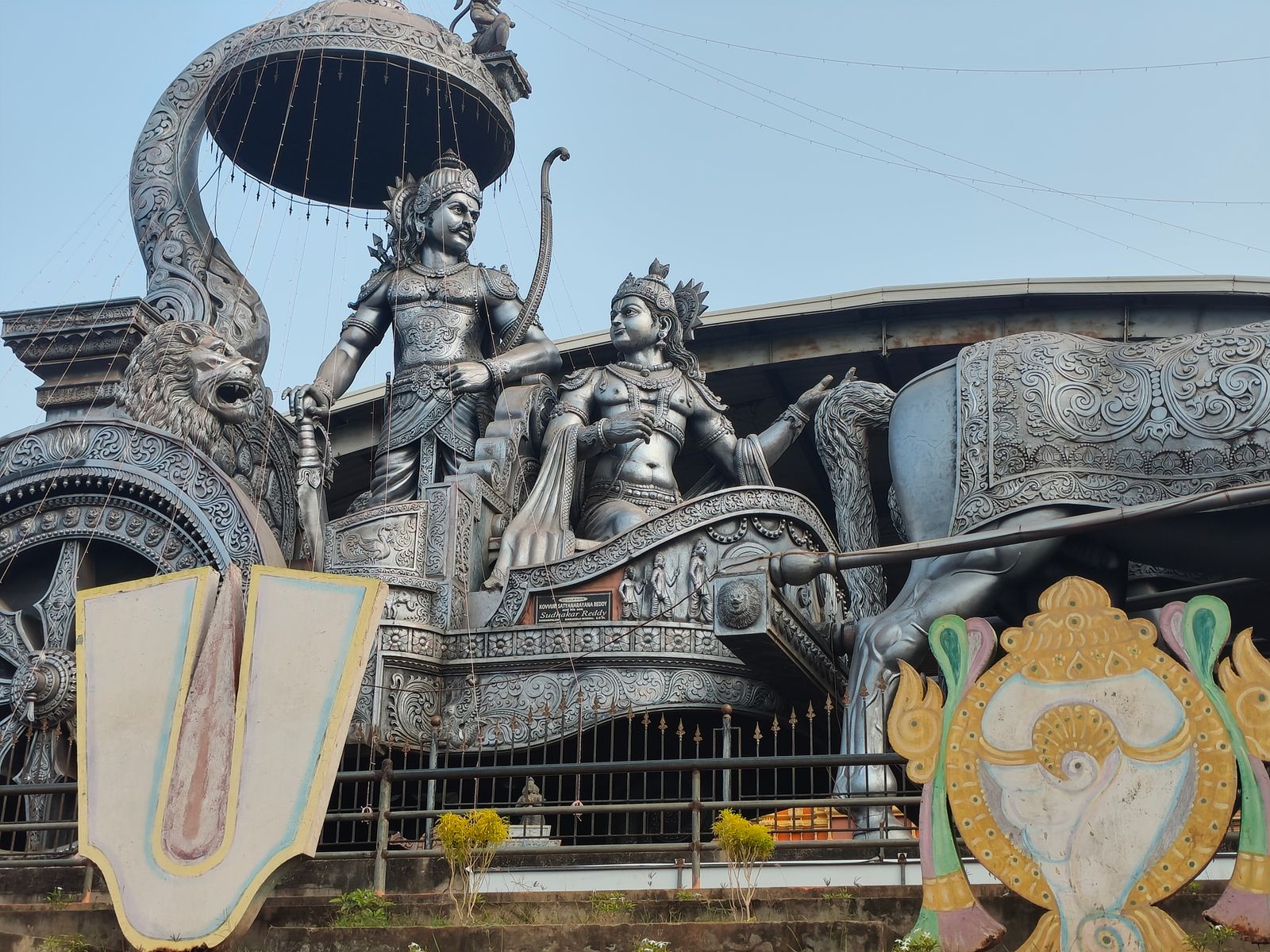
The text sits inside the Mahabharata, set at Kurukshetra, where Arjuna freezes before a war against his own relatives and Krishna, his charioteer, teaches him how to act without being ruled by fear or craving. Scholars place its composition somewhere between the 5th century BCE and the 2nd century CE, and the exact date is still debated.
What makes it central to yoga is its range. Where later systems such as the eight limbs lay out a technical method, the Gita offers a practice for ordinary duties, thoughts and feelings, and it says that different temperaments need different routes. That is why teacher trainings often treat it as required reading, and why teachers who want to go beyond the physical layer of any yoga style return to its language.
Which verses define yoga in the Gita?
A handful of verses carry most of the quotations used in classes: 2.47 on action without fixation on results, 2.48 on evenness of mind, 2.50 on skill in action, 6.19 on the steady lamp, and 18.66 on surrender. Translations differ in wording, but the ideas stay consistent.
| Verse | Key phrase | Plain meaning | How it shows up in practice |
|---|---|---|---|
| 2.47 | karmany evadhikaras te | You control the action, not the result | Give full effort to a pose without judging it against yesterday’s |
| 2.48 | samatvam yoga uchyate | Evenness of mind is yoga | Stay steady whether class goes well or badly |
| 2.50 | yogah karmasu kaushalam | Yoga is skill in action | Work attentively, without hurry or distraction |
| 6.19 | lamp in a windless place | A disciplined mind does not flicker | Return to the breath when attention wanders |
| 18.66 | sarva-dharman parityajya | Let go of anxious striving and take refuge in the divine | Offer your practice, drop the need to control |
What are the four yoga paths in the Bhagavad Gita?
The Gita centres on four paths: karma yoga (selfless action), jnana yoga (knowledge and self-inquiry), bhakti yoga (devotion) and dhyana yoga (meditation). Krishna says people differ in temperament, so the paths differ, yet all lead to the same freedom from restlessness and grief.
| Path | Main chapters | Core idea | Suits people who are | A modern practice |
|---|---|---|---|---|
| Karma yoga | 2 to 5 | Act fully, release attachment to results | Active, duty-driven, work-oriented | Do your job or class with full attention, then let the outcome go |
| Jnana yoga | 2, 7, 13, 18 | Tell the lasting self from the changing body and mind | Reflective, analytical, curious | Self-questioning in stillness: who is tired, who is anxious? |
| Bhakti yoga | 12 | Love, trust and surrender | Emotional, relational, drawn to devotion | Chanting, gratitude, dedicating your practice |
| Dhyana yoga | 6 | Steady the mind through single-pointed focus | Inward, disciplined, calm-seeking | Seated breath-focus for 5 to 10 minutes daily |
Many later teachers, including Swami Vivekananda, treated the four as complementary. A single hour of asana in online yoga classes can use all of them: effort without fixation, curiosity about sensations, gratitude, and focus on breath.
What is karma yoga in the Gita?
Karma yoga is acting with complete effort and attention while releasing attachment to the fruit of the action. Krishna answers Arjuna’s paralysis by saying that action is not the problem; grasping at outcomes is. It does not mean indifference to quality, only freedom from ego’s need to control the result.
It also reframes ambition: you can be driven and still be at peace, as long as your sense of worth is not hostage to applause or results. Our companion guide on karma yoga in the Bhagavad Gita goes through its chapters in more detail.
What is jnana yoga in the Gita?
Jnana yoga is the path of discriminating knowledge, viveka: seeing what is changing, such as the body, mood and circumstances, and what is steady, the self. Chapter 2 opens with this teaching to dissolve Arjuna’s grief. It is demanding, so traditional teachers often prepared the mind first through action and discipline.
What is bhakti yoga in the Gita?
Bhakti yoga is devotion, trust and surrender directed toward the divine in whatever form speaks to the practitioner. Chapter 12 gives it its fullest treatment, and Krishna calls steadfast devotees especially dear while acknowledging that the formless path is harder for embodied beings. It often suits people who come to yoga through chanting, music or prayer.
What is dhyana yoga in the Gita?
Dhyana yoga is the Gita’s meditation instruction in Chapter 6: a clean, steady seat, an upright body, a gentle gaze and the mind gathered on one point. Krishna compares the trained mind to a flame that does not flicker. It also advises moderation, since even eating, sleeping and effort support meditation, a link explored in our yogic diet guide.
If you want a simple way to begin, our guide to meditation for beginners offers short, realistic routines.
Myth check: is Sankhya a fifth path, and is the Gita only religious?
Three common misreadings are worth correcting.
- “Sankhya yoga is a fifth path.” Chapter 2 is titled Sankhya Yoga because it uses ideas from the Sankhya school, such as pure consciousness versus matter and the three gunas. That is philosophical groundwork for the four paths, not a separate practice.
- “The Gita endorses fighting for its own sake.” The battlefield is the setting for a debate about duty, doubt and detachment. Most traditional and modern teachers read it as a guide to inner conflict.
- “You must be Hindu, or devout, to benefit.” The Gita is scripture within Hindu tradition, yet its teaching on steadiness, attention and non-attachment is read widely as practical psychology. How much of it you adopt is a personal choice.
The gunas reappear in Chapters 14 and 17: sattva (clarity and balance), rajas (activity and restlessness) and tamas (inertia and dullness). The Gita says all three are always present in different mixtures, and growth means increasing sattva. Chapter 17 applies the idea to food and work, which is where the sattvic, rajasic and tamasic labels come from.
Which path should you start with?
Start with the path that matches how you naturally cope: karma yoga if you are busy and practical, jnana if you like questions, bhakti if you connect through feeling, dhyana if you want quiet. Most people end up blending two or three, and the Gita itself does not rank them.
- Busy professionals and students: Karma yoga is the easiest entry. Pick one task a day and do it with full attention, then stop thinking about how it will be judged.
- Overthinkers: Pair dhyana with jnana. Five minutes of breath focus, followed by one question such as “what am I reacting to right now?”
- People who love ritual, music or prayer: Bhakti suits you. Chanting, a diya, or a moment of thanks before practice counts.
- Complete beginners to yoga: You do not need Sanskrit. Take one verse, such as evenness of mind, and carry it through a single week of classes.
The aim is not to collect philosophy. The Gita judges a path by whether it makes you steadier, kinder and more skilful in daily life, and that is a fair test for any practice.
How do you apply the Gita on the mat? A five-step walkthrough
You can apply the Gita in any class by giving each path one job: effort for karma, curiosity for jnana, gratitude for bhakti, focus for dhyana, and attention to your gunas for pacing. Try the steps in order during a 30 to 45 minute session.
- Begin with an intention (bhakti). Dedicate the session silently to someone, or to gratitude for being able to practise.
- Give full effort without comparison (karma). In each pose, work at your own edge, not the person’s on screen. Let the pose be what it is today.
- Observe sensations (jnana). Notice tightness, warmth and breath as passing events, and ask what is steady underneath them.
- Anchor on the breath (dhyana). In the last 5 minutes, hold attention at the nostrils, and return gently when the mind wanders.
- Match the practice to your day (gunas). A restless, rajasic day calls for slow, grounding work such as long holds and gentle hatha yoga. A heavy, tamasic day suits something more energising like a vinyasa flow.
If you prefer practising at home, our yoga at home guide shows how to set up a space for this kind of attentive session.
How does the Gita differ from the Yoga Sutras?
The Gita is a narrative dialogue about motivation and duty, while the Yoga Sutras are a compact manual of method. The Gita asks why and how to live yogically, while the Sutras set out an eight-limbed path from ethics to deep absorption. Teachers often use both together.
| Feature | Bhagavad Gita | Yoga Sutras of Patanjali |
|---|---|---|
| Form | Dialogue in about 700 verses within the Mahabharata | Short aphorisms on practice |
| Tone | Narrative, devotional, emotional | Concise, technical, systematic |
| Structure | Four paths for different temperaments | Eight limbs in a sequence |
| Strength | Motivation and the psychology of acting well | Method for concentration and meditation |
| Best read for | Handling duty, doubt and results | Building a structured practice |
For the second text, see our overview of the yoga sutra. A simple way to hold the two together is the Sutras for method and the Gita for the reason you practise.
Frequently asked questions
Is the Bhagavad Gita a yoga text or a religious text?
It is both. The Gita is part of the Mahabharata and is scripture within Hindu tradition, yet its core content is a detailed teaching of karma, jnana, bhakti and dhyana yoga, which makes it one of the earliest systematic yoga texts as well.
How many types of yoga does the Bhagavad Gita describe?
The Gita centres on four paths: karma yoga, jnana yoga, bhakti yoga and dhyana yoga. Chapter 2 is titled Sankhya Yoga, but that names the philosophical framework behind the teaching rather than a fifth practical path.
What does the Bhagavad Gita say the definition of yoga is?
Two definitions are best known: “samatvam yoga uchyate”, evenness of mind is yoga, and “yogah karmasu kaushalam”, yoga is skill in action. Together they present yoga as steadiness of mind combined with effective, non-attached action.
Do I need to read the Bhagavad Gita to practise yoga?
No. Most physical yoga, including online classes, needs no prior study of the Gita. Reading it is optional and works well once you are comfortable with the basics and curious about the philosophy behind the practice.
How does karma yoga from the Gita differ from ordinary hard work?
Karma yoga asks for full effort while releasing attachment to the result. Ordinary hard work is often driven by anxiety about the outcome. Karma yoga separates the quality of the action from the emotional grip of how things turn out.
Next step
To try these ideas in a guided session, join Fitstrot’s online yoga classes and bring one Gita idea, such as effort without comparison, into your next class.


