
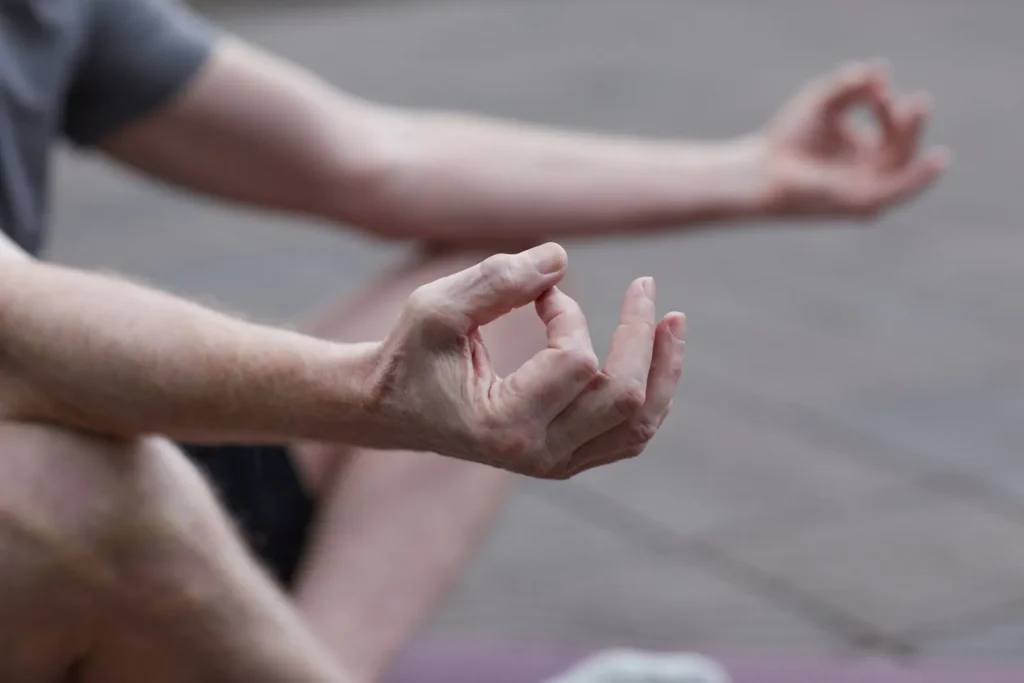
Ahimsa is the Sanskrit word for non-harming, and in yoga it is the first of the five yamas, the ethical restraints that traditional teaching places before postures and breathing. It asks you to reduce harm in what you do, say and think, toward other people, other living beings, the wider environment and yourself. This guide explains the ahimsa meaning in plain words, shows where it sits among the yamas, and turns it into habits for your mat, your conversations, your plate and your day. There are no diet rules and no perfection tests, only a workable way to practice ahimsa as part of yoga.
What does ahimsa mean in yoga?
Ahimsa means non-harming. The word joins a prefix of negation with a term for injury or violence. In yoga it is a commitment to cause as little unnecessary harm as you reasonably can through your actions, words and intentions, toward others, the natural world and yourself. It is a direction of travel, not a pass-or-fail test.
Two ideas make the meaning easier to hold. First, there are three directions of care: other people and animals, the environment you live in, and your own body and mind. Second, there are three channels through which harm travels: action, speech and thought. A shove, a sarcastic message and a long loop of self-blame are all harm, just in different channels.
The word is often translated as non-violence, and that is why people search for non-violence in yoga. Non-harming is closer to the spirit, because it covers quiet harms such as neglect, contempt and overwork that never look violent. It also says unnecessary harm. Everyday life involves some unavoidable harm, so ahimsa is about awareness and reduction, not paralysis or guilt.
Why is ahimsa the first of the yamas?
In the Yoga Sutras, traditionally attributed to Patanjali, ahimsa heads the list of five yamas, and the yamas form the first of eight limbs of yoga. Many teachers read this order as deliberate: if your basic stance toward people, animals and yourself is harmful, every later practice rests on shaky ground.
The eight limbs, in traditional order, are yama, niyama, asana (posture), pranayama (breath practice), pratyahara, dharana, dhyana and samadhi. Scholars debate when the Sutras were compiled. What is clear is that ahimsa is older than the text. It appears in several Indian traditions, including Jain and Buddhist thought, and the Bhagavad Gita also touches on non-violence. In the twentieth century, Mahatma Gandhi drew on the principle in his political work, which introduced the word to a global audience.
Teachers often describe the other four yamas as growing out of ahimsa. The table below shows one common way to read that link.
| Yama | Usual translation | How ahimsa shapes it |
|---|---|---|
| Ahimsa | Non-harming | The starting stance: do not cause needless harm to others, the world or yourself |
| Satya | Truthfulness | Truth is told without cruelty; honesty is not an excuse to wound |
| Asteya | Non-stealing | Taking someone’s time, credit or effort without consent is also a harm |
| Brahmacharya | Right use of energy | Not exhausting or exploiting yourself or others through excess |
| Aparigraha | Non-grasping | Hoarding and possessiveness cost other people and the planet |
Ahimsa is a yama, which means a restraint that shapes how you meet the outside world. The niyamas that follow are personal observances, including saucha (cleanliness), santosha (contentment), tapas, svadhyaya and ishvara pranidhana. In practice the two sets overlap. Santosha, for instance, is hard to feel while you are at war with your own body, which is exactly where ahimsa toward yourself begins.
How do you practice ahimsa on the mat?
Practice ahimsa on the mat by choosing sensation over pain: move until you feel a clear stretch or effort, then stop or ease off before it turns sharp, pinching or joint-deep. Breathe evenly, use props or a smaller version of the pose, and treat rest as part of class. Comparing yourself with others is quiet self-harm.
A simple walkthrough helps. Before class, take a minute to check in: how did you sleep, what is sore, is there an old injury to protect? During class, use your breath as the gauge. If you are holding it or your jaw is clenched, you have gone past useful effort. After class, notice whether you feel steadier or scraped. The table lists common signals and a kind response.
| What you notice | What it usually suggests | An ahimsa response |
|---|---|---|
| Dull, even stretch along a muscle, breath steady | Normal working sensation | Stay, breathe, hold for a few slow breaths |
| Sharp, pinching or electric pain, often near a joint | Too far, or alignment needs changing | Ease out slowly, modify the pose, skip it today if needed |
| Holding your breath or clenching the jaw | Effort has outrun ability | Back off by about a quarter and lengthen the exhale |
| Muscle shaking in a strong pose | Fatigue, often harmless | Stay briefly, or rest in child’s pose |
| Dizziness or lightheadedness | Fast transitions, low food or water, breath-holding | Sit or lie down, sip water, slow the pace |
| Thought of “I must match everyone else” | Comparison | Return to your own pace and pick one option gentler |
| Pain that lingers for days | May need assessment | Pause that movement and see a doctor or physiotherapist |
This is general guidance, not a diagnosis. Ahimsa does not mean avoiding effort. Building strength and holding a demanding pose are fine when your body is coping. The line to watch is between challenge and injury.
Ahimsa yoga poses: shapes that teach restraint
No single posture is ahimsa. Some shapes simply make restraint easier to feel, because they invite you to stay without forcing:
- Balasana (child’s pose): a built-in pause button when a practice starts to feel like a fight.
- Savasana (final relaxation): complete stillness, which gives an overworked nervous system a break.
- Viparita karani (legs up the wall): a restorative shape that asks nothing of the muscles.
- Supta baddha konasana (reclining bound angle): an open, supported pose where you practise not pushing the stretch deeper.
- Forward folds and twists with bent knees: a gentler version that teaches the difference between useful sensation and strain.
Slow, long-held, supported practice such as yin yoga is a natural classroom for this, and the steadier pace of hatha yoga suits it too. Even in a vigorous style like ashtanga yoga, the same principle holds: effort is welcome, injury is not. Any pose becomes an ahimsa pose when you do it with self-kindness instead of self-punishment.
How does ahimsa show up in speech and thought?
In speech, ahimsa means checking that what you say is accurate, useful and fair, and saying it without contempt. In thought, it means noticing resentment, harsh judgment and self-criticism instead of feeding them. A practical habit is to pause for one breath, ask whether your words help, and choose the least hurtful honest version.
This is where ahimsa and satya work together. Honesty matters, but a true remark delivered to humiliate still does harm. In the same way, staying quiet to keep the peace is not automatically kind, especially if it lets a problem grow. The aim is honest words with care in them.
Self-talk deserves the same attention. Swap “I am so lazy, I skipped class again” for “I missed today, and I will go tomorrow.” Be careful with the digital channels too: a forwarded message, a cutting comment or a pile-on in a family group chat is speech, and it travels fast. If low mood, anxiety or thoughts of hurting yourself are persistent, please speak to a doctor or a qualified mental health professional. Ahimsa is a daily mindset practice, not a treatment.
What does ahimsa have to do with food and the environment?
Many practitioners extend ahimsa to food, consumption and the environment, but the yamas themselves do not prescribe a particular diet. Choices range from fully vegetarian eating to simply wasting less, buying less and cutting single-use plastic. What matters is thoughtfulness, not one correct plate.
In India, vegetarian eating is common in many communities and is often shaped by region, religion and family custom. Other practitioners eat eggs, fish or meat and express ahimsa through different choices. Neither group owns the principle. If you do change your diet, a registered dietitian can help you keep meals balanced.
Ahimsa toward yourself belongs on the plate as well. Skipping meals, crash dieting, extreme fasting or eating far past comfort are forms of self-harm even when they look disciplined. Toward the environment, small habits add up: carry a cloth bag, finish what you serve, switch off lights and fans when you leave a room, repair before replacing, and be mindful of water in cities where supply is tight.
A day of ahimsa: a simple daily practice table
Ahimsa grows through small, repeatable habits, not a dramatic lifestyle overhaul. Use this table as a menu. Pick one cell for the week and ignore the rest.
| Part of the day | Toward yourself | Toward others | Toward the environment |
|---|---|---|---|
| Morning | Wake without a harsh inner critic; stretch within comfort | Greet people at home warmly before checking your phone | Use only the water you need while bathing |
| Workday | Take a real break; do not skip meals to “catch up” | Pause one breath before replying to a tense email | Print less, carry your own bottle |
| Mealtime | Eat enough, unhurried, without guilt | Serve others first without resentment, or ask for help | Take what you will finish; compost or share extras if you can |
| Evening | Move in a way that leaves you energised, not wrecked | Listen to one person fully, without fixing | Switch off unused lights and chargers |
| Bedtime | Write one line on where you did or did not practice non-harm | Let go of one grudge you carried today | Plan one small change for tomorrow |
Five myths about ahimsa
Myth: ahimsa means never feeling anger. Anger is a normal human signal. Ahimsa is about what you do with it: noticing it, cooling down, and acting without cruelty.
Myth: ahimsa means being passive. It does not ask you to accept harm, stay silent about wrongdoing or avoid hard conversations. Firm boundaries, honest feedback and leaving an unsafe situation are consistent with non-harming. A teacher correcting your alignment to prevent injury is practising ahimsa, even if it feels uncomfortable for a moment. If you are in danger at home or at work, protecting yourself comes first.
Myth: ahimsa means avoiding all discomfort. Strength, stamina and flexibility all involve effort. Productive challenge is different from harm, and the table above shows how to tell them apart.
Myth: ahimsa is only about others. Overtraining, ignoring pain, chronic sleep debt and harsh self-talk are harms too, and they are the ones most students overlook.
Myth: you must be perfect at it. Harm cannot be removed entirely. The practice is to notice it sooner, repair it faster and reduce it over time.
When ahimsa feels hard: quick fixes
If you snap easily, try a longer exhale and a short walk before you answer. If your class feels competitive, choose the lowest-effort option on offer for one pose and notice that nothing bad happens. If you slip and say something harsh, a short, specific apology is part of the practice. And if you feel guilty about every small harm, remember the word “unnecessary”: the goal is steady improvement, not self-punishment.
Frequently asked questions
What is the simplest definition of ahimsa?
Ahimsa means non-harming. It is the first of the five yamas and asks you to avoid unnecessary harm through your actions, speech and thoughts, toward other people, animals and the environment, and also toward yourself.
Is ahimsa only about physical violence?
No. Ahimsa covers physical action, spoken words and mental attitude. A cutting remark, a long grudge or constant self-criticism can go against it even when nobody is physically hurt, which is why teachers describe it as a practice of the mind as much as the body.
Does practicing ahimsa mean you must be vegetarian?
No. The yamas do not prescribe a diet. Many practitioners link ahimsa to vegetarian or plant-forward eating, especially in Indian culture, while others express it through eating mindfully, wasting less or consuming less overall. How far to take it is a personal decision.
Which yama comes first, ahimsa or satya?
Ahimsa is listed first, followed by satya, asteya, brahmacharya and aparigraha. Many teachers explain that ahimsa works as a filter for the rest, so truth, for example, is spoken in a way that avoids unnecessary harm.
How can a beginner start practicing ahimsa today?
Choose one habit: take one gentler variation in class, pause one breath before a sharp reply, or eat one unhurried meal. Repeat it for a week, then note in a line or two what changed. Small repeated choices build the practice faster than big resolutions.
Next step: If you would like injury-aware guidance while you bring ahimsa into your movement, join a live session in FitStrot’s online yoga classes and pick one habit from the table above to try in your first class.


