
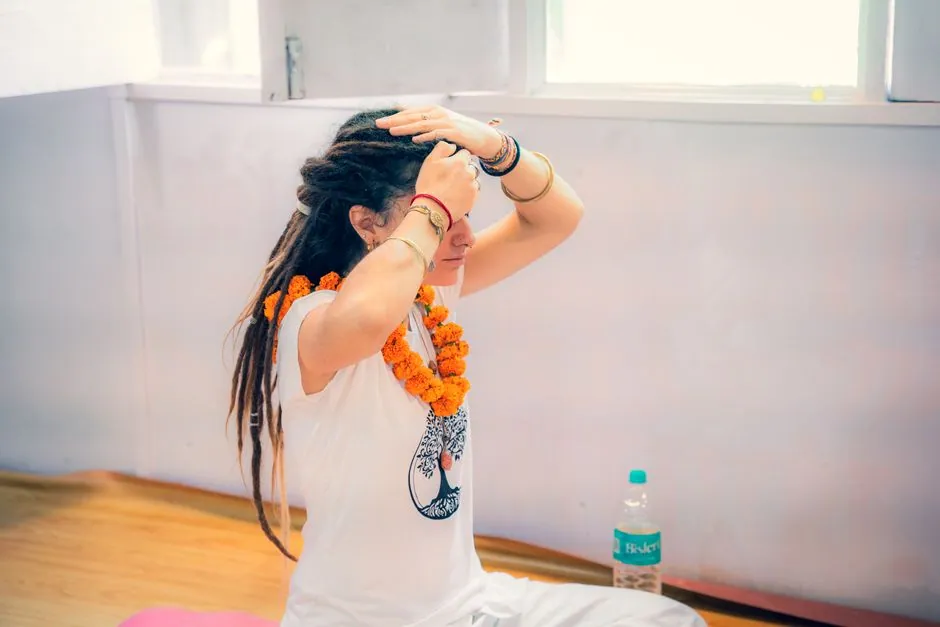
Malasana — the deep yogic squat most people know as Garland Pose — is the one yoga posture millions of Indians already did every day and then stopped doing. Sit on your heels with your feet flat, knees wide, chest lifted between your thighs, and you are in it. No strength prerequisite, no flexibility gate, no equipment. What makes malasana interesting is not that it is hard, but that a generation of chair-and-Western-toilet living has quietly taken it away, and getting it back changes how your hips, ankles and lower back feel on ordinary days.
This guide is not a list of twelve vague benefits. It is a form checklist you can screenshot, an honest audit of which claims have evidence behind them, a prop ladder for heels that refuse to touch the floor, and a clear list of people who should modify the pose or leave it alone.
What Is Malasana, and Why Does the Garland Pose Look So Familiar?
Malasana is a full-depth squat held as a yoga posture: feet flat on the floor roughly hip-width to shoulder-width apart, toes turned out 15–30 degrees, hips dropped below knee level, torso upright between the thighs, and palms pressed together at the chest with the upper arms lightly resisting the inner knees. The Sanskrit mala means garland or bead-string; asana means seat. Held for 30–60 seconds, it is a mobility and grounding posture, not a strength exercise.
It looks familiar to Indian readers for an obvious reason. The deep squat is the default resting position for a huge share of the country — the sabziwala at the corner, anyone using an Indian-style toilet, people eating or working at floor level, women grinding masala on a sil-batta. A 2001 review in the International Journal of Rehabilitation Research noted that squatting, kneeling and cross-legged sitting are so central to daily life in Asia and the Middle East that they demand far more joint range than Western populations typically need: the authors put the requirement for a full squat at roughly 130 degrees of hip flexion and 111–165 degrees of knee flexion (Mulholland & Wyss, 2001). That is a serious range — and it is exactly the range that vanishes after a decade of eight-hour desk days.
So malasana is less a skill to acquire than a capacity to reclaim. If your grandmother sits in it comfortably at 70 and you cannot at 30, the difference is practice hours, not genetics.
Malasana Pose, Step by Step: The 7-Point Form Table
Set up from standing, not from the floor — standing entry teaches the control you need to get in and out of the pose in real life.
| Step | What to do | Form cue | Common mistake | Fix |
|---|---|---|---|---|
| 1. Stance | Stand with feet hip- to shoulder-width apart | Narrower = deeper hip stretch; wider = easier | Feet too narrow for stiff hips | Start shoulder-width, narrow over weeks |
| 2. Toe angle | Turn toes out 15–30 degrees | Knees must point the same way as toes | Feet straight, knees collapsing inward | Widen toe-out until knees track cleanly |
| 3. Descent | Sit the hips straight down, 3–4 seconds | Think “sit”, not “bend forward” | Dropping fast and bouncing at the bottom | Lower to a chair edge first, then remove it |
| 4. Depth | Hips below knee height, heels down | Weight spread across the whole foot | Rolling onto the toes | Blanket or 2–3 cm wedge under the heels |
| 5. Spine | Lengthen from tailbone to crown | Sternum lifted, ribs stacked over pelvis | Rounding into a collapsed C-shape | Sit on a block; height beats a rounded back |
| 6. Arms | Palms at heart, upper arms on inner knees | Press arms and knees into each other lightly | Using the elbows to force the knees apart | Reduce pressure to about 20% effort |
| 7. Hold | 30–60 seconds, 5–10 slow breaths | Exhale longer than you inhale | Holding the breath and gripping the jaw | Count the exhale to 6; shorten the hold |
To exit, press the feet down and roll up slowly. Do not spring up — that is where stiff knees complain. Two to three rounds is plenty per session.
What Are the Real Garland Pose Benefits — and What Is Overclaimed?
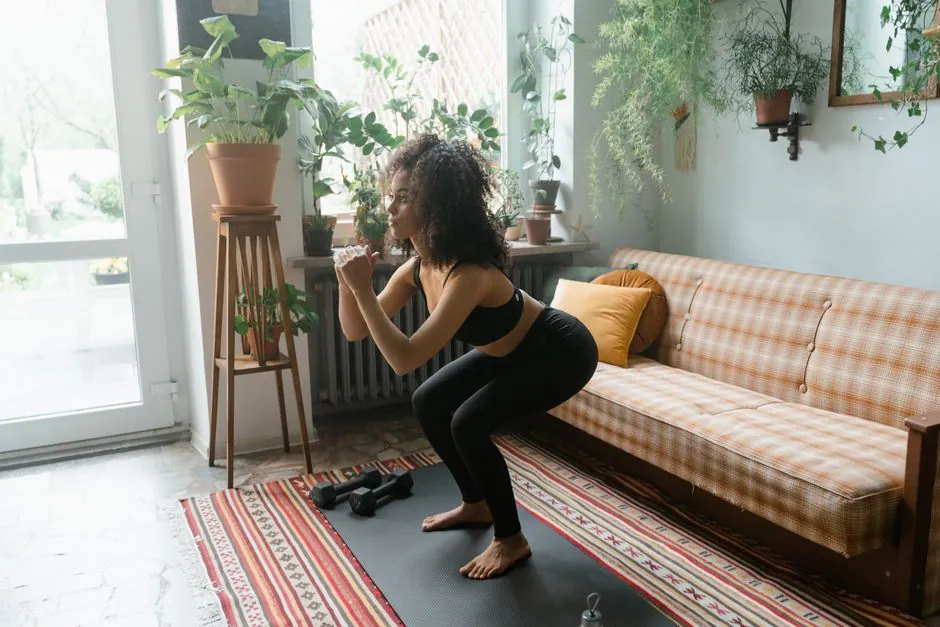
Malasana genuinely helps hip, ankle and adductor mobility, and it is a cheap way to interrupt long sitting. It does not detoxify anything, spot-reduce belly fat, or treat any medical condition. Here is each common claim graded against published evidence.
| Claim | Evidence strength | What the research actually shows |
|---|---|---|
| Improves hip, knee and ankle range of motion | Good | Squat depth is directly limited by ankle dorsiflexion and hip flexion range; a full squat needs ~130° hip flexion |
| Opens the groin and inner thighs | Good | Wide-knee loaded position stretches the adductors under bodyweight |
| Eases bowel movements | Moderate, indirect | Squatting on the toilet reduced straining and emptying time vs sitting in a 28-person trial — not the same as doing malasana on a mat |
| Prepares the body for childbirth | Weak / misattributed | Evidence favours upright birthing positions, not prenatal squat practice |
| Strengthens the legs | Weak | A 60-second static hold is mobility work, not resistance training |
| Burns belly fat / detoxifies organs | None | No mechanism, no supporting data |
| Calms the nervous system | Plausible, unproven for this pose | Slow breathing calms; the specific pose has not been isolated in trials |
Hip and ankle mobility: the best-supported malasana pose benefit
The mobility case is the strongest one. A 2020 study in the Journal of Physical Therapy Science analysed deep squat motion and found that ankle dorsiflexion range was a significant predictor of both the ankle angle and the hip flexion angle achieved during the squat — and that restriction on one side affected the other side too (Endo et al., 2020). It was a small study — nine healthy men — so treat it as a mechanism, not proof. The practical read-across is blunt: if your heels lift, your ankles are usually the bottleneck, not your willpower.
Cleveland Clinic adds a point worth absorbing: hips do not literally “open”, and stretching alone is rarely enough. Joints need to be taken through full, controlled ranges regularly, because a joint never used at end range is one the body stops maintaining (Cleveland Clinic). Malasana is valuable precisely because it is a loaded end-range position you can hold, not a passive stretch.
On dosage, Harvard Health’s general stretching guidance is a reasonable template: hold about 30 seconds, and aim for daily practice or at minimum three to four sessions a week (Harvard Health Publishing). Two 45-second holds a day is more useful than one heroic five-minute attempt on Sunday.
Malasana pose benefits for digestion and the pelvic floor
This is where honest wording matters. The often-cited research is Sikirov’s 2003 study in Digestive Diseases and Sciences, in which 28 healthy volunteers recorded six bowel movements each in three positions. Both the time to a sensation of satisfactory emptying and the subjective straining effort were sharply lower in the squatting position than on a standard or low toilet seat (Sikirov, 2003). That is a study about toilet posture. It supports the idea that squatting mechanically favours emptying — one reason Indian-style toilets have that reputation — but it does not show that holding malasana on your mat at 6 a.m. treats constipation. Practise it for mobility, treat better digestion as a bonus, and see a doctor for persistent constipation.
Drinking water in malasana: tradition, not evidence
“Drinking water in malasana” is a popular Indian search, usually tied to claims about digestion, knee health or “cooling the body”. There is no published clinical research on drinking water while squatting. The realistic upside is indirect: it gives you a reason to spend another 60 seconds a day in a deep squat, and that minute has a plausible mobility benefit. The water is not doing anything special from down there. Keep the ritual if you like it; do not build health expectations on it.
Your Heels Will Not Touch the Floor. Here Is the Fix.
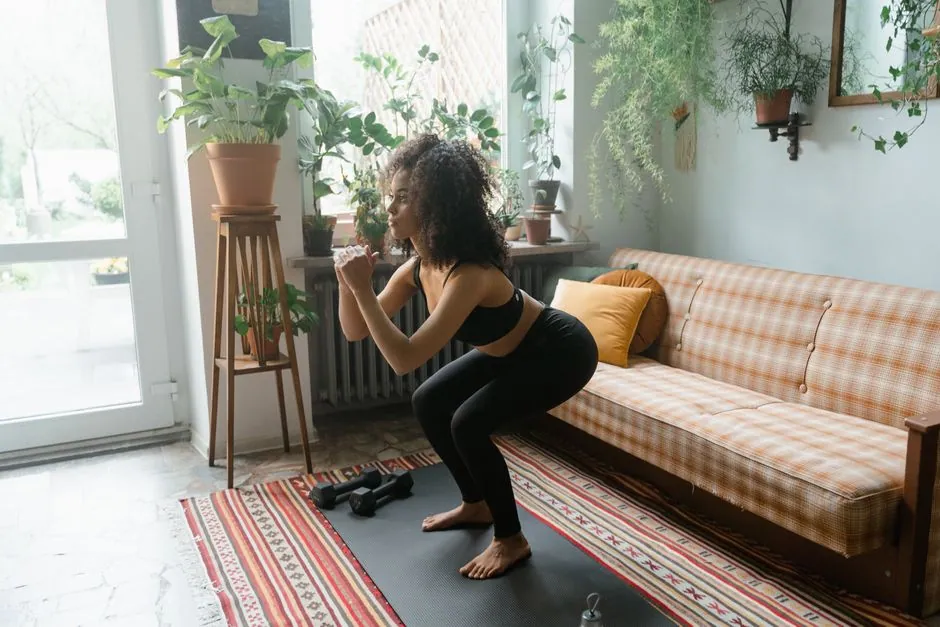
Heels lifting is the single most common malasana problem, and it is almost always ankle dorsiflexion range plus stiff calves — not tight hips. The wrong response is to force the heels down and let the arches roll in. The right response is to raise the floor to meet your heels and then lower it over weeks.
| Week | Setup | Prop and cost | Hold | Frequency | Move on when |
|---|---|---|---|---|---|
| 1 | Heels on a folded blanket, hips on a block | Blanket (free) + block ₹300–600 | 20–30 sec × 2 | Daily | No calf cramping, breathing easy |
| 2 | Heels on blanket, block removed | Blanket only | 30–45 sec × 2 | Daily | Spine stays long for the full hold |
| 3 | Heels on one folded edge, feet slightly narrower | Thin fold, ~2 cm | 45 sec × 2–3 | 5–6 days | Heels stay loaded, no toe-rolling |
| 4 | Flat floor, hands at heart or on a block in front | None, or block ₹300–600 | 60 sec × 2–3 | 5–6 days | You can talk through the hold |
Two things speed this up. First, 30 seconds of calf and soleus stretching before you squat — knee bent, heel down, weight forward. Second, a wall-supported version: back against a wall, feet 20–25 cm out, slide down. The wall removes the balance demand so the ankles are the only thing working.
If four weeks pass with no change, do not grind. Stiff ankles after an old sprain or a fracture may need hands-on assessment rather than more repetitions. A physiotherapist or a qualified teacher watching you live will spot in ten seconds what a mirror will not.
Malasana Squat vs Gym Squat vs Utkatasana: Three Different Jobs
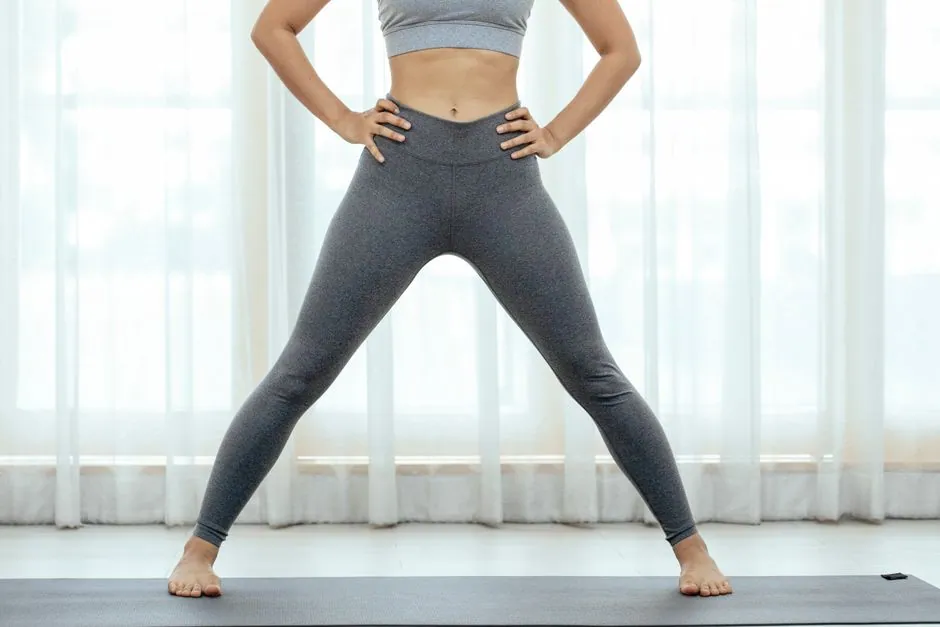
These are not interchangeable. The malasana squat is an unloaded, held, end-range position. A barbell or goblet squat is a loaded, moving strength lift. Utkatasana (Chair Pose) is a partial-depth isometric hold that mostly taxes the quadriceps and shoulders.
| Feature | Malasana (Garland Pose) | Gym squat (barbell/goblet) | Utkatasana (Chair Pose) |
|---|---|---|---|
| Primary goal | Hip, ankle and adductor mobility | Lower-body strength and muscle | Quad and shoulder endurance |
| Depth | Full, hips well below knees | Parallel to full, by programme | Shallow, thighs above parallel |
| Load | Bodyweight only | External load, progressive | Bodyweight only |
| Typical dose | 2–3 holds of 30–60 sec | 3–4 sets × 6–10 reps, 90–120 sec rest | 3 holds of 20–40 sec |
| Form cue | Sit tall between the thighs | Brace the midsection, drive the floor away | Weight in the heels, ribs down |
| Counts toward WHO strength days? | No | Yes | Partly |
That last row matters. WHO recommends 150–300 minutes of moderate aerobic activity a week plus muscle-strengthening work on two or more days, and for adults over 65, functional balance and strength training on three or more days a week (WHO Guidelines on Physical Activity and Sedentary Behaviour, 2020). Malasana does not fill that quota. Use it as the mobility layer under a programme that also includes real loading.
Malasana Variations to Grow Into
Once a flat-footed 60-second hold is comfortable, the pose stops being a destination and becomes a position you can work from. These are the progressions worth your time, roughly in order of difficulty:
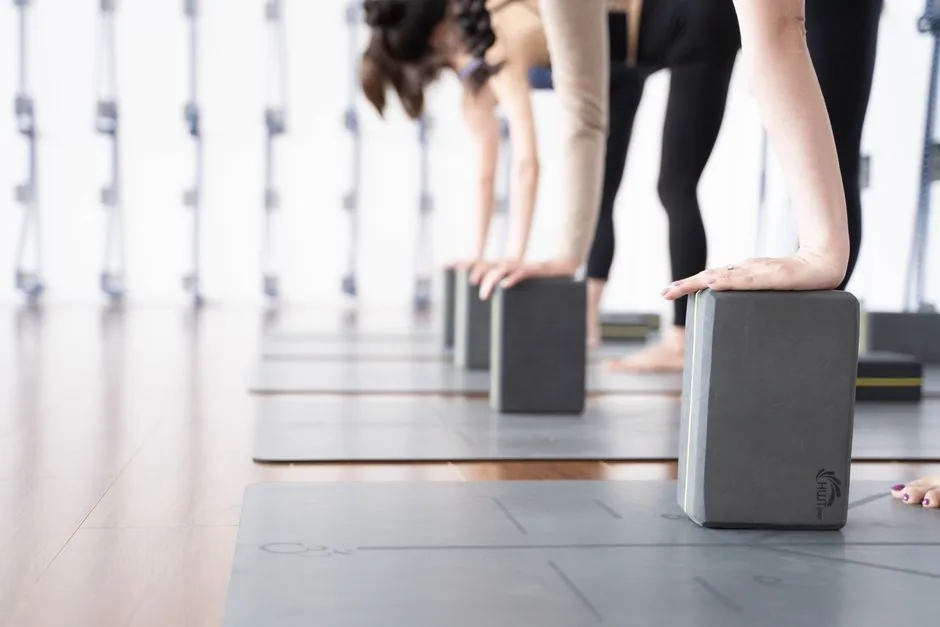
- Supported malasana: block under the hips, hands on the floor. The baseline for stiff bodies and the version most beginners should live in for a month.
- Narrow-stance malasana: feet hip-width or closer. Significantly more hip and ankle demand; do not attempt until the wide version is easy.
- Revolved malasana (Parivrtta): drop one hand between the feet and reach the other arm up. Adds thoracic rotation; skip it with disc issues.
- Malasana with heel lift: rising onto the toes at the bottom — a calf and balance drill, not a substitute for the flat-footed version.
- Squat-to-stand: hold the toes, straighten the legs partway, sink back down. Builds hamstring length for smooth standing entries.
- Malasana to Bakasana: the classic route into arm balancing. If that is your goal, read our Bakasana guide before you start shifting weight into your hands.
Pairing matters too. Malasana works as a counterpose after backbends such as Chakrasana, and as a mid-sequence transition. Our library of yoga poses lays out the sequencing logic.
Who Should Modify Malasana — or Skip It Entirely
This pose has a reputation for being universally safe because it is “natural”. It is not. If you have a diagnosed knee, hip or ankle condition, or you are pregnant, clear deep squatting with your doctor or physiotherapist first — and never change prescribed treatment on the strength of a yoga article.
Knee, hip and ankle injuries
Deep knee flexion compresses the joint at its most vulnerable angle. Anyone with a meniscus tear, a recent knee or hip replacement, patellofemoral pain, or an ankle fracture in the last year should not force a full squat without clearance. The rule: sharp pain, pinching, painful clicking, or pain lingering more than an hour afterwards means stop and get it looked at. A supported half-squat to a chair gives most of the mobility benefit at a fraction of the joint load.
Pregnancy: the claim that gets stretched furthest
Malasana is widely sold as childbirth preparation. The evidence that exists is about positions during labour, not squat practice during pregnancy. A Cochrane review of 30 trials involving 9,015 women without epidural anaesthesia found upright birthing positions were associated with about 25% fewer assisted deliveries (RR 0.75) and 25% fewer episiotomies — but also a higher chance of blood loss over 500 ml (RR 1.48), with much of the evidence rated low quality (Gupta et al., Cochrane, 2017). None of that tells you to do malasana in your second trimester.
The NHS advises keeping up normal activity such as yoga for as long as it is comfortable in pregnancy, while avoiding lying flat on your back for long periods after 16 weeks (NHS, Exercise in pregnancy). If you practise malasana while pregnant: use a wide stance, sit on a block or a low stool, keep a wall or chair within reach, and stop immediately with any pelvic girdle pain, which deep squatting commonly aggravates. In late pregnancy, or with placenta praevia, a short cervix or diagnosed pelvic girdle pain, skip it unless your obstetrician or physiotherapist has said otherwise.
Can I do malasana during periods?
Yes, for most people, if it feels comfortable. There is no evidence that a deep squat is harmful during menstruation, and many find gentle hip work eases cramping. Some traditional teaching discourages strong inversions and deep compression on heavy-flow days; that is convention rather than clinical guidance. The sensible approach is self-selection — shorten the hold to 20–30 seconds, use a block under the hips, and stop if cramping intensifies.
A Four-Week Malasana Yoga Position Plan for Desk Workers
If you sit eight to ten hours a day, month one is about frequency, not depth. Three 30-second squats spread across the working day change your ankles faster than one long hold at night, because you are interrupting the sitting rather than compensating for it.
A workable pattern: one hold on waking, one before lunch, one in the evening after dinner has settled, with 30 seconds of calf stretching before the morning hold. Twice a week, follow the evening squat with 10 minutes of hip and hamstring work — the kind of session a daily yoga routine slots into. Expect the first visible change — heels down without a blanket — between week three and week eight. An old ankle injury or years of chair sitting puts you at the slower end, which is normal, not failure.
Questions People Still Ask About Malasana
How long should you hold malasana?
Hold malasana for 30–60 seconds, two to three times per session. Beginners should start at 20–30 seconds with a block under the hips and build up over four weeks. Harvard Health’s general stretching guidance of roughly 30-second holds, performed daily or at least three to four times a week, is a sound dose for this pose.
Why can I not get my heels down in malasana?
Limited ankle dorsiflexion is the usual cause, not tight hips. Research on deep squat mechanics found ankle dorsiflexion range significantly predicted both ankle and hip angles achieved during the squat. Raise your heels on a folded blanket of about 2–3 cm, then reduce the height over three to four weeks rather than forcing the heels flat.
Is malasana safe if I have knee pain?
Not automatically. Full squats put the knee in deep flexion, which can aggravate meniscus injuries, patellofemoral pain and osteoarthritis. Get clearance from a doctor or physiotherapist first, and use a supported half-squat to a chair instead. Sharp pain, pinching, or pain lasting over an hour afterwards means stop.
Does malasana reduce belly fat?
No. There is no mechanism by which a 60-second static hold burns meaningful calories or targets abdominal fat, and spot reduction is not supported by evidence. Malasana is a mobility posture. Fat loss comes from a sustained calorie deficit plus regular aerobic and resistance training.
Can complete beginners do malasana on day one?
Yes, with props. Sit on a yoga block or a low stool, place a folded blanket under the heels, and use a shoulder-width stance with toes turned out 15–30 degrees. That supported version is a legitimate malasana, not a lesser one, and most beginners should practise it for three to four weeks before removing support.
Is malasana safe during pregnancy?
Only with medical clearance and modifications. The NHS advises continuing comfortable activity such as yoga during pregnancy, but deep squatting commonly aggravates pelvic girdle pain. Use a wide stance, sit on a block or stool, keep support within reach, and avoid it entirely in late pregnancy or with pelvic girdle pain unless your obstetrician approves.
How often should I practise malasana to see a change?
Practise daily or on five to six days a week, two to three holds per session. Most people notice heels staying down without a blanket between week three and week eight. Those with an old ankle sprain or many years of desk sitting typically sit at the slower end of that range.
Start Where Your Ankles Actually Are
Put a folded blanket under your heels tonight, hold the squat for 30 seconds, and repeat it tomorrow. That is the entire entry fee. If you want someone watching your knee tracking and adjusting your prop height as you progress, book a live online yoga session with a Fitstrot teacher and get the pose right before it becomes a habit you have to unlearn.


