
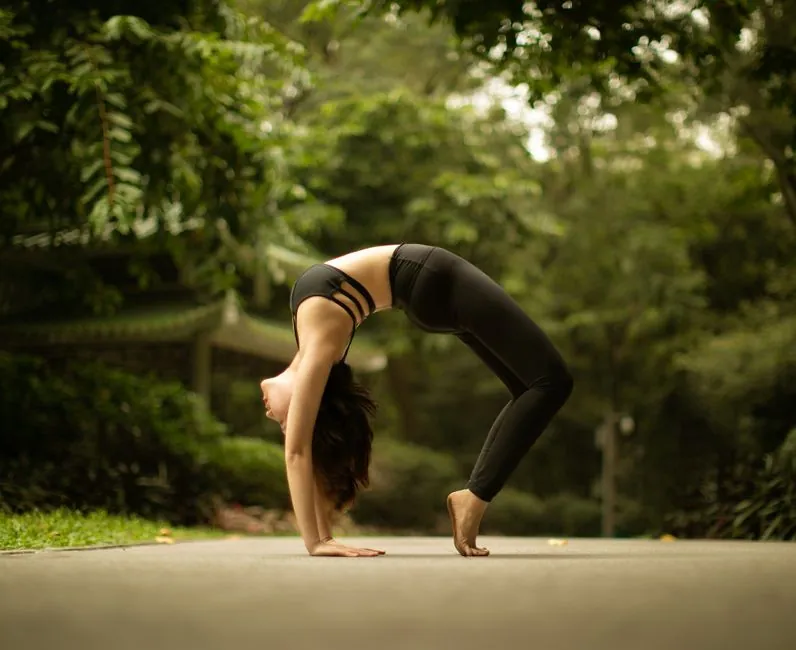
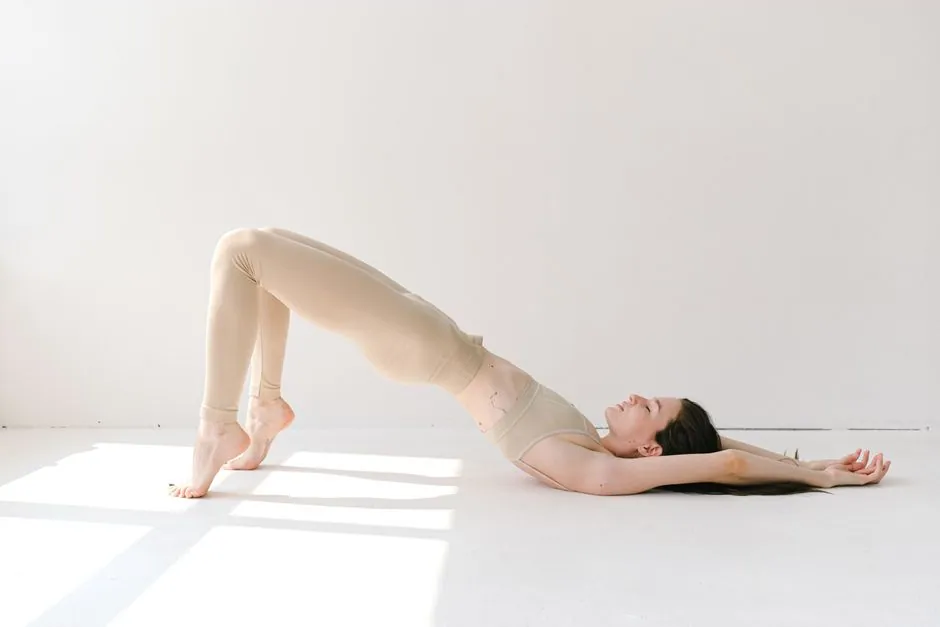
Chakrasana is the deep floor backbend where you lie on your back, plant your palms beside your ears and your feet under your knees, and press the whole body up into an arch — hips high, chest open, head hanging free. In English it is Wheel Pose; in most modern studios it is taught as Urdhva Dhanurasana, upward-facing bow. It is not a beginner shape, and no amount of enthusiasm shortens the runway. What it needs is shoulder flexion, thoracic extension, open hip flexors and enough tricep strength to straighten the arms — four separate qualities that most Indian desk workers have lost to a decade of chairs.
This guide does something the usual asana write-up skips. Instead of listing ten steps and ten benefits, it gives you a readiness test you can run in four minutes, a six-week progression from bridge to full wheel, the mistakes that reliably turn this pose into a sore lower back, and an honest read on which benefits are supported and which are folklore. Every number below comes from a source you can open yourself.
Chakrasana at a glance: name, level and what it demands
Chakrasana is an intermediate-to-advanced supine backbend that loads the wrists, shoulders, thoracic spine, hip flexors and quadriceps simultaneously. A competent practitioner holds it for 15–30 seconds with straight arms and the pubic bone as the highest point. Most healthy adults who train the prerequisites three times a week reach a supported version in six to ten weeks, not in one session.
| Attribute | Detail |
|---|---|
| Sanskrit / Hindi | चक्रासन (Chakrasana) — chakra = wheel, asana = seat or posture |
| Also known as | Urdhva Dhanurasana (ऊर्ध्व धनुरासन), Wheel Pose, Upward Bow |
| Level | Intermediate to advanced |
| Pose type | Supine backbend, weight-bearing on hands and feet |
| Primary movers | Gluteus maximus, hamstrings, erector spinae, triceps, anterior deltoid |
| Stretched | Iliopsoas, rectus abdominis, pectoralis major, latissimus dorsi |
| Typical hold | 15–30 seconds, 2–3 repetitions with 60 seconds of rest |
| Non-negotiable prerequisites | Pain-free wrist extension, overhead shoulder reach against a wall, 60-second bridge hold |
| Best time to practise | Late in a session, after 10–15 minutes of warm-up |
Chakrasana in Hindi and why the name matters
चक्रासन literally means “wheel posture”. The name is a shape instruction, not decoration: the intended curve runs evenly from wrists to ankles like a rim, which is why a pose that hinges sharply at one segment of the lower back is technically a failed chakrasana even if you got off the floor. Teachers who say “make a rainbow, not a tent” are restating the Sanskrit. Keep that image — it fixes more errors than any verbal cue about squeezing glutes.
Can you do chakrasana today? Run these four tests first
Four tests predict whether chakrasana will feel like an arch or a strain. Lie on your back and press into bridge for 60 seconds; stand against a wall and raise straight arms overhead keeping the lower back flat; kneel in a half-kneeling lunge and feel whether the front hip opens; and load your wrists in tabletop for 45 seconds. Fail any one and train that quality first.
| Test | How to run it | Pass criteria | If you fail |
|---|---|---|---|
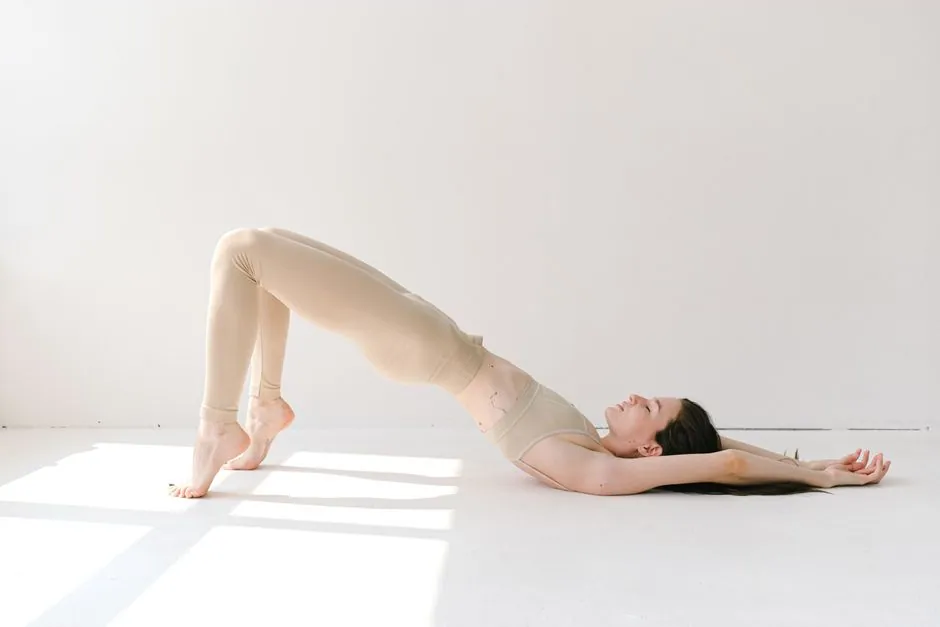
| Bridge hold | Setu Bandhasana, feet hip-width, hips lifted | 60 seconds, no lower-back pinching | Build to 3 × 45 sec daily before attempting wheel |
| Wall shoulder flexion | Back against wall, ribs down, raise straight arms overhead | Both wrists touch the wall with lower back flat | Daily lat and pec stretch, 2 × 45 sec per side |
| Hip flexor length | Half-kneeling lunge, tuck the tailbone, shift forward | Front-of-hip stretch without back compression | Couch stretch or Supta Virasana, 90 sec per side |
| Wrist load tolerance | Tabletop, weight into the palm heels | 45 seconds, no sharp wrist pain | Wrist prep drills; wedge a folded mat under the palm heels |
This matters more in India than the global yoga literature suggests. The ICMR-INDIAB survey of 14,227 adults found 54.4% were physically inactive, rising to 65.0% in urban areas, and that 88–95% reported no recreational physical activity at all (ICMR-INDIAB Phase 1, IJBNPA 2014). A body that has done almost no recreational movement for years does not have the shoulder and hip range chakrasana assumes. The four tests exist so you find that out on the floor rather than mid-lift.
How to do chakrasana: eight steps from set-up to exit
Lie supine, bend the knees and draw the heels within a hand’s length of the hips. Place the palms beside the ears, fingers pointing to the shoulders. Press the feet down and lift the hips first. Press the palms and pause on the crown of the head. Then straighten the arms, lift the head clear, and hold 15–30 seconds breathing steadily.
| # | Step | Breath | Form cue | Common error |
|---|---|---|---|---|
| 1 | Lie supine, knees bent, heels close to hips | Normal | Feet hip-width, toes forward | Heels parked too far from the hips |
| 2 | Palms beside the ears, fingers to shoulders | Normal | Elbows stacked over wrists, pointing up | Elbows splaying outward |
| 3 | Press feet, lift hips to bridge height | Exhale | Inner thighs drawing toward each other | Knees flaring wide |
| 4 | Press palms, rest lightly on the crown | Inhale | No weight on the neck — it is a checkpoint, not a rest | Sinking the head into the mat |
| 5 | Press into palms and feet, straighten the arms | Exhale | Push the floor away through the palm heels | Lifting with the lower back instead of the arms |
| 6 | Hold 15–30 seconds | Slow nasal breathing | Pubic bone as the highest point; ribs knitted | Holding the breath |
| 7 | Tuck the chin, bend the elbows and knees, lower | Exhale | Chin to chest before the head reaches the mat | Dropping the head first |
| 8 | Counter-pose: knees to chest, then a supine twist | Free | 30–45 seconds each | Standing up straight away |
Warm up properly before step one. Mayo Clinic’s flexibility guidance is to warm up with 5–10 minutes of light activity before stretching, hold each stretch for about 30 seconds (up to 60 in tight areas), stretch at least two to three times a week, and expect tension rather than pain, moving smoothly without bouncing (Mayo Clinic, Stretching: Focus on flexibility). Applied to chakrasana, that means sun salutations and cobra pose work come first — never a cold wheel as the opening move of a morning practice.
The six-week bridge-to-wheel progression
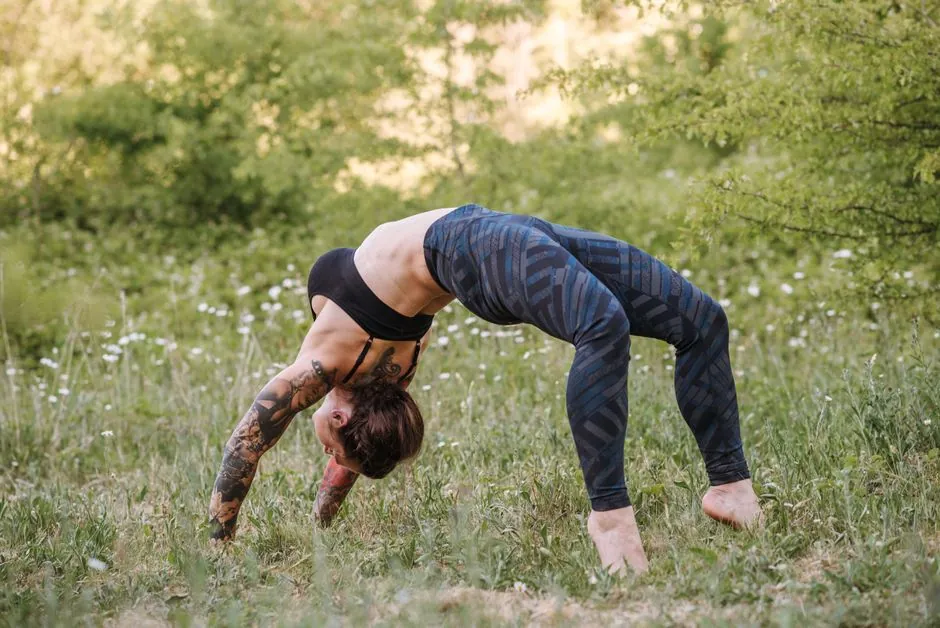
If you failed a readiness test, this is your route. Three sessions a week, roughly 20 minutes each, layered onto whatever practice you already do. The progression moves from bridge to supported wheel to the unsupported pose, and it deliberately spends two full weeks on shoulder and hip range before any lifting happens — because that is where most stalled attempts actually fail.
| Week | Main drill | Sets × reps / hold | Rest | Form cue |
|---|---|---|---|---|
| 1 | Setu Bandhasana (bridge) + wall shoulder slides | 3 × 45 sec; 3 × 10 slides | 45 sec | Ribs down, tailbone slightly tucked |
| 2 | Bridge with one leg lifted + half-kneeling hip flexor stretch | 3 × 20 sec per side; 2 × 90 sec per side | 45 sec | Hips level — do not let one side drop |
| 3 | Ustrasana (camel) at the wall + Salabhasana (locust) | 3 × 20 sec; 3 × 15 sec | 60 sec | Lift the chest before leaning the head back |
| 4 | Crown-of-head wheel (step 4 only), 5 kg of weight in the arms | 4 × 10 sec | 60 sec | Neck stays unloaded; stop if it compresses |
| 5 | Supported wheel — palms on two yoga blocks at the wall | 4 × 15 sec | 60 sec | Blocks raise the hands so tight shoulders can still straighten |
| 6 | Full chakrasana on the floor | 3 × 15–20 sec | 90 sec | Press the floor away; pubic bone highest |
Ardha chakrasana benefits as the standing entry point
Ardha Chakrasana, the standing half-wheel, is the low-risk cousin: feet hip-width, palms supporting the lower back, chest lifting as you lean back from the hips. Its benefits are modest but real — it teaches thoracic extension without wrist loading, it opens the front of the chest after hours at a laptop, and it is a sensible test of whether backward bending irritates your spine before you commit to the floor version. Two sets of 15 seconds is plenty.
Benefits of chakrasana, separated from the claims that don’t hold up
Chakrasana genuinely builds posterior-chain and shoulder strength, restores thoracic extension lost to sitting, and stretches hip flexors and chest under load. What it does not do is cure disease, lengthen the spine permanently or melt abdominal fat. The NHS classes yoga as a muscle-strengthening activity counting toward the 2-days-a-week strengthening target alongside 150 minutes of moderate aerobic activity (NHS physical activity guidelines).
The WHO 2020 guidelines set the same benchmark globally: 150–300 minutes of moderate or 75–150 minutes of vigorous aerobic activity weekly, plus muscle-strengthening work covering all major muscle groups on two or more days (WHO Guidelines on Physical Activity and Sedentary Behaviour, 2020). Chakrasana contributes to the strengthening half of that. It is not cardio, and one wheel is not a workout.
Urdhva dhanurasana benefits your spine actually gets
The measurable wins are strength and range, not medical outcomes. For back pain specifically, a Cochrane review of 12 trials and 1,080 participants found low- to moderate-certainty evidence that yoga produces small to moderate improvements in back-related function at three and six months versus non-exercise controls, with pain benefits that did not reach the threshold for minimum clinical importance, and no evidence that yoga beats other exercise (Wieland et al., Cochrane Database Syst Rev, 2017). That is a modest, honest result — and it applies to yoga programmes as a whole, not to wheel pose in isolation. Nobody has run a trial on chakrasana alone.
Chakrasana calories burned: the honest number
Very few. Harvard Health puts stretching and hatha yoga at roughly 120 kcal per 30 minutes for a 125-lb (57 kg) person, 144 kcal at 155 lb (70 kg) and 168 kcal at 185 lb (84 kg) (Harvard Health, calories burned in 30 minutes). A 20-second hold is a rounding error against that. If fat loss is the goal, chakrasana is the wrong tool — pair your yoga with regular cardio and a calorie-controlled Indian diet, and treat wheel pose as mobility and strength work.
Five mistakes that turn chakrasana pose into a sore lower back
- Hinging at L4–L5 instead of curving evenly. If the arch happens in one small segment of the lower back, you feel a pinch there within seconds. Fix: tuck the tailbone slightly and push the chest toward the wall behind you.
- Feet and knees splaying out. External rotation of the thighs makes the lift easier and the lower back angrier. Fix: squeeze a block between the thighs.
- Lifting before the arms are ready. If the arms cannot straighten, the load transfers to the spine. Fix: go back to blocks-at-the-wall in week 5 of the progression.
- Cranking the neck back. The head hangs; it does not reach. Fix: let the crown point at the floor and keep the throat soft.
- Skipping the counter-pose. Coming straight to standing leaves the erectors locked short. Fix: knees to chest for 45 seconds, then a supine twist.
Injury data justifies the caution. An analysis of 29,590 yoga-related emergency department presentations in the United States from 2001 to 2014 found the trunk was the most commonly injured region at 46.6%, sprains and strains made up 45.0% of diagnoses, and the injury rate rose from 9.55 to 17.01 per 100,000 participants over the period (Swain & McGwin, Orthop J Sports Med, 2016). Backbends are not the only cause, but “trunk” is exactly where a badly executed wheel goes wrong.
Who should not do chakrasana
Skip chakrasana entirely if you have a disc herniation, spondylolisthesis, recent spinal surgery, uncontrolled hypertension, a shoulder or wrist injury, carpal tunnel syndrome, or glaucoma. Avoid it in pregnancy and for at least six months after a caesarean. If you have any spinal diagnosis, clear the pose with your doctor or physiotherapist before your first attempt — this is not advice you should take from an article.
The eye risk is specific and measurable. In a study of 10 people with primary open-angle glaucoma and 10 without, head-down yoga positions raised intraocular pressure significantly within one minute — from 17 to 28 mmHg in glaucoma patients during downward dog, and from 18 to 24 mmHg in Halasana — returning to baseline within two minutes after release (Jasien et al., PLoS ONE, 2015). Chakrasana puts the head below the heart for the entire hold. Anyone with glaucoma or a retinal condition should discuss inverted and head-down postures with an ophthalmologist.
The NCCIH notes that yoga is generally safe for healthy people under qualified instruction, but that people with pre-existing knee or hip injuries, lumbar spine disease, severe high blood pressure, balance problems or glaucoma may need modifications, and that the emergency-department injury rate is higher in people aged 65 and over than in younger adults (NCCIH, Yoga: Effectiveness and Safety). Over 60, the supported version at the wall is a better long-term destination than the floor pose, and there is no prize for the harder shape.
Fitting chakrasana yoga into an Indian weekly routine
Chakrasana belongs late in a session, on two or three days a week, never daily. A workable week for someone with a desk job in Bengaluru or Pune: Monday and Thursday for backbend work after a 12-minute sun-salutation warm-up; Tuesday and Friday for hip and shoulder mobility; Wednesday and Saturday for cardio. That structure gives the spine 48 hours between loading sessions, which is the same spacing you would give any strength lift.
Practical Indian details that actually matter: practise on an empty stomach or at least three hours after a full meal — a wheel on top of rajma-chawal is genuinely unpleasant. Early morning is best for a quiet mind but worst for stiff joints, so if you practise at 6 am, double the warm-up. Mats matter more than you would expect; a thin 4 mm mat on a tiled floor is painful on the palm heels, while a 6–8 mm mat (roughly ₹800–₹2,000) gives the wrists a fairer deal. And if you share a small flat, clear a 2 × 1 metre patch — you will roll further than you think on the exit.
Pairing matters too. A consistent daily yoga habit builds the base range; the wheel is the occasional test of it. If you enjoy the pressing strength this develops, crow pose is a natural next project because both demand the same wrist tolerance and straight-arm scapular control.
Questions people ask about chakrasana
Is chakrasana the same as urdhva dhanurasana?
In almost all modern studios, yes — both names describe the floor backbend pressed up from palms and feet. Some traditional schools reserve “chakrasana” for the dropback version entered by standing and arching backward to the floor, using “urdhva dhanurasana” for the version pressed up from lying down. The final shape is identical.
How long does it take a beginner to reach full chakrasana?
For a healthy adult training three times a week, six to ten weeks to a supported wheel at the wall is realistic, and three to six months to a comfortable unsupported hold. If you sit at a desk all day, expect the longer end. Rushing the timeline is the single most common cause of the lower-back pain people blame on the pose.
Can chakrasana increase height?
No. Once growth plates fuse in the late teens, no posture adds bone length. What backbends can do is reduce the postural slump that makes people measure shorter than they are — typically a centimetre or so of apparent height, and only while the improved posture is maintained.
Is chakrasana safe during pregnancy?
No. Deep backbends over-stretch an already loaded abdominal wall, and the position is unstable as the centre of gravity shifts. Skip it for the whole pregnancy and until your doctor clears core and spinal loading postnatally, which is usually at least six months after a caesarean.
Why do my wrists hurt in chakrasana?
Because the set-up demands close to 90 degrees of wrist extension under full body load. Wedge a folded towel under the palm heels to reduce the angle, spread the fingers and grip the mat lightly so the load spreads across the whole hand, and build tolerance with 45-second tabletop holds before adding wheel attempts.
How long should I hold chakrasana?
Fifteen to thirty seconds per repetition, two to three repetitions, with 60–90 seconds of rest between. Longer holds do not add much and raise the risk of the arms fatiguing and the lower back taking over. Quality of the arch beats duration every time.
Does chakrasana reduce belly fat?
Not directly — spot reduction is not physiologically possible, and the calorie cost of a 20-second hold is negligible against the roughly 144 kcal per 30 minutes Harvard Health lists for hatha yoga at 70 kg. It does strengthen the muscles under abdominal fat and improve posture, which changes how the midsection looks without changing the fat itself.
Your next step
Run the four readiness tests tonight and write down which one you failed — that single answer tells you what to train for the next fortnight. If you would rather have someone watch your set-up than guess from a photograph, Fitstrot’s online yoga classes cover backbend progressions live, and one-on-one sessions are worth it if a past back or shoulder injury makes you cautious about pressing up at all.


