

A solid gym arm workout trains biceps and triceps in one focused session: about 6 to 8 exercises, 16 to 24 working sets, 45 to 60 minutes, and two or three different grips or angles for each muscle. Below you get the full plan with sets, reps, rest and form cues, then how often to run it, what to change as a beginner, and how to fix arms that refuse to grow.
Your arms already work on every press, row and pulldown, so an arm day is not about punishing them. It is about adding controlled, well-chosen volume. Triceps make up roughly two-thirds of the upper arm, which means a plan made only of curls will never give you the size you are after.
What Should A Gym Arm Workout Include?
A good arm workout at the gym includes one heavy compound-style lift per muscle (close-grip bench press for triceps, a barbell or EZ-bar curl for biceps), two to three isolation exercises that change grip and arm angle, and a high-rep finisher. In total that is 6 to 8 exercises and roughly 16 to 24 working sets in 45 to 60 minutes.
Think of the session in three blocks:
- Heavy block (first): close-grip bench press and a barbell curl, done while you are fresh, in the 6 to 10 rep range.
- Angle block (middle): overhead triceps work, incline curls, pushdowns and hammer curls. Each one loads a different part of the muscle, so you are not just repeating the same movement.
- Finisher (last): a light, high-rep cable curl or pushdown taken close to failure with clean form.
Gym Arm Workout: Sets, Reps, Rest And Form Cues
This is a session we would hand an intermediate lifter who trains arms once or twice a week. Choose a load where the last two reps of each set feel hard but your form stays clean. If you are newer to the gym, use the lower end of the sets and a lighter weight.
| # | Exercise | Sets | Reps | Rest | Form cue |
|---|---|---|---|---|---|
| 1 | Close-grip bench press | 4 | 6-8 | 2 min | Hands about shoulder-width, elbows tucked near your ribs, bar touches the lower chest |
| 2 | Barbell or EZ-bar curl | 4 | 8-10 | 90 sec | Elbows pinned beside the ribs, no hip swing, lower for 2 to 3 seconds |
| 3 | Overhead dumbbell triceps extension | 3 | 10-12 | 75 sec | Elbows point forward, not out; go for a full stretch behind the head |
| 4 | Incline dumbbell curl | 3 | 10-12 | 75 sec | Bench at roughly 45 to 60 degrees, shoulders back, let the arms hang straight before each rep |
| 5 | Rope triceps pushdown | 3 | 12-15 | 60 sec | Elbows fixed at your sides, pull the rope ends apart at the bottom |
| 6 | Hammer curl | 3 | 12-15 | 60 sec | Palms face each other, wrists straight, no shrugging |
| 7 | Dips (assisted if needed) | 2 | To 1-2 reps short of failure | 60 sec | Shoulders down, stop when the upper arm is parallel to the floor; skip if the shoulder pinches |
| 8 | Cable or band curl | 2 | 15-20 | 45 sec | Constant tension, squeeze for a second at the top |
That is 24 sets: 12 for biceps and 12 for triceps. If time is short, drop exercises 7 and 8 and you still have a complete 20-set session in about 40 minutes.
How Do You Run The Session From Warm-Up To Finisher?
Start with five minutes of light movement (arm circles, band pull-aparts, an easy rowing or cycling warm-up), then do two warm-up sets of your first exercise at about 50 percent of the working weight. Then work through the table in order, alternating a triceps move with a biceps move so one muscle rests while the other works.
A practical order is 1, 2, 3, 4, 5, 6, 7, 8 exactly as listed, which already alternates triceps and biceps. If the gym is crowded, you can superset pairs (for example pushdown plus hammer curl with no rest between them, then rest 60 to 90 seconds). Supersets save time without changing the workload much, because the two muscles do opposite jobs.
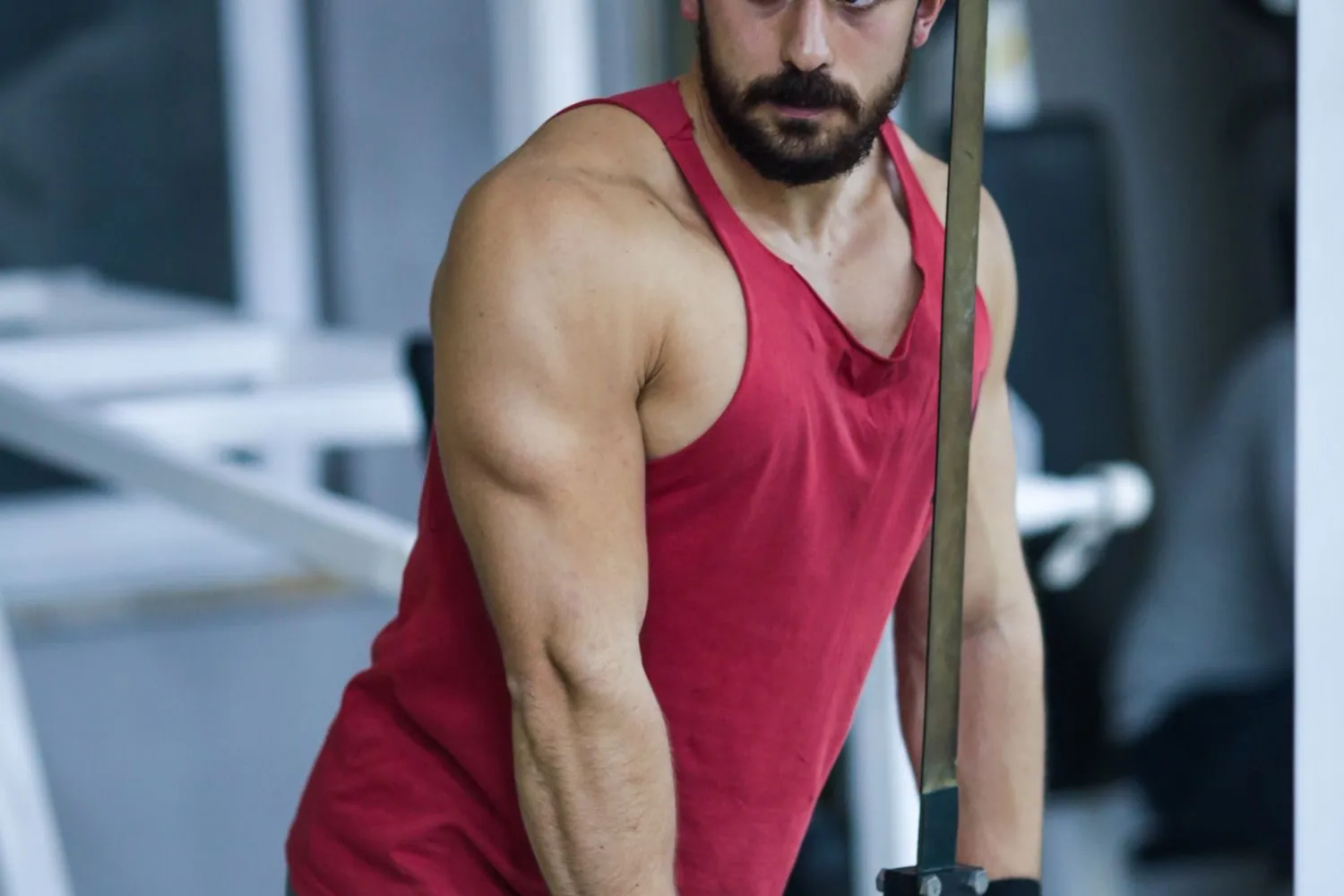
Use progressive overload to keep it working. When you hit the top of the rep range on every set with clean form, add the smallest jump available, usually 1 to 2.5 kg, and drop back to the bottom of the range. Write your numbers down so you can see real progress.
Should You Train Biceps And Triceps On The Same Day?
Yes, for most people it is the most efficient way to train arms. Biceps and triceps are opposing muscles: one bends the elbow, the other straightens it. Training them in the same session lets each one partly recover while the other works, so a 45 to 60 minute biceps and triceps workout covers both properly.
It is not the only valid setup, though. If you already train back, you are hitting biceps hard on rows and pulldowns, and our back and biceps workout shows how to layer curls onto that day without overloading the elbow. If you prefer pairing biceps with shoulders, the shoulder and bicep workout lays out that structure. For a deeper look at the three triceps heads, see our triceps workout at the gym guide.
What matters is that both muscles get real volume somewhere in your week, whether that is one combined arm day or spread across push and pull sessions.
How Many Sets And How Often Should You Train Arms Each Week?
Most lifters grow well on about 10 to 14 direct sets per muscle per week, spread over one or two sessions. Beginners can do less, around 6 to 10 sets, while advanced lifters sometimes push to 12 to 18. Training arms directly twice a week usually beats one marathon session, as long as you can recover between them.
| Experience level | Direct arm days per week | Sets per muscle per week | Exercises per session | Typical rep range |
|---|---|---|---|---|
| Beginner (under 6 months) | 1 | 6-10 | 4-5 total | 8-12 |
| Intermediate (6 months to 2 years) | 1-2 | 10-14 | 6-8 total | 6-15 |
| Advanced (2+ years) | 2 | 12-18 | 6-8 per session | 6-20 |
Remember that chest, back and shoulder days already give your arms indirect work. If you train chest and back hard twice a week, the lower end of these ranges is probably enough. If your curl and pushdown numbers climb over four to six weeks and your elbows feel fine, the volume is working. To place an arm day in your week, see our gym workout schedule and gym workout routine guides show how to place it.
Myth: Heavier Curls Mean Bigger Arms
Heavier curls do not automatically mean bigger arms. When the weight climbs but the range shrinks, you swing the bar with your hips and back, the biceps does less of the work, and the elbow takes more stress. A lighter weight lifted through the full range, with a slow lowering phase, builds more muscle than a heavy, sloppy rep.
Two related myths show up in every gym:
- “Biceps are the arm.” They are the smaller muscle. Give triceps equal attention and your arms will look noticeably bigger from the side and the back.
- “Spot reduction will melt arm fat.” Training arms builds muscle under the skin, but it does not burn fat from that spot. If fat is the concern, that is a whole-body nutrition and activity question, not an arm exercise one.
Why Aren’t My Arms Growing, Or Why Do My Elbows Hurt?
Most stalled arms trace back to a short list of causes: too little protein or sleep, no progressive overload, short range of motion, or ignoring triceps. Elbow soreness usually comes from too much volume too fast, swinging heavy weight, or locking out hard on every rep. The table below matches each symptom to a fix.
| What you notice | Likely cause | What to try |
|---|---|---|
| Same weights for 6+ weeks | No progressive overload | Log your sets and add 1 to 2.5 kg once you reach the top of the rep range |
| Biceps look fine, arms still look small | Triceps undertrained | Give triceps as many sets as biceps, including an overhead movement |
| Dull ache at the inner elbow after curls | Too much volume, swinging, or very heavy straight-bar curls | Switch to an EZ-bar or dumbbells, cut sets by a third for a week, slow the lowering phase |
| Pain at the back of the elbow on pushdowns or extensions | Locked-out reps, flared elbows, too much weight | Stop just short of lockout, keep elbows in, lighten the load |
| Front of the shoulder pinches during dips | Going too deep or poor shoulder control | Stop at parallel upper arms, or swap dips for pushdowns |
| Arms feel flat the day after training | Low food intake or poor sleep | Aim for 7 to 9 hours of sleep and eat enough across the day |
See your doctor if you feel sharp or burning pain, numbness or tingling in the hand, swelling around the elbow, or pain that lasts more than a week or wakes you at night. Do not train through those. Dull muscle soreness for a day or two is normal; joint pain is not. If you have a past elbow, wrist or shoulder injury, check with a doctor or physiotherapist before adding heavy dips or close-grip pressing.
How Should Beginners, Women And Home Lifters Adjust This Plan?
Beginners should start with 4 to 5 exercises, 2 to 3 sets each, using light dumbbells and focusing on form. Women can follow the same plan with the same rep ranges; the exercises do not change, only the starting weights. If you train at home, dumbbells and a bench cover almost every movement in the table above.
- Beginners: Do curl, hammer curl, pushdown or bench dip, and overhead extension, 2 to 3 sets of 10 to 12. Our biceps workout for beginners at the gym breaks the first month down step by step.
- Women: Training arms with weights will not make them bulky. It builds firmness and strength. Pick a weight where reps 10 to 12 are genuinely difficult.
- Home lifters: Swap the barbell curl for dumbbell curls and use a doorway band or a bench for dips. See our home gym workout guide for equipment ideas.
- Short on time: Run four supersets (pushdown plus curl, overhead extension plus incline curl, and so on) for a 30-minute arm session.
For muscle to grow, food matters too. Most people lifting regularly do well on roughly 1.2 to 2 grams of protein per kg of body weight a day. In an Indian diet that can come from eggs, paneer, curd, dal, soya chunks, chicken or fish, spread across three to four meals. If you are unsure how much you need, an online nutritionist consultation can turn your usual meals into a simple plan.
Next Step: Get An Arm Plan Built Around You
If you want your arm workout tuned to your strength, schedule and any elbow or shoulder history, book a session with a Fitstrot coach through 1-on-1 personal training. We will set your starting weights and adjust the plan as you progress.
Frequently Asked Questions
What is a good gym arm workout?
A good gym arm workout trains biceps and triceps in one session with 6 to 8 exercises, about 16 to 24 working sets, and 45 to 60 minutes of work. It pairs one heavy lift per muscle, such as close-grip bench press and a barbell curl, with isolation moves that vary the grip and angle.
How many exercises should an arm workout have?
Six to eight exercises, split evenly between biceps and triceps, suit most lifters. Beginners can start with four or five and focus on form. More than eight usually adds tired, low-quality sets rather than extra growth, so add sets to a few good exercises before adding new ones.
Can you do an arm workout every day?
No. Training arms directly every day leaves too little time to recover and raises the risk of elbow and wrist overuse pain. Biceps and triceps typically need about 48 hours before direct work again, so two or three arm sessions a week with rest days between them is plenty.
Should you train arms before or after chest and back?
Train the bigger muscles first. Chest and back lifts like bench press and rows need strong, fresh arms, so doing heavy curls and pushdowns before them can limit those lifts. Putting arms last, or on their own day, lets you use heavier weights on the main lifts.
How long does it take to see results from arm workouts?
With consistent training two times a week, enough protein and 7 to 9 hours of sleep, most people notice better strength within 3 to 4 weeks and visible size changes over about 8 to 12 weeks. Results vary with age, starting point, food and sleep, so treat these as rough timeframes, not guarantees.


