

A good biceps workout gym session needs only four exercises, about 12 to 16 hard sets and 35 to 45 minutes. Pick one heavy curl, one stretched-position curl, one neutral-grip curl and one cable or machine finisher, then add a rep or a little weight each week. Below you get the exact sets, reps, rest, form cues and fixes for a crowded gym floor.
What should a biceps workout gym session include?
A complete biceps workout gym session includes four exercises: a heavy barbell or EZ-bar curl, a stretched-position curl such as the incline dumbbell curl, a neutral-grip hammer curl, and a cable or preacher finisher. Together they add up to about 12 to 16 hard sets, take 35 to 45 minutes, and load the muscle at three different joint angles.
The biceps brachii has two heads. The long head runs along the outside of the arm and works hardest when your elbow sits behind your torso, as in an incline curl. The short head sits on the inside and takes more load when your elbow is in front of you, as in a preacher curl. Underneath both lies the brachialis, which adds thickness and responds to hammer and reverse-grip curls. You need one movement from each group, a controlled lowering phase and a full stretch at the bottom of every rep.
Which biceps exercises at gym work best, and how do you do them?
The best biceps exercises at gym are the EZ-bar or barbell curl for load, the incline dumbbell curl for the stretch, the hammer curl for the brachialis, and the cable curl for constant tension. Use 3 to 4 sets of 8 to 15 reps, rest 60 to 90 seconds on heavy sets, and keep your elbows close to your ribs.
| Exercise | Equipment | Sets x reps | Rest | Form cue |
|---|---|---|---|---|
| EZ-bar or barbell curl | Curl bar or straight bar | 3-4 x 6-10 | 75-90 sec | Elbows pinned to ribs, no leaning back |
| Incline dumbbell curl | Bench at 45 to 60 degrees | 3 x 10-12 | 60 sec | Let arms hang straight, full stretch each rep |
| Hammer curl | Dumbbells or rope on cable | 3 x 10-12 | 60 sec | Palms face each other, wrists straight |
| Preacher curl | Preacher bench or machine | 3 x 8-12 | 60 sec | Lower slowly, stop just short of locking out |
| Cable curl | Low pulley with straight or EZ attachment | 2-3 x 12-15 | 45 sec | Step back so the cable pulls from the start |
| Bayesian cable curl | Single handle, facing away from stack | 2-3 x 12-15 | 45 sec | Keep the elbow behind your body throughout |
| Concentration curl | One dumbbell, seated | 2 x 12-15 | 45 sec | Elbow braced on inner thigh, squeeze one second at the top |
You will not use all seven in one day. Choose four and rotate the rest in every four to six weeks, so your body keeps meeting a slightly new demand without your technique falling apart.
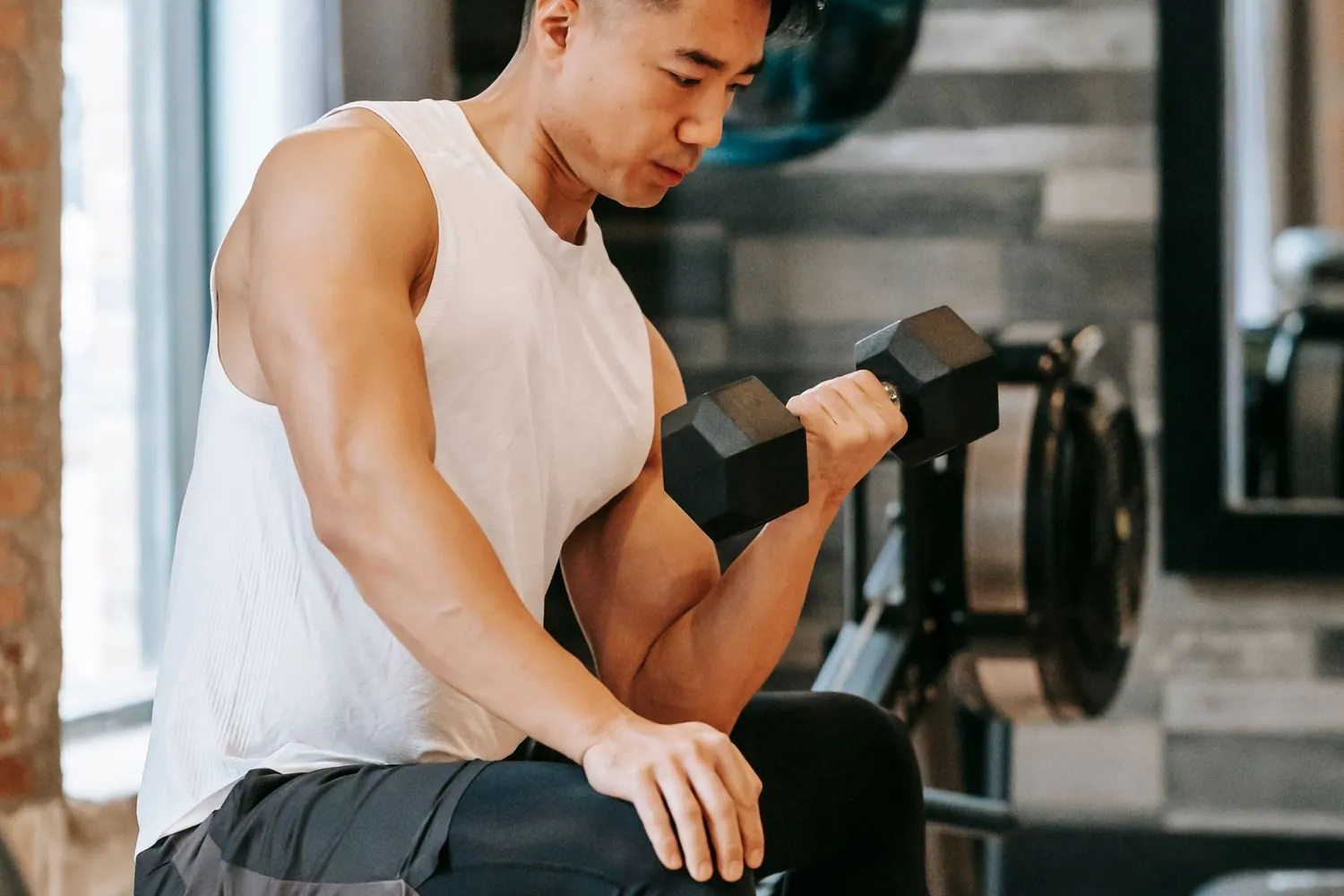
A biceps workout with dumbbells alone is perfectly workable: standard, incline, hammer and concentration curls cover all three muscle groups. A barbell lets you load more weight, while dumbbells let each arm work on its own and expose a weaker side. If your left arm stalls first, do your last rep with the weaker arm and match the reps on the stronger one.
A hammer biceps workout deserves a regular slot, not an afterthought. Arms that look flat from the side despite a decent front flex are usually short on brachialis thickness. For a closer look at setup and common errors on the angled bench, read our preacher curl workout guide, and for more grips and tempo ideas to rotate in, see our list of bicep workouts.
Myth check: do heavier curls and more swinging build bigger biceps?
No. Swinging the bar shifts tension to your lower back and shoulders, so the biceps do less work with the same weight. Heavier loads help only while your elbows stay fixed and the lowering phase takes about two to three seconds. If your torso rocks, drop the weight by 10 to 20 percent and keep the reps strict.
- Myth: you can change your biceps peak. The shape of the muscle belly and where it attaches are set by genetics. What you can change is size. Incline and preacher work build the muscle fully, which usually makes the peak look better.
- Myth: more sets always means more growth. Beyond roughly 14 to 16 hard sets in one session, extra sets mostly add fatigue and sloppy reps. Spread the volume over two days instead.
- Myth: curls alone build big arms. Rows, chin-ups and lat pulldowns load the biceps heavily too. If your back day is hard, your arms get a lot of work you never logged.
How should you set up a biceps workout routine for the time you have?
Match the session to your clock. A 30-minute biceps workout routine uses three exercises and 9 to 10 sets, a 45-minute session uses four exercises and 13 to 15 sets, and a 60-minute session adds a fifth movement and 16 to 18 sets. Beyond that, extra time rarely pays off for biceps alone.
| Session | Order of exercises | Total sets | Best for |
|---|---|---|---|
| 30 minutes | 1. EZ-bar curl 3 x 8-10 2. Incline dumbbell curl 3 x 10-12 3. Hammer curl 3 x 12 |
9 | Busy weekdays, done twice a week |
| 45 minutes | 1. Barbell curl 4 x 6-10 2. Incline dumbbell curl 3 x 10-12 3. Hammer curl 3 x 10-12 4. Cable curl 3 x 12-15, last set as a drop set |
13 | Once-a-week arm day for most intermediate lifters |
| 60 minutes | 1. Barbell curl 4 x 6-8 2. Incline dumbbell curl 3 x 10-12 3. Preacher curl 3 x 10-12 4. Hammer curl 3 x 12 5. Bayesian cable curl 3 x 12-15 |
16 | Once-a-week arm focus, longer weekend sessions |
Warm up first with one set at about 50 percent of your working weight for 10 to 12 reps and one at about 70 percent for 5 reps. Do the heaviest exercise first, while you are fresh, and keep cable work for last.
How many sets and how often should you train biceps?
Most lifters grow well on about 10 to 18 hard sets of direct biceps work per week. Train once with 12 to 16 sets, or twice with 6 to 9 sets per session, at least 48 hours apart. Rows and pull-ups add extra work. Beginners can start with 6 to 9 sets a week.
A hard set means you stop one to two reps before you cannot complete another clean rep. Warm-up sets do not count. Biceps on Monday and Thursday with 6 to 9 sets each day keeps you inside the range without marathon sessions.
If you prefer a separate arm day, the logical partner is our triceps workout gym guide, because the triceps make up most of your upper arm size. To fit all of this around chest, back, legs and shoulders, check our gym workout schedule.
How do you progress a biceps workout over four weeks?
Use double progression: pick a rep range such as 8 to 12, stay at the same weight until you hit the top of the range on every set, then add the smallest plate or dumbbell step and start again at the bottom. Most lifters can repeat this cycle every two to four weeks on curls.
| Week | Barbell curl target | What to do |
|---|---|---|
| Week 1 | 3 x 8 at a weight that leaves 2 reps in reserve | Learn the weight, stop each set clean, note it down |
| Week 2 | 3 x 9-10 at the same weight | Add reps before you add load |
| Week 3 | 3 x 10-12 at the same weight | Hit the top of the range on every set |
| Week 4 | Add 1 to 2.5 kg, back to 3 x 8 | Repeat the cycle, or take a lighter week if reps stall |
Log every set in your phone or a notebook. It shows whether a stall is real or just one bad night of sleep.
Troubleshooting: what if your biceps stall, hurt or the gym is crowded?
Most stalls come from too little food, too little sleep, sloppy reps or the same routine for months. Fix those four before you add more sets. If an exercise causes sharp or lingering elbow pain, stop it and swap the grip or the movement.
- The barbell rack is taken. Use dumbbells, a cable with a straight bar or an EZ attachment, or a machine curl. The muscle does not care what the tool is as long as the load rises over time.
- No incline bench free. Do a seated dumbbell curl with your back flat against an upright bench, or a Bayesian cable curl with your arm behind you for a similar stretch.
- Elbow or wrist pain on straight-bar curls. Swap to an EZ-bar or dumbbells, lower the weight and slow the lowering phase. Persistent or sharp pain needs a doctor or physiotherapist, not a new exercise, and no article can diagnose it.
- Arms are not growing. Check protein first. Most lifters do well on about 1.6 to 2 grams per kg of body weight a day. For a 70 kg person that is roughly 110 to 140 g, from foods such as eggs, paneer, curd, dal, soya chunks, chicken or fish spread across meals. A Fitstrot online nutritionist consultation can turn that into an Indian meal plan you can follow.
- One arm is clearly weaker. Start every dumbbell set with the weaker arm and give the stronger one the same reps, not more.
- You feel it in your shoulders. Pull your shoulder blades back slightly, keep your elbows beside your ribs and reduce the weight.
Who should change the plan, and how?
Beginners need fewer exercises, women lifters follow the same principles with their own weights, and people with limited time can train biceps twice a week in 30 minutes. Everyone should change the load before changing the form, and nobody should chase the burn instead of clean reps.
- Complete beginners: Do three exercises, 2 to 3 sets each, twice a week. Start lighter than you think. Our biceps workout for beginners guide covers the first month in detail.
- Women: The muscle responds to the same programming. Many women start with 3 to 5 kg dumbbells or the lightest bar and progress the same way, with 10 to 15 reps. Visible size takes many months of consistent training and eating.
- People training at home: Two adjustable dumbbells and a bench cover most of this plan. Our home gym workout guide shows how to set that up.
- Advanced lifters: Add 3 to 4 second negatives or a drop set on one or two exercises only, since they are tiring.
If you would rather have someone watch your form and adjust your sets each week, 1-on-1 personal training with a Fitstrot coach builds your arm day and everything around it to your schedule, your gym and your recovery. Book a session and bring your current curl routine to review.
Frequently Asked Questions
What is the best biceps workout at the gym?
The best biceps workout at the gym combines a barbell or EZ-bar curl for 3 to 4 sets of 6 to 10, an incline dumbbell curl for 3 sets of 10 to 12, a hammer curl for 3 sets of 10 to 12, and a cable curl for 2 to 3 sets of 12 to 15. Rest 45 to 90 seconds between sets.
How many sets of biceps per workout is enough?
Most people do well with 12 to 16 hard sets if they train biceps once a week, or 6 to 9 per session if they train twice a week. Beginners can start with 6 to 9 sets across the week. Past about 16 sets in one session, quality usually drops.
Can I do a biceps workout with dumbbells only?
Yes. Standard curls, incline curls, hammer curls and concentration curls cover the long head, short head and brachialis. You will miss the heavy loading of a barbell, but dumbbells let you correct left-right imbalances and use a fuller range of motion. Use 3 to 4 sets of 8 to 15 reps.
How long should a biceps workout take?
A biceps session takes about 30 to 45 minutes for most people, including warm-up sets. A 30-minute version with three exercises works for busy days, and a 60-minute version with five exercises suits an arm-focused day. If you are going longer than an hour, you are probably resting too long or doing too many sets.
Should you train biceps before or after back?
Train biceps after back in most cases. Rows, chin-ups and pulldowns need strong, fresh arms for gripping and pulling, and tired biceps limit those lifts. If your arms are a priority, train them first on a separate day or give them a short extra session two days after back.


