
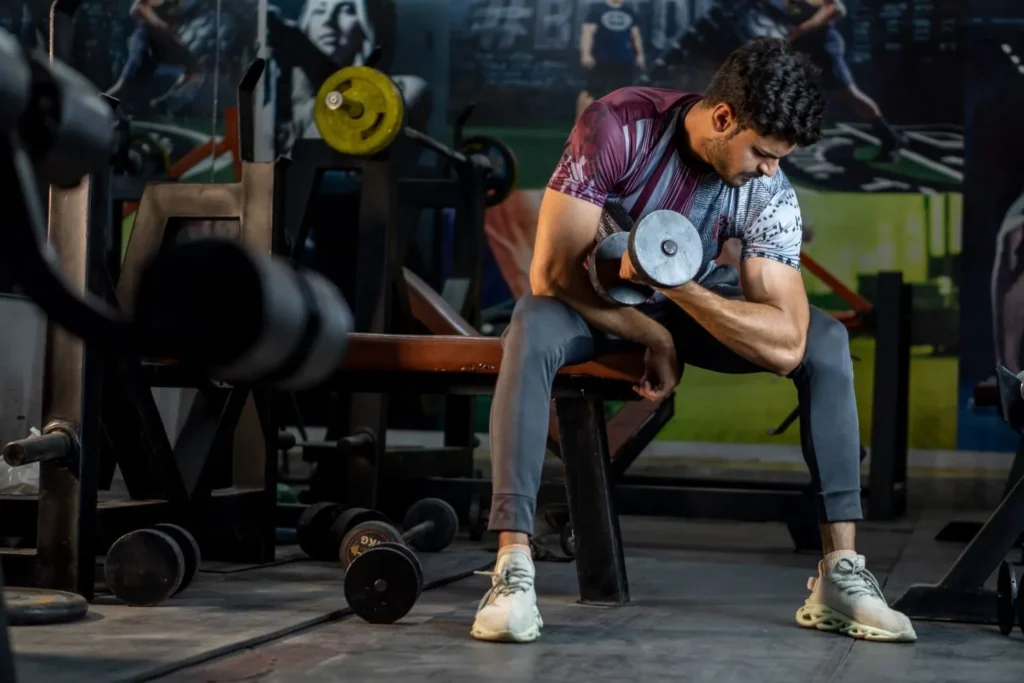
Yes, you can run a biceps and triceps workout same day, and for most lifters it is the most practical way to train arms. The two muscles do opposite jobs at the elbow, so one rests while the other works. Below you get a 16-set session, the order to do it in, superset and straight-set rest times, and where the session fits in your week, with a form cue for every exercise.
Is it a good idea to train biceps and triceps together?
Yes. Biceps bend the elbow and triceps straighten it, so while one muscle works the other recovers. A combined session of roughly 12 to 18 hard sets takes about 35 to 45 minutes, and each muscle still gets the 48 to 72 hours of rest it needs before your next arm session.
This pairing is called antagonist training, and it is why an arm day workout feels quick: your second exercise suffers far less than if you stacked two curls back to back.
It also fixes a common imbalance. Triceps make up roughly two-thirds of your upper arm, yet most people spend 20 minutes on curls and five on pushdowns. The triceps have three heads, and the long head only gets a full stretch when your arm is overhead, so a good session needs at least one overhead movement. The biceps work as a team with the brachialis underneath and the brachioradialis in the forearm, which is why hammer curls earn a place too.
Your arms also get indirect work from rows, pull-ups, bench press and shoulder press, which is why 6 to 8 direct sets per muscle is plenty for most people.
Biceps and triceps workout plan: exercises, sets, reps, rest and form cues
This is a three-pair session for the gym. Do A then B, rest as shown, and repeat for the listed sets. Choose a weight that leaves 1 to 2 reps in reserve on the last set.
| Pair | Exercise | Muscle | Sets x reps | Rest | Form cue |
|---|---|---|---|---|---|
| 1A | Close-grip bench press | Triceps | 3 x 8-10 | About 2 min after the pair | Hands roughly shoulder-width, elbows tucked at 30 to 45 degrees, bar touches lower chest |
| 1B | Barbell or EZ-bar curl | Biceps | 3 x 8-10 | About 2 min after the pair | Elbows pinned to your ribs, no torso swing, lower the bar for 2 to 3 seconds |
| 2A | Overhead dumbbell triceps extension | Triceps (long head) | 3 x 10-12 | About 90 sec after the pair | Elbows point up and stay narrow, ribs down, lower until you feel a stretch behind the head |
| 2B | Incline dumbbell curl | Biceps | 3 x 10-12 | About 90 sec after the pair | Bench at roughly 60 degrees, arms hang straight down, shoulders stay back |
| 3A | Cable rope pushdown | Triceps | 2 x 12-15 | About 60 sec after the pair | Elbows fixed at your sides, pull the rope apart at the bottom, lock out fully |
| 3B | Hammer curl | Biceps and brachialis | 2 x 12-15 | About 60 sec after the pair | Thumbs up, elbows still, squeeze for one second at the top |
That totals 16 working sets, 8 per muscle. If time is short, drop pair 3 and you still have a solid 10-set session.
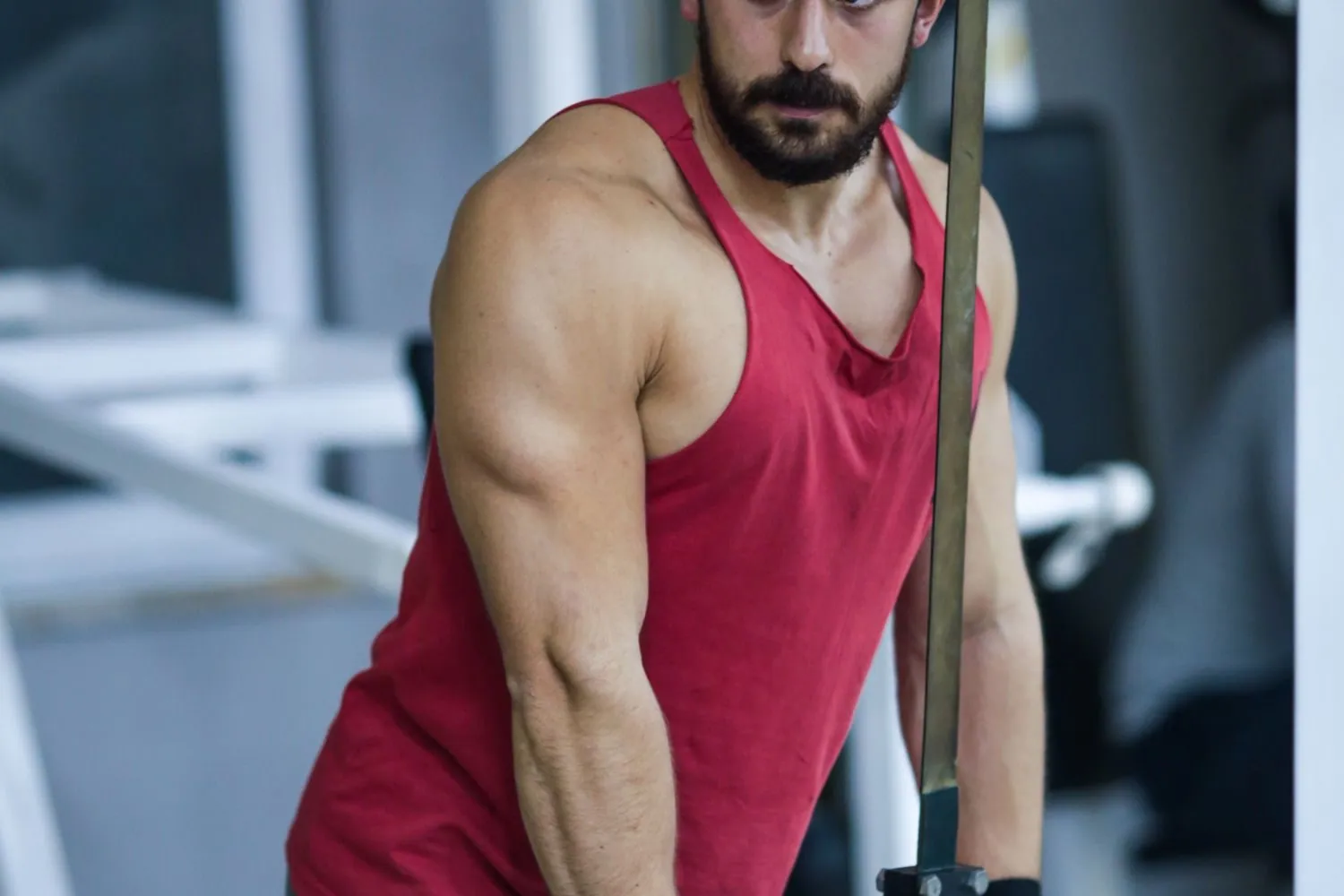
Warm up first: 5 minutes of light cardio, then 1 or 2 light sets of the first exercise at about half the working weight.
What order should you do the exercises in?
Start with the heavy, technical lift for the muscle you most want to grow, usually close-grip bench press for triceps, while your elbows and wrists are fresh. Then alternate biceps and triceps, finishing with light isolation work like rope pushdowns and hammer curls. Keep the total to three pairs, about 16 sets.
Three simple rules decide the order:
- Lead with the laggard. If your biceps are the weaker muscle, flip the pairs and curl first. Your best energy goes to the muscle that needs it.
- Heavy before light. Close-grip press and barbell curl go first; cable and dumbbell isolation work follows.
- Overhead before pushdowns. Do the overhead extension before the rope pushdown so the long head gets worked while it is fresh.
Want more exercise options for each muscle? Our biceps workout for the gym and bicep workouts guides cover curl variations, while tricep workouts and triceps workout at the gym cover pressing, extension and cable options.
Superset or straight sets: which works better for arms?
Use supersets when time is short: a biceps and triceps superset finishes the 16-set plan in about 30 to 35 minutes. Use straight sets when you want maximum weight on close-grip press and barbell curls, which takes about 40 to 45 minutes. Both build arms if the weekly sets and effort match.
| Factor | Superset (A then B, no rest between) | Straight sets (rest after every exercise) |
|---|---|---|
| Time for the 16-set plan | About 30 to 35 min | About 40 to 45 min |
| Rest | 60 to 120 sec after each pair | 2 min after compounds, 60 to 75 sec after isolation |
| Strength on the second exercise | Slightly lower | Closest to full |
| Pump and sweat | Higher, heart rate stays up | Lower, more relaxed pace |
| Best for | Busy days, home dumbbell sessions, 10 to 15 rep work | Heavy close-grip press, beginners learning form |
| Gym logistics | Needs two stations free, which is hard at peak hours | One station at a time |
A sensible hybrid: run pair 1 as straight sets because those lifts are heavy, then superset pairs 2 and 3.
Myth check: four arm day beliefs that waste your time
- “Arms need their own day every week to grow.” Not true. Pressing and pulling days already train both muscles, and two short arm finishers can work as well as one long session.
- “Swinging heavier weight builds bigger arms.” Swinging moves the load to your back and hips. A controlled curl with a lighter weight beats a swung curl with 10 to 20 percent more.
- “Every set must go to failure.” Stopping 1 or 2 reps short builds muscle with less elbow irritation.
- “Arm exercises burn arm fat.” Fat loss does not work by body part. It comes from a sustained calorie deficit across the whole body, which is where a plan from an online weight loss trainer helps. Arm training builds the muscle underneath whatever fat level you have.
Where does arm day fit in your week?
Place your biceps and triceps session at least 48 hours after your last heavy push or pull day, and leave 48 to 72 hours before the next arm session. Most people do well with 8 to 12 direct sets per muscle per week, split across one or two sessions depending on how many days they train.
| Your schedule | Where the arm work goes | Direct sets per muscle per week | Watch out for |
|---|---|---|---|
| 3 days, full body | Two arm pairs at the end of two sessions, or the full 16-set plan on the last day | About 8 to 12 | Do not hit heavy pressing and close-grip work on back-to-back days |
| 4 days, upper and lower | Finish both upper days with two arm pairs | About 8 to 12 | Arms also get indirect work, so cut a pair if elbows feel sore |
| 5 to 6 days, push, pull, legs | One dedicated arm session after a rest or leg day, not straight after push or pull | About 6 to 10 on top of indirect work | Elbow joints get tired when every day involves pressing or pulling |
| 2 days, very busy | The full plan once a week plus a two-pair finisher mid-week | About 8 to 10 | Keep the finisher short, 10 minutes or less |
If you follow a push and pull split, read our push day workout and pull day workout guides first, because they already count toward your triceps and biceps. Prefer to pair triceps with chest instead? The chest and triceps workout is the alternative to this approach, and you then train biceps with back.
How do you progress an arm workout week to week?
Use double progression: pick a rep range, such as 8 to 12 for curls, and stay at the same weight until you hit the top of the range on every set with clean form. Then add the smallest jump your gym offers, often 1 to 2.5 kg, and start again at the bottom of the range.
- Week 1: Barbell curl, 20 kg, 3 sets of 8, 8, 8.
- Weeks 2 to 3: Same 20 kg, add a rep when you can: 10, 9, 8, then 10, 10, 9.
- Week 4: Reach 12, 12, 12 on all sets, then move to 22.5 kg and drop back to 8 reps.
The numbers are an example; use your own starting weight and log every session. If you stall for 3 sessions in a row, swap one exercise for a similar one or take an easier week with about 30 percent fewer sets. If you want arm day built into a structured month, our 30 day workout plan shows how to schedule it around other sessions.
Troubleshooting: elbow aches, lagging arms and a weak pump
- Elbows ache during pushdowns or curls. Swap a straight bar for an EZ-bar or rope, lower the weight by about 20 percent, slow the lowering phase and trim one pair for two weeks. Sharp pain, swelling or aching that lasts more than a few days is a reason to stop and see a doctor or physiotherapist rather than push through.
- Close-grip bench feels weak. Your grip is probably too narrow. Widen it to shoulder-width and tuck your elbows.
- Biceps swing the torso. The weight is too heavy for your rep target. Drop it by 10 to 20 percent and stand with your back and glutes touching a wall if you need to.
- No pump and no growth. Check range of motion, food and sleep. A common muscle-gain target is roughly 1.6 to 2 g of protein per kg of body weight, so a 70 kg lifter aims for about 110 to 140 g a day across eggs, paneer, dal, curd, soya chunks, chicken or fish. An online nutritionist can help you hit this on a vegetarian diet.
Adjusting the plan: beginners, home lifters and busy schedules
A biceps and triceps workout for beginners should be shorter. For the first 4 to 8 weeks, do 2 sets each of three exercises (close-grip push-up or press, pushdown, dumbbell curl) for 10 to 15 reps, using straight sets, once or twice a week with at least 48 hours between sessions.
A biceps and triceps workout with dumbbells at home works well too. Use dumbbell curls, hammer curls, a close-grip floor press, an overhead extension and diamond push-ups, in supersets with about 60 to 90 seconds between pairs. A resistance band can replace the cable for pushdowns.
Busy weeks: two pairs, 3 sets each, takes about 20 minutes and still counts. Women and men follow the same plan; only the starting loads differ.
Frequently asked questions
Is it okay to train biceps and triceps on the same day?
Yes. They are opposing muscles, so one recovers while the other works. A session of 12 to 18 hard sets takes about 35 to 45 minutes. Leave 48 to 72 hours before training arms again, and keep heavy pressing and pulling days away from your arm session.
How many sets of biceps and triceps should I do in one session?
Aim for about 6 to 8 hard sets per muscle, so 12 to 16 sets in total. Beginners can start with 4 sets each. Going far beyond 20 sets in one arm session usually adds fatigue and elbow stress without much extra growth, since both muscles get indirect work from other lifts.
Should I do biceps or triceps first?
Start with the muscle you most want to grow, since it gets your best energy. For most people that is triceps, because they are about two-thirds of the upper arm and close-grip pressing needs fresh elbows. If your biceps lag behind, start with curls and keep the same alternating order.
How long should a biceps and triceps workout take?
A 16-set plan takes about 30 to 35 minutes as supersets and 40 to 45 minutes as straight sets, plus a 5 minute warm-up. If it takes much longer, you are probably resting more than 2 minutes between sets or checking your phone between exercises.
Can I do biceps and triceps after chest or back day?
You can, but keep it light. Chest day already works triceps and back day already works biceps, so add only 2 to 4 sets for each muscle after the main lifts. A full 16-set arm session is better on a separate day, at least 48 hours away from heavy pressing or pulling.
Next step: if you want your form checked and a weekly split built around your schedule, book a session with Fitstrot’s 1-on-1 personal training and bring this plan along.


