

If you are looking for a biceps workout at gym for beginners, the short version is this: three exercises, two to three sessions a week, and weights light enough that your last rep looks like your first. Dumbbell curls, hammer curls and one cable curl cover everything your arms need for the first two to three months. Below you get the exact sets, reps and rest, a form cue for every move, a four-week progression, and fixes for the problems first-timers hit most: swinging the weight, sore elbows and not knowing which machine is which.
What is the best biceps workout at the gym for a beginner?
The best beginner biceps workout is three exercises: dumbbell curl for 3 sets of 10-12 reps, hammer curl for 2 sets of 10-12, and a cable curl for 2 sets of 12-15, resting 45-75 seconds between sets. The session takes about 20 minutes and trains both heads of the biceps plus the brachialis, the muscle underneath that adds arm thickness.
| Exercise | Sets x reps | Rest | Form cue |
|---|---|---|---|
| Standing dumbbell curl | 3 x 10-12 | 60-75 sec | Elbows pinned to your sides; lift for 1 count, lower for 3 |
| Hammer curl | 2 x 10-12 | 60 sec | Palms face each other the whole way; wrists stay straight |
| Cable curl (rope or straight bar) | 2 x 12-15 | 45-60 sec | Stand one step back so the cable stays tight at the bottom |
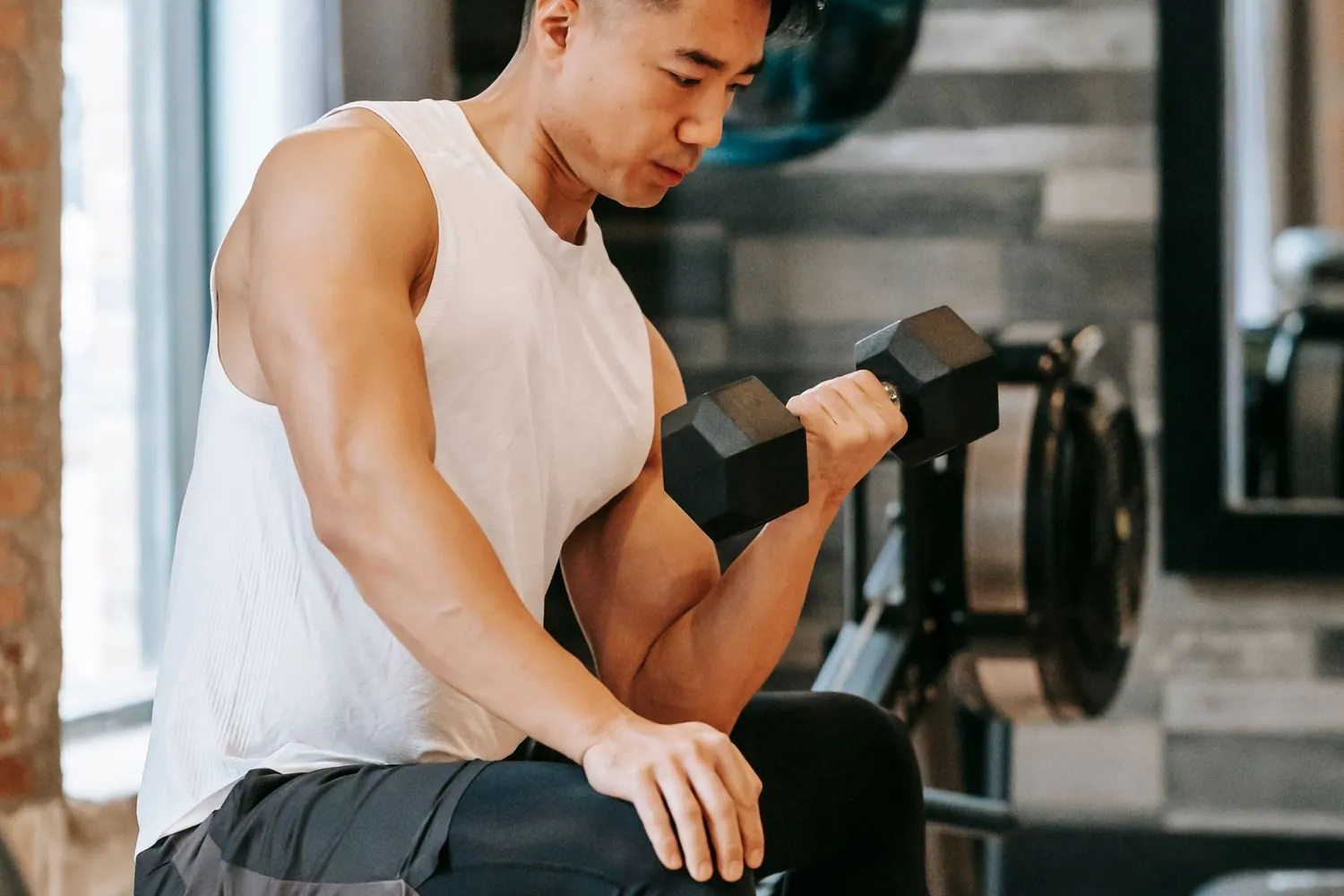
Choose a weight where the last two reps of each set feel hard but your upper arm has not started drifting forward. If you need your hips or shoulders to finish a rep, the dumbbell is too heavy. Put it down two steps on the rack and rebuild from there. That is seven working sets, enough for a beginner.
Warm up with two to three minutes of light cardio and one lighter set of the first curl for about 12 reps.
How do you do each biceps exercise with proper form?
Good curl form means your elbows stay beside your ribs, your torso stays still, and you lower the weight slower than you lift it, roughly 3 seconds down against 1 second up. If the weight only moves because your back or shoulders help, it is too heavy. Walk through each exercise like this.
Standing dumbbell curl
- Stand with feet hip-width apart, a dumbbell in each hand, palms facing forward, knees soft.
- Squeeze your shoulder blades gently back and keep your elbows against your sides.
- Curl both dumbbells up until your forearms are close to vertical, without letting the elbows travel forward.
- Pause for a beat, then lower for about 3 seconds until your arms are almost straight.
Hammer curl
- Hold the dumbbells like hammers, palms facing your thighs.
- Curl up with the same still elbows, keeping the grip neutral all the way.
- Lower slowly. Hammer curls hit the brachialis and the forearm muscle next to it, so you will usually handle slightly more weight than in a standard curl.
Cable curl
- Set the pulley at the lowest position and clip on a straight bar or rope.
- Step back one pace, elbows at your sides, and curl up without leaning back.
- The cable keeps tension on the muscle at the bottom, where free weights go slack, which is why it suits the final, higher-rep exercise.
Which gym equipment is best for biceps if you are a beginner?
For a beginner, dumbbells are the best starting equipment for biceps because they are easy to load in 2 kg steps, let each arm work independently and are simple to learn. Cables come second for constant tension, and the EZ bar third once your wrists feel comfortable. Straight barbells and heavy machines can wait a few weeks.
| Equipment | Beginner-friendly? | Best used for | Watch out for |
|---|---|---|---|
| Dumbbells | Very | Main curl, hammer curl | Swinging when the weight is too heavy |
| Cable stack | Yes, after a quick demo | Higher-rep finishing sets | Setting the pulley too high |
| EZ bar | Yes | Heavier two-arm curls with comfortable wrists | Gripping too wide and flaring the elbows |
| Preacher or curl machine | Yes | Learning strict form with the arm supported | Seat set so low that the shoulders roll forward |
How heavy should dumbbells be for a biceps workout as a beginner?
Pick a dumbbell you could lift about 14-15 times with good form, then stop at 10-12. That leaves two to three reps in reserve, which is hard enough to grow muscle and safe enough to protect your elbows. Many beginner men land near 6-10 kg per hand and many beginner women near 3-6 kg, but the rule matters more than the number.
Test it on your first warm-up set. If you finish 12 reps and could easily do five more, go up one dumbbell step next set. If rep eight already needs a swing, go down. Add weight only after you complete every set at the top of the range with clean tempo.
Your first four weeks: a simple biceps progression
Run the same three exercises and change only the variable in the table, and give the arms at least one rest day between biceps sessions.
| Week | Biceps sessions | Sets x reps (main curl) | Focus |
|---|---|---|---|
| 1 | 2 | 2 x 12 with a light weight | Learn the movement, stop 3-4 reps short of failure |
| 2 | 2 | 3 x 10-12 | Add the full 3-second lowering phase |
| 3 | 2-3 | 3 x 10-12, heavier by one step if the top reps are easy | Add hammer curl and cable curl |
| 4 | 2-3 | 3 x 10-12 plus 2 sets each of the other moves | Log your weights; aim for one extra rep or a slightly heavier dumbbell |
After month one, add a rep or a small weight jump whenever a session feels controlled. When you outgrow this plan, move on to our longer biceps workout gym guide for extra variations.
Biceps myths that waste beginners’ time
Myth: heavier always means bigger arms. Heavy weight with swinging mostly trains your lower back and shoulders. A lighter dumbbell lifted slowly asks more of the biceps than a heavy one thrown upward.
Myth: curl every day for faster growth. Muscle grows during recovery, not during the set. Two to three sessions a week with a rest day between is plenty. Daily curls tend to leave you with sore elbows and a stalled routine.
Myth: you can shape the biceps peak. Peak height is mostly genetics, set by where the muscle attaches. Training can make the muscle bigger, not change its shape, so do not chase special curls for a peak.
Myth: you can burn fat from one body part. Curls build muscle in the arm; they do not remove fat from it. Fat loss comes from overall food intake and activity across the week.
Troubleshooting: why is your biceps workout not working?
Most stalled beginner arm training comes from five fixable problems, usually too much weight, too little rest between sessions, or too little protein. Find your symptom below.
- The dumbbell swings and your back arches. Drop one weight step, brace your abs, and stand with your back lightly against a wall for a few sets.
- Your forearms burn before your biceps. Your grip is the weak link. Keep your wrists straight, use hammer curls and give it a few weeks; grip strength catches up quickly.
- Your arms do not look bigger after a month. That is normal. In the first four weeks most of your gains are neural, meaning you are getting better at the movement. Visible size usually follows over the next two to three months with steady eating and sleep.
- The inside of your elbow aches. Reduce the weight, slow down, and avoid locking out hard at the bottom. If it lingers, read the doctor note below.
Gym nerves: a first-week guide for new lifters
The hardest part of a first gym week is rarely the exercise. It is walking in, not knowing which equipment is free and feeling watched. A few habits remove most of that.
- Go off-peak if you can. Most Indian gyms are busiest from about 6 to 9 in the morning and 6 to 9 in the evening. A mid-morning or mid-afternoon slot gives you time to learn the cable station.
- Bring your plan. Save the three exercises on your phone so you never stand around wondering what comes next.
- Ask the floor trainer for one demo. Asking how to set the pulley is normal, and it is part of what you pay for.
- Re-rack your dumbbells, and remember that most people are busy with their own set, not judging yours.
Where does a biceps day fit in your weekly plan?
Biceps do not need a day of their own while you are a beginner. They fit best at the end of a pulling session, after rows and pulldowns, so your arms are fresh when your back needs them for heavier work. Our pull day workout shows that structure, and the back and biceps workout guide covers the combined session in detail.
If your plan already has rows and pull-ups, the sets in our back workout at gym for beginners count as indirect biceps volume, so you can keep the direct curl work to seven sets or fewer. For the rest of the week, our workout schedule for beginners and the general gym workout guide show how to place legs, push and pull days around it.
What should you eat to build your biceps?
Muscle needs protein and enough total food. A common range for people lifting regularly is about 1.2-1.6 g of protein per kg of body weight a day, so a 70 kg person would aim for roughly 85-110 g. Indian staples that help:
- 2 eggs: about 12 g protein
- 100 g paneer: about 18 g
- 1 bowl (about 150 g) cooked dal: about 8-10 g
- 50 g soya chunks (dry weight): about 25 g
If you are vegetarian or have a health condition that limits what you can eat, a plan built around your own food habits works better than a generic chart. Our online nutritionist consultation can set protein and calorie targets around your routine, and sleep of roughly 7-8 hours does as much for recovery as any food.
When should you see a doctor about arm or elbow pain?
See a doctor or physiotherapist if you have sharp pain during a curl, pain that lasts more than a few days after training, swelling or numbness in the arm or hand, a pop at the elbow, or a recent injury or surgery. A normal biceps workout feels like muscle effort and mild next-day soreness, not joint pain. Do not train through pain, and get medical advice before starting if you have a known elbow, shoulder or heart condition or high blood pressure.
Frequently Asked Questions
How many sets of biceps should a beginner do?
A beginner should do about 6-8 hard sets of direct biceps work per session, spread across two to three exercises, and train biceps two to three times a week. If your rows and pulldowns are already in the plan, stay near the lower end. Quality sets with controlled form beat a long list of exercises.
How often should beginners train biceps?
Two to three times a week works well, with at least one full rest day between sessions. Biceps also work during every pulling exercise, so the indirect volume from back day counts. Train them directly in one or two of those sessions rather than adding a separate arm day each time.
Can beginners build biceps with only dumbbells?
Yes. Dumbbells alone are enough to build visible biceps for the first year. A standing curl, hammer curl and incline or seated curl cover the main angles. Cables, EZ bars and machines add variety, but the thing that matters most is adding weight or reps gradually while keeping form strict.
Should beginners train biceps before or after back?
Train biceps after back in the same session. Rows and pulldowns need fresh arms and a strong grip to handle heavier weights, while curls are lighter on the rest of the body. Doing biceps first tires the arms and makes your back exercises weaker and less effective.
How long does it take to see results from a biceps workout?
Most beginners feel stronger within 2-4 weeks and see small visible changes after about 8-12 weeks of regular training, enough protein and decent sleep. Speed varies with genetics, age, starting body fat and consistency, so measure progress by weights and reps in a notebook, not by the mirror each day.
Want a plan that goes beyond arm day? Book a session with a Fitstrot trainer for 1-on-1 personal training and get a weekly programme built around your schedule, gym access and goals.


