
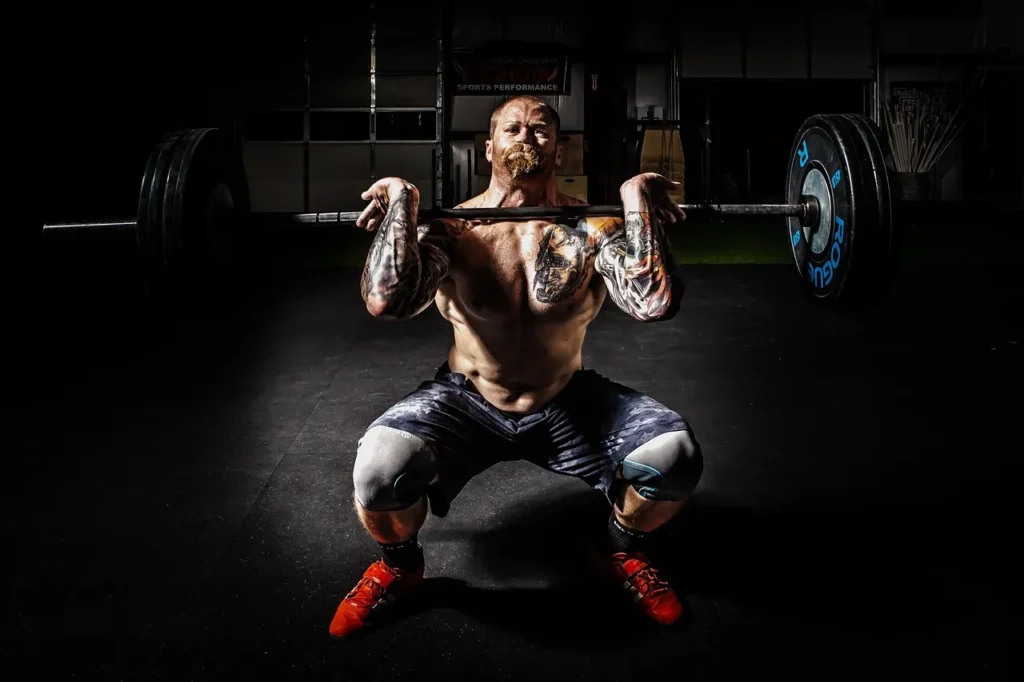
A good leg workout at gym is not about how sore you feel the next morning or how many machines you touch. It comes down to four muscle groups (quads, hamstrings, glutes and calves), about 10 hard sets per group each week, and weights that go up a little every few weeks. Below: the exercise table, sessions for three levels, machines vs free weights, and a 12-week plan, each number tied to published research.
If your main goal is fat loss rather than strength or muscle, read our leg workout for weight loss guide instead. This page is for people who want stronger, better-built legs from their time in the gym.
What makes a good leg workout at gym?
A good leg workout at gym trains quads, hamstrings, glutes and calves with at least one compound lift and one isolation exercise, adds up to roughly 10 or more hard sets per muscle each week, and hits each muscle about twice a week. A 2017 meta-analysis found each extra weekly set added about 0.37% more muscle growth.
That 2017 finding comes from a Schoenfeld, Ogborn and Krieger meta-analysis of 15 studies. It showed a graded dose-response: more weekly sets led to more growth, and 10 or more sets per muscle did better than fewer than 5. The same group’s 2016 frequency meta-analysis found that when total volume was the same, training a muscle twice a week beat once a week for growth (effect size 0.49 vs 0.30).
In practice, a good leg session has:
- One main compound lift (squat, leg press or hack squat) done first, while you are fresh.
- One hip hinge (Romanian deadlift or hip thrust) for hamstrings and glutes.
- One or two isolation moves (leg curl, leg extension, calf raise) for the parts compounds miss.
- A clear progression rule, so this week’s weights are written down and next week’s are slightly higher.
The order matters. The American College of Sports Medicine’s 2009 position stand on resistance training recommends doing large-muscle, multi-joint exercises before small, single-joint ones so you can keep the intensity high on the lifts that need it most.
Leg day workout exercises: the gym exercise table
Here are 12 leg day workout exercises found in almost any Indian commercial gym. Pick from each muscle group, not all in one day. Sets, reps and rest follow the ACSM advice of 6–12 reps for hypertrophy with longer rests on heavy compounds.
| Exercise | Main muscle | Sets | Reps | Rest | Form cue |
|---|---|---|---|---|---|
| Barbell back squat | Quads, glutes, adductors | 3–4 | 5–8 | 2–3 min | Brace your core before you go down, knees track over toes, hip crease at or below knee level |
| Leg press (45°) | Quads, glutes | 3 | 8–12 | 2 min | Lower until your hips are about to lift off the pad, and stop there. Do not lock your knees at the top |
| Hack squat machine | Quads | 3 | 8–12 | 2 min | Feet mid-platform, control a 2–3 second descent |
| Bulgarian split squat (dumbbells) | Quads, glutes | 2–3 per leg | 8–12 | 90 s | Put most of your weight on the front foot, torso slightly forward for more glute work |
| Leg extension | Quads (rectus femoris) | 2–3 | 10–15 | 60–90 s | Pause 1 second at the top, lower slowly |
| Romanian deadlift (barbell) | Hamstrings, glutes | 3 | 6–10 | 2–3 min | Push your hips back, keep the bar close to your legs, stop when your hamstrings are fully stretched, back stays neutral |
| Seated leg curl | Hamstrings | 3 | 8–12 | 90 s | Lean your torso slightly forward to stretch the hamstrings more |
| Lying leg curl | Hamstrings | 2–3 | 10–15 | 90 s | Keep your hips pressed into the pad and do not swing |
| Barbell hip thrust | Glutes | 3 | 8–12 | 2 min | Chin tucked, shins vertical at the top, squeeze for 1 second |
| Walking lunge (dumbbells) | Quads, glutes | 2–3 | 10–12 per leg | 90 s | Take long steps for glutes and short steps for quads, back knee lightly touches the floor |
| Standing calf raise | Calves (gastrocnemius) | 3–4 | 8–15 | 60 s | Take 2 seconds to lower into a full stretch and pause at the bottom |
| Seated calf raise | Calves (soleus) | 2–3 | 12–20 | 60 s | Knees bent at 90° shifts the work to the soleus. Use full range |

Squat depth: why going lower pays off
Half squats let you load more weight, which feels like progress. But a 2019 University of Tokyo trial measured muscle volume by MRI and found that 10 weeks of full squats grew the glutes by 6.7% vs 2.2% for half squats. Adductor growth was 6.2% vs 2.7%. Quad growth was similar in both groups (about 4.6–4.9%). For glutes and inner thighs, squat as deep as your hips and ankles comfortably allow.
Hamstrings: seated curls beat lying curls
A 12-week study in Medicine & Science in Sports & Exercise (2021) had people train one leg with seated curls and the other leg with lying curls. The seated-curl leg grew its whole hamstrings by 14%, compared with 9%. Sitting bends the hip, so the hamstrings work from a stretched position. If your gym has both machines, pick the seated one.
Leg day workout gym sessions for every level
Choose the column that matches how long you have trained consistently, not how long you have held a membership. The ACSM treats about 6 months of regular training as “intermediate”. Each session takes 50–75 minutes with warm-up.
| Order | Beginner (0–6 months) | Intermediate (6–24 months) | Advanced (2+ years) |
|---|---|---|---|
| 1 | Leg press: 3 × 10–12, rest 2 min | Back squat: 4 × 6–8, rest 3 min | Back squat: 4 × 4–6 (heavy), rest 3–4 min |
| 2 | Goblet squat: 2 × 10, rest 90 s | Romanian deadlift: 3 × 8, rest 2–3 min | Romanian deadlift: 3 × 6–8, rest 3 min |
| 3 | Seated leg curl: 3 × 10–12, rest 90 s | Bulgarian split squat: 3 × 8–10 per leg, rest 90 s | Hack squat: 3 × 8–10, rest 2 min |
| 4 | Dumbbell Romanian deadlift: 2 × 10, rest 2 min | Seated leg curl: 3 × 10–12, rest 90 s | Seated leg curl: 4 × 8–12, rest 90 s |
| 5 | Leg extension: 2 × 12–15, rest 60 s | Leg extension: 3 × 12–15, rest 60–90 s | Hip thrust: 3 × 8–10, rest 2 min |
| 6 | Standing calf raise: 3 × 12–15, rest 60 s | Standing calf raise: 4 × 10–12, rest 60 s | Leg extension: 3 × 10–15 (last set drop set), rest 60 s |
| 7 | — | — | Standing + seated calf raise: 3 + 3 sets, rest 60 s |
| Weekly frequency | 2 sessions (e.g. Mon, Thu) | 2 sessions (heavy day + lighter day) | 2 sessions, or 3 if legs are a priority |
| How hard | Stop with 3 reps left in the tank | 1–2 reps left on most sets | 0–2 reps left, last set of isolation moves to failure |
Leg day workout beginner session (weeks 1–8)
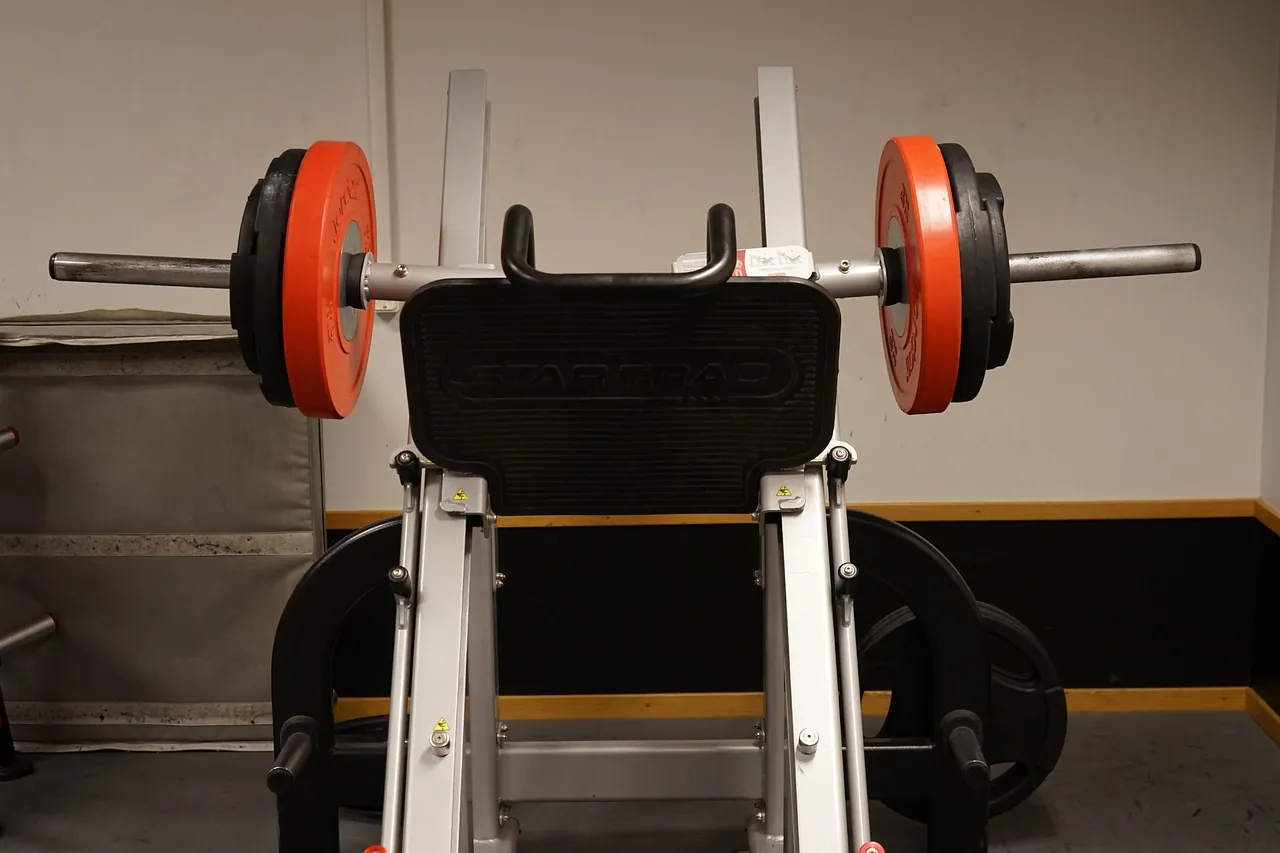
The beginner session starts with the leg press on purpose: the machine guides your path, you can stop a set safely without a spotter, and you build the strength that makes squatting easier. Practise the goblet squat every session; by week 6–8 most people are ready for the barbell. Leave about 3 reps in the tank, because early progress is mostly your nervous system learning the movement.
Full leg workout at gym: the intermediate session
The intermediate column is a true full leg workout at gym: a squat, a hinge, a single-leg lift, and isolation work for quads, hamstrings and calves. Across two sessions a week, that adds up to roughly 14–18 hard sets for quads, 12 for hamstrings and 8 for calves. This is in the range the volume meta-analysis links with more growth. Run a heavier day (squats at 6 reps) and a lighter day (leg press at 10–12 reps).
Advanced: when to add volume and when not to
The ACSM recommends experienced lifters cycle 1–12 rep loads with 3–5 minutes of rest on heavy sets. More sets only help if you recover from them: if your squat stalls three weeks running, cut two sets per exercise for a week before adding anything.
Leg workout at gym machine options vs free weights
Machines and free weights build leg muscle equally well. A 2023 meta-analysis of 13 studies and 1,016 adults found no difference in muscle growth between free-weight and machine-based training. Strength gains, however, were specific: people got stronger mostly at whichever tool they trained with.
That 2023 systematic review in BMC Sports Science, Medicine and Rehabilitation should settle a lot of arguments. For bigger legs, a machine-heavy leg workout at gym is completely valid; for a bigger barbell squat, you need to squat with a barbell.
| Factor | Machines (leg press, hack squat, curls, extensions) | Free weights (barbell, dumbbells) |
|---|---|---|
| Muscle growth | Equal (2023 meta-analysis) | Equal (2023 meta-analysis) |
| Strength on the barbell squat | Transfers less | Best choice |
| Learning curve | Low, usable from day 1 | Needs 4–8 weeks of technique practice |
| Lower-back load | Low (leg press, curls, extensions) | Moderate to high (squat, RDL) |
| Training close to failure | Safer, no spotter needed | Keep 1–2 reps in reserve on squats |
| Crowded Indian gym at 7–9 pm | Machines are often free | Squat rack may have a queue |
| Best use | Beginners, people with back niggles, extra volume | Main lifts, sport performance, balance and coordination |

For most people the best mix is one free-weight compound lift first, then machines for the high-effort sets that drive growth.
Myth: there is one best leg day workout
Search for the best leg day workout and you will find dozens of “ultimate” routines. Research supports no single routine, only principles:
- Volume: roughly 10+ hard sets per muscle per week (Schoenfeld et al., 2017).
- Frequency: each muscle trained at least twice a week (Schoenfeld et al., 2016).
- Range of motion: deep squats and stretched-position curls beat partial reps (Kubo 2019, Maeo 2021).
- Rest: longer rests on compound lifts. In a 2016 trial, trained men who rested 3 minutes between sets grew more front-thigh muscle thickness than those who rested 1 minute, and built a bigger squat.
- Progressive overload: the ACSM suggests raising the load by 2–10% once you can do 1–2 reps more than your target.
A routine that follows these rules and that you stick to for 12 weeks beats a clever one you drop after three.
Another myth: leg day “doesn’t matter” if you play cricket or walk 10,000 steps. Walking is good for your heart but does not load the legs enough to keep building strength. The WHO’s 2020 physical activity guidelines recommend regular muscle-strengthening activity for every age group, on top of aerobic activity.
Leg workout at gym for beginners: your first month, step by step
In your first month, a written plan matters more than the perfect exercise. Here is how to run your first leg workout at gym for beginners sessions:
- Warm up for 8–10 minutes. Do 5 minutes on the bike or treadmill, then bodyweight squats, walking lunges and leg swings (10 each). Before your first exercise, do two light sets at about 50% and 70% of your working weight.
- Find your starting weight. On the leg press, choose a weight you can lift 15 times but stop at 10–12. Write it down. That is your baseline.
- Learn one skill lift. Practise the goblet squat and the dumbbell Romanian deadlift at light weights. Film one set from the side to check your back stays flat.
- Add weight slowly. When you hit the top of the rep range for all sets, add the smallest step available: 5 kg on the leg press, or 1–2 kg per dumbbell.
- Rest 48–72 hours before the next leg day. Monday and Thursday, or Tuesday and Friday, both work.
- Expect soreness in week 1, then less. Heavy soreness after week 2 means too many sets.
If you are not sure where legs fit into your week, our push pull legs workout guide shows a 6-day split, and how many sets per workout explains how to set volume across all your body parts.

A 12-week leg day workout plan with progression
Repeating the same weights for months is the most common reason legs stop improving. This leg day workout plan uses three 4-week blocks and suits anyone past the beginner session.
| Weeks | Focus | Sets per muscle per week | Main lift reps | Accessory reps | Progression rule |
|---|---|---|---|---|---|
| 1–3 | Build base volume | 10–12 | 3 × 8 | 10–15 | Add 2.5 kg to the squat each week if every rep was clean |
| 4 | Deload | 5–6 | 2 × 8 at 70% of recent load | 10–12, easy | No progression, recover |
| 5–7 | More volume | 12–16 | 4 × 6 | 8–12 | Add a set to one accessory per week |
| 8 | Deload | 6–8 | 2 × 6 at 70% | 10–12, easy | No progression, recover |
| 9–11 | Strength emphasis | 10–14 | 4 × 4–5 | 8–10 | Add 2.5–5 kg to the squat and RDL when all reps are completed |
| 12 | Test and reset | 6 | Work up to a hard set of 5 | Light | Record your new 5-rep weight and start block 1 again from there |
Log every session. Seeing your numbers climb is the best defence against skipping leg day.
Troubleshooting: when leg day is not working
“My knees hurt when I squat”
Check that your knees point the same way as your toes rather than caving inward. Try raising your heels on 1–2 cm plates or using the hack squat. Sharp pain or swelling needs a physiotherapist or doctor, not a new exercise.
“My lower back gets sore after Romanian deadlifts”
You are probably rounding at the bottom. Stop each rep at a strong hamstring stretch, often just below the knee, and use dumbbell RDLs for 4 weeks while you practise the hinge.
“My legs are not growing even though I train hard”
Check three things: 10+ hard sets per muscle per week, weights higher than 8 weeks ago, and enough protein. A 2018 meta-analysis of 49 trials found that muscle gains from resistance training levelled off at about 1.62 g of protein per kg of body weight per day. For a 70 kg person, that is about 113 g a day. A katori of dal gives only about 7–9 g, so add paneer, curd, eggs, soya chunks or chicken.
Busy gym? A leg workout at gym with dumbbells only
When the rack and leg press have a queue, one pair of dumbbells and a bench is enough:
- Goblet squat, 3 × 10–12
- Dumbbell Romanian deadlift, 3 × 10
- Bulgarian split squat, 3 × 8–10 per leg
- Dumbbell hip thrust on a bench, 3 × 12
- Single-leg calf raise holding a dumbbell, 3 × 12–15 per leg
For more glute variations, see our hip thrust workout guide.

Who should adjust this plan?
Adults over 50, in-season athletes and anyone with a knee, hip or back condition should adjust this leg plan: start at the beginner session, favour machines over barbell lifts, and keep weekly volume near 8–10 sets per muscle. Anyone recovering from surgery needs medical clearance before heavy leg training.
Older adults (50+): Leg strength supports balance and independence. Start with the beginner session, favour machines, and add a single-leg balance drill. The WHO’s physical activity fact sheet reports that 31% of adults worldwide do not meet recommended activity levels. Starting late still helps.
Runners and footballers: Train legs heavy at least 48 hours before a key run or match, with 8–10 sets per muscle in season.
People with a knee, hip or back condition, or anyone recovering from surgery: Get clearance from your doctor or physiotherapist first. Then use machines with a controlled range of motion (leg press, seated leg curl) before free-weight squats and deadlifts.

Frequently asked questions
How many times a week should I do a leg workout at gym?
Twice a week suits most people. A 2016 meta-analysis found training each muscle twice a week produced more growth than once a week when total volume was the same. Beginners can start with 2 sessions of 12–15 total sets. Advanced lifters may add a third short session.
How long should a leg day workout take?
Most sessions take 50–75 minutes including an 8–10 minute warm-up. Heavy compound lifts need 2–3 minutes of rest between sets and isolation exercises need 60–90 seconds, so a 6-exercise session rarely fits in under 45 minutes if you rest properly.
Should I squat or leg press?
Both build leg muscle. A 2023 meta-analysis found no difference in hypertrophy between free-weight and machine training. Squat if you want barbell strength and athletic carryover. Leg press if you are a beginner, have back discomfort, or want to push close to failure safely. Many lifters do both.
How many sets per leg muscle do I need each week?
Aim for about 10 or more hard sets per muscle group per week, spread across two sessions. A 2017 meta-analysis showed a dose-response relationship, with each extra weekly set linked to about 0.37% more muscle growth, up to the limit of what you can recover from.
Is it okay to train legs when they are still sore?
Mild soreness is fine. Do a thorough warm-up and your performance usually returns within the session. If soreness makes you limp or cuts your usual weights by more than 10%, rest another day. Soreness that lasts beyond the second week of a new plan means the volume is too high.
What should I eat after a leg workout?
Eat a normal meal with 25–40 g of protein within a few hours, such as paneer bhurji with roti, eggs with rice, or chicken curry with dal and rice. Your total daily protein matters more than exact timing. A 2018 meta-analysis found gains levelled off around 1.62 g per kg of body weight per day.
Can women follow the same leg workout at gym?
Yes. The exercises, sets, reps and progression rules in this guide apply to anyone. Women often recover well between sets and may handle slightly higher volume. Anyone wanting more glute emphasis can add hip thrusts and do Bulgarian split squats with a forward lean.
Take this plan to the gym on your next leg day. Screenshot the session table for your level, log every weight, and review your numbers after week 4. If you would rather have a coach choose your loads and check your squat on video, book a Fitstrot personal training session.


