
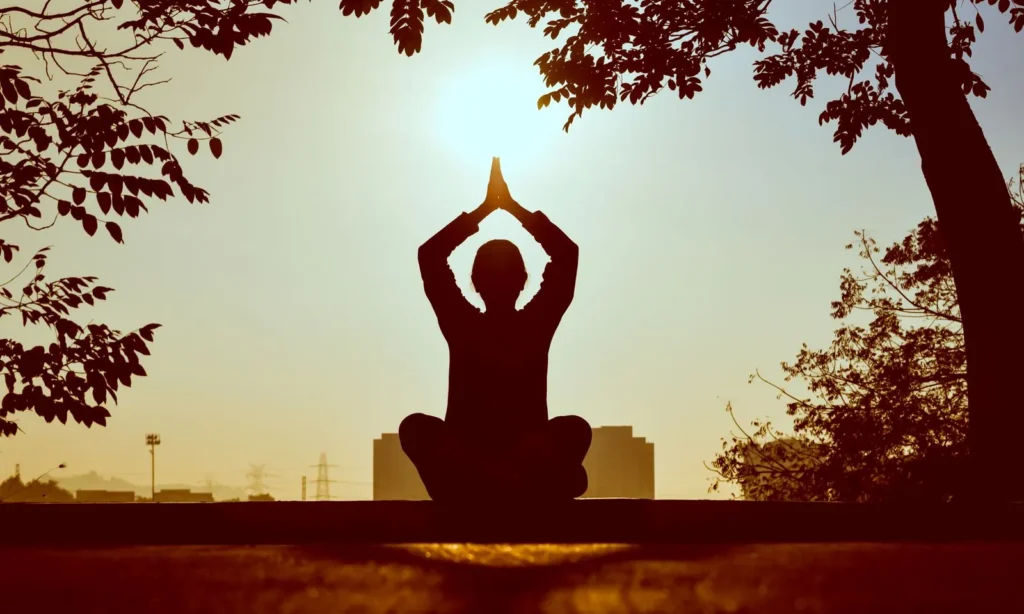
Tapas in yoga is the steady, self-chosen effort you keep up when comfort or mood pulls the other way. It is the third niyama in Patanjali’s eight-limbed path, and its Sanskrit root, tap, means “to heat”. Think of it as a slow, controlled fire that burns off laziness and scattered habits, not as a punishment. This guide covers the tapas meaning in yoga, its three kinds, how to practise it on and off the mat, and how to stop it turning harsh.
What does tapas mean in yoga?
Tapas in yoga means disciplined, sustained effort practised on purpose, even when it is uncomfortable. The word comes from the Sanskrit root tap, “to heat” or “to burn”. In everyday terms, it is the habit of showing up for your practice, say 20 minutes on the mat, long after the first burst of enthusiasm has faded.
In early Vedic texts, tapas described the heat generated by austerities such as fasting and long periods of meditation. By Patanjali’s time it had become something an ordinary householder could use. The Yoga Sutras link sustained tapas with a gradual refining of the body and senses, which is a slow, practical idea: effort repeated daily changes you.
That is why this tapas yoga philosophy matters for modern practitioners. You do not need a cave or a fast. You need a small commitment, kept honestly.
Where does tapas sit among the niyamas?
Tapas is the third of the five niyamas, the personal observances that follow the yamas in Patanjali’s eight limbs. The five are saucha (cleanliness), santosha (contentment), tapas (disciplined effort), svadhyaya (self-study) and ishvara pranidhana (surrender). The yamas guide how you treat others; the niyamas shape how you treat yourself.
| Niyama | Plain meaning | Everyday question to ask |
|---|---|---|
| Saucha | Cleanliness, inner and outer | What clutter, physical or mental, can I clear today? |
| Santosha | Contentment | Can I do my best without being unkind about the result? |
| Tapas | Disciplined effort | What small thing will I do today even if I do not feel like it? |
| Svadhyaya | Self-study | What did I notice about my habits and reactions? |
| Ishvara pranidhana | Surrender to something larger | Can I act fully and then let go of the outcome? |
Of the five, tapas is the one most people struggle with, because it asks for repeated action rather than a single good decision. For the wider framework, see our guide to yamas and niyamas. Tapas works best next to its neighbour santosha, which keeps effort from turning into restlessness.
How does tapas connect to kriya yoga?
Kriya yoga, introduced in Yoga Sutra 2.1, is the “yoga of action” made of three parts: tapas, svadhyaya and ishvara pranidhana. Tapas supplies the effort, svadhyaya (self-study) shows where to aim it, and surrender stops effort from feeding the ego. Together they form a simple daily loop: act, reflect, release the result.
You can run that loop in 15 minutes. Spend 10 on a set practice (tapas), take 3 to note what felt easy, hard or avoided (svadhyaya), and take 2 to sit quietly without grading yourself (surrender). Most people who skip the middle and last steps find their discipline turns brittle within a few weeks.
What are the three kinds of tapas?
Classical yoga thought, echoed in chapter 17 of the Bhagavad Gita, describes tapas on three levels: body, speech and mind. Physical tapas is disciplined action, speech tapas is truthful and useful talk, and mental tapas is cultivating calm and clarity. A balanced practice trains all three, not just the body.
| Kind | What it points to | Everyday practice | When it is overdone |
|---|---|---|---|
| Body | Cleanliness, simplicity, restraint, non-harm | A fixed daily practice time, a regular sleep schedule, moderate meals | Training through injury, crash fasting, sleep sacrificed for practice |
| Speech | Truthful, kind, useful words | Pausing before replying, skipping gossip, keeping small promises | Harsh “honesty” or going silent to avoid every difficult conversation |
| Mind | Steadiness, gentleness, self-restraint | 5 minutes of breath awareness, one screen-free hour in the evening | Suppressing feelings or judging every wandering thought |
Speech tapas overlaps closely with satya, the yama of truthfulness. The Gita also grades tapas by motive: effort done with steady faith and no hunger for reward is treated as the best, effort done for show or praise is shaky, and effort done in confusion or to hurt oneself misses the point. If you want the wider text, our piece on the Bhagavad Gita and yoga sets it in context.
Does tapas mean pushing through pain?
No. Tapas is steady effort, not self-punishment. Sharp, pinching or joint pain, or pain that radiates down a limb, is a signal to stop, not something to push through. Productive discomfort feels like muscular effort or stretch that eases when you leave the pose, while your breath stays smooth and even.
This is the most common misunderstanding of the idea, and it is where tapas needs its companions. Ahimsa, non-harm, sets the limit: discipline never justifies hurting yourself. Brahmacharya, often read as wise use of energy, reminds you to spend effort where it counts instead of burning out on everything. Santosha keeps the target realistic.
Two other myths are worth correcting. Tapas is not only physical, as the three-kind table above shows. And it does not demand dramatic austerity: for most people it looks like a consistent morning routine or a weekly class you actually attend.
If you are pregnant, recovering from surgery or injury, or living with a condition such as high blood pressure, a heart problem or a spinal issue, check with your doctor before intensifying any practice and tell your instructor. For you, choosing rest or a gentler variation on a given day is tapas, not failure.

How do you practise tapas on the yoga mat?
Practise tapas on the mat by fixing a time and length you can keep, then adding small, safe challenges: hold a familiar pose 3 to 5 breaths longer, or return after a missed day without drama. Use your breath as the gauge. If it turns ragged or you hold it, ease off.
Here is a walkthrough you can use in any style, whether a flowing vinyasa class or a slower hatha yoga session:
- Fix the container. Pick a time and a length, for example 7 am for 15 minutes. Decide it the night before so the morning needs no negotiation.
- Add one “stay” per session. In chair pose (utkatasana), keep knees tracking over the second toe, ribs drawn in, weight in the heels, and stay 3 to 5 breaths longer than is comfortable. Modification: bring the feet hip-width apart, or sit back to a wall.
- Hold plank with honest alignment. Shoulders over wrists, ears in line with the spine, lower ribs knitted in. If your lower back sags or wrists complain, drop the knees. Skip or modify if you have wrist injuries or shoulder pain.
- Use the breath test. Smooth inhales and exhales mean you can stay. Gasping, breath-holding or a trembling joint means come out. Staying with a pose that hurts is not discipline.
- Close with 2 minutes of stillness. Lie down or sit quietly. This is where the effort settles in and where surrender, the third limb of kriya yoga, begins.
With back discomfort, work with a qualified teacher and read about yoga for back pain first. Staying present in a pose is only useful if the pose suits your back.
The table below shows a gentle four-week ladder for building the habit without overreaching.
| Week | Daily commitment | Mat challenge | If you miss a day |
|---|---|---|---|
| 1 | 10 minutes, 5 days | Stay 2 breaths longer in two poses | Do 3 minutes of breathing, then carry on |
| 2 | 12 to 15 minutes, 5 days | Add a 5-breath hold in chair pose | Resume the next morning, no catching up |
| 3 | 15 to 20 minutes, 5 to 6 days | Add plank or a standing balance, with modifications | Shorten the session instead of skipping it |
| 4 | 20 minutes, 5 to 6 days | Hold your longest poses for 5 to 8 breaths | Take a planned rest day and note how you feel |
What do you do when your discipline stalls?
Troubleshoot a stalled practice by shrinking it, not abandoning it. Cut the session to 5 minutes, keep the same time of day, and rebuild from there. Showing up briefly protects the habit better than a perfect session you keep postponing.
- Motivation vanished. This is normal and is exactly what tapas is for. Do the 5-minute version and let the mood catch up afterwards.
- You are bored. Rotate styles: a flowing sequence one day, a slow hold-based session the next. Changing the format is not quitting.
- You missed a week. Restart at the previous level, not from guilt. Santosha is the antidote to the “I have ruined it” thought.
- You are exhausted or sore for days. Take a rest day. Overtraining is not tapas, and ahimsa applies to you too.
- Something hurts. Back off, modify, and see a doctor or physiotherapist if it persists beyond a few days.
How does tapas look for different people?
Tapas looks different at each stage of life. A desk worker might protect 10 minutes before opening the laptop; a student might keep a short daily routine through exam weeks; an older adult might choose gentle, consistent sessions over intensity. The common thread is a small commitment that is honestly kept.
- Office workers. After a long commute, a 10-minute session of neck, hip and chest openers kept 5 days a week counts for far more than one long weekend class.
- Beginners. Your tapas is returning to the mat. Do not chase deep poses. Use props such as a folded blanket, a block or a wall.
- Older adults and people with health conditions. Choose chair-supported or gentle sequences and get medical clearance first. Consistency matters more than depth.
- Busy parents. Short, repeatable sessions beat ambitious plans. Five minutes of breathing after the school run is real tapas.
If a guided structure helps you stay consistent, a scheduled online yoga class gives you a fixed appointment, and some people alternate it with online Zumba classes on days they want something livelier.
What do tapasya, tapaswi and “tapas yoga” studios mean?
Tapasya is the lived practice of tapas, the act of austerity or sustained discipline. A tapaswi is a person devoted to that practice. In everyday use the terms overlap, and studios that put “Tapas” or “Tapasya” in their name are usually signalling a discipline-focused, philosophy-friendly approach rather than a particular style of posture.
One note on search confusion: the Spanish word “tapas”, meaning small plates of food, is unrelated to the Sanskrit term and has a different origin.
Frequently asked questions about tapas in yoga
Is tapas the same as self-discipline?
Tapas is closely related to self-discipline but has a purpose beyond willpower. Self-discipline often serves an external goal, such as a deadline or a target weight. Tapas is effort aimed at inner steadiness and clarity, ideally held with humility and without clinging to the result.
What is an example of tapas in daily life?
Examples include practising at the same time every day, waking 20 minutes earlier to do it, speaking truthfully when a comfortable fib would be easier, or keeping a healthy habit going through a stressful month. Each is small, repeated and chosen.
Is tapas only for advanced yogis?
No. Tapas is one of the five niyamas and applies to every practitioner. A beginner practises it by returning to the mat consistently, holding a pose a few breaths longer than feels easy, and keeping a modest routine, whatever their flexibility or experience.
Can tapas become unhealthy?
Yes, when it drifts into ego, perfectionism or self-punishment, such as training through injury or skipping rest. Pairing tapas with ahimsa (non-harm) and santosha (contentment) keeps it sustainable. If discipline begins to feel like fear or compulsion, scale back and talk to a qualified teacher or a health professional.
How is tapas different from tapasya?
Tapas is the underlying principle, the heat of disciplined effort. Tapasya is the practice of it, the lived act of austerity or sustained discipline. In everyday speech the two words are often used interchangeably, so the difference is more about emphasis than a strict rule.
Your next step
If you want a steady structure for building a daily practice, book a trial session in Fitstrot’s online yoga classes and ask your instructor to help you set a 10-minute daily routine for week one.


