

If you are looking for yoga for sciatica, the safest approach is slow, supported, floor-based movement that eases tension around the hips and lower back without forcing the nerve into a stretch. Yoga is not a cure, and it cannot repair a damaged disc. What gentle practice can do is ease stiffness and muscle guarding, and build habits that make flare-ups less likely. Below are seven gentle poses with hold times, six poses to skip, a 15-minute routine and a four-week plan, plus the symptoms that mean you should see a doctor first.
When should you see a doctor before trying yoga for sciatica?
See a doctor before starting if you have numbness, leg weakness, changes in bladder or bowel control, severe or worsening pain, or pain that began after a fall, accident or sports injury. Bladder or bowel changes, or numbness around the groin or inner thighs, need urgent medical care the same day.
Get medical advice first, or stop and call your doctor, if you notice:
- Spreading numbness or pins-and-needles, or numbness in the groin, inner thighs or buttock area
- Weakness in the leg or foot, such as a dragging foot or a leg that gives way
- Difficulty passing urine or stool, leaking, or any new change in bladder or bowel control
- Severe pain, pain that keeps getting worse, or night pain that does not ease with rest
- Pain that began after a fall, road accident or sports injury, or back pain with fever or unexplained weight loss
- No improvement after about four to six weeks of sensible self-care
A doctor or physiotherapist is the right person to tell you what is causing your pain. Never stop or change a prescribed medicine because of a yoga routine, and if you are pregnant, check with your obstetrician first. This article is general information, not medical advice.
What is sciatica, and can yoga help it?
Sciatica is pain that travels from the lower back or buttock down one leg along the sciatic nerve, often with tingling or numbness. It is a symptom, not a diagnosis. Gentle yoga may ease the muscle tightness and stiffness around the area and support recovery, but it does not cure the underlying cause.
Common causes include a herniated (slipped) disc, narrowing of the spinal canal, and a tight piriformis, the small buttock muscle that sits close to the nerve, often called piriformis syndrome. Sciatic nerve pain is usually felt on one side, can burn or feel electric, and often worsens after long sitting.

Because causes differ, the same pose can soothe one person and flare another. Some backs prefer gentle bending, others gentle arching. A physiotherapist can usually tell which direction yours prefers.
Myth check: do you have to stretch hard to free a pinched nerve?
No. A nerve is not a muscle, and pulling hard on it can irritate it further. Aim for a mild stretch in the buttock or back of the thigh, roughly 3 or 4 on a 10-point scale, never a sharp or electric sensation.
Two related myths: no single pose, including pigeon, fixes sciatica for everyone, and long bed rest is not usually advised. Short walks and easy movement are generally better unless your doctor says otherwise.
Seven gentle yoga poses for sciatica: holds, reps and form cues
These yoga poses for sciatica are done lying down or on hands and knees, so gravity is not loading your spine. Breathe out as you ease into each one, and skip any pose that sends pain or tingling further down the leg.
| Pose | How long | Form cue |
|---|---|---|
| Pelvic tilts (knees bent) | 8 to 10 slow reps | Gently flatten the lower back on the exhale, release on the inhale. Small movement only. |
| Cat-cow on hands and knees | 8 to 10 slow rounds | Use about half your range. Move from the pelvis, no forcing at the ends. |
| Knee sway (small supine twist) | 5 breaths per side | Let bent knees drop part of the way, shoulders on the floor. Stop if leg symptoms increase. |
| Reclined pigeon (figure-four) | 30 to 60 seconds per side | Ankle on the opposite thigh, head and back on the floor. Hold lightly, do not pull hard. |
| Supine hand-to-big-toe with strap | 30 to 45 seconds per side | Strap round the foot, knee slightly bent, other foot on the floor. Keep the hips down. |
| Partial bridge | 5 to 8 lifts, 3 to 5 seconds each | Lift only until hips and knees line up. Press through the heels. |
| Legs up the wall | 3 to 5 minutes | Hips a hand-width from the wall, knees soft. Come out if the legs tingle. |
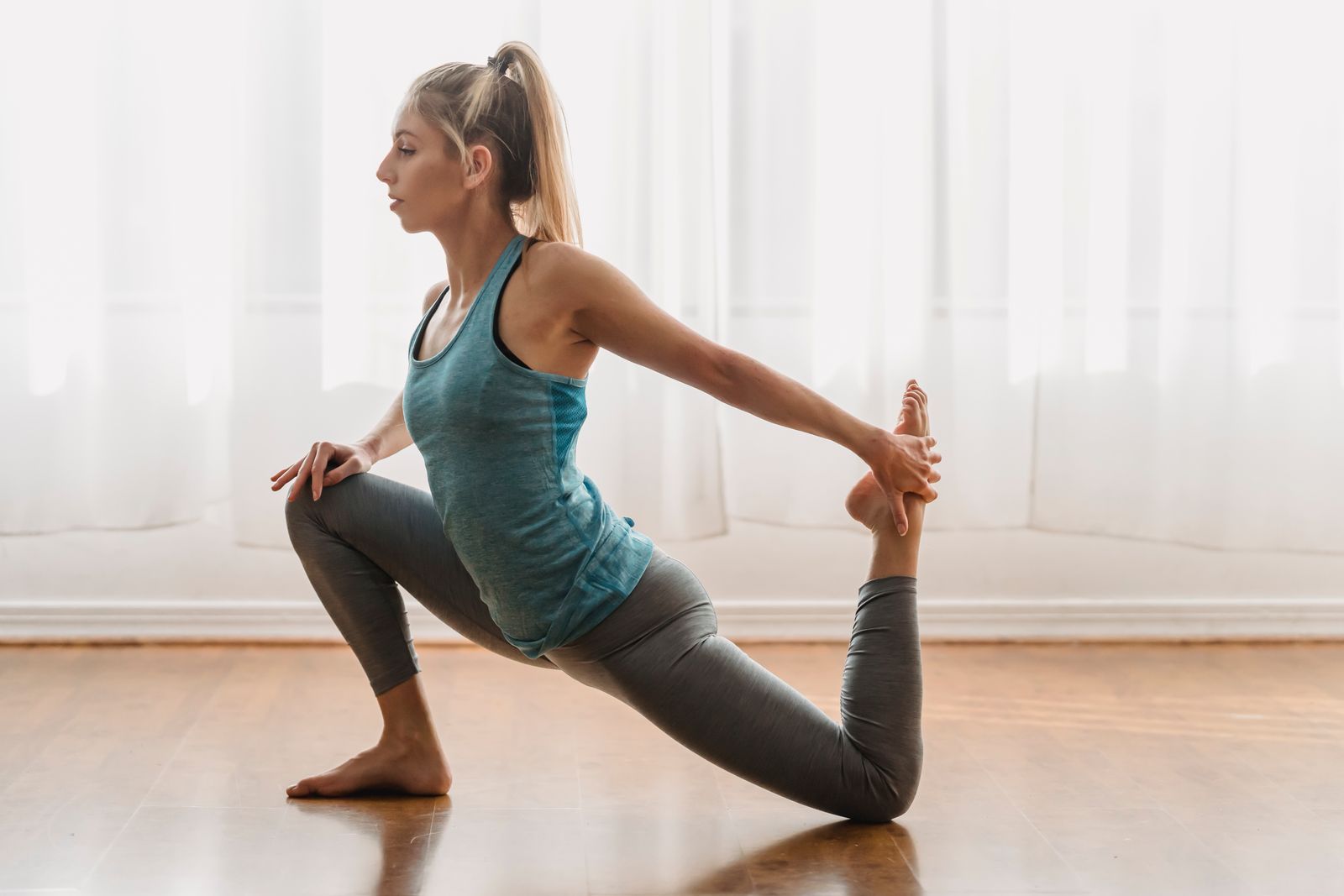
Reclined pigeon pose stretches the piriformis while your spine rests on the floor. If your hip feels pinched rather than stretched, keep the lower foot on the mat. Child’s pose with knees wide and a bolster is another option, but only if bending forward eases your leg symptoms.
A 15-minute daily routine, step by step
Use a firm mat rather than a soft bed. If you search for sciatica ke liye yoga in Hindi, the same rules apply: gentleness matters more than any single asana.
- Breathing, 2 minutes. On your back, knees bent, with a slightly longer exhale than inhale.
- Pelvic tilts, 1 minute.
- Cat-cow, 1.5 minutes.
- Knee sway, 2 minutes. Five breaths each side.
- Reclined pigeon, 2 minutes. One minute per side, or 30 seconds if that is your limit.
- Strap hamstring stretch, 2 minutes.
- Partial bridge, 1.5 minutes.
- Legs up the wall, 3 minutes. Finish with slow breathing.
If you also have general lower back stiffness, the routines in our guide to yoga for back pain can sit alongside this one once your doctor agrees.
Which yoga poses should you avoid with sciatica?
During a flare-up, avoid deep forward folds, deep or closed twists, strong backbends such as full wheel, straight double-leg raises, and fast jump-through vinyasa flows. These can load the lower spine or stretch the nerve sharply. Stay with supported floor poses, and stop any pose that sends pain, tingling or numbness further down the leg.
| Pose to skip for now | Why it can aggravate sciatica | Safer swap |
|---|---|---|
| Standing forward fold (Uttanasana) | Rounds the lower back under load and tugs on the hamstrings | Hands on a chair, knees bent, back flat |
| Seated forward fold (Paschimottanasana) | Strong spinal flexion with straight legs can pull on the nerve | Supine strap hamstring stretch |
| Deep or closed twists, revolved triangle | Combines bending and rotation, which can crowd the nerve root | Small knee sway on your back |
| Full wheel and deep backbends | Heavy compression of an irritated lower spine | Partial bridge, low lifts |
| Straight double-leg raises, boat pose | Strong pull on the lower back and hip flexors | Pelvic tilts, knees bent |
| Full pigeon with the torso folded, splits | Can twist the hip and over-stretch buttock and hamstring | Reclined pigeon on your back |
Troubleshooting: what to do when a pose does not feel right
- Sharp, electric pain or tingling travelling further down the leg: come out slowly and skip that pose. If it keeps happening, tell your doctor.
- The hamstring pulls too hard: bend the knee, lengthen the strap or shorten the hold.
- Pain is worse the next morning: you did too much. Halve the holds and repeat the previous week of the plan below.
- Numbness is increasing or the leg feels weak: stop practising and see a doctor.
How long does yoga take to help sciatica?
There is no fixed timeline. Many sciatica episodes ease within about four to six weeks with or without yoga, so improvement during a gentle four-week plan may partly reflect natural recovery. Practise 10 to 20 minutes most days, and if there is no improvement by four to six weeks, or symptoms worsen, see a doctor.
| Week | Days per week | Session length | What to do |
|---|---|---|---|
| Week 1 | 5 | 8 to 10 minutes | Breathing, pelvic tilts, cat-cow, knee sway, legs up the wall. Pain-free range only. |
| Week 2 | 5 to 6 | 12 to 15 minutes | Add reclined pigeon and the strap stretch, 30 seconds per side. |
| Week 3 | 6 | 15 to 20 minutes | Add partial bridge. Build holds towards 45 to 60 seconds if comfortable. |
| Week 4 | 6 | 15 to 20 minutes | Full routine plus a 10 to 15 minute easy walk. Review progress with your doctor or trainer. |
If a week feels too much, repeat the previous one.
Which yoga style suits a sensitive back?
Slow, floor-based styles such as restorative yoga and gentle hatha suit sciatica best, because they use props, short holds and few transitions. Yin can work once acute pain has settled. Fast vinyasa and power yoga flows are best avoided during a flare-up, because quick transitions can push you past your comfortable range.
Restorative yoga rests you on bolsters, while hatha yoga teaches alignment at an unhurried pace. Keep yin yoga holds short and supported at first. Vinyasa yoga and power yoga can return once you are pain-free. Our overview of types of yoga helps you pick a class.
Sciatica yoga for desk workers, pregnancy and older adults
If you sit most of the day. Long hours at a desk or on a two-wheeler are a common trigger for sciatica pain. Walk for a minute every 30 to 45 minutes, and take a thick wallet out of your back pocket before sitting. Yoga for posture covers simple habits for between meetings.
If you are pregnant. Sciatica is common in the later months, when the growing uterus and loosened pelvic ligaments can press on the nerve. Do not follow a general routine. Speak to your obstetrician first and choose a teacher trained in prenatal yoga.
If you are older, or have spinal narrowing. Use a chair or wall for support, shorten every hold, and ask your doctor which movements to avoid. One-to-one guidance helps, because a teacher can adapt each pose.
What else helps besides yoga for sciatica pain relief?
Short, easy walks keep the spine moving. Sleeping on your side with a pillow between the knees often feels better than lying on your stomach. For pain medicine, ask your doctor or pharmacist what suits you.
Extra body weight adds load to the lower spine, so yoga for weight loss can be a gentle support, as long as you follow the rules above. Legs up the wall also features in yoga for varicose veins. If stress headaches arrive with a back flare, yoga for migraine offers calming options.
Online yoga or in-person: which is safer for sciatica?
In-person or one-to-one sessions are usually safer when sciatica is new, severe or comes with numbness, because a teacher can check alignment and adjust poses in real time. Online classes suit people who already know the basic poses, have a strap and bolster at hand, and can tell comfortable stretch from nerve pain. Tell the teacher about your sciatica before the first class.
Yoga for sciatica FAQ
Is it safe to do yoga with sciatica?
Gentle, supported yoga is generally considered safe for many people with sciatica once a doctor has ruled out serious causes. Start with floor-based poses, keep stretches mild, and stop any movement that sharpens pain or sends tingling down the leg. Do not practise if you have numbness, leg weakness or bladder or bowel changes.
Which yoga pose is best for sciatic nerve pain?
There is no single best pose, because causes differ. Reclined pigeon is a popular choice because it stretches the buttock muscles while your back rests on the floor, and a strap hamstring stretch is another gentle option. Try 30 seconds per side and keep whichever feels comfortable.
Can yoga make sciatica worse?
Yes, if you choose poses that bend or twist the lower back deeply, push into sharp pain or move too fast. Deep forward folds, closed twists and strong backbends are the usual culprits. Practise slowly, use props, and check how your leg feels the next morning.
How often should I do yoga for sciatica?
Short, frequent sessions generally work better than one long class. A sensible range is 10 to 20 minutes on five or six days a week, built up over about four weeks. Cut the time or rest if symptoms flare, and see a doctor if nothing improves after four to six weeks.
Is walking or yoga better for sciatica?
They do different jobs, so many people do both. Short walks keep the spine moving without needing flexibility, while yoga adds gentle hip and hamstring stretching and teaches you to relax around the pain. Begin with whichever is comfortable and build up slowly.
Want a teacher to adapt every pose to your back? Book a session with FitStrot’s online yoga classes and tell your instructor about your sciatica before you begin.


