

If you are looking for yoga for lower back pain, the useful version is slower and smaller than most routines you will find online. The lumbar spine carries much of the load when you sit, lift and bend, so it responds best to gentle movement, short sessions and a careful read of how each pose feels. This guide is about the lower back specifically: which poses suit which kind of ache, a four-week build-up, and what to do on a bad day. It is general information, not a diagnosis, and it does not promise a cure.
If your discomfort spreads across the whole back, start with our broader guide to yoga for back pain. Pain that travels down a leg is a separate nerve question for a doctor.
Can yoga help lower back pain, and is it safe to try?
For simple, muscle-related lower back pain, gentle yoga is generally considered a safe, low-cost way to keep moving, and many people find stiffness eases over two to six weeks of regular 15-20 minute sessions. It is not a cure, it does not suit every cause of pain, and any pose that sharpens the pain should be stopped.
The lower back often hurts because the areas around it are not sharing the work. Tight hips and hamstrings tug on the pelvis, tired glutes and trunk muscles give less support, and the lumbar spine ends up doing the bending. Yoga practises the alternative: moving from the hips, building glute and trunk strength, and slowing the breath. Yoga for lower back pain relief is usually modest and gradual, and works best alongside walking and good sitting habits.
When should you see a doctor before trying yoga for lower back pain?
See a doctor first if your lower back pain comes with numbness, leg weakness, changes in bladder or bowel control, fever, or began after a fall or accident. Also get checked before starting if you are pregnant, have osteoporosis, or the pain wakes you at night or has lasted beyond two to three weeks without easing.
Get urgent medical help the same day if: you cannot control your bladder or bowels, you have numbness around the groin or inner thighs, or weakness in one or both legs is getting worse. Do not do yoga first.
See a doctor or physiotherapist before you start if you have:
- Numbness, tingling or shooting pain that travels down the leg, especially below the knee
- Back pain after a fall, road accident or other injury
- Fever, unexplained weight loss, or pain that is worse at night and does not ease with rest
- Pregnancy, or osteoporosis or fragile bones (twisting and deep forward bending can be unsuitable)
- A diagnosed disc problem, slipped vertebra or past spinal surgery, where your doctor should tell you which movements are fine
- Back pain that started for the first time after about age 50, or pain that has not eased after two to three weeks
Never stop or change prescribed medicines because of a yoga routine. Talk to your doctor about any change.
Which poses match your kind of lower back ache?
Notice when the ache shows up. Stiffness on waking, aching after sitting, pain when bending forward and pain when arching back each respond to different starting points. Use the table below to choose which yoga stretches for lower back pain to try first, begin with the gentle options, and treat it as a guide, not a diagnosis.
| What you notice | Start with | Go easy on |
|---|---|---|
| Stiff on waking, loosens within about 30 minutes | Pelvic tilts, cat-cow, knee-to-chest, child’s pose | Deep forward folds before you have warmed up |
| Aches after long sitting at a desk or on the commute | Bridge, bird-dog, legs-up-the-wall, short walking breaks | Long static holds in seated forward folds |
| Worse bending forward or sitting, easier standing or walking | Pelvic tilts, bird-dog, a few breaths in sphinx if it feels comfortable | Pulling the knees hard to the chest, deep forward folds |
| Worse arching back or standing for long, relieved by curling forward | Knee-to-chest, child’s pose, cat-cow in a small range | Sphinx, cobra, camel, wheel and other backbends |
| Sharp, shooting or electric pain, tingling or numbness | Stop and see a doctor | All stretching until you have been assessed |
Yoga poses for lower back pain: the routine, pose by pose
A beginner yoga for lower back pain routine uses about eight poses: pelvic tilts, knee-to-chest, cat-cow, child’s pose, a supine twist, bridge, bird-dog and legs-up-the-wall. Hold each for 20-60 seconds or repeat 5-10 slow rounds, breathe steadily, and keep every movement inside a comfortable range. The sequence takes roughly 15-20 minutes.
| Pose | How long | Form cue | Stop if |
|---|---|---|---|
| Pelvic tilts (lying, knees bent) | 8-10 slow tilts | Gently flatten the lower back to the floor on the exhale, release on the inhale | You feel pinching or pain |
| Knee-to-chest (Apanasana) | 20-30 seconds per side, twice | Hold behind the thigh, not over the knee; keep the head down | Pain in the back or hip |
| Cat-cow | 8 slow rounds | Move one vertebra at a time; small range is fine | Pain at either end of the movement |
| Child’s pose (Balasana) | 30-60 seconds | Knees wide, hips back toward the heels, forehead on a block or folded blanket | Knee pain or a pulling in the low back |
| Supine twist, knees bent | 20-30 seconds per side | Let the knees fall only as far as is easy; keep both shoulders down | Pain, or any tingling in the leg |
| Bridge (Setu Bandhasana) | 5 reps, 3-5 breaths each | Press through the feet and squeeze the glutes; do not over-arch the lower back | Pain in the lower back, or cramping in the hamstrings |
| Bird-dog | 5 reps per side, 5-second hold | Keep the hips level, as if balancing a cup of tea on the lower back | The back sags or you feel sharp pain |
| Legs-up-the-wall | 3-5 minutes | Hips a hand’s width from the wall; arms relaxed | Numb feet, or pain when the legs are raised |
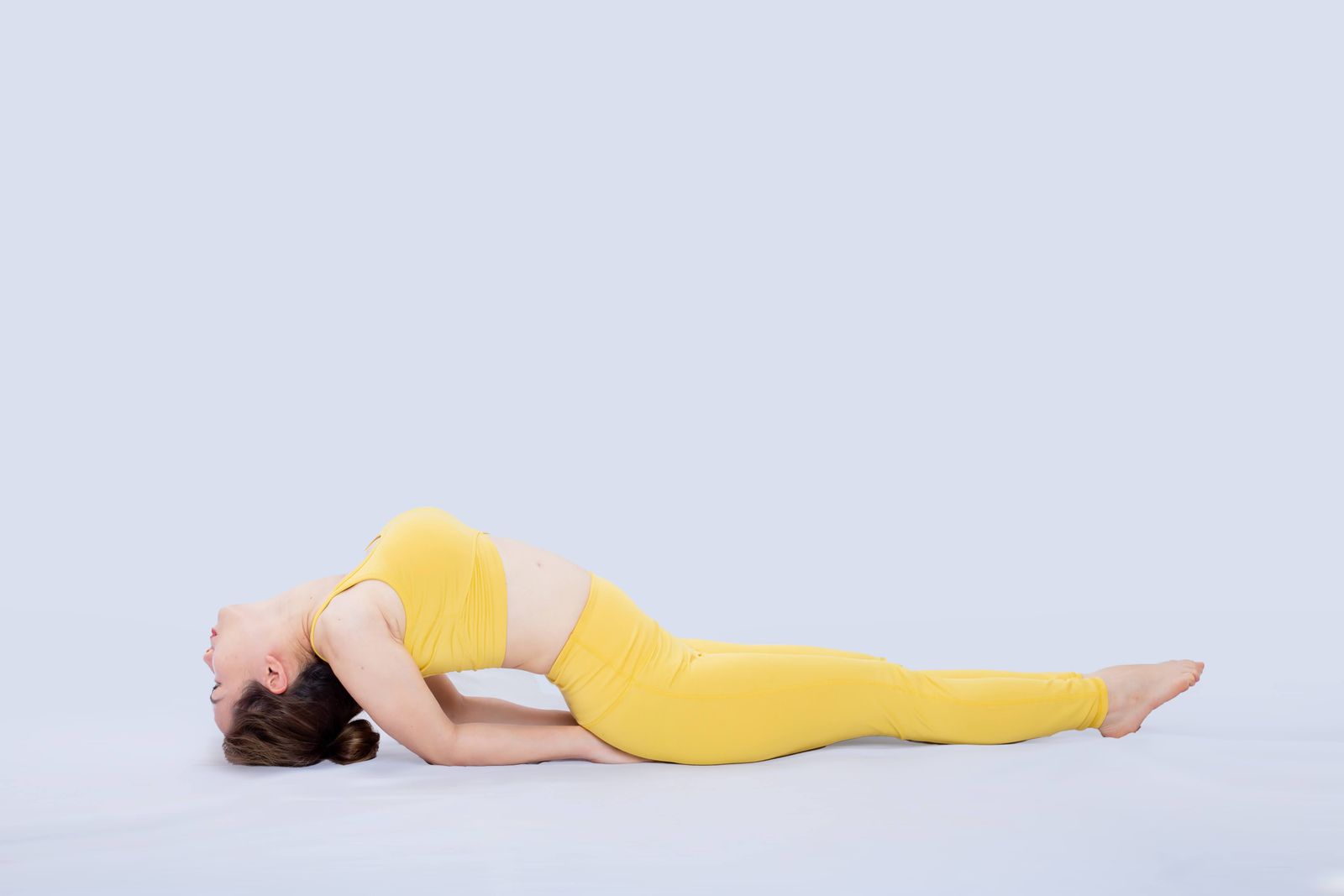
How do you do cat-cow and child’s pose without straining your lower back?
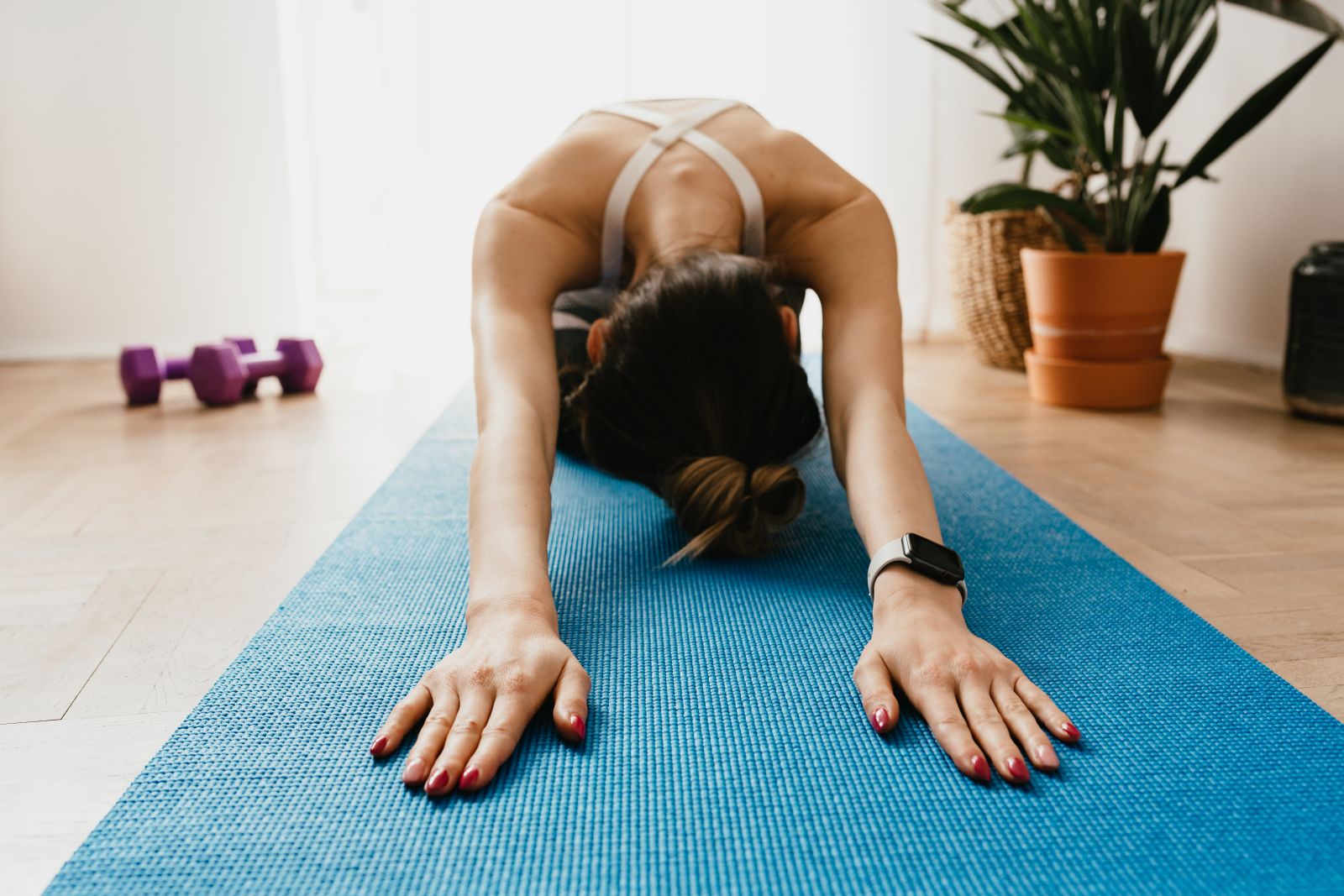
Come onto hands and knees with wrists under shoulders and knees under hips. Inhale to lift the chest and tailbone gently, exhale to round the spine, and repeat 8 slow rounds in a pain-free range. Then sit the hips back into child’s pose with knees wide and rest there 30-60 seconds, breathing into the lower back.
Cat-cow tips. Think of a smooth wave rather than a stretch. If your wrists complain, rest on the forearms; if your knees complain, fold a blanket under them.
Child’s pose tips. Rest the forehead on the mat, a block or a cushion, and reach the arms forward or alongside the body. A pillow between hips and heels helps if the hips do not reach back. Skip this pose if your knees hurt, and ask your doctor first if you are pregnant.
Myth check: does a deeper stretch mean faster relief?
No. For a sore lower back, a deeper stretch usually means more irritation, not faster relief. Gentle movement inside a comfortable range, repeated several times a week, is the more reliable approach, because pushing to your end range tends to set off muscle guarding.
“Touch your toes to fix it.” Being able to touch your toes is not the goal. A rounded, straight-legged forward fold can overload an irritated lower back. Bend the knees and hinge from the hips instead.
“A big twist will put it back in place.” Forced twisting does not reset anything. Keep twists small and slow, and stop at pinching or tingling.
“Push through the ache.” A mild, dull stretch is acceptable. A sharp, burning, electric or radiating sensation means stop. Yoga asanas for lower back pain to skip while sore include full wheel, deep camel, straight-leg forward folds and strong twists. Flowing styles such as vinyasa yoga suit later, once pain has settled and your trunk is stronger. Long yin yoga holds can soothe on quiet days, but not at end range on a flare-up day.
What if a pose hurts, or the pain is worse the next morning?
If a pose causes sharp pain, come out slowly and skip it. If you are simply sorer the next day, halve the time and the number of sessions for a few days. If you feel worse than before you started, or worse after two sessions in a row, pause and have it checked.
- Dull pulling in the hamstrings or hips: usually fine. Ease off by about a third and keep breathing.
- Tingling or buzzing in a leg: come out of the pose and do not repeat it until a doctor or physiotherapist has seen you.
- Cannot get down to the floor comfortably: tilt the pelvis forward and back sitting tall on a chair.
- Pain returns whenever you stop: keep sessions short and see a doctor if it does not improve over two to three weeks.
A four-week build-up, and what to do on a flare-up day
Build slowly: three short sessions in week one, adding one or two poses per week up to about 15-20 minutes on four or five days. On a flare-up day, do only 5-8 minutes of lying-down poses and breathing, and rest if even that feels aggravating.
| Week | Days per week | Session length | What to include |
|---|---|---|---|
| Week 1 | 3 | 8-10 minutes | Pelvic tilts, knee-to-chest, cat-cow, child’s pose |
| Week 2 | 3-4 | 12-15 minutes | Week 1 poses, plus supine twist and legs-up-the-wall |
| Week 3 | 4 | 15-20 minutes | Week 2 poses, plus bridge and bird-dog |
| Week 4 | 4-5 | 15-20 minutes | Full routine; add sphinx only if it feels comfortable; hold a little longer if you feel steady |
| Flare-up day | As needed | 5-8 minutes | Pelvic tilts, knee-to-chest, legs-up-the-wall, slow breathing only |
On flare-up days, supported, quiet practice is the sensible choice, and our guide to restorative yoga shows how to use bolsters and blankets. Legs-up-the-wall also appears in our article on yoga for varicose veins. Doing yoga for lower back pain at home? Our yoga at home guide covers a small corner setup.
Lower back pain yoga for desk workers, over-50s and gym-goers
Desk workers. Long sitting is a common trigger. Stand, walk or do three pelvic tilts every 30-45 minutes, and pair your routine with our guide to yoga for posture.
Over 50, or with bone-density concerns. Choose supported, lying-down or chair-based poses, avoid strong twists and deep forward folds, and get your doctor’s go-ahead first if you have osteoporosis.
Gym-goers and runners. If the back flares, pause heavy hinging and loaded spinal work, then return gradually. A coach can check your form through 1-on-1 personal training.
A note on lower back fat. No pose burns fat from one spot. Fat loss comes from overall food intake and activity, and our guide on yoga for weight loss explains which styles help. Use the poses above as your warm-up on those days.
What if your lower back pain keeps coming back?
Pain that keeps returning, or lasts beyond about three months, needs a proper assessment, not just more lower back pain exercises. Our guide to yoga for chronic pain management covers breathing and pacing, and yoga for migraine shares relaxation techniques for when tension spreads upward.
Questions about yoga for lower back pain
How long does yoga take to help lower back pain?
Many people notice less stiffness within one to two weeks of gentle practice, three to four times a week. Longer-standing pain generally takes several weeks to change, and improvement is usually gradual. If nothing improves after three to four weeks, or it worsens, see a doctor or physiotherapist.
Can I do yoga every day with lower back pain?
For simple muscular pain, a short, gentle session most days is usually fine, if you stay in a comfortable range. Take a lighter day when you feel sorer than usual. With any red-flag symptom, such as leg numbness or weakness, see a doctor first.
Which yoga pose is best to start with when my lower back is stiff?
Pelvic tilts and cat-cow are the usual first steps, because they move the lower back gently without a held stretch. Knee-to-chest and child’s pose make good follow-ups. Use the pain-pattern table above and choose whichever eases, rather than sharpens, the discomfort.
Should I do yoga when my lower back pain is at its worst?
During a severe flare-up, do only short lying-down movements and slow breathing, or rest. Skip stretches, twists and backbends until it settles. If pain is severe or comes with numbness, leg weakness, bladder or bowel changes, or an injury, get medical help instead.
Can yoga make lower back pain worse?
Yes, if poses are forced, if deep backbends, straight-leg folds or strong twists come too soon, or if you push through sharp pain. Keep your range comfortable, build up slowly, and learn the poses from a qualified teacher who can adapt them to your back.
Get guided help for your lower back
Join a live online yoga class with FitStrot and tell your teacher about your back before the session, so poses can be adjusted and progressed at your pace.


