

In yoga philosophy, svadhyaya means self-study: the steady habit of observing your own thoughts, reactions and motives, and checking them against wise texts and honest feedback. It is the fourth of the five niyamas (personal observances) in Patanjali’s Yoga Sutras, and it works closely with ahimsa and satya. This guide covers the meaning, the source, a seven-day starter plan, how to practise on and off the mat, and the usual ways the practice goes wrong.
What does svadhyaya mean?
Svadhyaya is Sanskrit for self-study. It joins “sva” (one’s own, the self) and “adhyaya” (a lesson, reading or chapter), so it literally means “one’s own reading”. In practice it is a daily habit of watching your thoughts, reactions and motives, supported by reading wise texts, so that you know yourself accurately rather than flatteringly.
Some teachers hear a second root, “dhyaya”, meaning to contemplate, which shifts the sense from reading toward reflecting. Both readings agree on the essentials: svadhyaya is active, repeated and lifelong. You do not “finish” it the way you finish a course. The word also appears in older Vedic literature, including the Taittiriya Upanishad, where regular study is treated as a lifelong duty rather than a stage of life.
Where does svadhyaya appear in the Yoga Sutras?
Patanjali lists svadhyaya in Yoga Sutra 2.32 as one of the five niyamas, after saucha (cleanliness), santosha (contentment) and tapas (disciplined effort), and before Ishvara pranidhana (surrender). Sutra 2.1 groups tapas, svadhyaya and Ishvara pranidhana as kriya yoga, and sutra 2.44 is usually translated as self-study leading to contact with one’s chosen ideal.
These five niyamas form the second limb of the eight-limbed path, right after the yamas, which include brahmacharya. If you want the wider picture of the eight limbs, our guide to Ashtanga yoga explains how Patanjali’s “ashtanga” differs from the modern posture style that borrows the name.
How is svadhyaya different from the other four niyamas?
Svadhyaya is the observational niyama. Saucha cleans, santosha accepts, tapas builds effort and Ishvara pranidhana lets go, but svadhyaya looks. It shows you which habits drain discipline and what stirs your discontent, which is why the other four tend to stay decorative without it.
| Niyama | Plain meaning | The question it asks | An everyday Indian example |
|---|---|---|---|
| Saucha | Cleanliness of body, space and mind | What am I taking in and keeping around me? | Clearing the cluttered work desk or the endless forwarded messages |
| Santosha | Contentment with what is | What do I already have that I overlook? | Noticing a good meal at home before scrolling other people’s holidays |
| Tapas | Disciplined effort | What small effort will I repeat today? | Getting on the mat at 6:30 am when the bed is warm |
| Svadhyaya | Self-study | What am I actually doing, and why? | Noticing you snap at family every evening after a stressful commute |
| Ishvara pranidhana | Surrender to something larger than the ego | What can I stop gripping? | Doing your best for an exam, then releasing the outcome |
Notice the order of operations. You cannot practise real contentment if you have never examined what triggers your discontent, and you cannot strengthen discipline if you do not know which habits undermine it. Svadhyaya is the diagnostic step that makes the rest practical instead of aspirational.

Myth: svadhyaya just means reading scripture
In its classical setting, svadhyaya did centre on reciting and studying sacred texts such as the Vedas, the Upanishads and later works. But reading alone is only half the practice. The point of the text is to act as a mirror: you read a passage, then ask what it reveals about your own behaviour. Reading without that inward turn is just study.
The Bhagavad Gita and yoga are a popular starting point because the Gita is built around a person in crisis. Arjuna questions his duty, his fear and his identity, and the dialogue models the same questions svadhyaya asks of you: what is my role, what is my nature, and which patterns keep me stuck. Read it in a translation you genuinely understand, whether that is English, Hindi or your mother tongue. A few verses read slowly beat a chapter skimmed.
Modern teachers widen the definition to any honest reflective material: a commentary from a teacher you trust, a line from the Yoga Sutras, or your own journal reread a month later. The book matters less than how you use it.
How do you start a svadhyaya practice in seven days?
Start with ten minutes a day for one week. Each day has one small task: write a baseline, log a trigger, read a few verses, watch your body on the mat, ask for feedback, reread your notes, then pick one pattern to test. A week is short enough to finish and long enough to show a first pattern.
| Day | 10-minute task | Prompt to write down |
|---|---|---|
| 1 | Baseline entry, before or after your usual practice | How did today actually go, and how do I feel about it? |
| 2 | Trigger log: note one moment of irritation, envy or defensiveness | What was I protecting or wanting just then? |
| 3 | Read a few verses of a text you trust, slowly | Which line unsettled or confused me, and why? |
| 4 | Notice your body and breath during your yoga session | Which pose did I avoid, rush or force? |
| 5 | Ask one trusted person for one honest observation | What did I feel when I heard it, and was any of it true? |
| 6 | Reread days 1 to 5 and underline anything that repeats | What shows up more than once? |
| 7 | Choose one pattern and one tiny experiment for next week | What small change will I try, and how will I notice it? |
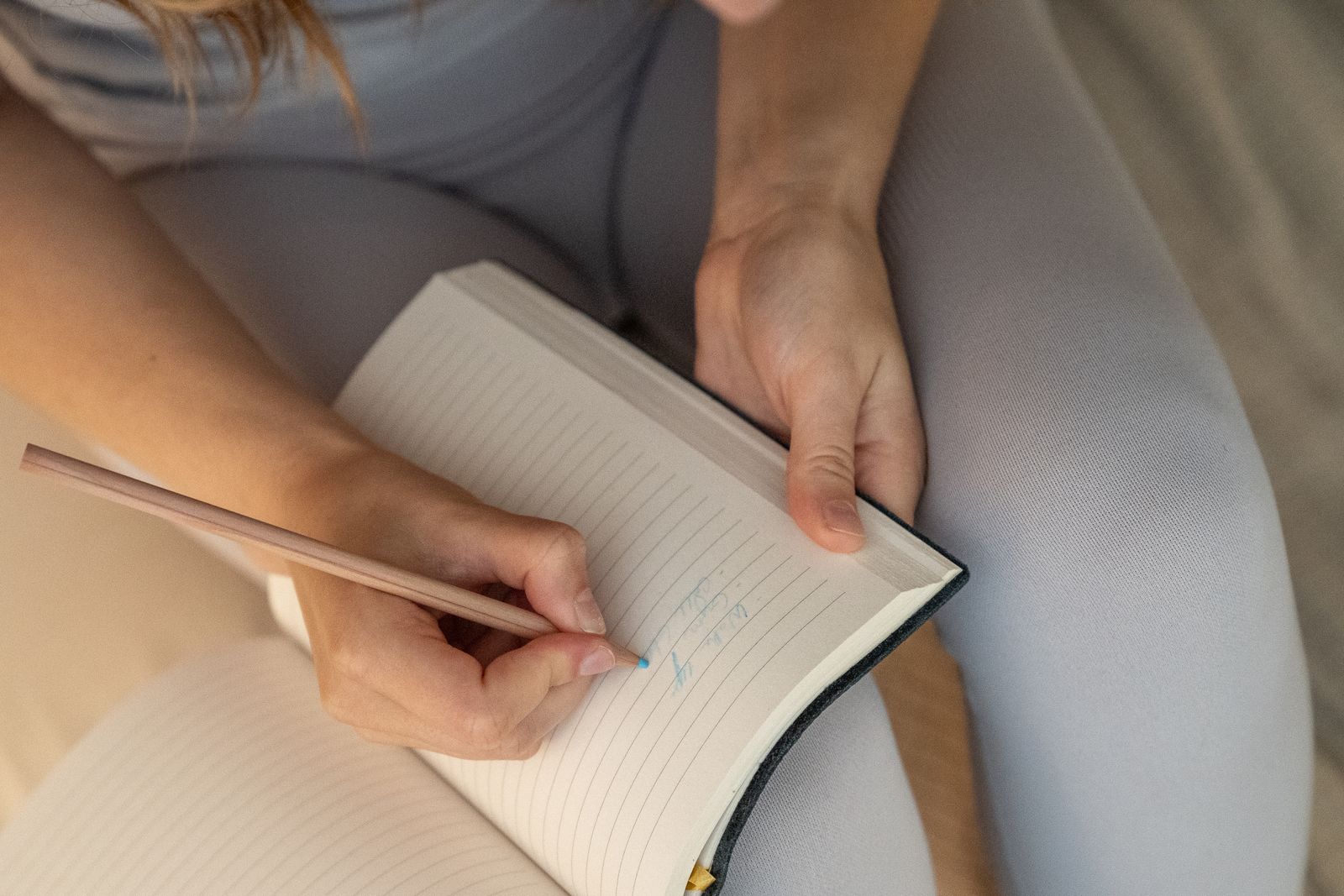
Three habits keep the journal useful. Pick a consistent time, because the mind is usually quieter after your yoga or first thing in the morning. Answer one prompt rather than free-writing aimlessly. And reread weekly, since a pattern is almost invisible in a single entry but obvious across five. Keep the tone of a scientist reviewing data, not a judge delivering a verdict.
How do you practise svadhyaya on the mat?
On the mat, svadhyaya means paying attention to how your body, breath and mind respond during the practice, instead of repeating poses on autopilot. Watch which poses you avoid, how your breath changes in a hard hold, and what story runs when you compare yourself with others. Record it afterwards in two lines.
- Which poses do you skip or rush? Ask honestly whether the cause is physical (tight hips, a sore wrist), boredom, or a story you tell about your limits. Only the physical reasons need adapting the pose; the others need attention.
- What does your breath do in a hard hold? A short, gripping breath often mirrors how you handle difficulty elsewhere. Try lengthening the exhale and see whether the effort changes.
- Do you compare yourself with the person on the next mat or screen? Note it without scolding yourself, then return to your own breath.
- What happens in the final rest? Use savasana as a few minutes of unfiltered observation rather than sleep or phone-checking.
One firm line: self-study is not a licence to push through pain. Sharp, pinching or joint pain means stop and adjust, and if it persists, speak to your doctor or physiotherapist. Studying yourself includes studying your limits with respect. This attentiveness turns vinyasa yoga or hatha yoga from plain exercise into a self-study tool.
Who benefits most from svadhyaya, and how should each person start?
Anyone can use svadhyaya, but the useful starting point differs. Students tend to benefit from watching comparison and exam pressure, working people from watching reactions to deadlines, and caregivers from watching irritability and exhaustion. Five minutes a day aimed at your most common stress pattern is enough to begin.
| Who | A pattern worth studying | A five-minute svadhyaya practice |
|---|---|---|
| Students preparing for exams | Comparing marks or ranks with friends; panic before mock tests | Each night write one thing you did well in study and one moment you spiralled; note the trigger |
| Office professionals | Snapping at colleagues or family after a long day or commute | On the way home, name the strongest feeling of the day and what set it off |
| Parents and caregivers | Irritability when tired; putting your own needs last until you burn out | Before bed, note the moment you lost patience and what you needed at that time (food, rest, quiet) |
| Regular yoga practitioners | Chasing advanced poses; ignoring the days the body asks for less | After class, write what you pushed, what you avoided and what you would do differently |
Troubleshooting: when self-study turns into self-criticism
Svadhyaya observes; it does not prosecute. These are the failure modes that most often derail it, with fixes.
- Every entry is a list of faults. Add one neutral fact and one thing that went reasonably well to each entry, and write in the third person if first person feels harsh.
- It stays purely intellectual. If you read philosophy but never connect it to a real reaction from this week, add one line: “Where did this show up for me?”
- It is irregular. Patterns appear only across repeated observation, so five honest minutes daily beat a two-hour session once a month.
- It becomes an excuse. “I’m just observing my anger” can postpone the harder work of changing. Once a pattern is clear, pick one small behaviour to adjust.
- It spirals into rumination. If journaling leaves you replaying the same worry or feeling lower for weeks, stop the exercise and talk to a counsellor, psychologist or doctor.
Self-reflection is a supportive habit, not a treatment. If you are managing anxiety, depression or another diagnosed condition, treat svadhyaya as a complement to professional care, never a replacement. It pairs well with a calming movement practice such as yoga for anxiety, where the reflective piece helps the calm last beyond class.
Is there a difference between svadhyaya and swadhyaya yoga?
No. “Svadhyaya” and “swadhyaya” are two English spellings of the same Sanskrit word, स्वाध्याय, and carry the same meaning. “Swadhyaya yoga” is a phrase some teachers and searchers use for self-study as a theme within yoga, not a separate style like Kundalini yoga.
If an article or class description uses “swadhyaya”, it refers to the same fourth niyama discussed here. Pronunciation is roughly “sva-DHYAH-yah”, with the stress near the middle.
How do the yamas, the niyamas and svadhyaya work together?
Svadhyaya is the observing part that makes the other practices honest. The yamas guide how you deal with the world; the niyamas guide your inner discipline. Svadhyaya helps you notice where you fall short of ahimsa, satya or brahmacharya, so you can adjust with specific facts rather than vague guilt.
Practising ahimsa, or non-harm, needs svadhyaya to spot the subtle ways you speak unkindly to yourself. Practising satya, or truthfulness, needs it to catch the small dishonesties you tell yourself before you tell them to others. And brahmacharya, often read as wise use of energy, needs it to reveal where your energy actually goes versus where you assume it goes. A simple evening check covers all three: where was I unkind, where was I untruthful, where did I waste energy?
Frequently asked questions about svadhyaya
Is svadhyaya only about reading scripture?
No. The classical root is reciting and studying sacred texts, but contemporary practice includes any honest self-observation: journaling, noticing emotional patterns, or reflecting on your reactions in a yoga class. Reading is one valid method, and many practitioners practise svadhyaya well through daily reflection alone.
How often should I practise svadhyaya?
Daily, even briefly. Five to ten minutes of reflection or journaling at a consistent time reveals recurring habits that a single long session would miss. Reread your notes once a week, because the value of svadhyaya comes from patterns across time, not from any one entry.
Do I need a teacher to practise svadhyaya?
Not strictly, but a teacher helps. They can explain difficult texts and offer honest feedback, which matters because self-observation has blind spots. You can start alone with a journal and quiet reflection, then add guidance from a teacher or mentor when questions pile up.
What is the difference between svadhyaya and mindfulness meditation?
Mindfulness mainly trains present-moment awareness without analysing content. Svadhyaya is more investigative: it looks at patterns, texts and motives over time and draws conclusions about your tendencies. The two overlap and support each other, so many people use both.
Can svadhyaya help with anxiety or stress?
It can ease reactivity for many people, because observing thoughts before reacting creates a small gap between trigger and response. It is a complement, not a treatment. If anxiety is persistent or affects daily life, see a qualified mental health professional alongside any yoga practice.
To try self-study inside a guided session, book an online yoga class with Fitstrot and use the seven-day plan above as your reflection prompts after each class.


