

The seated cable row is one of the easiest back exercises to do badly and one of the most productive when you do it well. You sit at a low-pulley station, brace your feet on the plate, and pull a handle to your lower ribs while your torso stays still. Done properly, the seated cable row loads your mid-back, lats, rear delts and biceps with steady tension from the first centimetre to the last. This guide covers setup, handle choice, common faults, sets and reps, and who should adjust the movement.
What does the seated cable row train, and why use it?
The seated cable row is a horizontal pull on a low-pulley machine. It mainly works the middle trapezius, rhomboids and lats, with the rear delts and biceps assisting and the spinal erectors and core holding your posture. Because the cable never goes slack, the muscles stay loaded through the whole rep, and the seated position removes most balance demands.
That is why coaches keep it in nearly every pulling day: you can load it in small steps, change emphasis by switching handles, and repeat it for clean volume without the fatigue deadlifts bring. If you sit at a desk with rounded shoulders, it also strengthens the muscles that pull your shoulder blades back.
- Middle traps and rhomboids: squeeze the shoulder blades together at the end of each pull.
- Latissimus dorsi: drive the elbows back and down, more so with a close, neutral grip.
- Rear delts: help move the upper arm behind the body, more so with wide grips.
- Biceps and forearms: bend the elbow and hold the handle.
- Spinal erectors, glutes and abs: keep your torso tall and still so the back does the work.
How do you do a seated cable row with proper form?
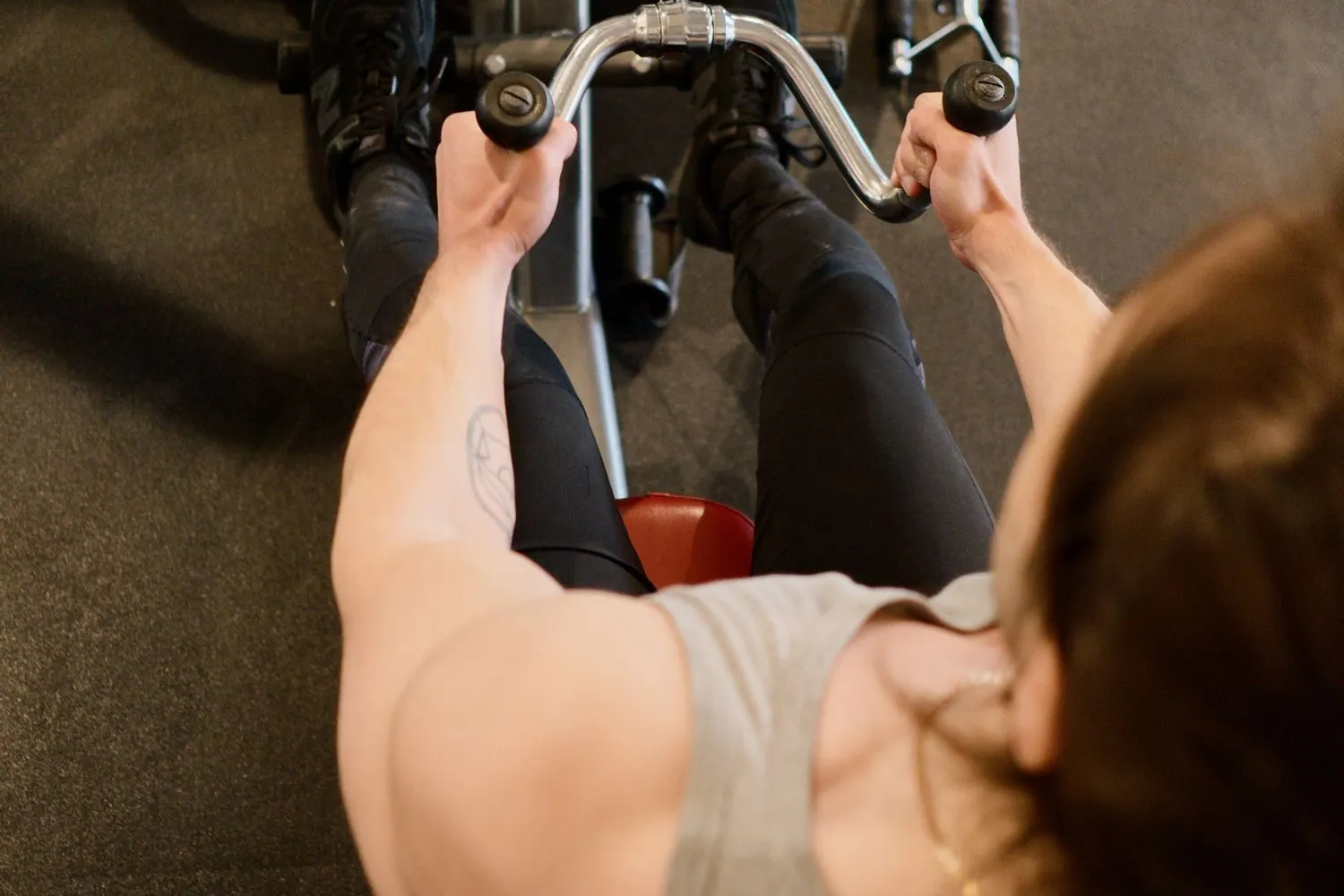
To do a seated cable row correctly, sit tall with knees slightly bent, grab the handle, and start the pull by drawing your shoulder blades back. Then bend your elbows and bring the handle to your lower ribs. Pause for one second, then return over about three seconds. Your torso should move only a few degrees.
- Set the seat and feet. Place both feet on the footplate with a soft bend in the knees, not locked straight. Sit so the cable runs roughly level with your lower ribs when your arms are extended.
- Pick up the handle safely. Lean forward, grab it, then sit upright before you take the weight. Do not yank the stack up from a rounded position.
- Brace. Ribs stacked over hips, chest proud but not flared, eyes forward.
- Start with the shoulder blades. Draw them back and down first, as if tucking them into your back pockets. Then let the elbows follow.
- Pull to the lower ribs. Elbows travel close to your sides and past your torso.
- Pause and squeeze. Hold for about one second with your shoulders down, not shrugged toward your ears.
- Return slowly. Let the arms straighten and the shoulder blades glide forward, feeling a stretch in the lats. Keep the spine neutral; do not let your upper back collapse into a curve to chase extra range.
A simple tempo to follow is 1 to 2 seconds pulling, a 1 second squeeze, and 3 seconds returning. Slowing the return is the quickest upgrade for most people because it stops the weight stack from dragging you forward.
Which seated cable row handle should you pick?
The V-bar (close, neutral grip) is the best default for a seated cable row because it lets you pull deep and loads the lats and mid-back together. A straight bar or wide handle shifts more work to the upper back and rear delts, while a rope lets your hands separate for a longer squeeze. Rotate handles every 3 to 4 weeks.
| Handle | Grip | Main emphasis | Best for | Cue |
|---|---|---|---|---|
| V-bar (close grip) | Neutral, palms facing | Lats and mid-back | Default choice, heavier sets | Elbows brush your ribs |
| Straight bar, shoulder width | Underhand | Lower lats, biceps | Strength-focused sets | Pull to the belly button |
| Wide bar | Overhand | Upper back, rear delts | Upper back thickness | Elbows flare to about 45 degrees |
| Rope | Neutral, hands separate at the end | Rear delts, rhomboids | Lighter, high-rep finishers | Pull ends beside the ribs |
| Single handle | Neutral, one arm | Each side separately | Fixing left-right gaps | Keep hips square, do not twist |
Learn the close-grip V-bar seated cable row first. Once form is steady, swap in the wide bar or rope on alternate weeks, much like the attachment changes in a cable crossover workout for the chest.
Myth check: does leaning back make the seated cable row harder?
No. Leaning back and swinging your torso lets the hips and lower back move the weight, so your lats and mid-back do less work. A strict seated cable row with a still torso at a lighter load builds more back than a sloppy rep with a heavier stack. Small, controlled hip movement is fine; big rocking is not.
A second myth is that the row should be felt in your lower back. A tired lower back means your spine is doing work that belongs to your upper back, so check your setup and drop the weight. Think of your hands as hooks: the pull is driven by the elbows moving back and the shoulder blades moving together.
Why does your seated cable row feel wrong? Troubleshooting
Most seated cable row problems come from the same few faults: too much weight, shoulders shrugging, a rounding spine, or a poor seat position. Match what you feel to the fix below, change one thing at a time, and film one set from the side to check your torso angle.
| What you notice | Likely cause | Fix |
|---|---|---|
| Lower back burns or aches | Rocking, rounding or leaning back too far | Cut the weight by 20 to 30 percent, brace, keep ribs over hips |
| Neck and upper traps tighten | Shrugging the shoulders | Start each rep by pulling shoulders down and back, not up |
| Only your biceps feel it | Arm-first pull, shoulder blades not moving | Pause at the start, retract the blades, then bend the elbows |
| Handle stops short of your body | Weight too heavy or elbows flaring | Lighten the load, tuck elbows closer, shorten your stretch |
| Hamstrings or hips feel tight | Legs fully locked or seat too far back | Keep a soft knee bend, slide closer to the stack |
| Fingers or forearms give out first | Grip is the limiter | Use a closer handle, add straps only on the last heavy sets |
| One side pulls harder | Natural strength gap | Add single-arm rows and match reps on both sides |
A tip for Indian gym floors: many cable stacks jump in 5 kg steps. If the next plate is too heavy, use the small add-on weight if there is one, or stay on the lower plate and slow the return.
How many sets and reps should you do?
For muscle growth, do 3 to 4 sets of 8 to 12 reps on the seated cable row, resting 60 to 90 seconds and stopping about 1 to 2 reps short of failure. For strength, use 4 to 5 sets of 6 to 8 reps with roughly 2 minutes rest. Add weight only when every rep stays strict.
| Goal | Sets | Reps | Rest | Effort | Tempo |
|---|---|---|---|---|---|
| Learn the movement | 2 to 3 | 12 to 15 | 60 sec | Easy, 3 to 4 reps in reserve | 2 sec pull, 3 sec return |
| Build muscle | 3 to 4 | 8 to 12 | 60 to 90 sec | 1 to 2 reps in reserve | 1 to 2 sec pull, 3 sec return |
| Build strength | 4 to 5 | 6 to 8 | About 2 min | 1 to 2 reps in reserve | Controlled pull, 2 sec return |
| Posture and endurance | 2 to 3 | 15 to 20 | 45 to 60 sec | Moderate | 2 sec pull, 2 sec squeeze |
Place it after your heaviest pull of the day, whether that is a deadlift variation, a pull-up or a lat pulldown, so you still have the energy to keep it strict. A sample session looks like this:
- Lat pulldown or assisted pull-up: 3 sets of 8 to 10
- Seated cable row (V-bar): 4 sets of 10 to 12
- Single-arm dumbbell row: 3 sets of 10 per side
- Rope face pull: 3 sets of 15
For exercise ideas around this lift, see our guides to cable back workouts, lat workouts and a full gym back workout routine. If you want it slotted into a weekly schedule, our workout plan guide shows how to spread push, pull and leg days.
Seated cable row vs lat pulldown vs dumbbell row
The seated cable row pulls toward you horizontally and builds back thickness, the lat pulldown pulls down from overhead and builds width, and the dumbbell row trains one side at a time with a longer stretch. They overlap, but they are not the same movement, and a balanced back day often includes more than one.
Treat the seated cable row as your controlled volume lift. It is stable, easy to load in small steps, and kinder to the lower back than a bent-over barbell row, which makes you hold a hinge for the whole set. Choose the lat pulldown when you want a broader upper back or are working toward pull-ups.
The single-arm dumbbell row is your accessory. It exposes left-right gaps a two-handed cable row can hide, and it only needs a bench and a dumbbell. A reasonable rule: cable row first for volume, dumbbell row after for balance, and a vertical pull somewhere in the same week.
Who should change the seated cable row?
Beginners, desk workers, people with back discomfort and lifters with long torsos can all use the seated cable row, but each should tweak the setup. Start lighter, shorten the range if your spine rounds, and stop any rep that causes sharp or radiating pain. Persistent pain needs a doctor or physiotherapist, not more weight.
- Beginners: start with 2 sets of 12 to 15 using a weight you could do for 5 or more extra reps. Learn the shoulder blade pull before chasing load.
- Women lifting for tone and posture: there is no special row for women. The same form, 8 to 15 reps and gradual loading apply. Heavy rows will not make you bulky; they build the upper back that supports good posture.
- Lower back sensitivity: the seated position is usually easier on the back than a bent-over row, but keep the load light, avoid deep forward leaning at the start, and stop if pain appears. See a doctor if it persists or spreads down a leg.
Be realistic about timelines too. With 2 pulling sessions a week, steady protein intake and enough sleep, most beginners feel stronger within 3 to 4 weeks, but visible back changes usually take a few months. No single exercise guarantees results.
Frequently asked questions about the seated cable row
Which muscles does the seated cable row work?
The seated cable row works the middle trapezius, rhomboids and latissimus dorsi most, with the rear delts and biceps assisting. Your spinal erectors, glutes and abs hold your torso steady during every rep. Changing the handle or elbow angle shifts the emphasis between the lats and the upper back.
Is the seated cable row good for lats?
Yes, especially with a close neutral grip such as a V-bar, where you drive the elbows back along your sides and finish with a stretch on the return. For lat width, combine it with a vertical pull like a lat pulldown or pull-up, which trains the lats from overhead.
How heavy should a seated cable row be?
Choose a weight you can pull for 8 to 12 clean reps with 1 to 2 reps left in the tank. Your torso should stay nearly still and your shoulder blades should visibly retract. If you must lean back or shrug to finish a rep, drop the weight by 10 to 20 percent.
Can beginners do the seated cable row?
Yes. It is one of the friendlier back exercises for beginners because the seat and footplate give you support and the movement is easy to learn. Start with 2 sets of 12 to 15 light reps, focus on pulling with the shoulder blades, and add weight in small steps over several weeks.
What is a good seated cable row alternative at home?
A single-arm dumbbell row, a resistance band row anchored to a door or sturdy post, or an inverted row under a firm table are good substitutes. Aim for 8 to 15 reps per set.
If you want someone to check your setup and build the week around your gym and schedule, book a 1-on-1 session with a Fitstrot coach through our 1-on-1 personal training service, and bring a short video of your row for the first review.


