

Online yoga classes for kids are live or recorded sessions taught over video, built around play, stories and short poses instead of long holds. Most families do well with 20 to 40 minutes, two or three times a week, with an adult nearby. This parents’ guide covers age bands, session length, home safety and what a good class actually looks like.
How do online yoga classes for kids work?
A kids’ online class is a video session of 15 to 45 minutes where an instructor leads breathing games, themed poses such as animals or superheroes, and a short relaxation at the end. Live groups, 1-on-1 sessions and recorded videos are the three formats, and each suits a different child.
The teaching is different from an adult class. Instructions are short, poses get names like “tree” or “cobra”, and the teacher keeps changing activity every few minutes. If you have taken online yoga classes yourself, the technology will feel familiar, but the pacing is closer to a game than a studio session. Compared with searching for yoga classes near me, the online route saves travel time, which matters in cities where a 30-minute class can cost an hour on the road.
What age can a child start, and how long should each session be?
Children can start from about age 3 with a parent beside them, and most programmes work best from 5 onwards. Session length should follow attention span: roughly 10 to 15 minutes for ages 3 to 4, 20 to 30 for ages 5 to 8, and 30 to 45 minutes for ages 9 and above.
| Age band | Session length | Times per week | What the class feels like | Parent role |
|---|---|---|---|---|
| 3 to 4 years | 10 to 15 min | 1 to 2 | Animal sounds, movement games, one or two simple poses | On the mat beside the child |
| 5 to 8 years | 20 to 30 min | 2 to 3 | Story-led sequence, balance games, breathing with a soft toy | In the room, helping with the device |
| 9 to 12 years | 30 to 40 min | 2 to 3 | Simple sun salutations, longer holds, partner or challenge poses | Nearby, occasional check-ins |
| 13 to 17 years | 40 to 45 min | 2 to 3 | Close to adult beginner level, with focus on posture and calm | Mostly independent |
These are starting points, not rules. A restless 6-year-old may do better with 20 minutes than 30, and extending slowly is better than forcing a long class. Teenagers who like structure can look at hatha yoga basics or a gentle vinyasa flow, and our guide to types of yoga helps match a style to the child.
What does a kids’ class look like, minute by minute?
A well-run 30-minute class for ages 6 to 9 follows the same arc every time: settle, warm up, move through 8 to 10 poses tied to a story, play one game, then relax. Children like knowing what comes next, and the repeated order helps them settle faster by the third week.
| Minutes | Segment | What happens |
|---|---|---|
| 0 to 4 | Settle in | Greeting, a breathing game such as “balloon breath” or a soft toy on the belly |
| 4 to 9 | Warm-up | Walking like a lion or swimming like a fish, with no formal poses yet |
| 9 to 22 | Story poses | Cat-cow, tree, mountain, cobra, child’s pose, a gentle bridge, linked by a short adventure |
| 22 to 26 | Game | Yoga freeze dance, balance challenge or a partner pose with a sibling |
| 26 to 30 | Wind-down | Lying-down relaxation, guided imagery, one calm breath to finish |
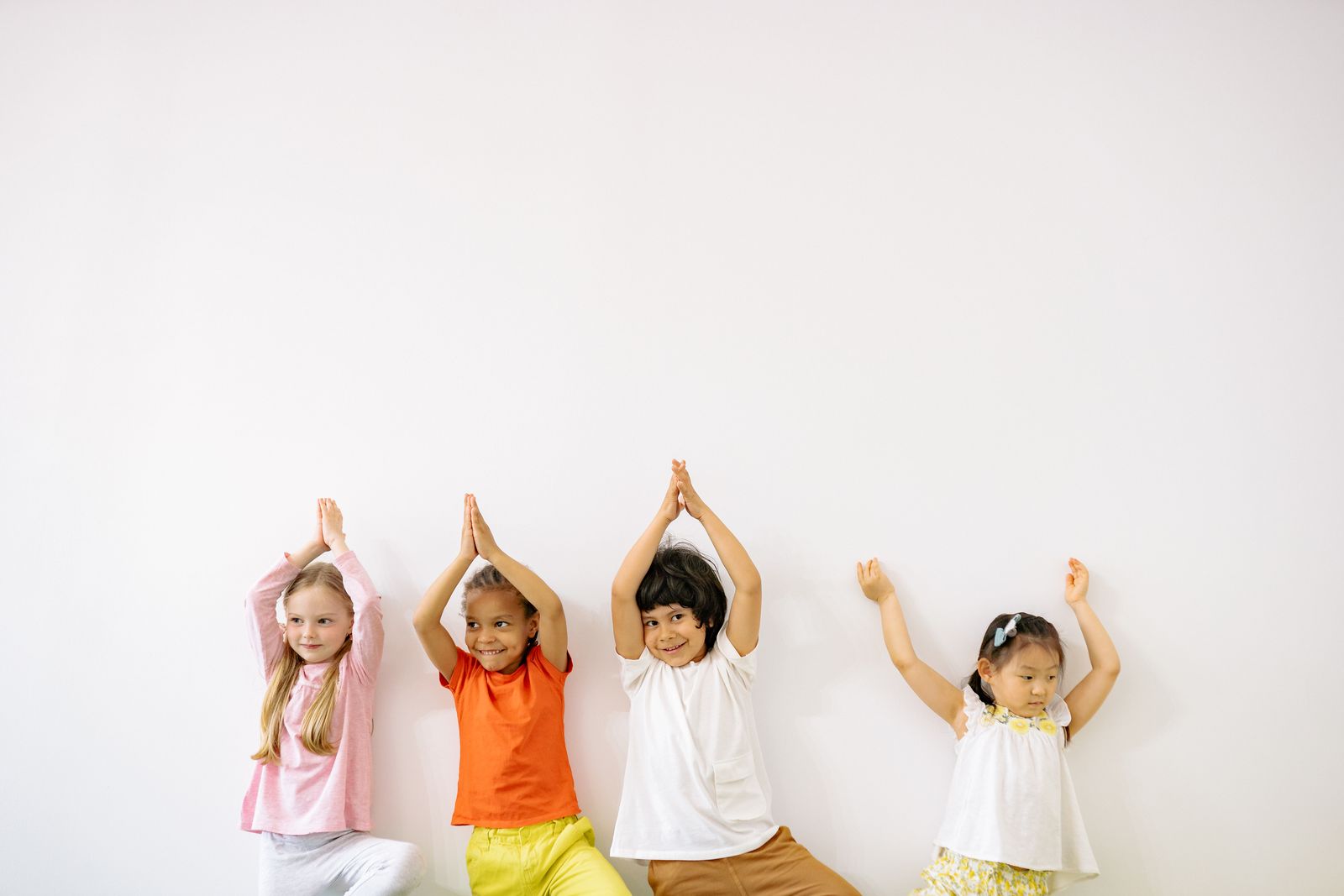
If a class jumps straight into long holds with no warm-up and no play, it was probably written for adults and shortened. That is a poor fit for a primary-school child.
Live group, 1-on-1 or recorded: which suits your child?
Choose a small live group for social children aged 5 and above, 1-on-1 for shy children or those with special needs, and recorded sessions as a backup for busy days. Live formats allow real-time correction, which matters because children often do not notice when a pose is wrong.
| Format | Best for | Feedback on form | Schedule flexibility | Watch out for |
|---|---|---|---|---|
| Live small group (about 6 to 10 kids) | Social, easily motivated children | Good, if the group is small | Fixed timings | Large groups where the teacher cannot see everyone |
| Live 1-on-1 | Shy children, special needs, younger kids | Best | Negotiable | Needs a good rapport with the teacher |
| Recorded or app-based | Practice between live classes | None | Total | Poor form going unnoticed, easy to skip |
Many families combine one live class a week with short recorded videos on other days, much as adults pair a class with a yoga app. Keep recorded content to simple, low-risk poses.
Myth check: does a child need to be flexible or calm to start?
No. Children are not expected to touch their toes or sit still, and classes are designed around wiggling. The aim is body awareness, breath and a bit of calm, not perfect poses. Three myths worth dropping:
- “My child is too hyper for yoga.” Active children often enjoy the movement games most, as long as the class keeps changing every few minutes.
- “Yoga is a replacement for sport.” It is not. It complements cricket, swimming or dance by adding balance, breathing and cool-down habits.
- “Deeper stretches mean better yoga.” Children’s joints are still developing, and forcing a stretch is the quickest route to a strain.
The commonly reported benefits are better body awareness, steadier breathing, improved balance and a calmer end to the school day. These are modest, gradual gains, and they vary from child to child. Our overview of the benefits of yoga explains the wider picture.
How do you set up a safe space at home?
You need about 2 metres by 1 metre of clear, non-slip floor, a mat or folded blanket, the device at a height where the whole teacher is visible, and a gap of 1 to 2 hours after a full meal. Keep furniture, toys and siblings out of the practice area.
A quick set-up checklist for flats and smaller homes:
- Floor: Tiles and marble get slippery in socks. Practise barefoot on a mat, or put the mat on a carpet or a rolled dari.
- Screen: Use a laptop or tablet on a stool or shelf, not a phone held in the hand. The child should see the teacher’s full body, and the teacher should see the child.
- Food and water: A light snack such as a banana is fine about 30 to 60 minutes before. Keep water close, and avoid a heavy meal in the hour or two before.
- Heat: In summer, practise in the cooler hours and keep the fan low enough that the child does not get a chill when relaxing.
- Stop rules: Pain, dizziness, a pinching feeling in the neck or back, or tears mean the child stops and rests. No pose is worth pushing through.
Inversions such as headstand and shoulder stand, and deep backbends, belong in supervised in-person settings, not in a home video class.
What if my child will not stay on the screen?
Shorter sessions, a game-first teacher and a parent joining in fix most attention problems. Start with 10 to 15 minutes, practise at the same time each day, and stop before the child tires. A child who leaves after ten minutes has still done ten minutes.
- Leaves the mat repeatedly: Pick a time before dinner when energy is lower, not straight after a school bus ride.
- Says it is boring: Try a different theme such as animals, space or Ramayana-style stories, or a different instructor.
- Giggles through everything: That is normal for this age. Let the teacher steer it back, and avoid correcting mid-flow.
- Refuses to join: Practise a few poses yourself nearby. Parents on the mat raise buy-in more than any other change.
- Has homework or tuition pressure: Treat yoga as the break between study blocks, not another subject to perform in.
How do you choose a good class for your child?
Pick a programme where the instructor has taught children before, groups are capped at around 10, content changes by age band, and a trial session is offered. Be wary of one script for every age or promises of exam marks, height gain or a cure for any condition.
- Child-specific experience: Ask how the teacher handles restless or anxious kids, not only what certificate they hold.
- Visible attention: In a live class, the teacher should name children and correct form, not just present to a screen.
- Safe pacing: Look for modifications offered for every pose and no pressure to copy advanced shapes.
- A trial class: Engagement differs from child to child, so test before paying for a long package.
- Clear policies: Ask about rescheduling, recordings and what happens if your child falls ill.
Fees differ widely between providers, so compare the same class length and group size rather than the headline rate.
What about children with anxiety, ADHD or a medical condition?
Yoga can be a gentle complement for children who find it hard to settle, but it is not a treatment. If your child has anxiety, ADHD, asthma, scoliosis, a heart condition or a recent injury, speak with the paediatrician or therapist before starting, and tell the teacher about it.
Look for an instructor willing to adapt, offering shorter segments, a quieter tone and optional poses. A rigid class can add stress instead of reducing it. If your child’s worry, sleep or focus problems are persistent, yoga should sit alongside proper medical or counselling support, never replace it. Teens who feel exam stress may also find our post on online yoga for stress relief useful.
How does yoga fit with school, tuition and other activities?
Treat yoga as a calming counterweight to a busy day. Two or three short sessions a week fit around school and tuition, ideally late afternoon or early evening, and they pair well with higher-energy activity on other days.
Some families put online Zumba classes on weekends for energy and keep weekday yoga calm. A short restorative yoga wind-down with parents before bed can also work during exam weeks. During school holidays, a daily 20-minute slot builds a habit that is easier to keep when term restarts.
Frequently asked questions
How long should an online yoga class be for a young child?
For ages 3 to 4, aim for 10 to 15 minutes. For ages 5 to 8, 20 to 30 minutes usually works, and older children can manage 30 to 45. Follow your child’s attention rather than a fixed rule, and shorten the class if they keep leaving the mat.
Do kids need any prior flexibility or experience to start yoga?
No. Kids’ classes are built for complete beginners and use games and animal shapes, so no flexibility or earlier practice is expected. Most children improve balance and comfort with movement gradually over several weeks of regular sessions.
Is online yoga safe for kids to do without adult supervision?
For children under about 8, an adult should be nearby for safety and camera set-up. Older children who know the basic cues can usually join on their own, with occasional check-ins. Avoid inversions and deep backbends at home.
How often should a child do yoga each week?
Two to three sessions a week is a sustainable pattern for most families, and even one regular class helps. Consistency matters more than frequency, since a steady weekly habit lasts longer than daily sessions that fade after a fortnight.
Can siblings of different ages take the same online yoga class?
It can work if the age gap is two or three years, with the older child helping the younger one. Larger gaps usually suit separate age-banded classes better, because pace, language and pose difficulty change a lot between ages 4 and 10.
Next step
Book a trial of Fitstrot’s online yoga classes and see how your child responds to a short, playful session before committing to a schedule.


