
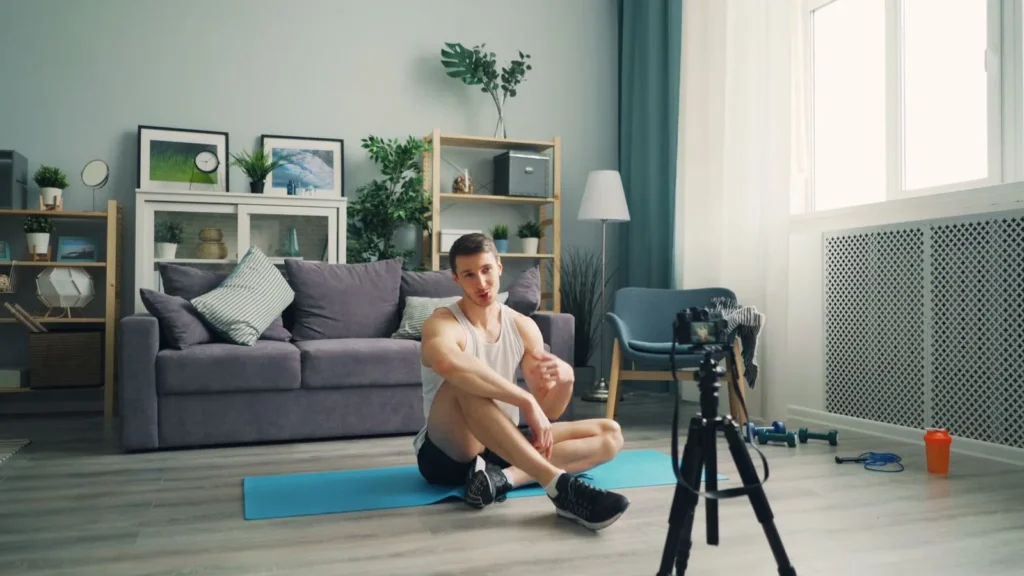
Wondering how to do zumba at home without a studio, a mirror wall or an instructor beside you? Clear about 6 by 6 feet of floor, put on proper shoes, warm up for 5 to 8 minutes, follow one beginner-level video for 20 to 30 minutes, then cool down for 5. That is the whole system. The rest of this guide fills in the details: space, floor, footwear, a full sample session, and what to do when it all feels clumsy in the first week.
A home Zumba workout is forgiving in one way a live class is not: you can pause, rewind and repeat. It is unforgiving in another: nobody is watching your form or your pace, so the structure has to come from you. Fitstrot’s lead Zumba trainer, Yash Pathak, is ZIN Licensed, ACE Certified and Strong Nation Certified, and the routine below follows the same three-part shape every good class uses: warm-up, main block, cooldown.
What do you need to do Zumba at home?
You need about 6 by 6 feet of clear floor (a little more if you can spare it), non-slip footwear with some cushioning, a screen you can see from every corner of that space, a water bottle and a small towel. No weights, bands or machines are needed for standard Zumba at home without equipment.
Most people over-think the shopping and under-think the space. Move the centre table, roll up the loose rug and check that your fingertips do not touch a wall, fan or sofa during a side step.
| Item | What to aim for | Why it matters |
|---|---|---|
| Floor space | Roughly 6 x 6 ft, with 1 to 2 ft clear on every side | Side steps, turns and arm swings need room in all directions |
| Footwear | Light cross-training or dance-style shoes with a flat, slightly slidey sole | Zumba pivots and shifts weight sideways, which cushioned running shoes can grip too hard |
| Screen | Phone, tablet or TV at about eye level, 6 to 8 ft away | You must see the instructor’s feet, not just the face |
| Water and towel | One bottle (500 ml to 1 litre) within reach | Sip between songs, not only at the end |
Floors, shoes and the Indian flat: what actually works
Most Indian homes have vitrified tiles, marble or polished stone. These look great and are slippery in socks, and hard on knees and shins when you add jumps. Tiles are not a reason to skip Zumba, but they are a reason to choose your footwear and moves with care.
- Do not dance in socks on tiles. Socks have almost no grip and they are the quickest route to a slip or a twisted ankle.
- Barefoot is a poor default. Fast pivots on bare soles can strain the arches and ball of the foot, and a stubbed toe on a table leg ends the session. Wear shoes unless a trainer who knows your feet says otherwise.
- Put down a yoga mat only if it is large and fixed. A small mat that slides or curls at the edge can be worse than bare tile. A thick exercise mat taped or wedged in place works better for many people.
- Live in a flat with a neighbour below? Choose the low-impact version of every jump: step the foot out instead of hopping. The calorie burn stays decent and the thumping drops sharply.
If your room is small, even a 4 by 5 foot patch works if you shrink the moves: smaller steps, arms closer to the body, and fewer travelling patterns. You lose a little range, not the workout.
How do you warm up for Zumba at home?
Warm up for 5 to 8 minutes: start with 2 minutes of marching and shoulder rolls, add 2 to 3 minutes of side steps, ankle and hip circles, then finish with 1 to 2 minutes of gentle knee lifts and arm swings. Your breathing should be slightly faster and your body warm, not tired.
This is a zumba warm up, not a stretching session. Long static holds before dancing can leave muscles loose but not ready to move quickly. Save those for the end.
A sample 30-minute at-home Zumba session
Use this as a template with any beginner or all-levels video. Match the time blocks, not the exact songs. The effort scale runs from 1 (easy chat) to 10 (cannot speak a full sentence); most of the main block should sit around 5 to 7. For a fuller routine with song order, see our 30-minute Zumba workout guide.
| Minutes | Block | What you do | Effort (1-10) |
|---|---|---|---|
| 0-5 | Warm-up | March, side steps, shoulder rolls, ankle and hip circles | 2-3 |
| 5-10 | Learn the pattern | First upbeat song at half intensity; watch the feet, copy footwork only | 4-5 |
| 10-15 | Build | Second song at normal pace, add arms once the feet feel automatic | 5-6 |
| 15-20 | Peak | Third and fourth songs, full range, include low-impact or high-impact options as your joints allow | 6-7 |
| 20-25 | Second push | Repeat a pattern you now know; sip water between tracks | 6-7 |
| 25-30 | Cooldown | Slow walking, deep breaths, then calf, hamstring, hip and shoulder stretches | 2-1 |
On a tired day, do the first three blocks only and call it a win. Showing up at half intensity for 15 minutes beats skipping.
Walkthrough: following a video without getting lost
- Pick one video and stay with it for a week. Repeating the same routine is how steps stop feeling foreign. Constantly switching sources keeps you permanently at the learning stage.
- Watch the feet first. Footwork carries the pattern. Arms, hips and styling sit on top.
- Do the first pass at half size. Smaller steps, fewer arms, no jumps. Add size once you can finish a pattern without looking down.
- Count in eights. Most Zumba phrases run in sets of eight beats. If you lose the count, wait for the next phrase to start rather than chasing the move.
- Pause and repeat without guilt. This is the home advantage. Rewind a hard 30-second section three times until it clicks.
If the moves themselves are the problem, drill them on their own for a few days. Our guide to basic Zumba steps covers the foundation moves one at a time, and Zumba at home for beginners goes deeper on your first two weeks.
Myths about doing Zumba at home
“I need to be able to dance.” No. Zumba is built from repeating steps, and a beginner who moves in the right direction at half speed is doing it correctly. Coordination develops with repetition.
“Higher and harder is always better.” Not at home on tile. High-impact jumping on a hard floor increases the load on knees, shins and feet. A low-impact version done with good rhythm is a real workout, and it is what many people can sustain for months.
“Zumba at home is only for weight loss.” Weight change depends on your overall food intake, sleep and consistency over weeks, and no routine guarantees a particular result. As a rough guide, an average adult may burn about 300 to 500 kcal in an hour of moderate Zumba, depending on body weight and effort. Treat that as a ballpark, not a promise.
How long and how often should a beginner do Zumba at home?
Beginners can start with 20 to 30 minutes, three days a week, with at least one rest day between sessions. After 3 to 4 weeks, many people move to 4 or 5 days or extend sessions to 40 to 45 minutes. Increase either time or frequency, not both at once.
For a deeper breakdown of weekly frequency, read how often you should do Zumba. Morning or evening both work, so pick the slot you will actually keep. Our note on the best time to do Zumba explains the trade-offs, such as avoiding a heavy meal in the 1.5 to 2 hours before you start.
Troubleshooting: when home Zumba is not going well
| Problem | Likely cause | What to try |
|---|---|---|
| Knees ache during or after | High-impact jumps on a hard floor, or shoes with little cushioning | Switch to low-impact versions, keep knees soft, check your shoes |
| Keep losing the steps | Video too advanced, or you are copying arms before feet | Choose a beginner video, watch feet only, halve the speed |
| Room feels too tight | Furniture within arm’s reach, or moves too big for the space | Shrink steps and arm size, or clear one more metre in a single direction |
| Out of breath after 5 minutes | Starting too hard, or skipping the warm-up | Drop to effort 4-5 for two weeks and build up |
| Bored by week three | Same video, nothing new to aim for | Add one new video a week, or try a live class for variety |
Closing with a cooldown that actually helps
Spend the last 5 minutes slowing down: walk in place for a minute, take a few deep breaths, then hold each stretch for about 20 to 30 seconds. Cover calves, front and back of the thighs, hips, chest and shoulders. Your breathing should be near normal before you sit down.
A zumba cooldown costs five minutes and pays back through less stiffness the next morning. Rehydrate, and eat a normal balanced meal such as dal, roti and sabzi within an hour or two.
Is home Zumba right for you? A few audience notes
- Complete beginners: Start with 15 to 20 minute sessions of low-impact choreography. Learn the footwork before adding speed.
- People carrying extra weight: Choose low-impact variations and wear well-cushioned shoes. Progress by adding minutes, not jumps.
- Adults over 50: Step instead of hop, keep one foot on the floor where possible, and have a chair nearby for balance.
- If you want toning: Dance cardio builds stamina and some muscular endurance, but it is not a replacement for strength training. Our guide on Zumba toning explains what to expect.
See your doctor first if you have a heart condition, high blood pressure, joint or back problems, are pregnant or recently postpartum, are recovering from an injury or surgery, or have been inactive for a long time. Stop and get medical advice if you feel chest pain or pressure, severe breathlessness, dizziness, fainting, or sharp joint pain. These are not symptoms to dance through.
Frequently asked questions about how to do Zumba at home
Do I need any equipment to do Zumba at home?
No. Standard Zumba needs only clear floor space, supportive non-slip shoes and a screen or speaker. Weights, bands and machines are not needed. A water bottle, towel and fan make the session more comfortable, and a fixed exercise mat can help on very slippery tile.
How much space do I need for Zumba at home?
Aim for about 6 by 6 feet, with 1 to 2 feet clear around you in every direction. A smaller area of about 4 by 5 feet works if you reduce step and arm size. Check that nothing sits within reach of your extended arms.
Can I do Zumba at home barefoot?
It is better to wear supportive shoes. Zumba has quick pivots and side shifts, and bare feet on tiles can slip, strain the arches or catch a toe. Socks are the worst choice on a smooth floor. Wear clean indoor shoes unless your trainer advises otherwise.
Is Zumba at home as effective as a studio class?
It can be, if you follow a structured routine with a warm-up, a main block and a cooldown, and you keep the effort moderate to hard. A live class adds correction and motivation. At home, you gain flexibility and repeat-ability. Many people combine both.
What is the biggest mistake people make doing Zumba at home?
The most common mistake is doing too much too soon: skipping the warm-up, jumping on a hard floor, and attempting advanced choreography in week one. Start at half intensity, learn the footwork, and add intensity only after two or three comfortable weeks.
Next step: try one guided class
A video can teach you the steps, but a trainer can fix your form while you move. Book a trial in Fitstrot’s online Zumba classes this week and compare it with your home routine. Prefer something more personal? Our 1-on-1 personal training can build a plan around your joints and schedule, and our guide to online Zumba classes explains what a typical live session looks like.


