
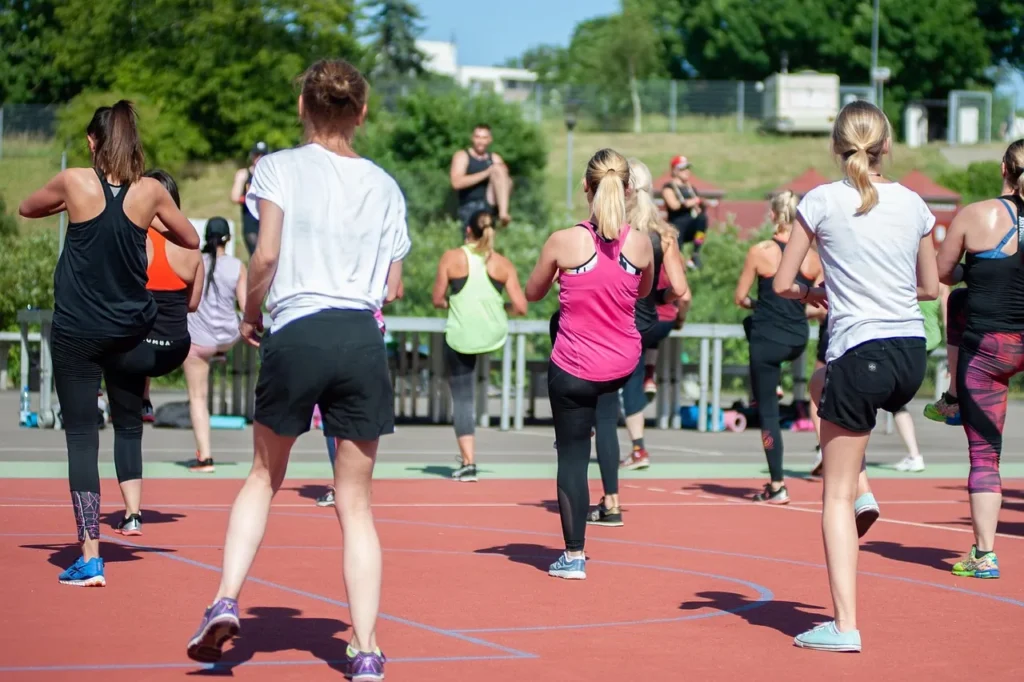
A 30 minute Zumba workout is long enough to count as real cardio: in a 2012 study sponsored by the American Council on Exercise, a Zumba class averaged about 9.5 kcal a minute at roughly 80% of maximum heart rate. At that pace, 30 minutes comes to around 285 kcal for a fit young adult. Your number will be different. The session only works if it is planned. Just playing songs until the timer runs out doesn’t get you the same result.
Below you’ll find a timed routine, calorie estimates at Indian body weights, a four-week plan, easier and harder versions of every move, and fixes for sore knees and lost motivation. Everything is designed for a small flat with a phone and a playlist.
Is 30 minutes of Zumba enough to get fitter?
Yes, if you do it often enough. The WHO recommends that adults get at least 150 minutes of moderate-intensity activity a week. Five 30-minute Zumba sessions reach that exactly. A systematic review of 11 studies (586 participants) published in 2016 found that Zumba reliably improves aerobic capacity. Its effects on body weight were small but positive.
The World Health Organization’s physical activity fact sheet sets that floor of 150 minutes a week of moderate activity, plus muscle-strengthening on 2 or more days. It also reports that 31% of adults worldwide, about 1.8 billion people, were physically inactive in 2024. The NHS guidelines for adults aged 19 to 64 give an alternative: 75 minutes of vigorous activity a week, spread over 4 to 5 days. The NHS lists aerobics as vigorous and dancing as moderate. A well-run Zumba session moves between the two.
Done 3 to 5 times a week, 30 minutes is a complete cardio plan. The 2016 systematic review by Vendramin and colleagues in PM&R also found only limited evidence that Zumba builds strength or flexibility. That is why the weekly plan below adds two short strength sessions instead of expecting dance to do everything.
The 30-minute Zumba routine, minute by minute
A 30 minute Zumba class works like interval training: high-energy songs alternate with easier ones, so your heart rate rises and falls. Each block below is one song. If a song runs long or short, finish it and adjust the next block.
| Time | Block | Moves (repeat in 8-counts) | Sets × reps | Rest | Effort (talk test) | Form cue |
|---|---|---|---|---|---|---|
| 0:00–5:00 | Warm-up | March in place, step-touch, shoulder rolls, gentle hip circles | 1 song, 4 × 8-counts per move | None, keep moving | Can chat easily | Heels down, soft knees, grow the arm range slowly |
| 5:00–9:00 | Merengue | Merengue march, side step with arm pumps, turning march | 1 song, 6 × 8-counts per move | None | Can talk, can’t sing | Small steps, move from the hips, brace your core |
| 9:00–13:00 | Salsa | Salsa basic forward-back, side salsa, salsa with a clap | 1 song, 6 × 8-counts per move | None | Talk in short sentences | Weight on the balls of the feet, relaxed shoulders |
| 13:00–15:00 | Active recovery | Slow step-touch, deep breaths, arm reaches | Half a song | This is the rest | Breathing settles | Sip water and breathe out through the mouth |
| 15:00–19:00 | Reggaeton | Squat bounce, step-and-punch, body roll | 1 song, 4 × 8-counts per move, 2 rounds | 8-count march between rounds | A few words, then a breath | Knees follow the toes, chest up in the squat |
| 19:00–23:00 | Bollywood / bhangra | Bhangra shoulder bounce, hop-kick (or tap-kick), “light-bulb” hand twist with a step | 1 song, 6 × 8-counts per move | None | Hardest block | Land softly, heel then toe; keep hops low |
| 23:00–26:00 | Cumbia finisher | Cumbia step, grapevine, knee lifts | 1 short song, 4 × 8-counts per move | None | Bring it down gradually | Drive the knees without leaning back |
| 26:00–30:00 | Cool-down | Slow sway, calf stretch, quad stretch, hamstring hinge, chest opener | Hold each stretch 20–30 s per side | Not needed | Back to normal breathing | Stretch without bouncing, breathe slowly |
That gives you about 18 minutes of working blocks, 2 minutes of active recovery and 9 minutes of warm-up and cool-down. For a longer finish, the stretches in our cool-down stretches guide fit the final four minutes.
Step by step Zumba for beginners: learning the routine in three sessions
Don’t try all 30 minutes at full intensity the first time. Spread the learning out instead:
- Session 1: Practise each move with no music, 4 × 8-counts each, counting out loud. Walk it. Don’t bounce yet.
- Session 2: Add the music at half effort. Use marching steps only for the arms, then add the legs. It’s fine to fall off the beat. Keep moving and join back in on the next “1”.
- Session 3: Run the whole routine. Aim for “can talk, can’t sing” in the merengue and salsa blocks, and allow a little more in reggaeton and bhangra.
If a step still doesn’t make sense, our guide to Zumba dance moves breaks down the footwork for each rhythm.
How many calories does 30 minutes of Zumba burn?
Somewhere between about 140 and 300 kcal for most adults. Young, fit women in the 2012 ACE study averaged 9.5 kcal/min, which works out to about 285 kcal in 30 minutes. In a 2015 study of adults with an average age of 63, Zumba Gold averaged 4.6 kcal/min, or about 138 kcal in 30 minutes. Heavier bodies and bigger movements burn more.
The ACE figure comes from a study by Luettgen, Porcari and colleagues at the University of Wisconsin–La Crosse. They tested 19 healthy women aged 18 to 22 during classes averaging just under 39 minutes. The women averaged 369 kcal a class, a heart rate of 154 bpm (80% of maximum) and 64% of VO2max. The older-adult figure comes from a 2015 Zumba Gold study in the Journal of Sports Science and Medicine. Sixteen participants burned 197.9 kcal in a 45-minute class, averaging 4.3 METs, which counts as moderate intensity.
Research on Zumba has not been done across different Indian body weights, so the table below uses the closest activities in Harvard Health’s 30-minute calorie chart, converted from pounds to kilograms.
| Activity (30 min) | ~57 kg | ~70 kg | ~84 kg | Source |
|---|---|---|---|---|
| Low-impact aerobics (Zumba with no jumps) | 165 kcal | 198 kcal | 231 kcal | Harvard Health |
| Fast dancing | 180 kcal | 216 kcal | 252 kcal | Harvard Health |
| High-impact aerobics (Zumba with hops and jumps) | 210 kcal | 252 kcal | 294 kcal | Harvard Health |
| Brisk walking, 4 mph (6.4 km/h) | 135 kcal | 175 kcal | 189 kcal | Harvard Health |
| Hatha yoga / stretching | 120 kcal | 144 kcal | 168 kcal | Harvard Health |
| Zumba class, fit women aged 18–22 (9.5 kcal/min × 30) | ≈ 285 kcal (group average) | ACE, 2012 | ||
| Zumba Gold, adults averaging 63 years (4.6 kcal/min × 30) | ≈ 138 kcal (group average) | J Sports Sci Med, 2015 | ||
Keep these numbers in proportion. It takes 30 focused minutes to burn 250 kcal, and only a few minutes to eat it back as a snack. This matters for the next section.
Myth check: can a Zumba workout for weight loss work on its own?
It helps, but it rarely does the job alone. The 2016 systematic review found only “small but positive” reductions in body weight from Zumba programmes. In an 8-week trial, inactive women doing three 60-minute sessions a week lost weight and fat mass and improved lung function. That is 180 minutes a week, not 30 minutes now and then.
The trial, Ljubojevic et al., 2022, in the International Journal of Environmental Research and Public Health, followed 41 women aged 35 to 45. Twenty-one of them completed 24 sessions, and their body mass, BMI and fat mass all fell significantly compared with the inactive control group.
Three honest points before you judge your progress by the scale:
- Spot reduction doesn’t work. Hip-shaking reggaeton blocks won’t burn belly fat in particular. Fat loss happens across the whole body.
- Appetite often rises. A 250 kcal session followed by an extra “I earned it” samosa and chai cancels out.
- The scale lags behind fitness. Your resting breathlessness, stamina on stairs and waist measurement usually improve before your weight does.
If losing weight is your main goal, see Zumba as the fun, sustainable part of the plan and pair it with the right food. Our guide on how often you should do Zumba covers weekly frequency and rest days in more detail.
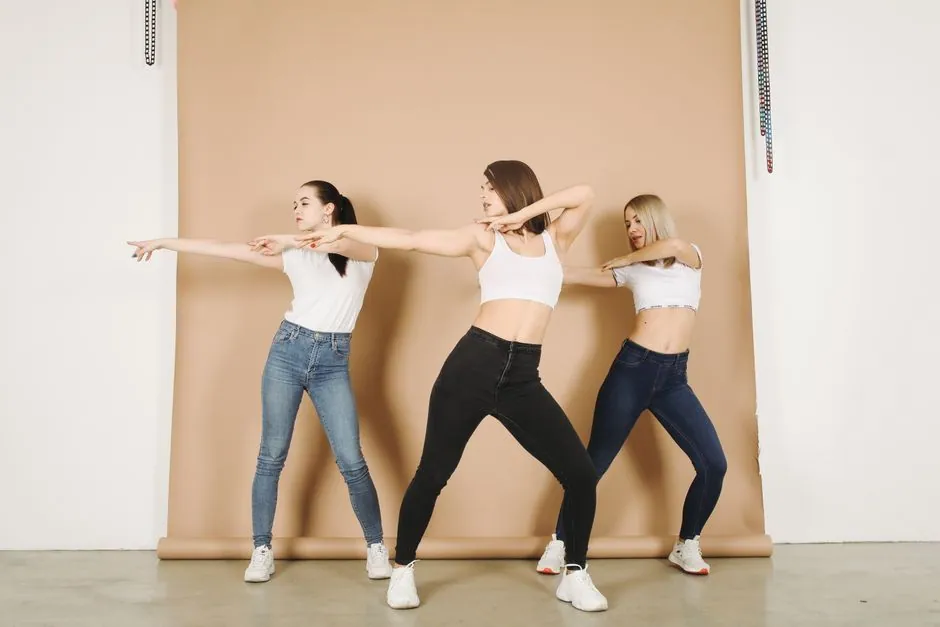
Setting up a home Zumba workout in an Indian flat
You need a clear floor, good shoes and some thought for your neighbours below.
- Space: About 2 m × 2 m of clear floor. Push the centre table aside and check that ceiling fan blades are well above your raised arms.
- Floor: Marble and vitrified tiles are hard on the joints and slippery when sweaty. A thick yoga mat is too soft for turns. The best option is a flat rubber gym mat or a dhurrie that is firmly taped down. On a hard floor, choose low-impact versions of every move.
- Shoes: Cross-trainers or dance sneakers with a fairly smooth sole, so you can pivot. Heavily treaded running shoes grip the floor during turns and twist your knees. Don’t dance barefoot on tiles.
- Screen and sound: Put the phone or TV at eye level so you aren’t looking down. Bluetooth earphones help in shared homes and late at night.
- Neighbours: In apartments, swap hops for step-taps before 7 a.m. and after 9 p.m. Your downstairs neighbour will be grateful.
- Timing: Wait 2 to 3 hours after a full meal. If you train early in the morning, a banana or a few soaked almonds 30 minutes before is enough.
Zumba workout at home for ladies: practical fixes
Wear a supportive sports bra, since bouncing blocks are uncomfortable without one. Choose fitted leggings or track pants over a loose salwar, which can catch under your feet during turns. Tie back your dupatta or take it off. If you’re fitting it around cooking, school runs or office calls, book the same time every day like any other appointment. During your period, the low-impact options in the table below are a good default.
Beginner and advanced versions of each dancing Zumba workout move
Scale each block up or down without changing the choreography.
| Move | Beginner / low-impact version | Advanced version | Reps per set | Rest | Form cue |
|---|---|---|---|---|---|
| Merengue march | March in place, arms at chest height | Travelling march with overhead arm pumps | 4–6 × 8-counts | None | Stay tall, don’t lean back |
| Salsa basic | Step forward and back, no hip action | Faster tempo, hip action and a turn every 4th count | 4–6 × 8-counts | None | Push off the ball of the foot |
| Squat bounce (reggaeton) | Quarter squat, no bounce | Deep squat with a bounce and arm punch | 2 × 4 × 8-counts | 8-count march | Knees stay over the toes |
| Bhangra shoulder bounce | Shoulder bounce with alternating heel taps | Shoulder bounce with a small hop on each count | 4–6 × 8-counts | None | Land softly, knees bent |
| Hop-kick | Tap-kick, no hop | Hop-kick with an arm swing | 4 × 8-counts | None | Kick from the hip, not the knee |
| Grapevine | Slow grapevine, step-together | Grapevine with a jump turn | 4 × 8-counts | None | Cross behind, watch the rug |
| Knee lifts | Knee to hip height, alternate slowly | Double-time with opposite elbow to knee | 4 × 8-counts | None | Brace the core, no rounding |
Zumba for beginners at home: first two weeks
Use only the beginner column for the first two weeks, even if it feels easy. Tendons in the calves and knees adapt more slowly than your heart and lungs. That is why soreness often turns up a week or two in, not on day one. Add one advanced move per block each week after that.

A 4-week plan: Zumba workout at home, three to five days a week
This plan builds from three to five sessions a week and adds the strength work that WHO and NHS guidelines recommend on two days. Take at least one full rest day a week.
| Week | Zumba days | Session version | Strength (15–20 min) | Weekly Zumba minutes | Progress when… |
|---|---|---|---|---|---|
| 1 | Mon, Wed, Sat | Beginner column, no hops | Tue: squats, wall push-ups, glute bridges — 2 sets × 10, 60 s rest | 90 | No joint pain the next morning |
| 2 | Mon, Wed, Fri, Sat | Beginner, bigger arms | Tue: 3 sets × 10, 60 s rest | 120 | You can talk through the salsa block |
| 3 | Mon, Tue, Thu, Sat | One advanced move per block | Wed, Fri: 3 sets × 12, 45–60 s rest | 120 | Heart rate recovers in the 2-min break |
| 4 | Mon, Tue, Thu, Fri, Sat | Advanced in reggaeton and bhangra only | Wed, Sun (short): 3 sets × 12 | 150 | You hit the WHO 150-minute mark |
After week 4, keep five sessions a week or swap one for brisk walking or cycling to rest the same joints.
Checking intensity without a smartwatch
Use the talk test or a simple heart-rate formula. Mayo Clinic defines moderate exercise as 50–70% of maximum heart rate (you can talk but not sing) and vigorous exercise as 70–85% (only a few words between breaths). Estimate your maximum as 208 minus 0.7 × your age.
Using the Mayo Clinic exercise-intensity formula, a 30-year-old’s estimated maximum is 208 − 21 = 187 bpm. That puts the vigorous zone at about 131–159 bpm. The 154 bpm average in the ACE study falls right in that range. To check without a device, count your pulse at the wrist for 15 seconds right after the bhangra block and multiply by 4. If the number is consistently above 85% of your estimated maximum, or you feel dizzy, slow down.
Music: building a Bollywood Zumba workout playlist
Filmi and Punjabi tracks suit Zumba well because they have a steady, danceable beat. Match each song’s energy to its block rather than just picking favourites.
Picking each zumba workout song by energy
- Warm-up and cool-down: Mid-tempo, easy grooves. Slow romantic songs are fine for the stretch.
- Merengue, salsa and cumbia blocks: Latin tracks with a clear, even beat, which is where Zumba’s choreography comes from.
- Reggaeton and bhangra blocks: Your highest-energy Punjabi or party tracks, the ones that make you want to jump.
- Recovery: One slower track so your breathing can catch up.
For tested track ideas for each block, see our list of the best Zumba songs.
When your 30 minutes isn’t working: troubleshooting
- Knees ache after the reggaeton block: Your squats are probably too deep or your knees are caving inward. Use the quarter squat and check that your shoes aren’t gripping the floor during turns.
- Calves or shins sore for days: Too much hopping too soon, or tiles with no mat. Go back to the no-hop version for a week and add 30-second calf stretches to the cool-down.
- Out of breath by minute 10: You are pushing too hard in the early blocks. Keep the merengue and salsa blocks at “can talk” and save your effort for later.
- Bored by week 3: Keep the structure and swap only the songs.
- No change after 6 weeks: Check how often you actually train (3 sessions a week is the minimum), your intensity (check your pulse) and your food. Then add the advanced column.
- Keep skipping sessions: Train at a fixed time or join a live class where someone expects you.
Who should modify the routine or check with a doctor first?
Zumba is generally safe for healthy adults, but some people should adapt it and get medical advice before starting:
- Heart conditions, uncontrolled high blood pressure or diabetes on insulin: Get your doctor’s clearance and stay at moderate intensity.
- Pregnancy: Ask your obstetrician. Avoid jumps, fast turns and lying on your back after the first trimester.
- Knee or back pain, or recent injury: Use only the low-impact column, and see a physiotherapist if pain continues.
- Adults over 55 or those who have been inactive for a long time: Zumba Gold–style sessions (averaging 4.3 METs in the 2015 study) are the right starting point.
Stop right away and get medical help if you have chest pain, unusual breathlessness, dizziness or palpitations.
Zumba workout videos for beginners vs a live class
Free videos are fine for trying Zumba out, but they can’t watch you. Nobody notices caving knees, gripping shoes or a stalled plateau. A live online class fills that gap. At Fitstrot, Zumba sessions are led by Yash Pathak, our lead trainer, who is ZIN Licensed, ACE Certified and Strong Nation Certified. He can give you beginner or advanced cues on the spot. Classes run live and online, so you can follow along from home while someone watches your form.
Frequently asked questions
How many calories does a 30 minute Zumba workout burn?
Most adults burn about 140–300 kcal. In the 2012 ACE study, young women averaged 9.5 kcal/min (about 285 kcal in 30 minutes). Harvard Health estimates 165–294 kcal for 30 minutes of low- to high-impact aerobics at 57–84 kg.
Is 30 minutes of Zumba a day enough?
Five 30-minute sessions a week reach the WHO minimum of 150 minutes of moderate activity. Add two short strength sessions a week, because Zumba does little for muscle strength.
Can I do Zumba every day?
You can do low-impact sessions most days, but take at least one full rest day a week. Also rotate high-impact days so your calves and knees can recover.
Will a 30-minute Zumba workout reduce belly fat?
Not in one particular spot. Zumba adds to overall fat loss, but the research shows only small weight changes unless you also manage your food and train at least three times a week.
Can a complete beginner do Zumba at home?
Yes. Learn the moves without music first, use the low-impact versions for two weeks, and work at a “can talk, can’t sing” effort.
What shoes should I wear for Zumba on a tiled floor?
Wear cross-trainers or dance sneakers with a fairly smooth sole so you can pivot. Avoid heavily treaded running shoes and dancing barefoot on tiles.
Should I eat before a morning Zumba session?
A light snack such as a banana 30 minutes before is enough. Leave 2 to 3 hours after a full meal.
Try the routine three times this week using only the beginner column. If you’d like a trainer to check your form, book a live session through Fitstrot’s online Zumba classes.


