
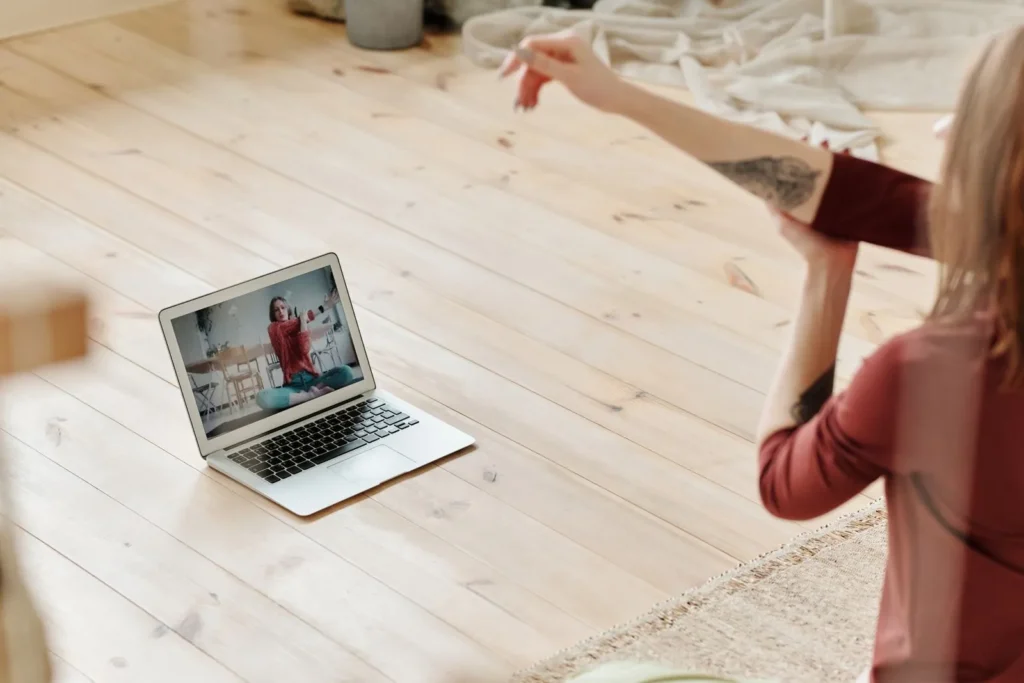
Knowing how to choose an online zumba class saves you from the most common mistake: signing up for the loudest, longest or cheapest option and quitting in week two. The right class is the one you can follow at your current fitness level, at a time you can actually keep, with an instructor whose cueing you understand. This guide gives you a five-point checklist, three comparison tables, a seven-day test run and fixes for when a class is not working.
What should you check first when choosing an online Zumba class?
Check five things in this order: instructor credentials, class level and length, live or recorded format, how clearly the instructor cues each move, and whether the schedule fits your week. Most beginners do well with 30 minutes, two or three times a week, led by a licensed instructor who names every new step before adding the music.
The table below turns those five checks into a scorecard you can use on any provider, including Fitstrot. Give each row 0 (red flag), 1 (unclear) or 2 (good). As a rule of thumb, a class scoring 8 or more out of 10 deserves a proper trial week, and anything under 6 is worth skipping.
| Check | What good looks like | Red flag |
|---|---|---|
| Instructor | Named, licensed Zumba instructor with real online teaching practice | No credentials listed, or only a logo and a promise |
| Level and length | A clearly labelled beginner option of 20 to 30 minutes | Only 60-minute classes with no level labels |
| Format | Live batches, recordings or both, stated upfront | You cannot tell whether anyone watches you |
| Cueing and music | Move is named and counted first, then the music joins | Steps change with no verbal warning |
| Schedule | A slot you can hold for four weeks in a row | Timings that clash with work, meals or commute |
Does instructor certification matter for online Zumba?
Yes. A licensed Zumba instructor has been trained in basic steps, rhythms, cueing and class structure, which matters more on screen because nobody can walk over and correct your posture. Look for a named instructor, a stated licence and live online teaching experience, not just a brand logo.
Online teaching is a slightly different skill from studio teaching. On a laptop, the voice does most of the work: clear counts, a warning before each change and a calm pace for newcomers.
At Fitstrot, lead Zumba trainer Yash Pathak is ZIN Licensed, ACE Certified and Strong Nation Certified. In plain terms, the ZIN licence covers teaching Zumba class formats, the ACE certification covers general exercise instruction and safety, and Strong Nation covers the interval-style Strong format from the Zumba family. You can use the same questions on any provider: who teaches, which licence do they hold, and how long have they taught online? A provider that answers plainly is usually one that takes the job seriously.
How long should your first online Zumba classes be?
Beginners should start with 20 to 30 minute sessions, two or three days a week, and add about 10 minutes only after finishing comfortably without dizziness, sharp pain or long breaks. A full 60-minute class is a goal for roughly weeks four to eight, not a day-one requirement.
Class length is the factor people ignore, and it causes the most early burnout. The table gives a sensible starting point by level; if you are brand new, our guide to Zumba for beginners walks through the first few sessions in more detail.
| Your level | Start with | Sessions per week | Move up when |
|---|---|---|---|
| New to exercise or restarting after a long gap | 20 to 30 minutes | 2 to 3 | You finish and recover within about 5 minutes |
| Some regular activity (walking, yoga, gym) | 30 to 45 minutes | 3 | You follow basic steps without pausing |
| Regular exerciser | 45 to 60 minutes | 3 to 4 | You want faster choreography and longer routines |
| Returning after injury or illness | 15 to 20 minutes, low impact | 2 | Your doctor or physiotherapist has cleared you |
Use the talk test while you dance: you should be breathing harder but still able to say a short sentence. If you cannot, slow down and keep your feet lower.
On calories, an hour of Zumba burns about 300 to 500 kcal for most adults, depending on body weight and effort, so a 30-minute session is roughly half that. Do not pick a longer or harder class just to chase a bigger number. Four easy 30-minute sessions you actually attend beat one heroic 60-minute class you never repeat.
Live, recorded or hybrid: which format fits you?
Choose live if you want accountability and real-time correction, recorded if your schedule changes every week, and hybrid if you want both. Many beginners do well starting live for two to four weeks, then adding recordings for extra days once the basic steps feel familiar.
None of these is automatically better. The honest question is which one you will still be using in month three. Our deeper comparison of live vs recorded Zumba classes covers the trade-offs; the matrix below is the short version.
| Factor | Live batch | Recorded | Hybrid |
|---|---|---|---|
| Real-time correction | Yes, instructor can respond | No | On live days only |
| Schedule flexibility | Fixed timings | Anytime | Fixed core, flexible extras |
| Accountability | High, others are present | Depends on you | Medium to high |
| Pause and repeat a step | No | Yes | Yes on recorded days |
| Best for | Newcomers, people who skip workouts | Shift workers, frequent travellers | People who want structure and freedom |
If you like the energy of a crowd, look for an interactive format where the instructor can see participants. We explain how that works in our post on interactive Zumba group classes online in India.
Four myths that lead people to pick the wrong class
Myth 1: “I need to know how to dance first.” You do not. Beginner classes break choreography into short patterns of four or eight counts, and everyone misses steps early on. If you are unsure what actually happens in a session, read what a Zumba class is before you book.
Myth 2: “The hardest class is the best class.” Intensity beyond your level makes you sore, discouraged and likely to quit. The best class is the one you can repeat three times a week for a month.
Myth 3: “The priciest class, or the one with the most followers, must be the best.” Price and popularity say nothing about cueing or level fit. Compare what each fee includes per week (number of live sessions, access to recordings, batch size) rather than the headline number. Our page on Zumba class fees covers fees in more detail.
Myth 4: “Online means no feedback.” That is true of a pre-recorded video you watch alone, but not of a live batch where the instructor can call out your name, slow the pace or offer an easier option on the spot.
A 7-day test run: how to trial a class before you commit
A trial week tells you more than any description. If a provider offers a demo or trial session, use it; if not, ask for a sample or the batch schedule before you pay. Then run this simple test.
- Day 1: Take your first class at beginner level. Note whether the instructor named each step before the music joined it.
- Day 2: Rest or walk for 20 minutes. Check how your legs, knees and lower back feel.
- Day 3: Repeat the same class or instructor. Do the steps feel easier the second time?
- Day 4: Rest day. Drink water, stretch lightly.
- Day 5: Try a different time slot, format or instructor for comparison.
- Day 6: Rest, then score each class out of 10 on clarity, energy and comfort.
- Day 7: Choose the class where you finished, smiled and wanted to come back. That one wins.
Troubleshooting: when the class you picked is not working
- “I cannot keep up with the steps.” Drop to a beginner class or use the low-impact version: march in place, keep feet low and add arms only when the feet feel automatic. Repeating the same class for a week helps.
- “The video lags or the sound drops.” Close other apps and move closer to your router. If lag continues, ask the provider whether a recording or a different batch is possible.
- “My knees or ankles hurt.” Reduce jumps, check that your shoes have cushioning and avoid dancing barefoot on hard tiles. Sharp or lasting pain means stop and see a doctor or physiotherapist before returning.
- “I am bored after two weeks.” Try a different rhythm or instructor, or move to a group format where you can see other people.
- “I keep skipping sessions.” Shorten the class to 20 minutes and lock one fixed slot, such as right after you drop the kids at school or before dinner.
- “I feel dizzy, faint or have chest discomfort.” Stop immediately. Get medical advice before you dance again.
Which online Zumba class suits your situation?
Pick by situation: women-only batches if privacy matters, 20 to 30 minute sessions if you work long hours, group classes if you want company, and a low-impact approach if your joints are sensitive. If you have a heart, blood pressure or joint condition, or you are pregnant, check with your doctor first.
If privacy comes first: a women-only batch removes the worry of being watched while you learn. See our guide to Zumba classes for ladies online.
If you are stressed and sleep-deprived: choose a lower-intensity, music-led class and treat it as decompression, not punishment. Our post on online Zumba sessions for stress explains how to set that up.
If you work from home: a short 30-minute slot between meetings or just after work is easier to keep than an hour-long evening batch. Put it in your calendar like any other meeting.
If you have an old injury or need extra strength first: combine Zumba with 1-on-1 personal training so someone can build strength around the weak area while you ease into dance.
If you are comparing providers: look at the whole picture, from instructor and level to timings and fees, not one feature in isolation. FitStrot’s online Zumba classes are one option; our overview of online Zumba classes shows what to expect from any of them.
What do you need at home before the first session?
You need a clear floor space of roughly 2 m by 2 m, supportive sports shoes, a water bottle and a screen you can see from the whole space. No equipment is required. Zumba classes at home work best when the space is cleared before you start, not after you trip over a chair.
Choose a non-slip surface, since wet or polished tiles are a slipping risk. Our guide to doing Zumba at home without equipment explains space and setup in more detail, whichever class you choose.
Frequently asked questions
What is the most important thing to check before choosing an online Zumba class?
Check that the class level and length match your current fitness, then confirm the instructor is licensed and cues clearly. A beginner-friendly 20 to 30 minute class with a licensed instructor beats an advanced class with an impressive playlist.
How long should a beginner online Zumba class be?
Start with 20 to 30 minutes, two or three times a week. Add about 10 minutes once you finish comfortably, and aim for a full 45 to 60 minute class over the next several weeks if your body and schedule allow.
Is a live or recorded online Zumba class better for beginners?
Live is often easier for beginners because the instructor can correct and encourage you in real time. Recorded works well if your timings are unpredictable. Many people combine both: live for structure, recordings for extra practice.
Do I need a certified instructor for an online Zumba class?
It is strongly recommended. A licensed instructor has been trained in steps, cueing and class structure, which matters more online where no one can physically correct you. Ask which licence they hold and how long they have taught online.
How do I know if an online Zumba class is too hard for me?
Warning signs are not being able to say a short sentence, losing the steps for most of the class, dizziness, or joint pain. Move to a shorter, lower-impact class, and speak to a doctor if the symptoms continue.
Your first step is simple: pick two classes from the scorecard, trial each once this week and keep the one you want to repeat. To start, explore FitStrot’s online Zumba classes and match a batch to your schedule.


