
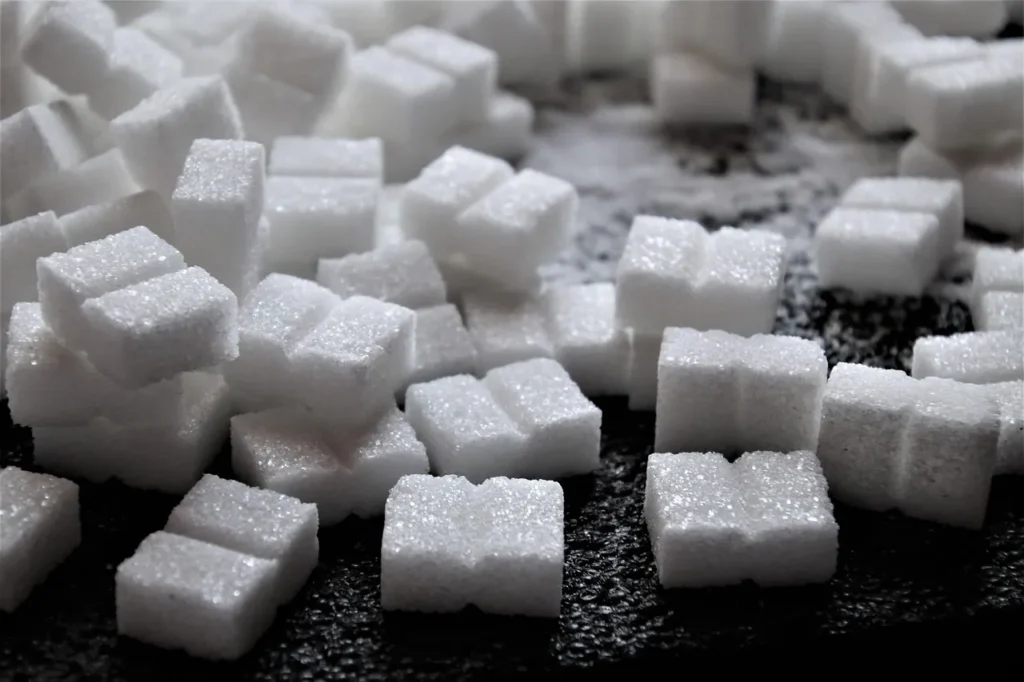
The side effects of sugar are not one dramatic event. They are dozens of small, quiet changes that add up: acid on your teeth within minutes, a blood-glucose swing within two hours, extra fat stored in the liver within days, and a measurably higher risk of diabetes, heart disease and low mood over years. This guide walks through how sugar affects the body organ by organ, what counts as a “safe” amount for Indians, where the hidden sugar in a normal Indian day actually comes from, and how to cut back without misery.
This is general education. If you have diabetes, prediabetes, fatty liver or PCOS, or are pregnant, take your sugar targets from your doctor, and never change a medicine based on an article.
What are the side effects of sugar?
When free sugar regularly exceeds about 25 g a day, the main side effects of sugar are tooth decay, fat build-up in the liver, weight gain, insulin resistance and type 2 diabetes, higher heart disease risk, faster skin ageing and poorer mood. A 2023 BMJ umbrella review of 73 meta-analyses linked high sugar intake to harm across 45 health outcomes.
That review, published in the BMJ in April 2023 (Huang et al.), pooled 73 meta-analyses covering 83 health outcomes and found harmful associations for 18 endocrine and metabolic outcomes, 10 cardiovascular outcomes, 7 cancers and 10 others, including dental, liver and neuropsychiatric outcomes. Its authors concluded that high dietary sugar is “generally more harmful than beneficial for health, especially in cardiometabolic disease”, and recommended keeping free or added sugar below 25 g a day and sugary drinks to less than one serving a week.
Two caveats. First, most of that evidence was rated low or very low quality, because most of it is observational. Second, the problem is free sugar — sugar added by a manufacturer, a cook or you, plus the sugar in honey, syrups and fruit juice. Sugar inside whole fruit or plain milk behaves differently.
How sugar affects the body: from first sip to ten years
Some effects happen before you finish your chai; others take a decade of daily habits to show up.
| Timeframe | What is happening | What the evidence shows |
|---|---|---|
| Minutes | Plaque bacteria on your teeth turn sugar into acid | WHO names free sugar the most common risk factor for tooth decay, which affects about 2.5 billion people |
| 1–2 hours | Glucose enters the blood; insulin rises to move it into cells | For people with diabetes, a reading above 180 mg/dL one to two hours after eating counts as high blood sugar |
| 2–4 hours | Glucose falls back; hunger and cravings can return quickly after a sugary, low-fibre snack | Common experience of the “sugar crash”; worse when sugar is eaten alone, without protein or fibre |
| Days | The liver converts excess fructose into fat | In a 2017 trial, 9 days of swapping sugar for starch cut children’s liver fat from a median 7.2% to 3.8% |
| Years | Insulin resistance, weight gain, higher blood pressure and triglycerides | Regular sugary-drink drinkers have about a 26% higher risk of type 2 diabetes |
| 5+ years | Mood and mental health | Men eating 67 g or more of sugar a day from sweets and drinks had 23% higher odds of a common mental disorder after 5 years |
| Decades | Collagen stiffening in skin and blood vessels through glycation | Sugar cross-links collagen and elastin into advanced glycation end products (AGEs) |
Effects of sugar on the body, organ by organ
| Organ / system | Main effect of too much free sugar | Early sign you might notice | Reversible? |
|---|---|---|---|
| Teeth | Acid erosion and cavities | Sensitivity, brown spots, frequent fillings | Early enamel damage can be slowed; cavities need a dentist |
| Liver | Fat build-up (fatty liver) | Usually none; picked up on ultrasound or liver tests | Often, in early stages, with diet and weight change |
| Pancreas and blood sugar | Insulin resistance, prediabetes, type 2 diabetes | Thirst, frequent urination, tiredness after meals | Prediabetes often can be; diabetes needs medical care |
| Heart and blood vessels | Higher blood pressure, triglycerides and inflammation | None until a test or an event | Risk falls with sustained change |
| Skin | Glycation of collagen, faster ageing | Duller, less elastic skin over years | Partly; you can slow new damage |
| Brain and mood | Energy swings; long-term link to low mood | Afternoon slump, irritability, cravings | Energy usually improves within weeks |
Teeth: the fastest, most certain effect
According to the WHO fact sheet on sugars and dental caries, tooth decay is the most common noncommunicable disease in the world, affecting about 2.5 billion people, and free sugar is its most common risk factor. WHO states that keeping free sugar below 10% of energy, and ideally below 5%, minimises decay risk across your whole life. How often you eat sugar matters too: five sweet chais a day means five acid attacks. WHO also advises fluoride toothpaste (1,000–1,500 ppm).
Liver: where fructose turns into fat
Table sugar is half glucose and half fructose. Fructose is handled mainly by the liver, which turns a surplus into fat (de novo lipogenesis). Fatty liver usually has no symptoms until an ultrasound finds it.
The encouraging part is how fast the liver responds. In a 2017 trial in Gastroenterology (Schwarz et al.), 41 children with obesity who habitually ate more than 50 g of fructose a day had sugar replaced by starch for just 9 days, with the same total calories. Median liver fat dropped from 7.2% to 3.8% and insulin response improved. It was short and small, but it shows the liver reacts to sugar itself, not only to calories.
High blood sugar effects on body
In a healthy person, insulin brings blood sugar back down after a sweet. Trouble starts when years of sugar surges, extra weight and inactivity make cells resistant to insulin, leading to prediabetes or type 2 diabetes.
Cleveland Clinic defines hyperglycaemia as a fasting glucose above 125 mg/dL in someone without a diagnosis, or above 180 mg/dL one to two hours after eating in someone with diabetes. Early symptoms include thirst, hunger, frequent urination, headaches and blurred vision. If it stays high for years, it can damage the eyes, kidneys, nerves, heart and blood vessels, and slow wound healing. If you notice these, get a fasting glucose or HbA1c test. Vomiting, fruity breath and laboured breathing need emergency care.

Heart and blood vessels
Sugar affects the heart mostly indirectly: through weight gain, higher triglycerides, higher blood pressure and chronic inflammation. Sugary drinks are the clearest example. The Harvard T.H. Chan School’s Nutrition Source reports that men who averaged one sugary drink a day had a 20% higher risk of heart attack, while women drinking more than two servings a day had a 40% higher risk of heart attack or death from heart disease. If your main concern is cholesterol specifically, we cover that separately in does sugar raise cholesterol?
Side effects of sugar on skin
Sugar affects skin through glycation. As a 2010 review in Clinics in Dermatology (Danby, “Nutrition and aging skin: sugar and glycation”) explains, glucose and fructose link to the amino acids in collagen and elastin, the proteins that keep skin firm, forming advanced glycation end products (AGEs). Cross-linked collagen is stiff and hard to repair. The process speeds up when blood sugar runs high and is further driven by UV light, so sugar plus unprotected sun is a double hit. Cutting sugar will not erase existing lines, but it can slow new damage. Claims that a sugar detox will “clear acne in a week” go beyond the evidence.
Brain and mood
The short-term effect is the familiar sugar crash: a quick lift, then tiredness and a craving for more. The long-term picture is more serious. In the British Whitehall II study (Scientific Reports, 2017), men in the highest third of sugar intake from sweet foods and drinks, 67 g a day or more, had 23% higher odds of developing a common mental disorder five years later, even after adjusting for weight, other diseases and diet. Low mood did not predict later sugar intake. It is an association, not proof.
How much sugar per day is safe?
For most Indian adults, a safe target is under 25 g of added sugar a day, about 6 level teaspoons. ICMR-NIN’s 2024 Dietary Guidelines for Indians define intake above 5% of energy, or 25 g a day, as “high” sugar. WHO sets an upper limit of 10% of energy, about 50 g, and says 5% gives added benefit.
The major limits line up closely:
| Source | Limit | In grams (2,000 kcal diet) | Approx. level teaspoons |
|---|---|---|---|
| ICMR-NIN, Dietary Guidelines for Indians (2024) | Added sugar below 5% of energy | 25 g (meal plans allow 25–30 g) | 6 |
| WHO (upper limit) | Free sugar below 10% of energy | 50 g | 12 |
| WHO (ideal) | Free sugar at 5% of energy or less | About 25 g | 6 |
| American Heart Association | Women 100 kcal; men 150 kcal of added sugar | About 25 g women; about 36 g men | 6 women; 9 men |
| BMJ umbrella review (2023) | Free or added sugar below 25 g; sugary drinks under 1 serving a week | 25 g | 6 |
The ICMR-NIN Dietary Guidelines for Indians (2024) say added sugar could be removed entirely, since it adds calories without vitamins, minerals or fibre, and they list jaggery and honey as added sugars. The WHO healthy diet fact sheet gives the 50 g upper limit as “about 12 level teaspoons”, so one level teaspoon is roughly 4 g. That makes the maths easy: count teaspoons.
Where does the sugar in an Indian day come from?
Sugar arrives quietly, in drinks, packaged snacks and “healthy” foods. Here is how a normal day adds up, at 4 g per teaspoon.
| Item | Typical habit | Added / free sugar | Share of a 25 g day |
|---|---|---|---|
| Masala chai | 3 cups, 2 tsp sugar each | 6 tsp ≈ 24 g | Almost 100% |
| Filter coffee | 2 cups, 1½ tsp each | 3 tsp ≈ 12 g | About 50% |
| Cola or soft drink | One 355 ml can | 7–10 tsp ≈ 28–40 g (Harvard) | 110–160% |
| Packaged fruit juice | One tetra pack | All juice sugar counts as free sugar (WHO); read “added sugar” on label | Often most of the day’s limit |
| Sugarcane juice | One large glass | Juiced sugar counts as free sugar (WHO) | Treat as an occasional drink |
| Mithai (jalebi, gulab jamun, barfi) | 1–2 pieces | Varies widely; sugar syrup is a main ingredient | Can use a full day’s limit |
| Jaggery in dal, chikki or chai | 1–2 tsp | Counts as added sugar (ICMR-NIN) | 16–33% |
| Packaged food label check | Per 100 g or 100 ml | ICMR-NIN flags over 3 g added sugar per 100 g (solids) or 2 g per 100 ml (drinks) as high | Use as a quick filter |
The chai row is the eye-opener for most families. Three sweetened cups alone reach the ICMR limit before you have touched a biscuit. You do not have to give up chai; halving the sugar in each cup saves about 12 g a day, roughly 4.4 kg of sugar a year.
Side effects of sugar cane juice
Ganne ka juice is fresh, but once sugarcane is crushed its sugar is “free” in the WHO sense: no fibre, absorbed quickly, easy to drink in bulk. Treat a glass as an occasional treat, not a daily health drink, especially with diabetes or fatty liver. Unsweetened nimbu pani or chaas are better everyday coolers.

Three sugar myths, corrected
Jaggery vs sugar: which is better?
Jaggery (gur) is less refined and carries traces of minerals, so it is often sold as the “healthy sugar”. The ICMR-NIN 2024 guidelines explicitly list jaggery and honey as added sugars, the same category as white sugar. So in the jaggery vs sugar debate, the practical answer is: choose whichever you prefer for taste, but count every teaspoon of either toward the same 25 g limit. Swapping two spoons of sugar for two spoons of gur changes the flavour, not the side effects of sugar. For how different foods raise blood glucose, see our glycemic index chart of common Indian foods.
“Fruit sugar is just as bad”
No. Whole fruit comes with fibre, water and nutrients that slow absorption and make it hard to overeat. WHO’s definition of free sugar deliberately excludes the sugar inside whole fruit, while including the sugar in fruit juice. A guava, an apple or a bowl of papaya is not the problem. Three glasses of mango shake a day is.

Side effects of sugar-free tablets
Sugar-free tablets and sweeteners such as sucralose, aspartame, saccharin and stevia seem like the obvious fix. In May 2023, however, WHO advised against using non-sugar sweeteners for weight control, finding no long-term benefit for body fat, and possible links between long-term use and higher risk of type 2 diabetes, heart disease and death in adults. The guideline does not apply to people who already have diabetes, whose doctors may still recommend them. The ICMR-NIN guidelines add that pregnant and breastfeeding women and children should avoid sugar substitutes. The better goal is to retrain your palate to want less sweetness.

A four-week walkthrough to cut sugar without the misery
A gradual approach lets your taste adjust. This plan assumes a healthy adult; adapt it with your doctor if you have a condition.
- Week 1 — Audit. Write down every teaspoon you add and every packaged item with added sugar for 3 days. Multiply teaspoons by 4 g. Most people are surprised.
- Week 2 — Drinks first. Stop soft drinks and packaged juices completely, and halve the sugar in each chai or coffee. Drinks are the easiest win because liquid sugar does not fill you up.
- Week 3 — Fix the snacks. Replace biscuits and bakery items with roasted chana, peanuts, fruit, curd or a boiled egg. Use the ICMR label rule: skip packaged foods above 3 g added sugar per 100 g.
- Week 4 — Plan the sweets. Keep mithai for a set occasion, such as one small piece on Sunday or at festivals, rather than cutting it forever. Eat it after a meal, not on an empty stomach.
Pair it with movement, since working muscles use glucose; a short walk after meals is an easy habit. For a structured home routine, online yoga classes are a gentle place to start.
Troubleshooting: cravings, crashes and headaches
Most people hit one of these in the first two weeks.
- Strong afternoon cravings. Usually a sign lunch was mostly refined carbs. Add dal, paneer, curd, eggs or sprouts, plus a vegetable, so the meal digests more slowly.
- Tired and foggy after lunch. Check the plate: large portions of white rice or roti with a sweet drink produce a sharper rise and fall. More protein and fibre, and a short walk, help.
- Headaches or irritability in the first days. Often reported, and usually temporary. Drink enough water, keep regular meals, and do not cut caffeine and sugar in the same week.
- Shaky, sweaty or confused when meals are delayed. This needs a proper check-up, especially if you take any diabetes medicine. Do not self-treat.

Who needs to be especially careful with sugar?
People with prediabetes or diabetes, fatty liver, PCOS or high triglycerides, pregnant women, and young children benefit most from keeping added sugar well under 25 g a day. They should set exact targets with a doctor or registered dietitian, because medicines and test results change what is safe.
- Prediabetes and type 2 diabetes: sugar is not banned, but it has to fit your medicines and glucose readings. Never adjust insulin or tablets yourself. Our guide to insulin resistance and weight loss explains the link with body weight.
- Fatty liver: sugary drinks and juices are the first thing to cut, given how quickly liver fat responds.
- Children: WHO advises that children under 2 avoid sugar-sweetened drinks entirely, and ICMR advises children avoid sugar substitutes. Build habits early: plain milk, whole fruit and home snacks.
- Pregnancy: follow your obstetrician’s advice, especially if you are screened for gestational diabetes. Avoid sugar substitutes, per ICMR-NIN.
If you want a plan built around your own reports, food habits and family meals, a one-on-one session with a registered dietitian is the most direct route.
Frequently asked questions
What are the side effects of sugar in the body?
Regularly eating more than about 25 g of free sugar a day is linked to tooth decay, fatty liver, weight gain, insulin resistance, type 2 diabetes, higher heart disease risk, faster skin ageing and poorer mood. A 2023 BMJ umbrella review found harmful associations across 45 health outcomes.
How much sugar per day is safe for an Indian adult?
ICMR-NIN’s 2024 guidelines treat more than 25 g of added sugar a day, or 5% of energy, as high. That is about 6 level teaspoons, including sugar in chai, sweets, packaged foods and jaggery.
Is jaggery better than sugar?
Only slightly, if at all. Jaggery has traces of minerals, but ICMR-NIN classifies it as an added sugar, like white sugar and honey. Count every teaspoon of jaggery toward the same daily limit.
Does eating fruit have the same effect as eating sugar?
No. The sugar inside whole fruit comes with fibre and water, and WHO does not count it as free sugar. Fruit juice, including fresh juice and sugarcane juice, does count as free sugar.
Are sugar-free tablets safe to use instead of sugar?
WHO’s 2023 guideline advises against sweeteners for weight control because they showed no long-term fat-loss benefit and possible links to diabetes and heart disease. People with diabetes should follow their doctor’s advice. ICMR-NIN advises children and pregnant or breastfeeding women to avoid them.
How quickly does the body recover after cutting sugar?
Some changes are fast. In a 2017 trial, children’s liver fat nearly halved after 9 days of swapping sugar for starch. Energy and cravings usually settle within 2–4 weeks, while risks such as diabetes and heart disease fall over months and years.
Can sugar affect my skin?
Yes. Sugar binds to collagen and elastin to form advanced glycation end products (AGEs), which stiffen skin over time, and UV light speeds this up. Reducing sugar and using sun protection can slow new damage.
Start with one change this week: count the teaspoons in your chai for three days, then halve them. If you would like a dietitian to build a low-sugar Indian meal plan around your own reports and routine, book an online nutrition consultation with Fitstrot.


