
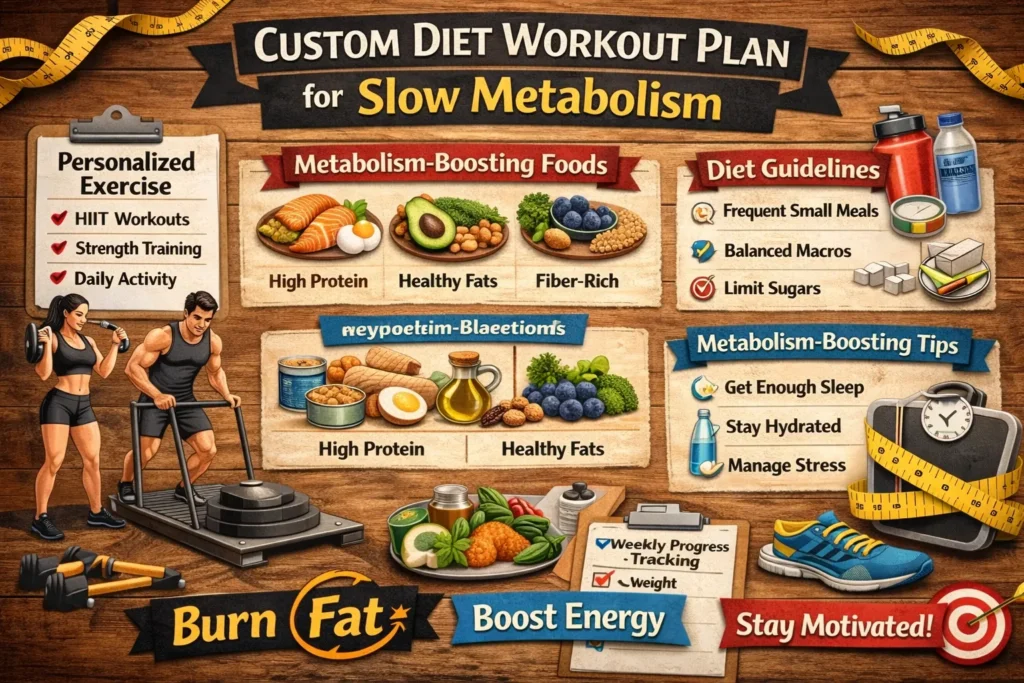
A custom diet workout plan for slow metabolism starts with an honest question: is your metabolism actually slow, or are food, movement, sleep and muscle quietly working against you? For most people it is the second. This guide separates myth from fact, flags when a thyroid check is the right first step, and gives you a plan template with Indian meals, gram targets and a weekly training split.
Nothing here is a diagnosis or a promise of results. If you have a medical condition or take regular medication, use this as a framework to discuss with your doctor or dietitian.
What does “slow metabolism” actually mean?
Metabolism is the energy your body spends each day: roughly 60 to 70 percent at rest, about 10 percent digesting food, and the rest on movement. A genuinely slow metabolism means you burn noticeably less than expected for your size, usually from low muscle mass, very low activity, long-term crash dieting or a medical cause such as an underactive thyroid.
Differences between healthy people of the same weight and age are real but smaller than most people believe, often a couple of hundred calories a day, not a thousand. That is good news, because the biggest levers are ones you control. If you want to check your own pattern first, our guide to the signs of a slow metabolism explains what is typical and what needs testing.
Slow metabolism myths vs facts
Much online advice about “boosting metabolism” is exaggerated. This table sorts the common claims.
| Common claim | What is closer to the truth | What to do instead |
|---|---|---|
| Eating 5 to 6 small meals speeds up metabolism | Meal frequency barely changes total calories burned; total food and protein matter more | Choose 3 meals and 1 to 2 snacks you can stick to |
| Skipping meals “resets” metabolism | Very low intake can lower daily activity and muscle, making progress harder | Eat regular meals with protein |
| Green tea or spices burn fat | Any effect is tiny, a handful of calories at most | Enjoy them as habits, not fixes |
| Cardio alone fixes it | Too much cardio with too little food can cost muscle | Build a base of strength training plus walking |
| Fat burners and detox teas help | They are unproven, and some cause palpitations or stomach trouble | Skip them |
| My weight gain is all due to metabolism | Portions, sleep, stress, hormones and medicines also play a part | Track honestly for 2 weeks, then check with a doctor |
One true point behind these myths: muscle does use more energy than fat, even at rest. The difference per kilogram is modest, so building muscle is a slow, helpful lever, not a quick switch. The real value of strength training is that it protects muscle while you lose fat.
Thyroid caution: when to see a doctor before you start
Some people really do have a slowed metabolism, and the cause may be medical. Book a doctor visit before you rely on diet and exercise alone if you notice several of these together:
- Unexplained weight gain despite normal eating and activity
- Constant tiredness, feeling cold when others are comfortable
- Constipation, dry skin, hair thinning or swelling in the face
- Irregular or heavy periods, or a family history of thyroid disease
A doctor can decide whether a thyroid blood test or other checks are needed. If you are already diagnosed with a thyroid issue, diabetes, PCOS, kidney or heart disease, or take regular medicines, tell your doctor or registered dietitian before changing your diet or starting intense workouts. Never stop, skip or change a prescribed medicine on your own, and do not start supplements without advice. Stop exercise and seek care for chest pain, fainting or severe breathlessness.
How do you build a custom diet workout plan for slow metabolism?
Set calories about 300 to 500 below your maintenance level, eat roughly 1.2 to 1.6 g of protein per kg of body weight daily, lift weights 3 times a week, and walk 7,000 to 10,000 steps. Review every 2 weeks. If you have kidney disease or any medical condition, get these numbers set by your doctor.
- Estimate maintenance. Many adult women maintain on roughly 1,700 to 2,200 kcal a day and men on 2,200 to 2,800, depending on size and activity. Use these as starting ranges only.
- Apply a small deficit. Stay about 300 to 500 kcal below. Do not go under roughly 1,200 kcal (women) or 1,500 kcal (men) without supervision.
- Anchor protein. For a 70 kg adult, 1.2 to 1.6 g per kg is about 85 to 110 g a day, spread over meals.
- Fill the plate. Half vegetables and salad, a quarter protein, a quarter roti, rice or millets.
- Lift, then walk. Strength sessions come first; steps fill the gaps.
- Review fortnightly. Change one thing only: portion, steps or training volume.
Our guide on a workout and diet plan shows how to combine the two parts, and the page on a custom-tailored plan for fat loss and diet explains how personalisation changes the numbers.
A one-day Indian diet template
This is an example for a vegetarian-friendly day around 1,600 to 1,800 kcal. Adjust portions to your own target; eggs, fish or chicken can replace paneer or soya.
| Meal | Example | Approx. protein |
|---|---|---|
| Breakfast | Moong dal chilla (2) with 100 g paneer filling, mint chutney | 25 to 30 g |
| Mid-morning | 1 fruit and a handful (20 g) of roasted chana | 4 to 5 g |
| Lunch | 2 rotis, 1 katori dal, a sabzi, salad, 150 g curd | 20 to 25 g |
| Evening | Chai with less sugar, 2 egg whites or a small bowl of sprouts | 8 to 12 g |
| Dinner | Soya or chicken curry (100 g cooked protein), 1 roti or 1 small bowl millet, vegetables | 25 to 30 g |
That adds up to about 85 to 105 g of protein. Values are rounded and vary with cooking oil and brand. For a plan matched to your food habits, budget and health reports, an online nutritionist consultation is the safest route.
The weekly workout template
Three strength days, one lighter conditioning day and daily walking suit most beginners. Beginners can do 2 to 3 sets per exercise, with 60 to 90 seconds rest.
| Day | Session | Sets x reps | Form cue |
|---|---|---|---|
| Mon | Lower body: squat to chair, glute bridge, step-ups | 3 x 8 to 12 | Push through heels, keep knees tracking over toes |
| Tue | Walk 30 to 45 min | Steady | Fast enough to feel warm but still able to talk |
| Wed | Upper body: incline push-up, band or dumbbell row, shoulder press | 3 x 8 to 12 | Ribs down, no shrugging |
| Thu | Yoga or mobility 20 to 30 min | None | Slow breathing, no pain |
| Fri | Full body: deadlift pattern with light weights, plank, carry | 2 to 3 x 8 to 10 | Flat back, hinge at the hips |
| Sat | Optional intervals or dance session 20 to 25 min | Easy to moderate | Stay at a pace you can recover from |
| Sun | Rest, easy walk | None | Sleep and recovery |
Add weight or a rep only when your form is clean. For ideas on structure, see our home workout plan, and men can pair this with the workout plan for men. If you want form checks and progression handled for you, 1-on-1 personal training does that.
Your first 14 days, step by step
Do not start everything on day one. A staged start keeps energy up and shows you what is working.
- Days 1 to 3: only log what you eat and your steps. Add no rules yet. This gives you an honest baseline.
- Days 4 to 7: add a protein source to breakfast and swap one sugary snack for fruit and nuts. Begin two short strength sessions of 25 minutes.
- Days 8 to 10: raise steps by about 1,500 a day and fix a bedtime.
- Days 11 to 14: bring in the third strength session, trim portions modestly and take waist and weight readings.
Compare day 14 with your baseline. If energy is steady and you are not starving, keep going. If you feel dizzy, weak or unusually cold, eat a little more and speak to your doctor.
Troubleshooting: why a “slow metabolism” plan stalls
- Eating too little. Very low calories cause tiredness, poor sleep and lost muscle. Raise intake slightly and retest for 2 to 3 weeks.
- Too much cardio, too little lifting. If the scale drops but strength falls, shift sessions towards weights.
- Weekend drift. Two heavier days can cancel a five-day deficit. Plan them instead of ignoring them.
- Sleep under 6 hours. Hunger rises and training quality drops. Aim for 7 to 9 hours.
- Judging by the scale only. Check waist, strength and energy too.
Past the first month, expect slow, steady change. Many people see changes in energy and measurements within 6 to 8 weeks of consistent effort, though the pace differs.
Sleep, stress, water and supplements
Poor sleep and high stress push appetite up and recovery down, so treat them as part of the plan, not extras. Aim for a fixed bedtime and a 10-minute wind-down without screens. Water needs vary with weather, body size and activity; roughly 2 to 3 litres a day including tea, buttermilk and watery foods suits many adults, but people with heart or kidney conditions must follow medical advice.
Supplements are optional. Whey protein is a convenience, not a requirement, if food protein falls short. Vitamin D, omega-3, zinc and magnesium should be taken only after a blood test or advice from a doctor, because needs and doses differ. Avoid fat burners completely.
Who needs a different starting point?
Over 35 or sedentary for years. Start with walking and bodyweight moves for 3 to 4 weeks before adding load. Women with irregular periods or PCOS. Work with a doctor and keep calories steady rather than aggressive. Shift workers. Fix meal times to your waking hours and protect 7 hours of sleep somewhere in the day. People with a history of disordered eating. Get professional support before any calorie tracking. For a gym-based version, see our gym workout diet plan.
Frequently asked questions
Can you speed up a slow metabolism?
You can influence it modestly by building muscle, eating enough protein, walking more and sleeping well. Dramatic boosts from teas or supplements are not supported. If a medical cause such as a thyroid problem is behind it, a doctor needs to manage that first.
How much protein should I eat with a slow metabolism?
Most healthy adults do well with roughly 1.2 to 1.6 g of protein per kg of body weight daily, spread across meals. People with kidney disease or other conditions should get their target from a doctor or dietitian.
Is strength training or cardio better for a slow metabolism?
Strength training should come first because it protects and builds muscle. Add daily walking and, if you enjoy it, one or two light cardio sessions a week. Too much hard cardio on low calories can work against you.
Can a slow metabolism cause weight gain even when I eat little?
A medical cause like an underactive thyroid can contribute to weight gain, but under-reported food intake, low activity and poor sleep are far more common explanations. Track honestly for two weeks and speak to a doctor if symptoms persist.
How long does a custom diet workout plan for slow metabolism take to work?
Most people notice better energy and small measurement changes within 6 to 8 weeks of steady effort. Larger changes take months, and results vary with starting point, health and consistency.
Next step: want these ranges turned into a plan around your reports, food habits and schedule? Book a session with a FitStrot online weight loss trainer and share any thyroid or medical details up front.


