
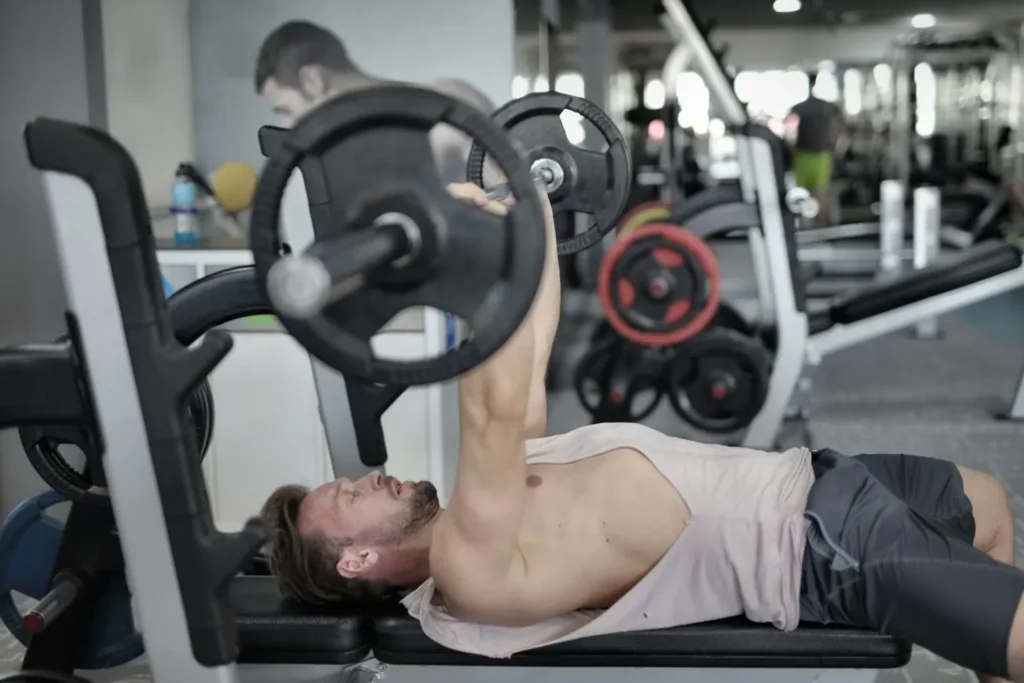
A solid chest day workout plan comes down to five exercises, about 14 to 16 hard sets and roughly an hour in the gym: a heavy press first, a second press at a different angle, a dip or machine press, and two isolation lifts to finish. This guide gives you the exact session, the numbers to hit, form cues for each lift and fixes for when your chest refuses to grow.
It assumes a normal Indian gym with a flat bench, an incline bench, dumbbells, a cable stack and a pec deck. If yours has less, the home option further down still works.
What should a chest day workout plan include?
A good chest day plan includes five exercises: a heavy compound press for 4 sets of 6-8 reps, a second press at a different bench angle, one dip or machine press, and two isolation lifts for 10-15 reps. That adds up to roughly 14 to 16 working sets, with 60 seconds to 3 minutes of rest between sets.
The chest is one large muscle, the pectoralis major, but its fibres fan out from the collarbone down to the lower ribs. A press at a flat angle hits the middle fibres hard, an incline emphasises the upper part near the collarbone, and a dip with your torso leaning forward loads the lower part. Using all three angles in one session is what stops the chest from looking flat on top.
Order matters as much as the exercise list. Heavy compound lifts come first because they need the most strength, balance and shoulder stability. Isolation lifts such as flyes come last because they use light weights and you can do them well even when tired.
The full chest day: exercises, sets, reps and rest
This is the session to follow if you have been lifting consistently for about 6-12 months. Pick weights that make the last 1-2 reps hard but still clean.
| # | Exercise | Sets | Reps | Rest | Targets |
|---|---|---|---|---|---|
| 1 | Incline barbell press (bench at 15-30 degrees) | 4 | 6-8 | 2-3 min | Upper chest, front shoulders, triceps |
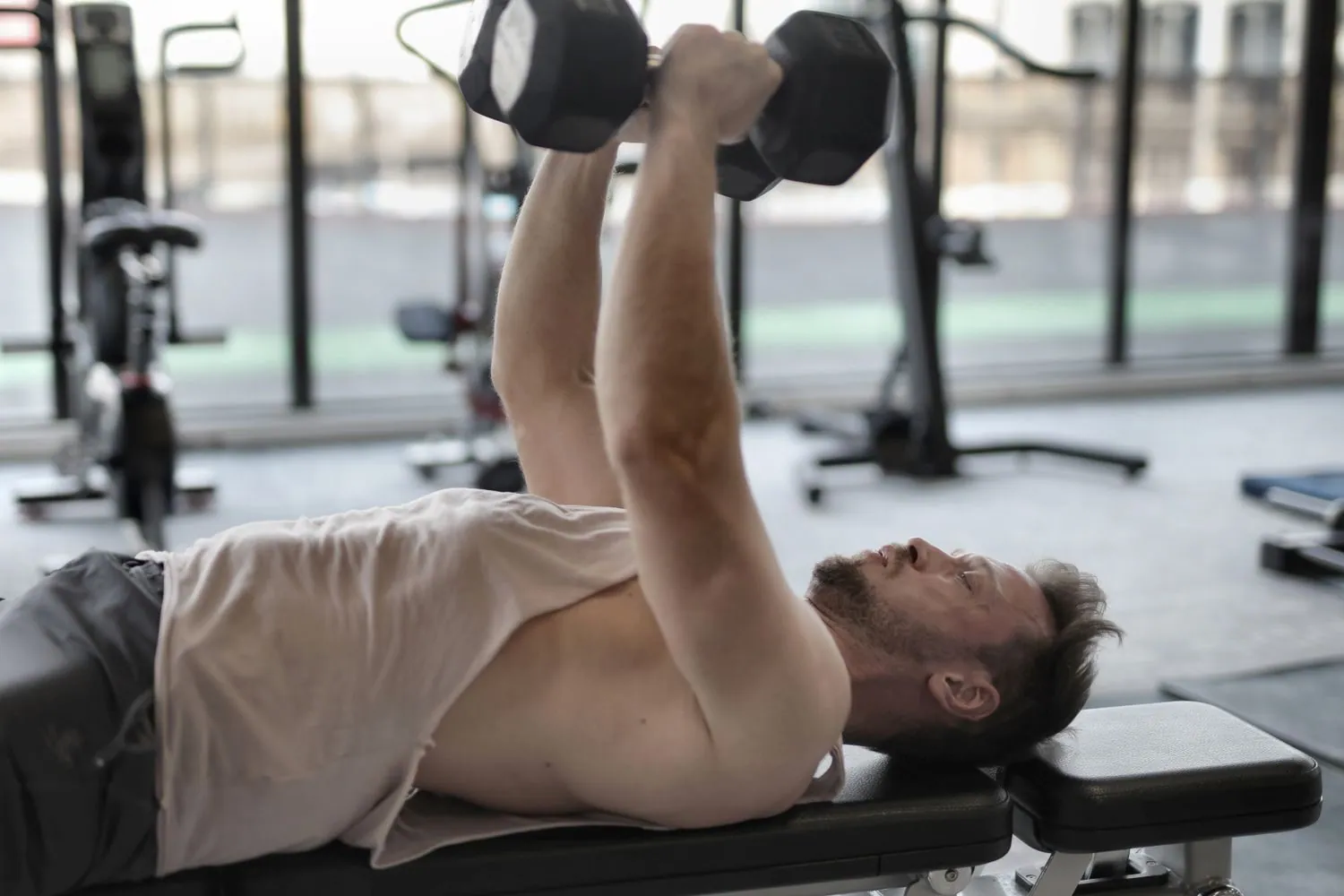
| 2 | Flat dumbbell press | 3 | 8-10 | about 2 min | Mid chest |
| 3 | Chest dips (lean forward) or machine chest press | 3 | 8-12 | 90 sec | Lower chest, triceps |
| 4 | Low-to-high cable fly | 3 | 12-15 | 60 sec | Upper chest stretch and squeeze |
| 5 | Pec deck fly | 2-3 | 12-15 | 45-60 sec | Whole chest, finishing pump |
Total: 15-16 working sets. If you are short on time, drop exercise 5 and you still have a complete session. If you have no cable stack, swap exercise 4 for an incline dumbbell fly done with a slow, controlled stretch.
Beginner, intermediate or advanced: which chest day is yours?
Your chest day should match how long you have been training, not what a bodybuilder posts online. A beginner needs 3-4 exercises and about 8-10 sets, an intermediate lifter needs 5 exercises and 14-16 sets, and an advanced lifter may need 6 exercises and up to 20 sets, often split over two days.
| Beginner (0-6 months) | Intermediate (6 months-3 years) | Advanced (3+ years) | |
|---|---|---|---|
| Exercises per session | 3-4 | 5 | 5-6 |
| Working sets per session | 8-10 | 14-16 | 16-20, or 10-12 across two days |
| Main press | Machine or dumbbell press | Incline barbell press | Barbell and dumbbell presses, rotated every 6-8 weeks |
| Rep range | 10-15 | 6-15, heavier on first lifts | 5-15 with some heavy sets |
| Rest between sets | 60-90 sec | 60 sec-3 min | 60 sec-3 min |
| Chest sessions per week | 1 (or full-body days) | 1-2 | 2 |
| Weekly chest sets | about 8-10 | about 12-16 | about 16-20 |
Most people grow well on roughly 10-20 hard chest sets a week. Going above that rarely helps unless you recover well, sleep enough and eat enough.
Walkthrough: how to run the session from warm-up to last set
Minutes 0-10, warm-up. Spend 3-5 minutes on light cardio such as a rower or cross-trainer, then do arm circles, band pull-aparts and 10-15 push-ups. Before the first press, do 2 ramp-up sets: about 50% of your working weight for 8-10 reps, then about 75% for 3-5 reps.
Minutes 10-30, the heavy presses. Do the incline barbell press with a smooth tempo: lower the bar in about 2 seconds to the upper chest, pause briefly, press up in about 1 second. Stop each set with 1-2 reps still in the tank. Then move to the flat dumbbell press and let the dumbbells go a little deeper for a stretch across the chest, as long as your shoulders feel fine.
Minutes 30-45, dips or machine press. Lean your torso forward about 20-30 degrees and lower until your upper arms are roughly parallel to the floor. If dips hurt your shoulders, use a machine chest press instead.
Minutes 45-60, isolation. Take the cable and pec deck flyes closer to failure than the presses. Light weights only work if the last 2-3 reps are genuinely hard. Pause for a second at the stretch, squeeze at the end and do not swing the weight.
After the session. Write down every weight and rep. Use double progression: when you hit the top of the rep range on all sets, add the smallest increase you can, usually 2.5 kg on a barbell or one dumbbell step. If you cannot add weight, add one rep instead.
Form cues for each lift
Use this table as a quick form checklist before each exercise.
| Exercise | Setup cue | Movement cue | Common mistake |
|---|---|---|---|
| Incline barbell press | Bench at 15-30 degrees, shoulder blades pulled back and down, feet flat | Bar touches the upper chest, elbows about 45-75 degrees from your torso | Bench set too steep, so the shoulders do the work |
| Flat dumbbell press | Dumbbells start over the chest, wrists stacked over elbows | Lower until elbows are just below bench level, press in a slight arc | Flaring elbows to 90 degrees and bouncing at the bottom |
| Chest dips | Lean forward, knees bent, chest up | Lower slowly, stop when upper arms are parallel to the floor | Going too deep and straining the front of the shoulder |
| Low-to-high cable fly | Pulleys at the bottom, slight bend in the elbows | Sweep hands up and together in front of the upper chest | Turning it into a front raise or a curl |
| Pec deck fly | Seat so handles are at chest height, back pressed to the pad | Squeeze for a second, return slowly | Letting the weight stack slam back down |
Myth check: four chest day beliefs that waste your time
Myth 1: Flat bench alone builds a full chest. Flat pressing is a good base, but it leaves the upper chest under-trained for many people. Add an incline press every chest day.
Myth 2: Flyes shape the inner chest. You cannot choose which part of the muscle grows. Muscle shape is largely genetic. Flyes train the whole chest through a stretched position, and that is useful enough on its own.
Myth 3: More exercises mean more growth. Eight exercises of half-effort sets build less than five exercises of hard sets. Quality sets near failure beat a long list.
Myth 4: Heavier is always better. A bar bounced off the chest and pressed with a back arched like a bridge trains your ego and your shoulder joint. Controlled reps with a weight you can lift cleanly build more muscle.
Why is my chest not growing even though I train it every week?
The usual causes are too few hard sets (under about 10 a week), stopping 4-5 reps short of failure, no change in weights over 6-8 weeks, or too little food and sleep. Fix one thing at a time: log your lifts, add a set or two, and eat roughly 1.6-2 g of protein per kg of body weight daily.
For a 70 kg person, that protein range is about 110-140 g a day, which Indian diets can reach with eggs, paneer, dal, curd, chicken or fish, and soya chunks spread across 3-4 meals. Sleep of 7-8 hours matters just as much.
- Triceps or shoulders burn out first: Your elbows are probably too wide or the bench too steep. Lower the incline, tuck elbows slightly and think about pushing your hands together as you press.
- You cannot feel your chest working: Use lighter weight, slow the lowering phase to 3 seconds and pause at the stretch. Pull your shoulder blades back and down before every press.
- Front shoulder pain on the bench: Reduce range of motion, switch to dumbbells or a machine, and keep elbows from flaring. If pain continues for more than a week or two, get it checked by a physiotherapist or doctor instead of training through it.
One safety note: sharp pain, pressure in the chest, breathlessness or dizziness during a workout is not a muscle problem. Stop, rest and see a doctor before lifting again.
Chest day for home, beginners, women and busy people
Home with dumbbells only. You can run a decent session with a pair of adjustable dumbbells and a bench or the floor: floor press 4 x 8-12, incline push-ups or feet-elevated push-ups 3 x to near failure, dumbbell fly on the floor 3 x 12-15, and slow tempo push-ups 2 x as many as possible. Our home workout plan shows how to fit this into a full week.
Beginners. Start with three lifts: machine or dumbbell chest press, incline dumbbell press and a pec deck. Do 2-3 sets each with 10-15 reps and add weight slowly. In the first 6-8 weeks, learning the movement matters more than the number on the dumbbell.
Women. The same plan works. Chest training does not shrink or enlarge breast tissue; it builds the muscle underneath and improves pressing strength and posture. Use the beginner volume for the first couple of months and increase gradually.
Busy schedules. If you only have 30-35 minutes, do three exercises: incline dumbbell press 4 x 8-10, dips or machine press 3 x 8-12, and a cable fly 3 x 12-15. That is 10 sets and still a real workout.
Where does chest day fit in your weekly split?
Train chest once or twice a week with at least 48 hours between hard chest sessions. Once a week works for beginners and for 5-day splits with 15-16 sets on chest day. Twice a week suits lifters who split about 6-10 sets per session, and you should avoid heavy shoulder or triceps work the day before.
Chest sits well beside triceps and shoulders because they assist every press, but then total pressing volume rises quickly, so trim sets on those days. If you follow a five-day structure, see our 5-day workout plan for how chest day slots between back, legs and shoulder days. For a full week laid out day by day, see the workout plan for men.
Food matters too. Without enough calories and protein, even a perfect chest day builds slowly. A registered dietitian through online nutritionist consultation can fit your protein target to a vegetarian, eggetarian or non-vegetarian Indian diet.
Frequently asked questions about chest day
How many exercises should a chest day have?
Four to six exercises suits most people: three or four for beginners, five for intermediates. Fewer than three usually misses a chest angle, and more than six tends to add fatigue without adding growth. Aim for 14-16 hard sets in total and keep the effort high on every one.
How often should you train chest in a week?
Once or twice a week works for most people, with at least 48 hours between hard sessions. Aim for roughly 10-20 hard sets across the week. A beginner can start with one session of 8-10 sets, then move to two sessions as recovery improves.
How long should a chest day workout take?
A full chest day takes about 60-75 minutes including a 10-minute warm-up and rest between sets. A shorter version with three exercises and about 10 working sets can be done in 30-40 minutes. Longer than 90 minutes usually means too much rest time or too many exercises.
Can you do a chest day at home with only dumbbells?
Yes. Floor or bench dumbbell press, feet-elevated push-ups and dumbbell flyes cover the chest well. Use 3-4 sets of 8-15 reps, slow your lowering phase to 3 seconds and add reps or weight each week. Adjustable dumbbells that reach 20-30 kg are enough for most beginners.
Should you train chest and triceps on the same day?
You can, and many popular splits do. Triceps work during every press, so they are already partly trained. If you pair them, do chest first, then 2-3 triceps exercises for about 6-9 sets, and cut chest volume slightly if your elbows feel sore.
Chest day gets easier when someone checks your bench angle, elbow position and weights each week. Book a 1-on-1 personal training session with Fitstrot and get a chest day built around your gym, your shoulders and your schedule.


