
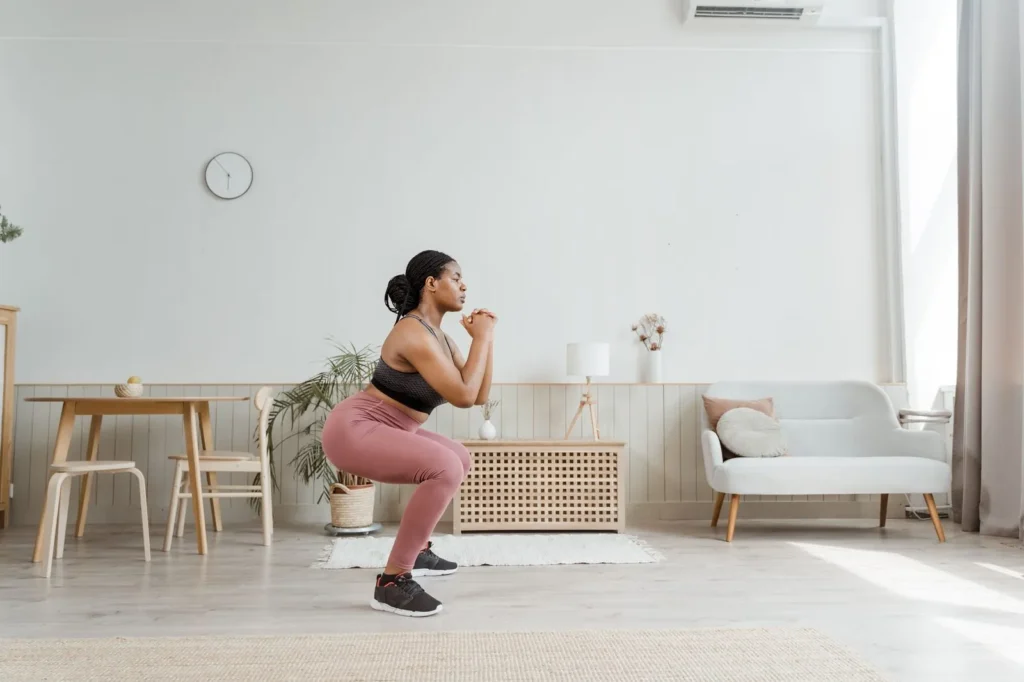
A basic workout for beginners at home needs four moves, a wall, a sturdy chair and about 15 minutes, two to three days a week. You push, squat, march and stretch. That is the whole programme for your first two to three weeks, and it costs nothing. Below you get the exact sets and reps, form cues for every move, a four-week progression, fixes for when it feels too hard, and a clear signal for when to move on.
What is a basic workout for beginners at home?
A basic workout for beginners at home is a short routine of four bodyweight movements: a wall push-up, a chair squat, a march in place and a standing stretch. Do two sets of 8 to 10 reps, rest about 60 seconds between sets, and train on two or three non-consecutive days a week. A session takes roughly 15 minutes.
Those four moves cover everyday patterns: pushing, sitting down and standing up, moving your legs rhythmically, and reaching without strain. Together they make a basic home workout that trains your upper body, legs and heart a little, with no learning curve.
Starting small is practical, not timid. Your heart and muscles adapt within weeks, but tendons and joints adapt more slowly. People who begin with a 45-minute video routine often feel wrecked for three days and quit. A short routine you repeat beats an ambitious one you do once.
The 15-minute starter routine, move by move
Start with a two-minute warm-up: roll your shoulders, circle your hips, and walk around the room at an easy pace. Then work through the table in order. These are simple exercises for beginners at home, so keep the effort moderate and finish each set feeling you could do two or three more reps.
| Order | Exercise | Sets x reps | Rest | Form cue |
|---|---|---|---|---|
| 1 | Wall push-up | 2 x 8-10 | 60 sec | Hands at shoulder height, body in one straight line, elbows about 45 degrees from your ribs |
| 2 | Chair squat (sit-to-stand) | 2 x 8-10 | 60 sec | Feet hip-width apart, hips go back first, knees track over toes, stand without pulling on your hands |
| 3 | March in place | 2 x 30 sec | 30 sec | Knees to a comfortable height, swing opposite arm and leg, breathe so you can still talk |
| 4 | Standing forward stretch | 1 x 20-30 sec | None | Knees soft, hinge from the hips, let arms hang, stop at a mild pull and never bounce |
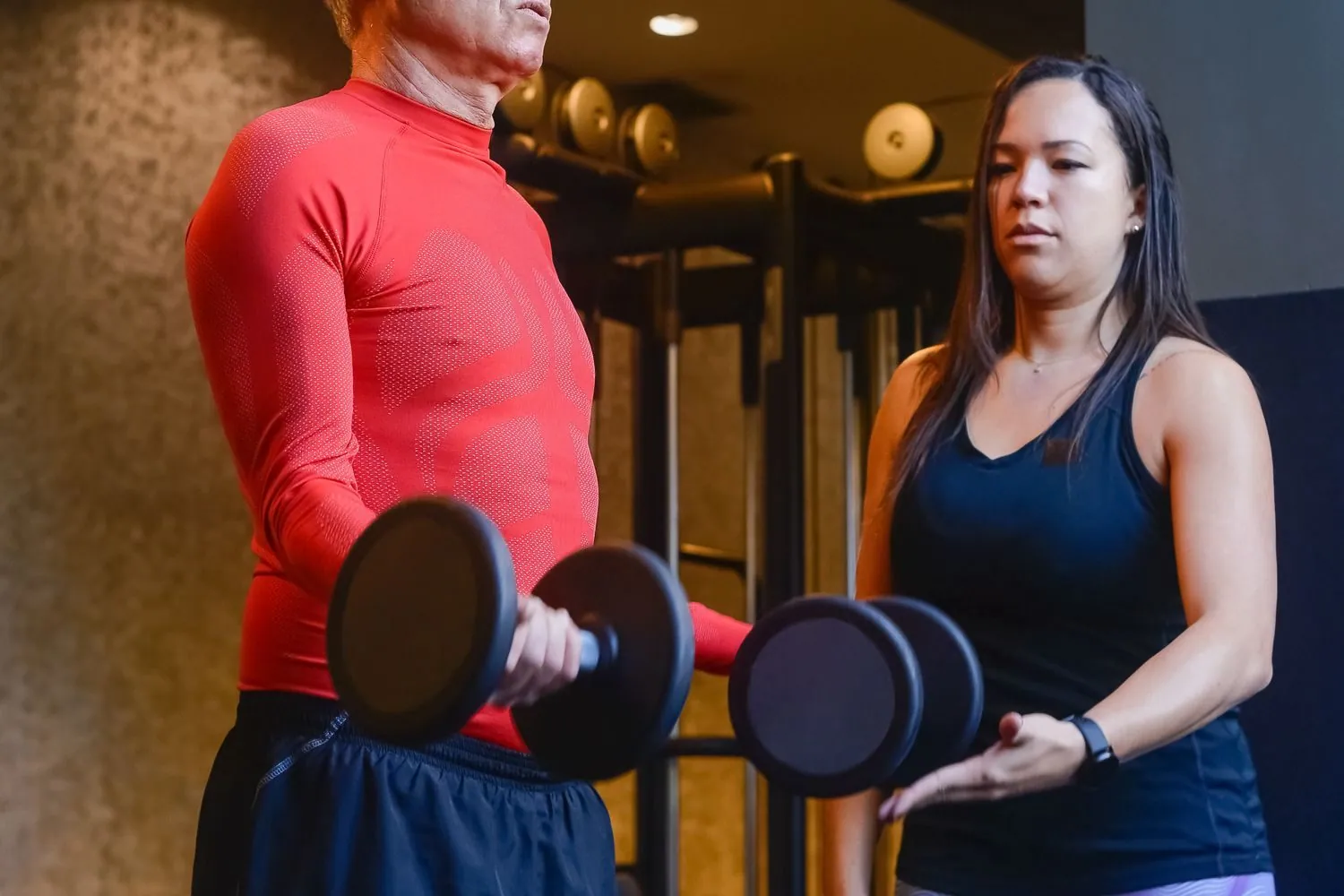
Altogether this takes about 12 to 15 minutes including the warm-up and rest breaks. If it feels easy, that is correct for now, because the habit is what you are really training in the first month. Vitrified tiles and marble are slippery in socks, so wear grippy flat shoes or stand on a yoga mat or folded dari.
How do you do each move correctly?
Each move comes down to one rule: control. Lower for about two seconds, pause briefly, then push or stand back up over one to two seconds, breathing out on the effort. Slow reps with a steady trunk teach your muscles the pattern and protect your joints far better than fast, sloppy ones.
Wall push-up, step by step
- Stand about one arm’s length from the wall, feet hip-width apart.
- Place your palms on the wall at shoulder height, slightly wider than your shoulders.
- Tighten your stomach lightly so your body stays in one line from head to heels.
- Bend your elbows and bring your chest towards the wall over about two seconds.
- Press back to straight arms and breathe out as you push.
Chair squat, step by step
- Place a sturdy chair against a wall so it cannot slide, and stand in front of it.
- Push your hips back as if reaching for the seat, keeping your chest tall.
- Lightly touch the seat, or hover just above it if that feels steady.
- Press through your whole foot and stand up, squeezing your thighs and hips at the top.
March in place: lift one knee at a time, swing the opposite arm and keep your shoulders relaxed. If balance worries you, rest a hand on the chair back or march seated.
These bodyweight exercises for beginners appear in every longer plan, so learning them well now pays off. For a wider no-equipment menu, see our guide to bodyweight workouts.
Does a beginner workout have to hurt to work?
No. A beginner session should feel like mild muscle effort, and you should finish able to do two or three more reps. Mild soreness for a day or two is normal early on. Sharp, pinching or joint pain is not normal, and it means you should stop that movement and use an easier version.
Three myths cause most early dropouts:
- Myth: no pain, no gain. Muscle fatigue is the signal you want. Joint pain is a warning, and being sore for three days means you did too much.
- Myth: you must train daily from day one. Rest days are when your body adapts.
- Myth: a beginner workout at home without equipment is too weak to matter. After a long break, your own bodyweight is a real load, and you can make it harder later.
Sweat is not the scoreboard either. Track reps completed with good form instead.
How many days a week should a beginner work out at home?
Two to three days a week, on non-consecutive days such as Monday, Wednesday and Friday, is enough for a beginner. Each session lasts about 15 minutes, leaving rest days for muscles and tendons to adapt. The common adult target of roughly 150 minutes of moderate activity a week is a goal for later.
The table below is a four-week path from the starter routine. Change only one thing per week so you can tell what is working. If you want a full weekly layout once you outgrow this, our workout schedule for beginners lays out how to space sessions.
| Week | Days | Push-up / squat | March | What changes | How it should feel |
|---|---|---|---|---|---|
| 1 | 2-3 | 2 x 8 | 2 x 30 sec | Learn the form, nothing else | Easy, relaxed breathing |
| 2 | 3 | 2 x 10 | 2 x 40 sec | A few more reps and seconds | Slightly warm, light effort |
| 3 | 3 | 3 x 8-10 | 3 x 40 sec | One extra set | Moderate, mild fatigue |
| 4 | 3, plus a 20-minute easy walk on another day | 3 x 10 | 3 x 45 sec | Optional glute bridge, 2 x 8-10 | Steady, finishing with reps in reserve |
If life gets busy and you miss a week, repeat the last week you completed instead of jumping ahead. Missing a few days does not erase your progress.
What should you do when this routine feels too hard?
Scale down, not up. Use a counter or table edge for push-ups, a higher chair seat for squats, a seated march, and five reps instead of eight. Finish feeling that you could do a little more. Gasping, shaking or sharp pain means the version is too hard today, so switch to an easier one.
The routine table is a target, not a minimum. Here are the common snags and fixes.
| Problem | Likely cause | Fix |
|---|---|---|
| Wrists ache in the push-up | Hands too low or wrists bent back | Move your hands higher on the wall and keep wrists stacked under your palms |
| Knees fall inward in the squat | Tired legs or rushing | Push knees out over your toes, use a higher seat, slow the lowering |
| Lower back pulls in the forward stretch | Locked knees or rounded spine | Bend your knees more and rest your hands on your thighs |
| Dizzy or very breathless in the march | Going too fast or holding your breath | Slow down, march seated, sip water, rest fully before continuing |
| Sore for three days or more | Too many reps too soon | Halve the volume next session and stay at that level for a week |
| Skipping sessions by week three | No fixed time slot | Pick set days and a set time, and lay out your mat the night before |
Fix the habit before the intensity: three short sessions on the same days beat any single perfect workout.
Fitting a home workout for beginners into a real Indian day
A two-metre patch beside the bed, a chair against the wall and 15 minutes is all you need, so the real obstacle is timing, not space.
- Morning: a glass of water first, then the routine before you get pulled into the day.
- Evening: after work and before dinner works well. Wait roughly one to two hours after a heavy meal, since squatting on a full stomach is uncomfortable.
- Desk jobs: if you sit for most of the day, your hips and upper back are stiff. Take the chair squats and stretch seriously, and walk for a couple of minutes every hour.
- Age 40 and above, or returning after a long break: begin at the Week 1 level or even one step below it, such as counter push-ups and seated marching.
On rest days, a few basic yoga poses for beginners loosen stiff hips and shoulders without adding load. For live guidance, try our online yoga classes.
When should you see a doctor before or during a basic workout?
See your doctor before you start if you have a heart condition, high blood pressure, diabetes, are pregnant, have had recent surgery, or have a joint or back problem. Stop and get checked if exercise brings on chest pain or pressure, fainting, unusual breathlessness, or joint pain that lasts more than a few days.
Mild muscle soreness is normal. Sharp, pinching, clicking-with-pain or swollen joints are not, so do not train through them. A doctor or physiotherapist can tell you which movements suit you. This guide is general fitness information, not medical advice.
When is it time to move to a bigger plan?
Move on when you have finished three sets of 10 reps with good form for two weeks in a row, you are not sore the next day, and the routine feels automatic. Add one thing at a time: one more set, five more reps, or ten more seconds of marching.
From here, the natural next step is our guide to at home workouts for beginners, which adds more exercises and a fuller weekly structure. After that, a rotating home workout routine covers different muscle groups, and a home dumbbell workout adds light resistance when you want a bigger strength challenge.
A word on expectations: 15 minutes of bodyweight work three times a week builds the habit, strength and stamina. It burns only a modest amount of energy, so it is not a fast route to weight loss, and no routine can guarantee results. If fat loss is your main goal, food and daily movement matter as much as the workout. Our online weight loss trainer programme combines both.
Frequently asked questions
What is a good basic workout for beginners at home?
A good basic workout has four moves: a wall push-up, a chair squat, a march in place and a standing stretch. Do two sets of 8 to 10 reps for the first two, 30 seconds of marching, and one stretch hold, on two to three days a week. It takes about 15 minutes.
Can I do a basic home workout without any equipment?
Yes. The routine above uses only your bodyweight, a wall and a sturdy chair. Dumbbells and resistance bands can wait until the basics feel easy, usually after three to four weeks. A mat or folded dari is useful for comfort but not essential.
How long should a beginner workout at home take?
About 12 to 15 minutes, including a two-minute warm-up and rest breaks. That is long enough to train the main movement patterns and short enough to repeat. Increase time only after four consistent weeks, and add by sets or reps rather than adding long extra sessions.
Is it okay to work out at home every day as a beginner?
It is better to start with two to three days a week. Rest days let muscles and tendons adapt, and they lower the risk of overuse injury. After about four weeks, you can add easy walking on other days, but keep at least one full rest day.
Will a basic workout help me lose weight?
It helps indirectly by building a routine, strength and stamina, but on its own it burns only modest energy. Meaningful, safe weight loss usually comes from a sustainable eating pattern plus regular movement over months. No workout can promise a specific number of kilos.
Want someone to watch your form on camera and adjust the plan each week? See how Fitstrot’s 1-on-1 personal training works.


