
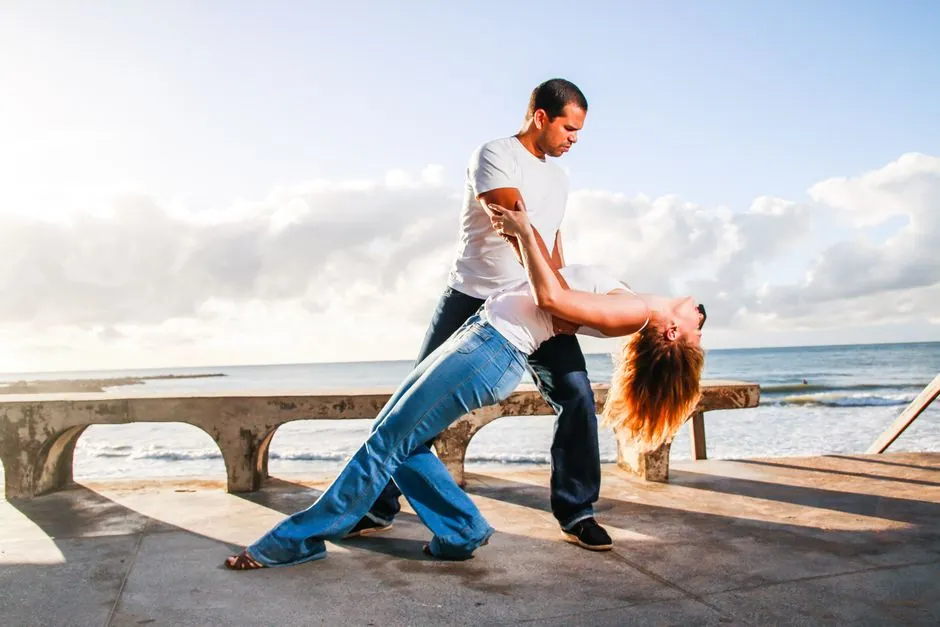
The bachata dance is a Dominican couples’ dance built on a small, four-beat travelling square with a hip pop on the fourth count. Dembow is the Dominican drum-machine pattern that powers most of today’s Latin urban music. In a bachata zumba block they arrive back to back: a slow, grounded, hip-led track, then a fast, punchy one that spikes your heart rate. This guide covers where each style actually comes from, the counts and cues for the basic steps, how the fitness version differs from what a studio would teach you, and what a 10-minute bachata-and-dembow block does to your heart rate — with the numbers from published research rather than guesswork.
What is bachata dance, and what is dembow?
Bachata is a Dominican partner dance and music genre built on an eight-count pattern of three steps and a hip accent, danced in a small square. Dembow is a repetitive, syncopated percussion pattern from the Dominican Republic that underpins reggaeton and Dominican urban music. Zumba uses bachata for grounded hip work and dembow for fast, high-intensity bursts.
They are not the same kind of thing, which is the most common point of confusion. Bachata is a dance and a genre. Dembow is a rhythm — a drum pattern sitting underneath many genres. You can dance bachata to bachata music; you cannot really “dance dembow”, you dance to dembow.
Bachata dance meaning: what the word originally described
UNESCO, which added Dominican bachata to the Representative List of the Intangible Cultural Heritage of Humanity in 2019, notes that the term is presumed to be of African origin and that it originally referred to a lively gathering or party rather than to a musical genre at all (UNESCO ICH, inscribed 2019). Only later did the word attach itself to the guitar-led music played at those gatherings, and later still to the dance. So the bachata dance meaning most people search for — “sensual Dominican couples’ dance” — is the youngest layer of a much older word.
What is dembow, and where did the name come from?
Dembow emerged in the Dominican Republic through the late 1980s and 1990s as producers looped and sped up a syncopated dancehall drum pattern. The name traces back to the 1990 Jamaican record “Dem Bow” by Shabba Ranks, whose riddim was sampled and rebuilt until it became the spine of Spanish-language urban music. That pattern is why reggaeton, Dominican dembow and much of Latin pop feel rhythmically related even when their tempos differ by 40 beats per minute.
Bachata dance origin: from Dominican backyards to a UNESCO listing
Bachata developed in the Dominican Republic from the 1960s onward as a fusion of rhythmic bolero with Afro-Antillean genres including son, cha-cha-chá and merengue. UNESCO describes the traditional ensemble as one or two guitars carrying the lead, with percussion made up of bongos, maracas and a güira over a bass line, and the dance itself as “a couple’s dance characterised by a sensual hip movement and simple eight-step structure.”
Bachata’s cousin merengue was inscribed three years earlier, in 2016, and UNESCO describes it as danced in pairs with flirtatious gestures, moving in circles to accordion, drum and saxophone (UNESCO ICH, merengue, 2016). Both were learned informally — by observation, participation and imitation, not in classes. That is exactly why a Zumba instructor can teach you a usable bachata basic in about four minutes: the core pattern was made to be picked up by watching.
For the fuller arc of how these rhythms ended up in a fitness format at all, our history of Zumba post traces the programme from a forgotten aerobics cassette in Cali, Colombia to a global class format.
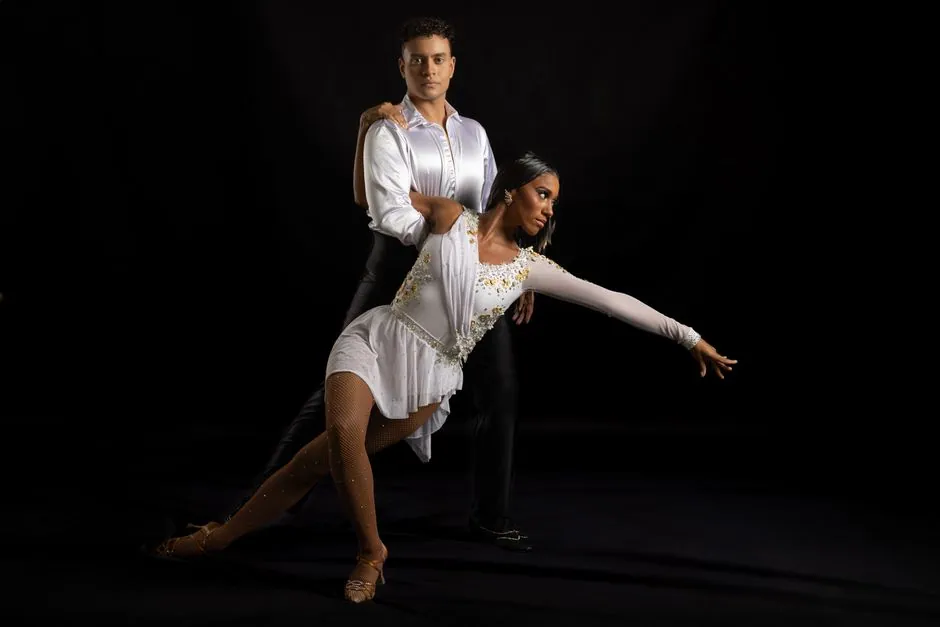
The bachata dance form, count by count
The basic is four beats repeated in mirror image, which is why it is taught as an eight. You travel three steps one way, pop the hip on the fourth beat instead of stepping, then reverse. That is the whole pattern; turns, body waves and footwork variations are decoration on top of it.
| Count | What the feet do | What the hips do | Form cue |
|---|---|---|---|
| 1 | Step right foot to the right | Weight settles into right hip | Land on the ball of the foot, then the heel |
| 2 | Left foot closes beside right | Hip stays low and level | Knees soft — never locked |
| 3 | Step right foot to the right again | Weight fully on right | Keep the square small: 30–40 cm of travel |
| 4 | Tap left toe, no weight transfer | Pop the left hip up and out | The pop comes from the knee bending, not the waist |
| 5 | Step left foot to the left | Weight settles into left hip | Chest stays tall, eyes forward |
| 6 | Right foot closes beside left | Hip low and level | Shoulders quiet and down |
| 7 | Step left foot to the left again | Weight fully on left | Return to the exact spot you started |
| 8 | Tap right toe, no weight transfer | Pop the right hip up and out | Ribs stacked over pelvis — don’t lean back |
The hip pop on counts 4 and 8 is the signature, and it is where beginners either over-effort or skip it entirely. It is not a waist twist — it is what happens when you bend the supporting knee and let the free hip rise. If your lower back is working, it is coming from the wrong place.
How bachata zumba differs from the social dance and from bachata dance classes
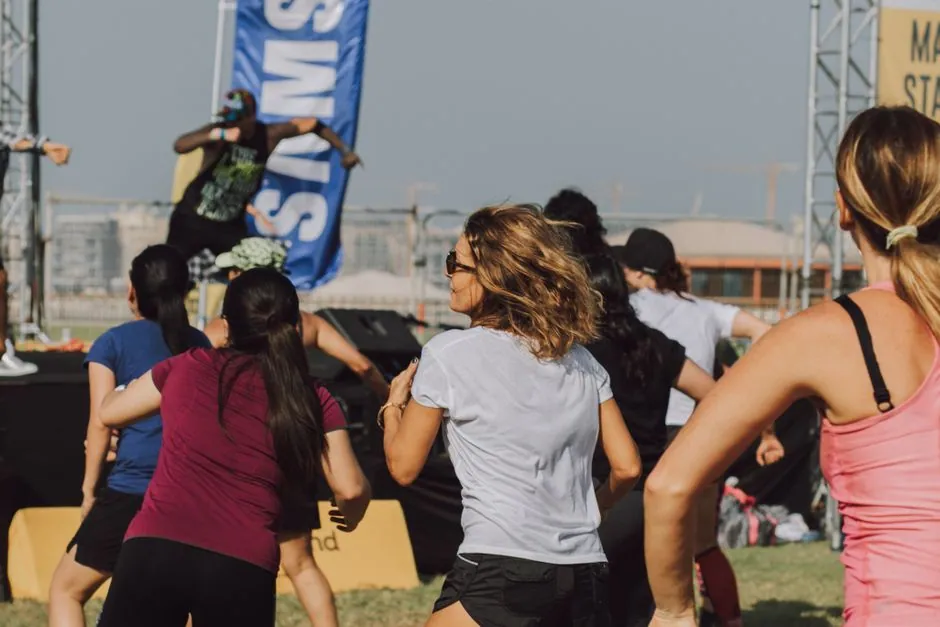
The fitness version keeps the rhythm and the hip action and throws away the partner. That is the honest one-line summary, worth knowing before you sign up expecting something else.
| Element | Social bachata | Bachata in a Zumba class | Formal bachata dance classes |
|---|---|---|---|
| Partner | Required | None — everyone dances solo | Required, usually with rotation |
| Primary goal | Connection and lead-follow | Cardiovascular work and enjoyment | Technique, musicality, turn patterns |
| Travel | Small square, minimal floor travel | Directional travel added to raise intensity | Small square, then turn patterns |
| Turn patterns | Core of the dance | Rare — solo spins at most | Taught systematically over weeks |
| Time to first usable version | 2–3 sessions with a partner | One track, roughly 4 minutes | 4–8 weeks for a social-floor basic |
| Typical session length | Open-ended social dancing | 4–8 minutes inside a 45–60 min class | 60–90 minutes |
| Correction you receive | From your partner, implicitly | General cues to the whole room | Individual technical correction |
If you want to dance bachata socially at a party in Mumbai or Bengaluru, a fitness class will not get you there — go to a partner-dance school. If you want the hip mobility, the rhythm and a genuinely hard 40 minutes of cardio, the fitness version is the efficient route. Our breakdown of core Zumba dance moves covers the wider move vocabulary these blocks sit inside.
Bachata, merengue, dembow and reggaeton: a rhythm cheat sheet
Four Latin rhythms turn up constantly in class playlists and people mix them up weekly. The tempo ranges below are the working ranges instructors and DJs use; individual tracks sit outside them often enough that you should treat these as orientation, not law.
| Rhythm | Typical tempo | Feel | Dominant body action | How it is used in class |
|---|---|---|---|---|
| Bachata | ≈120–140 BPM | Smooth, grounded, romantic | Hip pop on counts 4 and 8 | Recovery-paced track; hip mobility |
| Merengue | ≈120–160 BPM | Bright, marching, relentless | Alternating weight march with hip sway | Warm-up or steady mid-class track |
| Reggaeton | ≈85–100 BPM | Heavy, laid back, half-time | Grounded squat-and-drop, shoulder drive | Strength-flavoured, lower-body focus |
| Dominican dembow | ≈110–130 BPM | Fast, staccato, relentless | Rapid hip shake, quick feet, small jumps | Peak-intensity track; heart-rate spike |
Reggaeton and Dominican dembow share the same underlying drum pattern, which is why they feel like siblings, but the tempo gap changes the movement: reggaeton at 90 BPM invites you to sink and grind, while dembow at 125 BPM leaves time only to shake and go. For the tracks that show up most often in Indian classes, our roundup of the best Zumba songs is a better starting point than a genre chart.
Sensual bachata dance in a fitness class: what actually survives
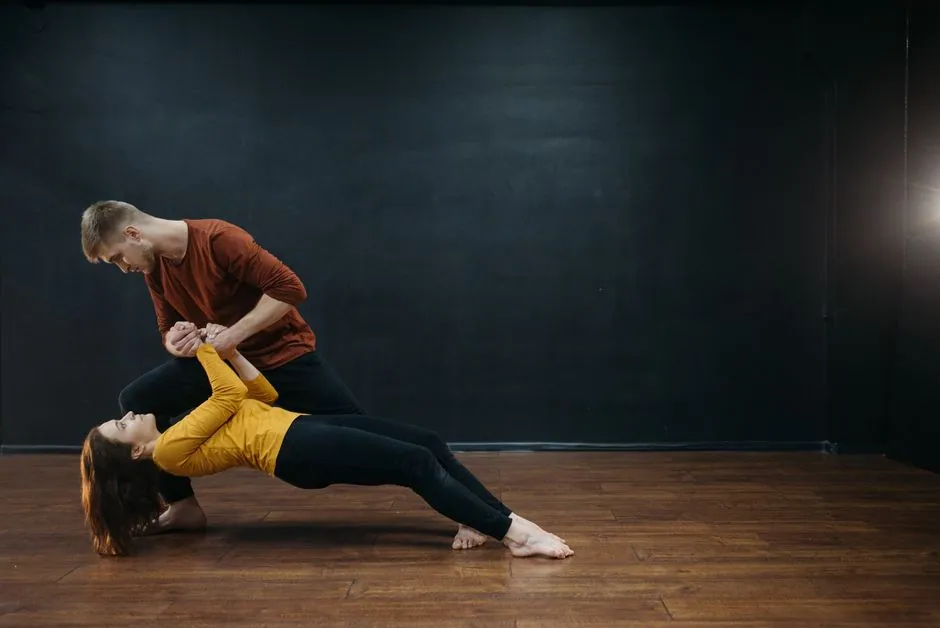
Search “bachata” and you will mostly see sensual bachata — the modern, body-wave-heavy style built on close partner contact, head rolls and deep isolations. Very little of it transfers to a group fitness room, and instructors who claim otherwise are overselling.
What survives is the hip action, the weight transfer and the musicality. What does not survive: the lead-follow frame, the partner-dependent body waves, the dips, and almost all the turn patterns, because none of them work without a second person. A fitness class will sometimes borrow a shoulder roll or a body roll as a styling accent on counts 4 and 8, and that is roughly where the borrowing stops.
That is not a criticism of either format, just a reason to pick the right one: sensual bachata is a social skill built over months with partners, while a bachata zumba block is a cardio tool you can use tomorrow morning in your living room.
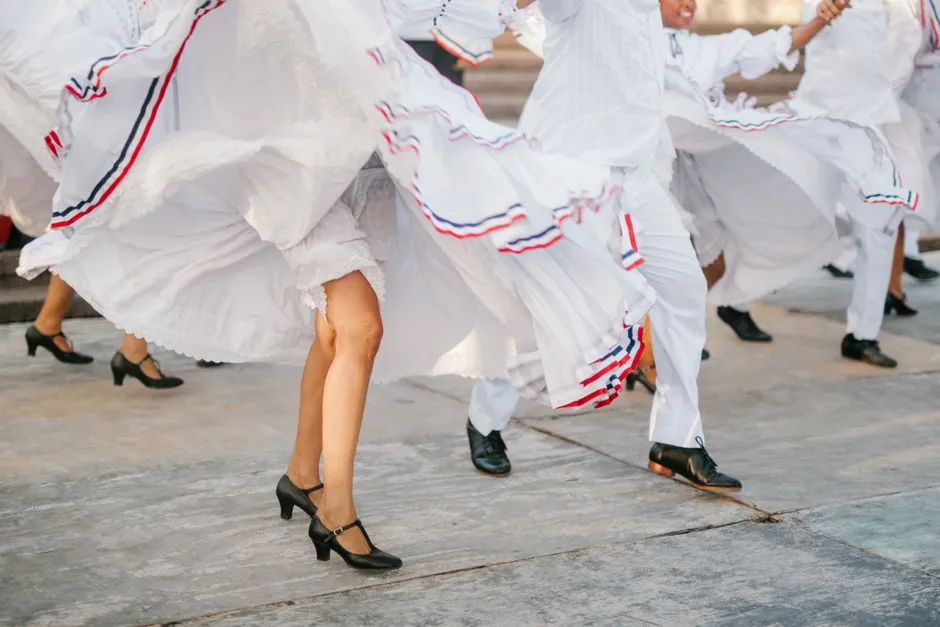
What a bachata-and-dembow block does to your heart rate
A full Zumba session averaged 9.5 kcal per minute and 369 kcal total in a University of Wisconsin-La Crosse study of 19 experienced female participants, with an average heart rate of 154 bpm — 79% of measured maximum — across a mean class length of 38 minutes 48 seconds (Journal of Sports Science and Medicine, 2012). That 79% sits squarely in the vigorous range.
Longer-term, an eight-week randomised controlled study of overweight, physically inactive women doing one to two one-hour classes per week recorded a 3.1 mL·kg⁻¹·min⁻¹ increase in maximal oxygen uptake and a 1.2% reduction in body fat, alongside significant drops in interleukin-6 and white blood cell count and large improvements in reported energy and emotional well-being (Journal of Sports Sciences, 2016). The sample was small — 10 per group — so treat the size of the effect as indicative rather than settled, but the direction is consistent.
Set against public health targets, that is useful. The WHO recommends at least 150 minutes of moderate-intensity activity per week for adults and reports that 31% of adults worldwide — about 1.8 billion people — fall short (WHO physical activity fact sheet). The CDC frames the same target as 150 minutes moderate or 75 minutes vigorous per week, plus muscle-strengthening on at least two days (CDC adult activity guidelines). At 79% of maximum heart rate, three 40-minute classes a week clears the vigorous target with room to spare. The NHS adds that meeting the weekly target is associated with up to a 30% lower risk of early death (NHS, benefits of exercise).
Here is a practice block you can run at home to drill the two rhythms rather than just follow along. Treat each track as a round.
| Round | Rhythm / tempo | Work | Reps | Rest | Form cue |
|---|---|---|---|---|---|
| Warm-up | Merengue ≈125 BPM | March with hip sway, gradually widening | 5 min continuous | — | Build pace slowly; don’t start at full speed |
| 1 | Bachata ≈125 BPM | Basic side-to-side eight-count | 8 × 8-counts | 30 s | Pop from the knee, not the waist |
| 2 | Bachata ≈130 BPM | Basic with quarter-turn each eight | 8 × 8-counts | 30 s | Spot a fixed point to stop dizziness |
| 3 | Dembow ≈120 BPM | Fast side-step with double hip shake | 4 × 45 s | 20 s | Shorten the step as speed rises |
| 4 | Dembow ≈125 BPM | Alternating low jumps, knees soft | 3 × 40 s | 30 s | Land mid-foot, never flat or on the heel |
| 5 | Bachata ≈120 BPM | Basic at half intensity, breathing down | 6 × 8-counts | — | Use it as an active recovery track |
| Cool-down | Bachata ≈110 BPM | Hip circles, calf and hip flexor stretch | 5 min | — | Hold each stretch 20–30 s, breathe out into it |
Mayo Clinic recommends 5 to 10 minutes of warm-up and the same again for cool-down, performing your chosen activity at a low, slow pace that builds gradually, so that heart rate and blood pressure recover in a controlled way (Mayo Clinic, warm up and cool down). The dembow rounds are the part people skip the warm-up before, and they are precisely the part where a cold calf or ankle gets hurt.
Five things that go wrong in your first bachata zumba class
- Chasing the instructor’s footwork instead of the beat. The pattern is four beats. If you are behind, drop the styling and just step 1-2-3-tap on time. Rhythm first, decoration later.
- Travelling too far on counts 1–3. Bachata lives in a 30–40 cm square. Big steps make the hip pop impossible and wreck your balance on the turn variations.
- Forcing the hip from the waist. Lower-back ache after a bachata block almost always means the pop is coming from lumbar rotation. Bend the supporting knee and let the free hip rise on its own.
- Going hardest on the dembow track. It is the fastest track, not the one to prove yourself on. Halve the range of motion before you halve your form.
- Relying on the mirror. A 10-week trial of 39 women aged 18–25 doing three one-hour Zumba sessions per week found that training in front of mirrors significantly impaired knee joint position sense and static balance compared with training without them, though dynamic balance improved (PeerJ, 2026). If you are training at home with a screen rather than a wall of mirrors, that is arguably an advantage — use it by checking your position occasionally instead of watching yourself continuously.
Dancing bachata and dembow at home in India
Most Indian homes give you a 2 m × 2 m clear patch at best, and bachata is one of the few Latin rhythms that genuinely fits in it — the basic barely travels. Dembow needs a little more, for the quick side-steps and small jumps.
Four adjustments matter here more than anywhere else. Polished marble and vitrified tile are slippery under a dry sock and grippy under a bare foot — wear cross-trainers with a flat, non-marking sole and let them pivot. If you live above a neighbour, keep the dembow rounds low-impact: swap the small jumps for fast alternating heel lifts, which preserve the heart rate and remove the thud. Prefer a fan to air conditioning — cold air on a warm hip flexor tightens it. And hydrate before rather than during; a 40-minute block in a Chennai or Delhi summer costs far more fluid than the same class in a cooler climate.
If following along at home is leaving you lost during the faster tracks, a live online Zumba class lets an instructor correct your timing in real time instead of you guessing from a video. Yash Pathak, Fitstrot’s lead Zumba trainer, is ZIN Licensed, ACE Certified and Strong Nation Certified. If you are still deciding whether this counts as real cardio training, our post on whether Zumba is cardio goes through the physiology.

Frequently asked questions about bachata dance and dembow
Is bachata one of Zumba’s four core rhythms?
No. Zumba’s four core rhythms are salsa, merengue, cumbia and reggaeton. Bachata and dembow are extremely common additions, and many instructors program at least one bachata track per class, but they sit outside the mandatory four. Expect to meet them in most classes without being able to count on it every time.
What is the difference between bachata and dembow?
Bachata is a genre and a partner dance with a defined eight-count step pattern, typically around 120–140 BPM, led by guitar. Dembow is a percussion pattern, not a dance — a syncopated drum loop that underpins reggaeton and Dominican urban music. In class, bachata tracks are grounded and hip-led; dembow tracks are fast and jumpy.
Do I need a partner to do bachata in a Zumba class?
No. Every participant dances solo, facing the instructor. The partner connection, lead-follow frame, dips and turn patterns that define social bachata are all removed. If you want the partnered version, look for dedicated bachata dance classes at a partner-dance school rather than a fitness studio.
Why does the dembow track feel harder than the bachata track?
Tempo and impact. Dominican dembow typically runs 110–130 BPM against bachata’s 120–140, but the movement is quicker and jumpier, so foot contacts per minute roughly double. Since a full Zumba class already averages 79% of maximum heart rate, the dembow track is usually where you touch your session peak.
How many calories does a bachata and dembow session burn?
Published measurement of a full Zumba class put the average at 9.5 kcal per minute and 369 kcal per session for 19 young women across a mean 38 minutes 48 seconds. Your own figure depends on body mass, fitness and how much you hold back, so treat 300–400 kcal for a 40-minute class as a reasonable planning number rather than a promise.
Is bachata safe if I have knee or lower-back problems?
Bachata’s basic is low-impact and usually tolerable, but the hip pop must come from the knee and hip, not from twisting the lumbar spine. Dembow’s small jumps are the higher-risk element. If you have a diagnosed knee, hip or spinal condition, clear it with your doctor or physiotherapist first and ask your instructor for a low-impact substitution.
How long before the bachata dance steps feel automatic?
Most people can follow the basic eight-count within a single four-minute track. Making it feel automatic — hip pop included, without watching the instructor — typically takes two to four weeks of two or three sessions. The turn variations take longer, because the challenge there is spotting and balance rather than the step itself.
Where can I hear dembow music outside a fitness class?
Dembow’s pattern sits under a large share of contemporary Spanish-language urban music, so most mainstream reggaeton playlists will give you the half-time version of it. For the faster Dominican dembow, search the genre name directly on any streaming service; the tempo difference is audible within a few bars.
Take the next step
Pick one thing from this page and do it this week: run the 22-minute block in Table 4 twice, with two days between, and count only whether you stayed on the beat. Rhythm is the skill that unlocks everything else in a Latin dance workout — calories and mobility follow it, not the other way round. If you would rather have someone watching your timing than guess at it alone, book a trial session and let an instructor fix the hip pop in five minutes instead of five weeks.


