

A Kerala diet for weight loss does not require giving up rice, coconut or meen curry. It requires knowing what actually carries the calories on a Malayali plate: extracted coconut fat, a second and third helping of rice, and a protein portion shrunk to a garnish. Kerala’s kitchen already holds what a fat-loss plate needs — fish, tapioca, vegetables, fermented breakfasts and red rice. This guide rebuilds it with real portions, a 7-day chart, a swap table and honest numbers on coconut.
What does a Kerala diet for weight loss actually look like?
A working Kerala weight-loss plate is half vegetables (thoran, avial, salad), one quarter protein (fish, egg, chicken, dal or curd) and one quarter cereal — about 1 cup of cooked matta rice or 1 puttu, not 3 cups of rice. Most Kerala adults land at 1,400–1,800 kcal a day with 70–90 g protein and lose 0.5–1 kg a week.
That structure is not a Western import. The ICMR-NIN Dietary Guidelines for Indians (2024) ask for no more than 45% of daily energy from cereals and millets, 400 g of vegetables including greens, about 27 g of visible cooking oil on a 2,000 kcal reference diet, 70 g of fish or meat for non-vegetarians, and roughly 72–79 g of protein. The typical Kerala plate inverts it: rice or kappa supplies 55–65% of calories, coconut oil goes in by ladle rather than teaspoon, and the fish that should anchor the meal turns up as one small piece in a pool of gravy.
The World Health Organization’s healthy diet fact sheet (updated January 2026) caps total fat at 30% of energy, saturated fat at 10%, free sugars at 10% and salt at 5 g a day. On a 2,000 kcal day that saturated-fat ceiling is about 22 g — three coconut-heavy dishes can use it up before dinner.
The coconut question, settled with numbers instead of slogans
Coconut is not one food. Grated coconut, thick coconut milk, coconut oil and coconut water behave differently on a weight-loss plan, and lumping them together is why the advice contradicts itself. Two tablespoons of grated coconut in a thoran adds about 54 kcal and 1.4 g of fibre; one tablespoon of coconut oil adds about 120 kcal and no fibre.
The oil first. The American Heart Association’s explainer on coconut and saturated fat puts coconut oil at about 82% saturated fat, with more than 11 g of saturated fat per tablespoon — close to the whole 13 g daily limit the AHA suggests for lowering cardiovascular risk. It also notes that everyday coconut oil carries only about 13–14% medium-chain triglycerides, far below the concentrated MCT oil used in the studies quoted in coconut-oil marketing. Harvard’s Nutrition Source page on coconut oil is blunter: the dominant fat is lauric acid at roughly 47%, and lauric acid does not behave as an MCT in the body.
The hard evidence is a 2020 systematic review and meta-analysis of 16 clinical trials in Circulation, indexed on PubMed as Neelakantan et al. 2020. Against non-tropical vegetable oils, coconut oil raised LDL cholesterol by 10.47 mg/dL (95% CI 3.01–17.94) and HDL by 4.00 mg/dL (95% CI 2.26–5.73). Crucially for fat loss, it did not significantly change body weight, body fat percentage, waist circumference or fasting glucose. The honest summary: coconut oil is not a fat burner, nor poison — it is a calorie-dense fat that nudges LDL upward.
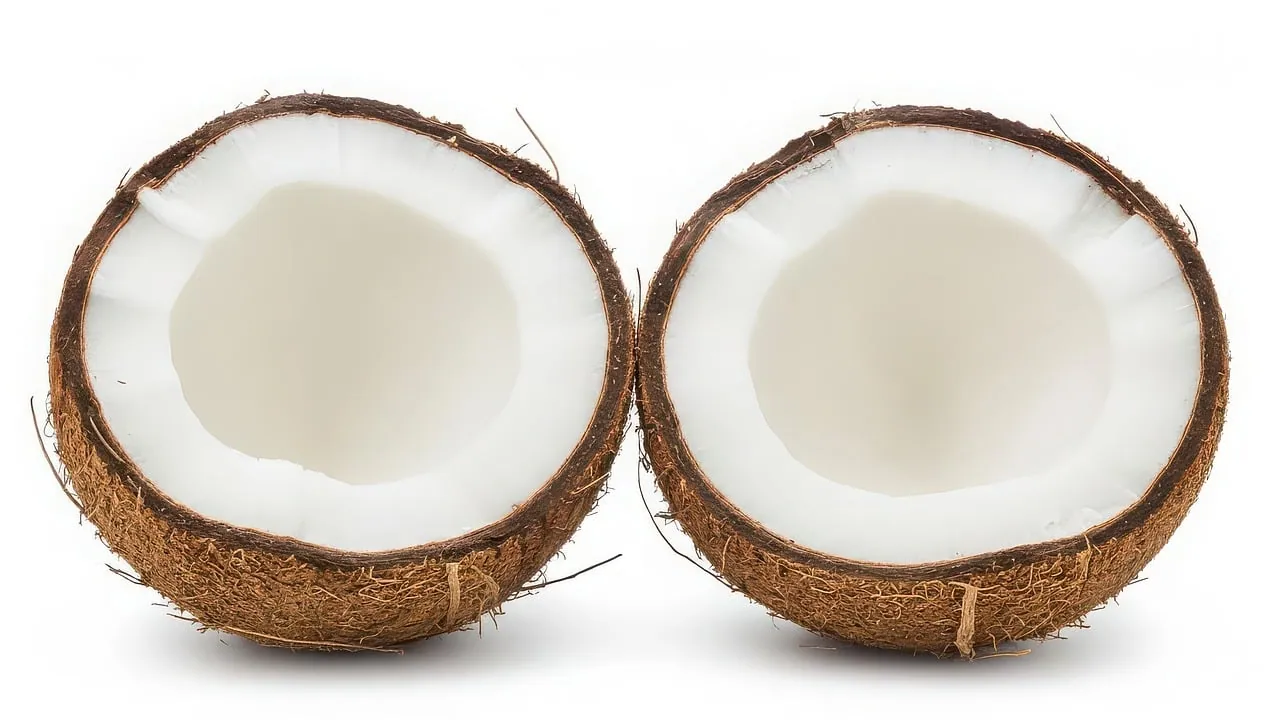
| Form and serving | Calories | Total fat | Saturated fat | Fibre | Verdict on a fat-loss plan |
|---|---|---|---|---|---|
| Fresh grated coconut, 2 tbsp (15 g) | ~54 kcal | ~5.0 g | ~4.6 g | ~1.4 g | Keep — fibre comes with the fat. |
| Thick coconut milk (onnam paal), 50 ml | ~100 kcal | ~10 g | ~9 g | ~0.3 g | Swap for the thin second extract. |
| Coconut oil, 1 tbsp (13.6 g) | ~120 kcal | 13.6 g | ~11.2 g | 0 g | Measure: 1 tsp per dish, not a ladle. |
| Tender coconut water, 200 ml | ~38 kcal | ~0.1 g | ~0.1 g | 0 g | Fine as a drink, not a fat burner. |
The practical rule falls out of the table. Two tablespoons of grated coconut in a thoran plus a teaspoon of oil in the tempering is about 8.5 g of saturated fat — inside WHO’s ~22 g ceiling. But puttu with four tablespoons of coconut, appam in first-extract milk and two tablespoons of oil across the day passes 35 g before any fish. Kerala’s coconut problem is not coconut; it is extraction and repetition.
Kerala staples by the numbers: kappa, puttu, appam, idiyappam and matta rice
Most Kerala weight-loss attempts fail at portion estimation, not food choice: kappa feels light because it is plain, puttu cylinders small because they are narrow. Values below are approximations from the ICMR-NIN Indian Food Composition Tables 2017 combined with standard Kerala recipe proportions — planning numbers, not laboratory readings.
| Food | Serving as actually eaten | Calories | Protein | Fibre |
|---|---|---|---|---|
| Kappa (tapioca), boiled | 150 g cooked | ~190 kcal | ~1.8 g | ~2.4 g |
| Puttu (rice flour + coconut) | 1 cylinder (~120 g) | ~215 kcal | ~3.5 g | ~1.5 g |
| Appam | 1 medium, ~60 g | ~120 kcal | ~2.0 g | ~0.6 g |
| Idiyappam | 2 pieces (~100 g) | ~170 kcal | ~3.0 g | ~1.0 g |
| Kerala matta red rice, cooked | 1 cup (~150 g) | ~180 kcal | ~3.5 g | ~1.8 g |
| Meen curry (sardine/seer), fish only | 100 g fish | ~150 kcal | ~18 g | 0 g |
| Cabbage or beans thoran | 1 katori, ~100 g | ~90 kcal | ~2.5 g | ~3.5 g |
| Avial | 1 katori, ~100 g | ~130 kcal | ~2.5 g | ~3.0 g |
| Olan (ash gourd, thin coconut milk) | 1 katori, ~100 g | ~95 kcal | ~1.5 g | ~2.0 g |
| Sambar | 1 katori, ~150 g | ~110 kcal | ~4.5 g | ~3.0 g |

No single dish here is a disaster — the damage is volume: three cups of rice at lunch is 540 kcal before curry. And the protein column is thin everywhere except the fish row, the biggest correctable flaw in Kerala eating.
Is Kerala matta rice actually better than white rice?
Modestly, yes, on bran and fibre rather than magic. Harvard’s Nutrition Source page on rice reports an average glycaemic index of about 55 for brown rice versus 64 for white, and cites cohort data in which five or more weekly servings of white rice tracked with a 17% higher risk of type 2 diabetes in a US population — 55% higher comparing highest to lowest intakes in Asian populations — while two or more weekly brown-rice servings tracked with an 11% lower risk. Matta is parboiled and unpolished, so it keeps more bran than milled white rice.
What matta does not do is cancel quantity. A cup is still about 180 kcal, so switching from white to matta on a three-cup habit changes little on the scale.

Your 7-day Kerala diet plan, built around 1,500–1,700 kcal
This is a template, not a prescription. It sits near 1,500–1,700 kcal and 80–95 g protein, producing the 0.5–1 kg per week pace the US CDC’s guidance on losing weight calls most sustainable — and even a 5% reduction measurably improves blood pressure, cholesterol and blood sugar. Scale the rice or kappa up if you are a tall, active man; down if you are a small-framed woman.
| Day | Breakfast | Lunch | Evening | Dinner |
|---|---|---|---|---|
| Mon | 1 puttu + 1 katori kadala curry + 1 boiled egg | 1 cup matta rice + 100 g meen curry + cabbage thoran + salad | Black tea + 10 roasted peanuts | 2 idiyappam + veg stew (thin milk) |
| Tue | 2 idli + sambar + 1 tbsp coconut chutney | 1 cup matta rice + sambar + beans thoran + 100 g grilled fish | Sambharam (buttermilk), 1 glass | 1 appam + egg roast (1 egg, 1 tsp oil) |
| Wed | 150 g kappa + 100 g sardine curry | 1 cup matta rice + avial + 1 katori moru curry + salad | Tender coconut water, 200 ml | Veg upma (40 g rava) + 1 katori curd |
| Thu | 2 dosa + sambar + 1 boiled egg | 1 cup matta rice + chicken curry (100 g, skinless) + olan | Guava or 1 small banana | 2 idiyappam + dal curry + cucumber salad |
| Fri | 1 puttu + 1 katori cherupayar + 1 tsp coconut | 1 cup matta rice + 100 g meen curry + pumpkin erissery | Black coffee + 5 almonds | Veg soup + 100 g grilled fish or paneer |
| Sat | 3 small appam + stew (thin milk) | 1 cup matta rice + kadala curry + beetroot thoran + salad | Sambharam, 1 glass | 2 wheat chapati + egg curry (2 eggs) |
| Sun | 2 idli + sambar + chutney | Small sadya: 1 cup rice, avial, thoran, olan, pachadi | Tender coconut water | 100 g kappa + 100 g fish curry + greens thoran |
Three rules hold it together. Eat the protein item first at every meal. Keep visible oil at or below 3 teaspoons a day, in line with the ICMR-NIN ceiling. And do not add payasam, banana chips or a late-night parotta on top of an already balanced day — any one can erase the deficit. To match this to your weight, blood reports and work shifts, a consultation with an online dietitian beats guessing.
Swap table: the best Kerala diet for weight loss keeps the dish and changes the method
Nothing here asks you to eat differently from family. Each swap keeps the dish recognisable and cuts calories by changing extraction, portion or method — subtracting fat and starch, not culture.
| Instead of | Use | Roughly saves | Why it works |
|---|---|---|---|
| Appam with thick first-extract coconut milk | Appam with the thin second extract | ~80 kcal per serving | A fraction of the fat, same aroma |
| 3 cups of rice at lunch | 1 cup matta rice + double vegetables | ~360 kcal | Fibre and volume replace starch |
| Kappa with fried fish and oil drizzle | 150 g kappa with steamed or curried fish | ~150 kcal | Removes 1–2 tbsp absorbed frying oil |
| Evening ethakka appam or banana fry | Sambharam and a guava | ~200 kcal | Deep-fried banana snacks are oil sponges |
| Beef fry or pork ularthiyathu twice a week | Meen curry or grilled fish | ~250 kcal per meal | Protein without the saturated fat load |
| 2 parotta with curry at dinner | 2 wheat chapati or 2 idiyappam | ~200 kcal | Maida parotta carries 8–10 g added fat |
| Payasam at every family lunch | One small bowl, festival days only | ~250 kcal | Sugar plus thick coconut milk, densest on a sadya |
Meen curry, egg and the protein floor most Malayali plates miss
Kerala has one of India’s best protein advantages — a coastline, a fish market in every town, a cuisine built for it — and most people waste it. A floor of 1.2–1.6 g of protein per kg of body weight (roughly 70–100 g a day at 60–65 kg) protects muscle during a deficit and blunts hunger. Cleveland Clinic’s guidance on protein for weight loss puts protein at 10–35% of daily calories and notes the body handles roughly 25–35 g at a time — an argument for spreading it across four meals, not piling it into dinner.
The American Heart Association’s fish and omega-3 recommendation is two servings of fish a week, a serving being about 3 ounces cooked, oily fish preferred. Mathi and ayala sit squarely in that category and cost little, so four to five fish meals a week is realistic here in a way it is not elsewhere in India.
Per serving: 100 g mathi or ayala ~18–20 g protein, 2 eggs ~12 g, a katori of kadala or cherupayar ~7–9 g, 150 g curd ~5 g, 100 g skinless chicken ~25 g, 100 g paneer ~18 g. Stack three or four across the day and the floor takes care of itself. Our guide to a high protein diet for weight loss breaks down Indian sources gram by gram.
Where a South Indian diet for weight loss goes wrong outside Kerala
A South Indian diet for weight loss is assumed to be light by default because it is rice-and-sambar rather than roti-and-ghee. The same three leaks appear across Tamil Nadu, Karnataka, Andhra and Kerala: oversized rice portions, a fermented breakfast that becomes four dosas in a pool of oil, and a protein serving treated as a condiment. Kerala adds a fourth — extracted coconut fat.
The corrections are regional, the arithmetic identical. Cap dosas at two and keep chutney a chutney. Watch the ghee on bisi bele bath, and the oil in Andhra pickles and fried sides. In Kerala, measure the coconut oil and drop the first extract. For the national picture, read our Indian diet for weight loss guide alongside this.
Stuck after three weeks? Here is what is usually happening
- The rice portion crept back. A cup becomes a heaped cup becomes a second serving. Weigh cooked rice weekly — 150 g is smaller than most people picture.
- Coconut oil is unmeasured. A free pour into the cheena chatti is easily 2–3 tablespoons, or 240–360 kcal, per dish. Use a teaspoon for a fortnight until your eye recalibrates.
- Weekend family lunches are uncounted. Two heavy weekend meals offset five disciplined weekdays. Keep rice to one serve, payasam to one bowl.
- Water weight is masking fat loss. Salt, poor sleep and cycle phase can hide 1–2 kg of real fat loss for a week. Track a weekly average and a waist measurement, as our guide on how to reduce body fat percentage explains.
- Protein is still under 60 g. Below the floor you lose muscle with the fat and hunger climbs. This plateau feels like willpower failure but is a menu problem.
- The deficit shrank with you. After 6–8 kg of loss a 65 kg body needs fewer calories than a 73 kg one did. Recalculate instead of assuming the old plan still applies.
Said plainly: a Kerala diet will not deliver 10 kg in a month, and any plan promising it is dehydrating or starving you. At 0.5–1 kg a week, 10 kg takes three to five months — the answer that still holds at month twelve.
Onam, sadya, Ramadan and eating out without abandoning the plan
Kerala’s calendar is built around food, and a plan that cannot survive Onam is not a plan. For a sadya, take one serving of rice, fill the leaf with avial, thoran, olan and pachadi, eat the payasam last and stop at one bowl — around 700–900 kcal instead of 1,600–2,000. For iftar, break the fast with dates and water, then eat a protein-anchored meal rather than fried pathiri. Eating out, choose karimeen pollichathu, fish curry meals or grilled dishes over biryani and parotta, and ask for the curry separate so you control the ratio.

Diet alone has a ceiling. Three or four resistance sessions a week plus daily walking protect lean mass, which is what keeps the weight off after the first 5 kg. To have that programmed around Kerala meal timings and a working schedule, an online weight loss trainer can handle the training while you handle the plate.
Frequently asked questions
Is a Kerala diet good for weight loss?
Yes, when portioned. A traditional Kerala diet supplies fish, a wide range of vegetables, pulses and parboiled rice, covering protein, fibre and micronutrients well. The problems are rice quantity, extracted coconut fat and fried snacks. Corrected for those, a 1,500–1,700 kcal Kerala plan typically produces 0.5–1 kg of loss per week.
Can I eat kappa (tapioca) while trying to lose weight?
Yes, if it replaces rice rather than joining it. About 150 g of boiled kappa carries roughly 190 kcal with only 1.8 g of protein, so it is a starch slot, not a free food. Pair it with 100 g of fish curry or an egg, skip the coconut oil drizzle, and keep it to one meal a day.
Is Kerala matta rice better than white rice for weight loss?
Somewhat. Matta is parboiled and unpolished, so it retains more bran and fibre. Harvard’s Nutrition Source puts brown rice at an average glycaemic index of 55 versus 64 for white, with two or more weekly brown-rice servings linked to an 11% lower type 2 diabetes risk. Matta still delivers about 180 kcal per cooked cup, so portion size still decides the outcome.
Is coconut oil good for weight loss?
No. A 2020 Circulation meta-analysis of 16 trials found coconut oil raised LDL cholesterol by 10.47 mg/dL versus non-tropical vegetable oils while producing no significant change in body weight, body fat percentage or waist circumference. At about 120 kcal and 11 g of saturated fat per tablespoon, treat it as a cooking fat to measure, not a supplement to add.
How much weight can I lose on a Kerala diet in one month?
Realistically 2–4 kg for most adults, at the 0.5–1 kg per week pace the CDC identifies as most sustainable. Larger first-month drops usually include water weight from cutting rice and salt. Anyone promising 8–10 kg in a month is describing dehydration and muscle loss, not fat loss.
Is puttu or appam better for a weight-loss breakfast?
Appam is lighter per piece at roughly 120 kcal versus about 215 kcal for one puttu cylinder, but people eat three appam and one puttu, which evens it out. The bigger decision is the accompaniment: kadala curry or egg adds protein, while thick first-extract coconut milk adds around 100 kcal per 50 ml with almost no fibre.
Can vegetarians follow a Kerala diet for weight loss?
Yes, though the protein floor takes more planning without fish. Build meals on kadala, cherupayar, thoran with dal, curd or sambharam, paneer, and eggs if you eat them. Aim for 7–9 g of protein from a katori of pulses at three meals plus curd, which gets a 60 kg adult close to 70 g a day.
Is a South Indian diet for weight loss the same as a Kerala diet?
They overlap but are not identical. Both lean on rice, fermented breakfasts, sambar and vegetables. Kerala adds substantially more coconut and far more fish, which raises both the saturated fat and the protein available. The calorie leaks — oversized rice portions and undersized protein servings — are the same across all southern states.
Want this matched to your body weight, thyroid or diabetes reports and your own kitchen? Book a 1-on-1 session with a Fitstrot dietitian and walk away with a Kerala plan built on the foods already in your house. Start with an online nutrition consultation.


