

The best ab workouts for men at home train the whole core, not just the front of the stomach: a plank-type hold, a side or rotation move, a lower-ab raise and one dynamic finisher, done in a 20 to 25 minute session three or four times a week. You need floor space and a mat or folded blanket, nothing else. Below you get the exact sets, reps, rest and form cues, a four-week progression, and a straight answer on why abs do not show through training alone.
Everything here works in a flat, a hostel room or on a terrace. If you want a wider view of ab training beyond the home setting, our main guide on ab workouts covers the basics, and this page stays focused on what you can do with no equipment at all.
What should a complete home ab workout include?
A complete home ab workout trains four jobs: resisting arching of the lower back (planks, dead bugs), resisting twisting (side planks), bending the spine (reverse crunches, leg raises) and rotating (bicycle crunches, woodchops). Pick one or two moves from each, do 3 sets, and keep the whole session to roughly 20 to 25 minutes.
Your core is more than the six-pack muscle. The rectus abdominis at the front bends your spine, the obliques on the sides rotate and brace you, and the deep transverse abdominis wraps around the middle like a belt. A routine made only of crunches trains one of these well and leaves the rest weak, which is why many men with a long crunch habit still feel their lower back tire during lifting or long walks.
The 20-minute home ab circuit: sets, reps, rest and form cues
Warm up for 2 to 3 minutes first with cat-cow, hip circles and marching on the spot. Then work through this table in order, finishing all sets of one move before starting the next. This is a no equipment ab workout, so a mat or folded blanket under your back and forearms is all you need.
| Exercise | Sets x reps or time | Rest | Form cue |
|---|---|---|---|
| Dead bug | 3 x 8 per side | 30 sec | Lower back lightly pressed into the floor; lower opposite arm and leg over 3 seconds |
| Forearm plank | 3 x 30 to 45 sec | 30 sec | Elbows under shoulders, glutes tight, ribs pulled down; stop when hips sag |
| Reverse crunch | 3 x 12 to 15 | 30 sec | Curl knees toward chest and lift the hips a few centimetres; no swinging |
| Slow bicycle crunch | 3 x 10 per side | 30 sec | Turn the ribcage toward the knee, not just the elbow; keep the neck loose |
| Side plank | 3 x 20 to 30 sec per side | 30 sec | Feet stacked, hips high, one straight line from head to heels |
| Mountain climbers | 3 x 30 sec | 45 to 60 sec | Shoulders over wrists, hips level, knees driven toward the chest with control |
These are bodyweight ab exercises, so effort comes from slow tempo and clean positions, not speed. If a set ends with your lower back arching or your neck pulling, the rep count was too high for today.
Form walkthrough: the moves men most often get wrong
Dead bug. Lie on your back with arms pointing at the ceiling and knees bent at 90 degrees over your hips. Exhale, press your lower back gently down, and lower one arm and the opposite leg until they hover just above the floor. Return and switch. If your back lifts off the floor, shorten the range.
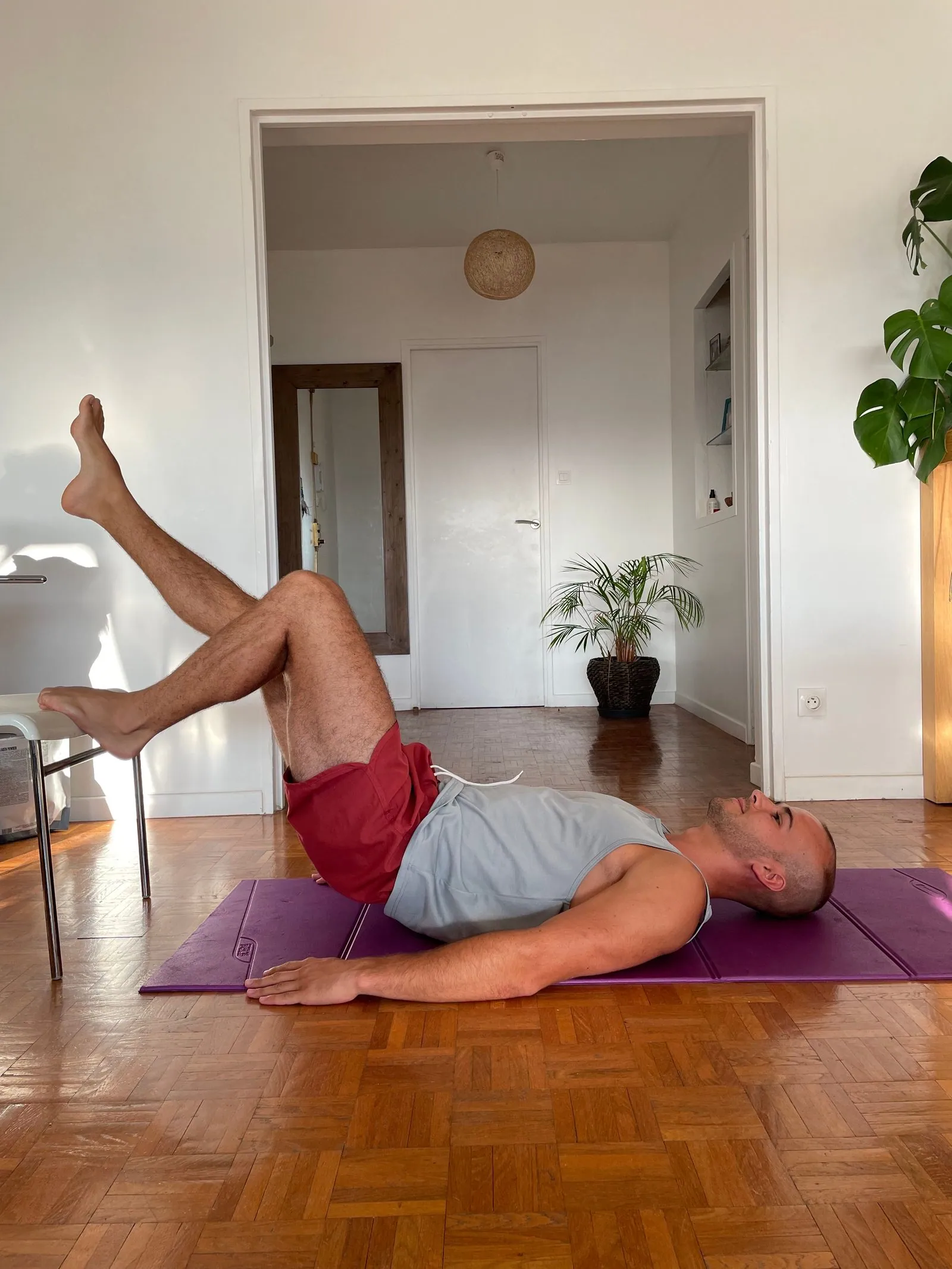
Reverse crunch. Lying flat, bring your knees in, then use your lower abs to curl your pelvis off the floor, rolling up one vertebra at a time. The hips rise only a few centimetres. Lower over 3 seconds. Swinging the legs hands the work to the hip flexors.
Side plank. Lie on one side with your elbow under your shoulder. Lift your hips until your body forms a straight line, and breathe steadily. Drop to the knees (bent-knee version) if your hips sag before 15 seconds.
Leg raise. This is the harder version of the reverse crunch and a solid lower abs workout at home. Keep the legs straight, lower them slowly toward the floor, and stop the moment your lower back starts to arch.
How do you progress ab workouts at home without equipment?
Change one variable at a time: first add 2 to 3 reps or 5 to 10 seconds per set, then slow each rep to a 3-second lowering, then move to a harder variation such as leg raises or a long-arm plank. Add load, like a loaded backpack, only when every set is clean.
Use this four-week ladder if you are starting out or coming back after a break.
| Week | Sessions | Sets | What changes |
|---|---|---|---|
| 1 | 3 | 2 per move | Learn the positions; stop 2 reps before your form slips |
| 2 | 3 | 3 per move | Same reps and times as week 1, an extra set |
| 3 | 3 to 4 | 3 per move | Add 2 to 3 reps or 5 to 10 seconds; lower slowly over 3 seconds |
| 4 | 3 to 4 | 3 per move | Swap the reverse crunch for leg raises; try a long-arm plank |
When bodyweight stops being hard, resistance is easy to find at home. Hold a loaded backpack against your chest for sit-ups, rotate a 5 litre water can side to side for woodchops, or use a single dumbbell or kettlebell. A stability ball makes rollouts and pikes harder, and a pull-up bar lets you do hanging knee raises. If you would rather use cables and machines, our guide to an abs workout in the gym covers that route.
Myth check: crunches will not burn belly fat
Ab exercises build the muscle underneath, but they do not remove fat from over it. Fat comes off across the whole body, in an order set mostly by genetics, and the driver is a steady calorie deficit. Training your stomach does not choose where the fat leaves from. This is why a man can do 100 crunches a day and still see no outline.
Visible abs depend mainly on body fat. For many men, definition starts showing somewhere around the low teens in body fat percentage, though that varies a lot from person to person. A sensible pace is a deficit of roughly 300 to 500 kcal below maintenance, which tends to mean about 0.25 to 0.5 kg lost per week. Anything promising a flat stomach in a week is not realistic, and crash dieting will cost you muscle and energy.
Protein helps you keep muscle while you lose fat. A reasonable target for most active men is roughly 1.2 to 1.6 g per kg of body weight, so about 85 to 110 g a day at 70 kg. Easy Indian sources are eggs (about 6 g each), paneer (roughly 18 g per 100 g), cooked dal (about 7 g per katori), curd and soya chunks. For a full plan built around your food habits, an online nutritionist consultation is the practical route, and an online weight loss trainer can pair that with your training. Our six pack workout guide covers how to bring training and food together, and it is the right next read if abs are the goal.
Why does my lower back or neck hurt during ab exercises?
Back or neck strain during ab work usually means the hip flexors or neck are doing the job your abs should do: the ribs flare, the lower back arches, or the hands pull the head forward. Shorten the range, slow down, keep the lower back lightly pressed down, and stop any move that causes sharp pain.
| Problem | Likely cause | Fix |
|---|---|---|
| Lower back arches in plank or dead bug | Ribs flaring, glutes switched off, range too big | Tuck the ribs down, squeeze glutes, shorten the range or the hold |
| Neck aches during crunches | Pulling the head with the hands | Fingertips behind the ears, eyes on the ceiling, lift with the ribcage |
| Front of hips burns in leg raises | Hip flexors taking over | Bend the knees, go back to reverse crunches for 2 weeks |
| Cannot hold a plank for 20 seconds | Strength not built yet | Plank from the knees or do 5 x 10 seconds, adding time weekly |
| Abs never feel worked | Reps too fast, using momentum | Exhale on the effort, pause 1 second at the top, lower slowly |
Muscle soreness a day or two after a session is normal. Sharp pain, pain that lasts beyond a few days, or any tingling or numbness is not. In that case, stop and see a doctor or physiotherapist before continuing.
How often should men train abs, and how do you fit it in a week?
Train abs three to four times a week with at least a day in between. Core muscles recover like any other muscle and respond to hard sessions every 24 to 48 hours, so daily circuits mostly add soreness and tired hip flexors, not extra progress.
A simple weekly layout looks like this:
- Monday and Thursday: the full circuit from the table above.
- Wednesday: a lighter 10 minute session of dead bugs, planks and side planks, or a gentler day with yoga for men.
- Saturday: circuit again, with the week-three or week-four changes.
- Other days: a 30 to 40 minute walk, or a dance cardio session such as Zumba for men.
Ab work is one part of a plan. To place it next to push, pull and leg days, see our guide to workouts for men, and our overview of the types of workouts if you are choosing between styles.
If you sit at a desk for most of the day, begin with the week-one version for two weeks. Tight hips from sitting make leg raises and sit-ups feel harder than they should, and dead bugs and side planks are a safer start.
Is training alone enough, or should you use a coach?
Home training works, and everything above can be done on a mat at home. The weak point is form: with nobody watching, a dead bug quietly becomes a hip flexor exercise. If you want your technique corrected live and a plan tied to your schedule, 1-on-1 personal training at Fitstrot is built for that.
Frequently asked questions
How many sets and reps should men do for ab workouts at home?
Aim for 4 to 6 exercises, 3 sets each. Use 10 to 15 controlled reps for moving exercises such as reverse crunches, and 20 to 45 seconds for holds such as planks. Rest roughly 30 seconds between sets, and progress by adding a few reps or seconds each week.
Can men do ab workouts every day at home?
It is better not to. Hard ab sessions need 24 to 48 hours of recovery, so three or four days a week gives better results than seven. On off days, walk, stretch or do light mobility work, and keep any extra core work to short, easy holds.
How long does it take to see abs with home workouts?
You will feel stronger in 2 to 3 weeks of regular training, but seeing abs depends on body fat, not on the exercises. For many men with a higher starting body fat, visible definition takes several months of steady training plus a moderate calorie deficit.
Do you need equipment for ab workouts at home?
No. Dead bugs, planks, side planks, reverse crunches and mountain climbers need only a mat or blanket. Once they feel easy, add a loaded backpack, a water can, a dumbbell or a pull-up bar to make the same patterns harder without buying anything special.
Are planks better than crunches for abs?
Neither is better alone. Planks train the core to resist movement and protect the spine, while crunches and reverse crunches train the abs to bend it. A good routine uses both, plus a side plank for the obliques, rather than choosing one.
Want a core plan built around your level and your week? Book a 1-on-1 personal training session with Fitstrot and get your form checked live.


