

The best tricep workouts train all three heads of the muscle, not just the part a pushdown reaches. Your triceps make up roughly two-thirds of the upper arm, so they matter more for arm size than biceps do. This guide gives you a five-exercise session, a sets-and-reps table, a weekly layout, fixes for stalled progress and a no-equipment version you can do at home.
Why do tricep workouts need to hit three heads?
Tricep workouts need to hit three heads because the triceps brachii has a long, a lateral and a medial head, and each loads differently. The long head crosses the shoulder joint, so it only stretches fully with your arm overhead. Pushdowns keep the arm at your side, so a pushdown-only routine leaves the largest head undertrained.
That one fact explains most stalled arms. People add weight to pushdowns for months, the lateral and medial heads get stronger, and the arm still looks flat from the side because the long head never got a real stretch under load.
| Head | Where it sits | What it does | Best exercise type |
|---|---|---|---|
| Long head | Inner back of the arm, attaches at the shoulder blade | Extends the elbow and helps pull the arm back; the biggest of the three | Overhead extensions, skull crushers taken slightly behind the head |
| Lateral head | Outer side of the arm | Powers heavy, fast elbow extension and gives the horseshoe look | Close-grip press, dips, straight-bar pushdowns |
| Medial head | Deep, underneath the other two | Works in almost every elbow extension at any load | Rope pushdowns, reverse-grip pushdowns, kickbacks |
How do you build an effective tricep workout?
An effective tricep workout has three slots: a heavy compound press such as close-grip bench or dips for 6-8 reps, an overhead extension for the long head at 10-12 reps, and one or two isolation finishers like rope pushdowns at 12-15 reps. That adds up to about 12-15 hard sets and takes roughly 35-45 minutes with warm-up.
Leave out any slot and you leave muscle behind. The compound press gives you the heaviest overload, the overhead movement covers the long head, and the finishers fatigue the lateral and medial heads with constant tension. Here is the full session as a table you can screenshot.
| Exercise | Sets x reps | Rest | Form cue |
|---|---|---|---|
| Close-grip bench press (or dips) | 4 x 6-8 | 90 sec | Hands about shoulder-width, elbows tucked at roughly 45 degrees, bar touches lower chest |
| Overhead dumbbell extension | 3 x 10-12 | 60 sec | Upper arms stay beside your ears, lower slowly for 2-3 seconds until you feel the stretch |
| Rope pushdown | 3 x 12-15 | 45 sec | Elbows pinned to your ribs, split the rope apart at the bottom and squeeze |
| Single-arm overhead extension or kickback | 3 x 12-15 per arm | 45 sec | Keep the upper arm still, only the forearm moves, pause one second at full lockout |
| Diamond push-up (finisher) | 2 x to near failure | 45 sec | Hands under the chest, body in one line; drop to your knees when form slips |
Walkthrough: running the session from first set to last
Start with two to three minutes of light movement such as arm circles and band pull-aparts, then do one or two light warm-up sets of the first exercise. Triceps and elbows both dislike cold, heavy work, so this step is not optional.
Take the compound press first while you are fresh, because it lets you move the most weight. Choose a load where the last two reps of each set are slow but clean. Move to the overhead extension next, while your shoulders are still stable and your grip is strong.
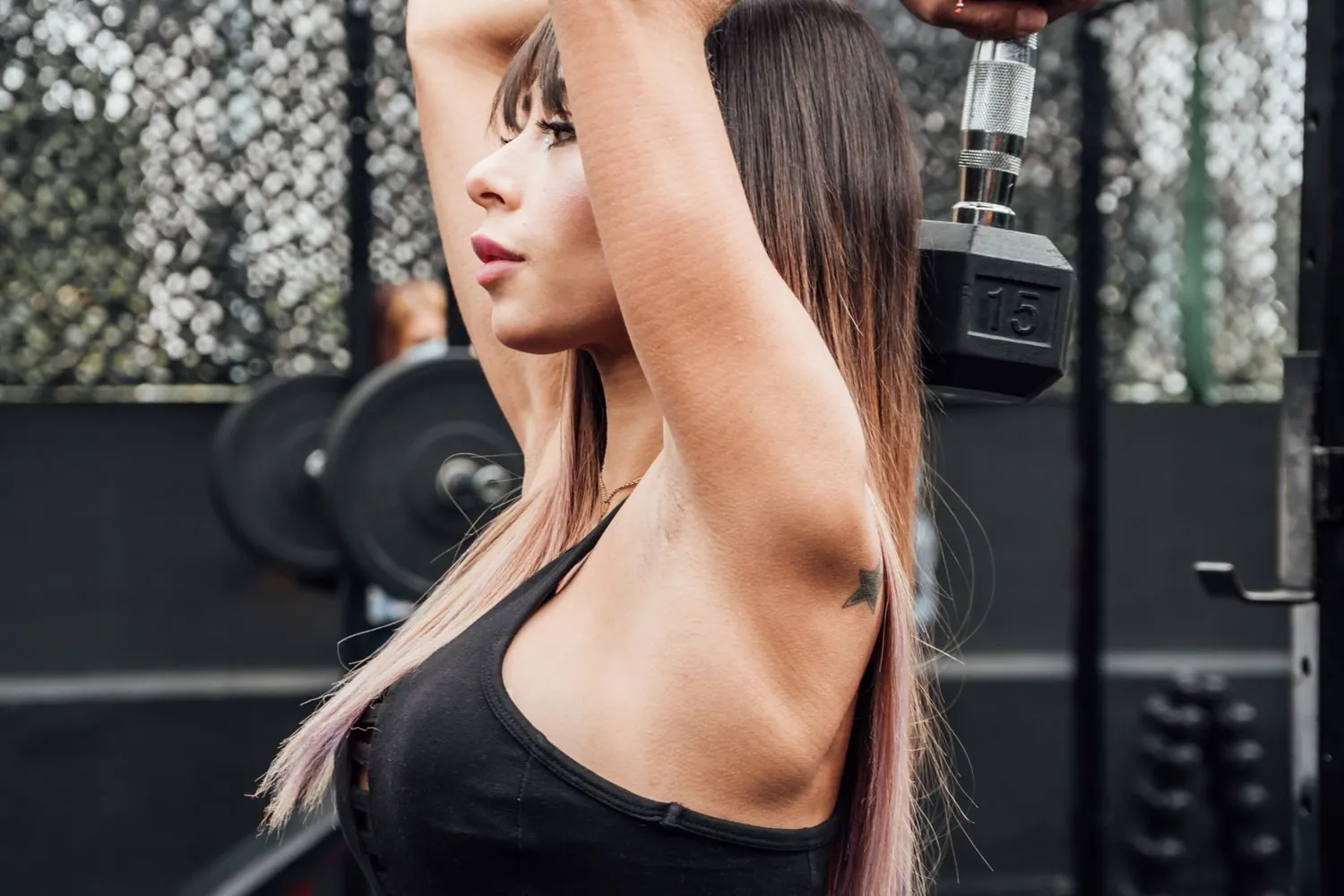
Finish with pushdowns, the single-arm work and the diamond push-ups. By this point fatigue is helping you, because the muscle has to recruit more of its fibres to keep moving. Stop each set one or two reps before form breaks down, and only take the last set of the push-ups close to failure.
Progress by adding a rep or two each week until you hit the top of the range on every set, then add the smallest weight jump you have. That is 1 to 2.5 kg on a dumbbell or one plate-pin on a cable stack. Writing the numbers down matters more than any exercise choice.
If you train in a commercial gym and want machine and cable swaps for each slot, our triceps workout for the gym guide lays out the substitutions.
How often should you train triceps in a week?
Most people grow best training triceps directly twice a week, with at least 48 hours between sessions. Aim for roughly 10-16 hard direct sets per week in total. Triceps also work on every bench press and shoulder press day, so those sessions count toward your recovery budget even though they are not tricep days.
| Level | Direct tricep sessions | Direct sets per week | Notes |
|---|---|---|---|
| Beginner (under 6 months) | 1-2 | About 6-10 | Pressing days already give a lot of indirect work; keep it to three exercises |
| Intermediate (6 months to 2 years) | 2 | About 10-14 | One heavy day, one lighter higher-rep day with more overhead work |
| Advanced (2 years plus) | 2-3 | About 12-16 | Watch the elbows; tendons adapt more slowly than muscle |
Triceps fit naturally on a push day with chest and shoulders, or opposite biceps on a dedicated arm day. If you are building the pulling side too, our bicep workouts guide keeps the upper arm balanced. To slot arms into a broader push-pull week, see the upper body workout breakdown, and for how different training styles compare, the types of workouts overview helps.
What is the best rep range for tricep growth?
The best rep range for tricep growth is a mix: 6-10 reps on compound presses and 10-15 reps on extensions and pushdowns. Heavy sets build strength and overload the whole muscle, while higher reps let you feel the stretch and squeeze. Going below about 6 reps on isolation moves tends to load the elbow and wrist more than the muscle.
Myths that quietly hold back tricep workouts
Myth: pushdowns alone are enough
Pushdowns are a good finisher, but they never put the long head in a stretched position. Add at least one overhead movement for 3 sets and your arm growth usually restarts.
Myth: dips wreck your shoulders
Dips are hard on the shoulders only when done too deep or with the elbows flaring wide. Keep the torso fairly upright, go down until your upper arms are roughly parallel to the floor, and skip them if the front of the shoulder pinches. Close-grip bench is a fine swap.
Myth: high reps tone the arm, low reps bulk it
There is no separate toning mode. Muscle gets bigger or stays the same, and what you see in the mirror also depends on body fat. Train in the ranges above and the shape follows.
Myth: tricep exercises burn the fat off the back of the arm
You cannot choose where fat comes off. Tricep work builds the muscle underneath, but arm fat reduces only as overall body fat falls, through a steady calorie deficit and enough protein. Sensible fat loss is roughly 0.25-0.5 kg a week, and no workout can guarantee results.
Troubleshooting: why your triceps are not growing or your elbows hurt
- Arms look flat from the side: you are probably missing overhead work. Add one overhead extension for 3 sets of 10-12 and lower it for a slow count of 2-3 seconds.
- Elbow pain on skull crushers or extensions: use a lighter weight, switch to a cable or dumbbell variation, keep the elbows from flaring and cut volume for a couple of weeks. If sharp or lasting pain continues past about two weeks, get it checked by a doctor or physiotherapist.
- Shoulders taking over on pushdowns: your elbows are drifting forward or you are leaning on the weight. Lower the load, pin your elbows to your ribs and keep your chest up.
- Weights stuck for weeks: check sleep and protein first, then add a rep per set before adding weight. Eight weeks is a fair window to judge a programme.
- Triceps sore for four days: you did too much too soon. Drop to 2 sets per exercise for a week and build back up.
Tricep workouts at home with no equipment
You can train triceps at home without equipment using diamond push-ups, bench dips off a sturdy chair, and pike push-ups. For the overhead long-head work, a single dumbbell, a filled water can or a backpack with books works for overhead extensions. A resistance band anchored under a door replaces cable pushdowns.
- Pike push-up: 3 x 8-12, in place of the heavy press.
- Backpack or single-dumbbell overhead extension: 3 x 12-15, in place of the overhead dumbbell extension.
- Bench dip (feet flat, hips close to the chair): 3 x 10-15, in place of dips.
- Band pushdown: 3 x 15-20, in place of the rope pushdown.
- Diamond push-up: 2 x to near failure, as the finisher.
Women often skip arm work for fear of bulk, but a normal tricep programme builds firm, defined arms rather than large ones; our workouts for women guide covers how to fit it in. Men chasing size can pair these sessions with the workouts for men plan, and anyone short on gym access can browse online workouts to build a weekly routine.
Home sessions are also where technique slips fastest, because nobody is watching your elbow flare or your range of motion. If you want a coach checking your overhead work and adjusting loads each week, 1-on-1 personal training at Fitstrot builds all three heads into your plan from the first session.
What should you eat to support tricep growth?
To support muscle growth, most people training regularly do well on roughly 1.6-2.2 g of protein per kg of body weight a day, spread over three or four meals. For a 70 kg person that is about 110-155 g. In an Indian diet, that means dal, curd, paneer, eggs, chicken, fish, soya chunks and sprouts at every meal, not only at dinner.
Eat a carbohydrate source such as roti, rice or poha an hour or two before training, and get 7-8 hours of sleep. If your diet is vegetarian or you struggle to reach your protein target, a personalised plan from an online nutritionist can fill the gaps without an expensive supplement habit.
Frequently Asked Questions
What are the best tricep workouts?
The best tricep workouts combine a heavy compound press (close-grip bench or dips), an overhead extension for the long head, and an isolation finisher such as rope pushdowns. Together they train all three heads for roughly 12-15 hard sets a session, twice a week.
How many sets and reps should I do for triceps?
Do 4 sets of 6-8 reps on the compound press, then 3 sets of 10-15 reps on each extension or pushdown. That totals about 12-15 direct sets in a session, and roughly 10-16 direct sets per week is enough for most people.
How often should I train triceps?
Train triceps directly about twice a week, with at least 48 hours between sessions. Triceps also work during chest and shoulder pressing, so beginners can often manage with one or two direct sessions without losing progress.
Can I do tricep workouts at home without weights?
Yes. Diamond push-ups, bench dips, pike push-ups and band pushdowns all train the triceps without dumbbells. A backpack or a filled water can works for overhead extensions, though real dumbbells make it easier to add weight steadily.
Why are my triceps not growing?
The usual causes are no overhead exercise, too little protein or sleep, and never adding reps or weight. Add one overhead extension, eat about 1.6-2.2 g of protein per kg daily, and track your numbers for eight weeks before judging.
Next step: pick the five-exercise session above, write down this week’s weights, and book a 1-on-1 session if you want a trainer to check your overhead form.


