
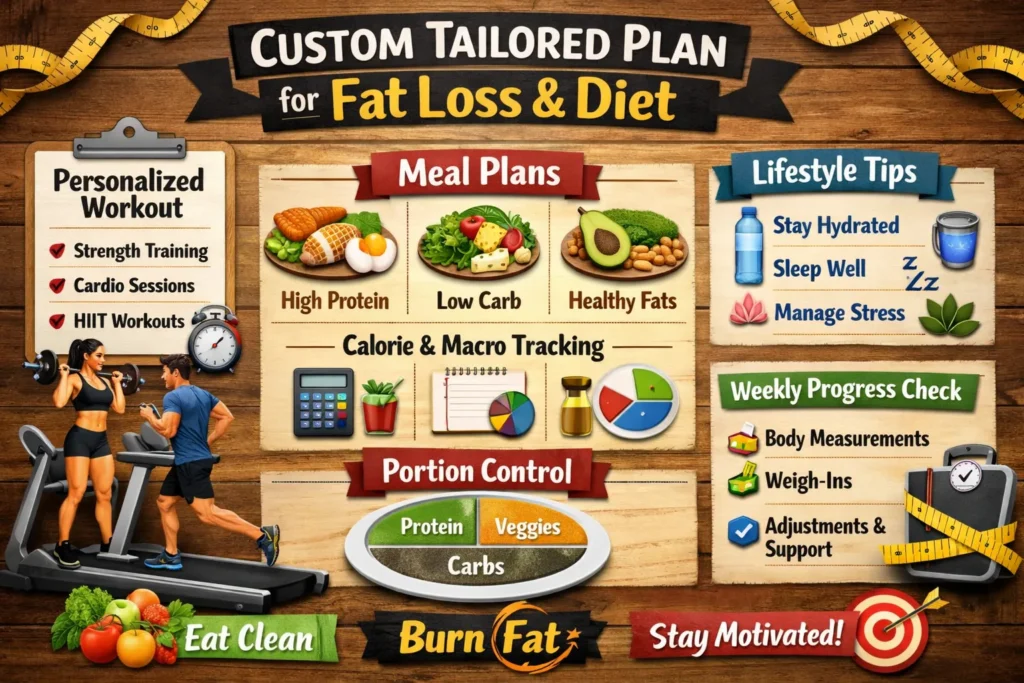
Most diet charts fail for a simple reason: they were written for someone else. A custom tailored plan for fat loss and diet starts with your height, weight, daily schedule, food habits and health history, then sets calories, protein, meals and workouts around them. This guide shows how that tailoring works in practice, with an assessment table, a protein-by-body-weight table and sample plans for different Indian routines, so you can build your own or judge one you are offered.
What makes a custom tailored plan for fat loss and diet different?
A custom tailored plan sets your calorie deficit, protein target, meal timing and training around your own body, schedule and food preferences. A typical safe starting point is a deficit of 300 to 500 kcal below maintenance, protein of 1.2 to 1.6 g per kg, and 2 to 4 strength sessions weekly, adjusted every 2 to 4 weeks.
A generic chart says “1,500 kcal, no rice, no sugar” to everyone. A tailored plan asks different questions. When do you wake up? Who cooks at home? Do you eat eggs? Do you travel for work? Can you walk during the day or are you desk-bound for ten hours? Two women of the same weight can need very different plans if one is a college student in a hostel and the other manages a joint-family kitchen and a full-time job.
Tailoring also means the plan changes. Your first plan is a best estimate. Your body, your results and your life will tell you what to adjust. For a related overview, see our custom weight loss plan guide.
The assessment: what to measure before you plan
Good plans begin with good inputs. Use the table below as a checklist. You can gather most of it in 20 minutes at home with a tape measure, a weighing scale and a notebook.
| Input | What to note | How it changes the plan |
|---|---|---|
| Height, weight, waist | Weigh in the morning; measure waist at the navel | Sets the starting calorie and protein range |
| Weight history | Past diets, regain, highest and lowest weight | Past crash diets call for a gentler deficit and more food |
| Daily schedule | Wake time, work hours, commute, sleep hours | Decides meal timing and which time slot is realistic for workouts |
| Food preference | Vegetarian, eggetarian, non-vegetarian, vegan, Jain, foods you dislike | Decides protein sources and the whole menu |
| Who cooks | You, family, hostel mess, tiffin, office canteen | Plan works within what you can actually control |
| Activity level | Daily steps, current workouts, injuries | Sets training volume and starting difficulty |
| Health and medication | Thyroid, PCOS, diabetes, BP, anaemia, reports | Needs a doctor or dietitian’s input before any aggressive plan |
| Stress and sleep | Hours slept, night snacking, emotional eating | Poor sleep often needs fixing before a bigger deficit |
You will notice “body type” is not on the list. Labels such as ectomorph or endomorph are popular online, but they are not a reliable way to plan food. Real measurements, history and routine are far more useful.
How do you build your own fat loss plan step by step?
Build the plan in five steps: set a realistic rate of loss of 0.25 to 0.75 kg per week, set a calorie range, set a protein target, structure your meals around Indian staples, then schedule 2 to 4 strength sessions and daily walking. Review progress every 2 to 4 weeks and change one thing at a time.
- Pick a pace. Aim for roughly 0.25 to 0.75 kg per week. Faster than this often costs muscle and energy.
- Estimate calories. Many adult women maintain at about 1,800 to 2,200 kcal and many men at about 2,200 to 2,800 kcal, depending on size and activity. Subtract 300 to 500 kcal. Treat this as a starting guess, not a rule.
- Set protein first. Protein protects muscle and keeps you full. Use the table below.
- Build the plate. Half vegetables, a quarter protein, a quarter carbohydrate, plus a measured amount of ghee or oil.
- Add training. Strength work 2 to 4 times weekly plus 7,000 to 10,000 daily steps.
| Body weight | Protein range per day (1.2-1.6 g/kg) | Rough split across meals |
|---|---|---|
| 55 kg | 66-88 g | 3 meals of 18-25 g plus a snack of 8-12 g |
| 65 kg | 78-104 g | 3 meals of 22-30 g plus a snack of 10-15 g |
| 75 kg | 90-120 g | 3 meals of 25-35 g plus a snack of 12-18 g |
| 85 kg | 102-136 g | 3 meals of 30-40 g plus a snack of 12-20 g |
If you carry a lot of extra weight, calculating protein on your goal weight instead of current weight is common. For ready-made structures, our diet plan for weight loss guide has sample days you can adapt.
Myth check: what a “custom” plan is not
A custom plan is not a macro split copied from an influencer, a list of banned foods or a PDF with your name typed on top. Real customisation changes with your results, includes foods you like and respects your health limits. If a plan cannot explain why a number was chosen, be cautious.
- “Carbs make you fat.” Excess calories make you gain fat. Rice, roti and potatoes can fit in measured portions.
- “Eat every two hours to boost metabolism.” Meal frequency matters far less than total intake and protein. Choose the pattern you can follow.
- “Skip dinner to lose faster.” This often causes late-night snacking. A lighter, earlier dinner usually works better.
- “A custom plan means a restrictive plan.” The opposite. It should be flexible enough for weddings, travel and festivals.
How the same goal looks for different routines
The table shows how tailoring changes a plan even when the goal and calorie deficit are similar. These are illustrations, not prescriptions.
| Profile | Meal structure | Training slot | Common watch-out |
|---|---|---|---|
| Desk-job professional, vegetarian | Paneer or dal at lunch, curd daily, roasted chana at the desk | 3 strength sessions of 40 minutes, early morning or after work | Long sitting hours; set a walk reminder every hour |
| Hostel or PG student | Mess rotis and sabzi plus eggs, milk, peanuts and roasted chana | 30-minute bodyweight sessions, 3 days a week | Limited control over oil; add protein from outside |
| Homemaker in a joint family | Family meals with smaller rice portion, extra dal and sabzi | Home sessions of 30 minutes while others are out | Tasting while cooking and finishing leftovers |
| Shift worker | Fixed main meal before or after shift, protein-rich snack during shift | Sessions on off-days and short walks on shift days | Poor sleep and heavy tea or snacks at night |
| Vegan or Jain | Soya, tofu, dal, chana, rajma, nuts and seeds, with careful planning | 3 strength sessions weekly | Protein and vitamin B12; check with a dietitian |
Matching the plan to what you eat
The best plan uses food you already know how to cook. A tailored diet is not a starvation diet, and it also is not a Western meal plan dropped onto an Indian kitchen. Think in terms of protein, vegetables, carbohydrate and fats you can find locally.

The image above shows the four building blocks: protein, vegetables, healthy fats and tracking. Here is how to translate them for different preferences:
- Vegetarian: rely on dal, paneer, curd, milk, soya, sprouts and chana. See our vegetarian diet plan for weight loss.
- Vegan: use tofu, soya chunks, lentils, chickpeas, nuts and seeds, and consider B12 with your doctor’s advice. See the vegan diet plan for weight loss.
- Women’s specific needs: iron, calcium and cycle changes matter. Our weight loss diet plan for women goes deeper.
- Fasting periods: festivals and religious fasts need a modified structure. See the Ramadan diet plan for weight loss for an example of fasting-friendly planning.
If you eat out often or follow family meals, decide two or three “default orders” in advance. For example, tandoori chicken or paneer tikka with salad, dal and one roti, or idli with sambar. Defaults remove daily decisions.
When should you adjust your plan?
Adjust your plan if weight, waist and measurements have not changed for 2 to 3 weeks despite consistent effort. Change only one variable at a time, such as 100 to 200 kcal, an extra 1,000 daily steps, or one more strength session, then wait another 2 weeks before judging.
Before changing food, check that your tracking is honest. Cooking oil, tea with sugar, weekend meals and “tasting” at home often hide hundreds of calories. If you are hungry all day, tired or irritable, the deficit may be too large. Eat more, not less. If weight is dropping faster than 1 kg a week for several weeks, you are likely losing muscle too, so raise calories a little and keep protein high.
Review your plan monthly. Strength numbers, sleep and energy matter as much as the scale. Plateaus are normal, and they are not a sign that your metabolism is broken.
When do you need a doctor or dietitian first?
See a doctor or registered dietitian before starting if you have diabetes, thyroid disease, PCOS, high blood pressure, kidney or liver problems, anaemia, a history of eating disorders, or if you are pregnant, breastfeeding or taking regular medication. They can adjust targets safely. Never change medication on your own to lose weight.
For example, a thyroid condition changes how you track progress, and our thyroid diet plan for weight loss explains the basics. Stop and seek medical advice if you feel dizzy, faint or have chest pain, or if your periods stop. This article is general education, not medical advice.
DIY plan or coach: how to choose
A self-made plan works if you are healthy, motivated and enjoy tracking. A coach or dietitian helps if you have medical conditions, a history of failed diets, little time, or need accountability. You can start DIY with the steps above and ask for help when you stall.
A nutritionist consultation turns your assessment into a menu that fits your kitchen. A 1-on-1 personal training programme adds form correction and progression, and online yoga classes are a calm option for recovery days and stress.
Frequently asked questions
What is a custom tailored plan for fat loss and diet?
It is a fat loss plan built around your measurements, schedule, food preferences and health history instead of a generic chart. It sets a moderate calorie deficit, a protein target, practical meals and a training routine, and it is reviewed and adjusted every few weeks.
How much weight can I lose per week with a tailored plan?
For most adults, about 0.25 to 0.75 kg per week is a sustainable pace. The first 2 to 3 weeks may show a faster drop because of water. Results vary with starting weight, sleep and consistency, and no outcome is guaranteed.
How much protein do I need on a fat loss diet?
A common range is 1.2 to 1.6 grams per kg of body weight daily, so a 65 kg person would aim for about 78 to 104 grams. People with kidney disease or other conditions should check with a doctor before raising protein.
Can I follow a custom fat loss plan as a vegetarian?
Yes. Dal, paneer, curd, milk, soya, tofu, sprouts, chana and rajma can meet protein needs when spread across 3 meals and 1 to 2 snacks. It takes more planning than a non-vegetarian diet but works well.
When should I change my fat loss plan?
Review it every 2 to 4 weeks. If your waist, weight and measurements have not changed for 2 to 3 weeks despite consistent effort, change one thing, such as calories, steps or training, then reassess. If you feel unwell, eat more and see a professional.
If you would rather have a coach do the assessment and build the plan with you, book an online weight loss trainer consultation and bring your measurements and a typical day of eating.


