
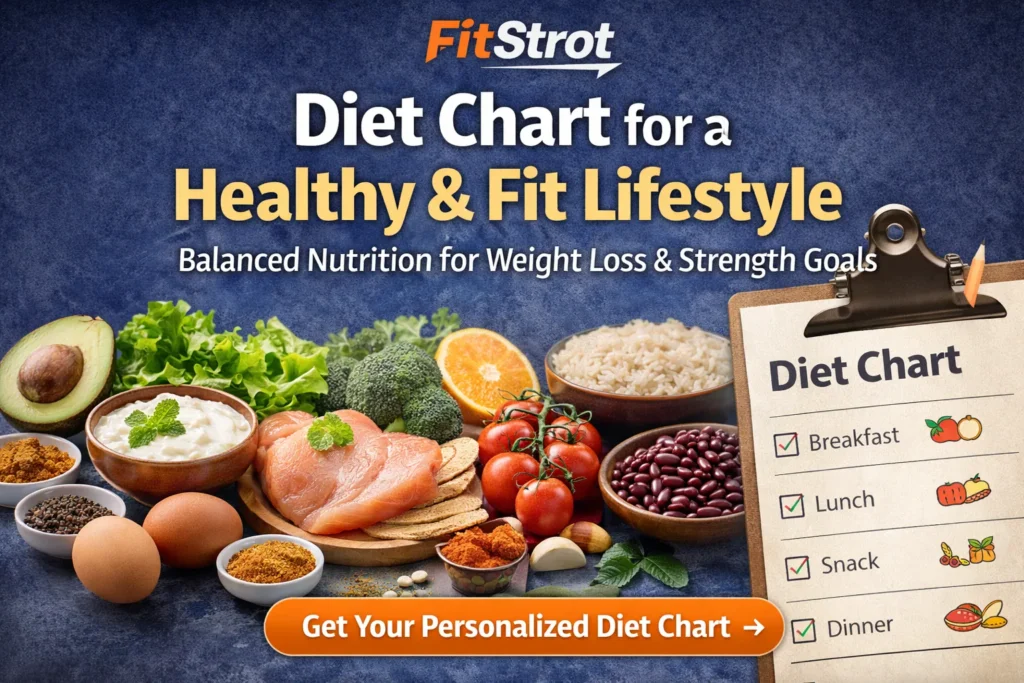
A diet chart is a written eating plan that tells you what to eat, how much, and when, built around your calorie needs, protein target and daily routine. A good one removes daily guesswork: you open the chart, not the delivery app. This guide shows you how to design your own diet chart step by step, with Indian sample days in grams and calories, and how to adjust it for fat loss, maintenance or muscle gain.
It is a general guide for healthy adults. If you have a medical condition, jump to the section on when a printed chart is not enough.
What is a diet chart, and what should it include?
A diet chart is a structured plan listing meals, portions and timings for a day or week. A useful one includes a daily calorie range, a protein target in grams, meal timings, portion sizes in household measures like katori and roti, two or three swap options per meal, and a weekly review date.
What it should not include: extreme calorie cuts, banned food groups, or promises like “lose 10 kg in 10 days”. A chart is a tool for consistency, not a punishment. The same chart can be used for months if you adjust portions every two weeks.
How do you make a diet chart in six steps?
Estimate your maintenance calories, choose a goal calorie range, set a protein target, split calories across three meals and one or two snacks, convert them into Indian foods with portions, then review every two weeks. Most adults finish a first draft in about 30 minutes.
- Estimate maintenance calories. A rough starting point is 28 to 33 kcal per kg of body weight for sedentary to lightly active adults. A 65 kg person lands near 1,800 to 2,150 kcal. This is an estimate, not a measurement.
- Pick a goal range. Fat loss usually means about 300 to 500 kcal below maintenance; muscle gain about 200 to 300 above. Never go below 1,200 kcal a day without medical supervision.
- Set protein. About 0.8 to 1 g per kg for a sedentary adult, and about 1.2 to 1.6 g per kg if you train or are cutting calories.
- Split the day. Three meals plus one or two snacks, with protein at every meal.
- Convert to foods. Use the plate method: half vegetables, a quarter protein, a quarter grain, plus a little fat.
- Review. If weight and energy are not moving as planned after two weeks, change portions by about 100 to 150 kcal, not the whole chart.
How should a diet chart change with your goal?
The structure stays the same; only calories, protein and carbohydrate timing change. Fat loss needs a modest deficit and higher protein to protect muscle, maintenance needs steady balance, and muscle gain needs a small surplus with carbohydrates around training. Keep changes small and judge them over two weeks.
| Goal | Calories vs maintenance | Protein per kg | Carbohydrates | Meal pattern |
|---|---|---|---|---|
| Fat loss | 300 to 500 kcal below | 1.2 to 1.6 g | Moderate, mostly whole grains and pulses | 3 meals, 1 snack, early dinner |
| Maintenance | About equal | 0.8 to 1.2 g | Moderate to high | 3 meals, 1 to 2 snacks |
| Muscle gain | 200 to 300 kcal above | 1.4 to 1.8 g | Higher, concentrated around training | 3 meals, 2 snacks, pre and post workout |
| Busy, irregular schedule | About equal | 1.0 to 1.2 g | Moderate, easy carry foods | Fixed breakfast, portable snacks |
If fat loss is your main goal, our healthy diet chart for weight loss and nutrition diet chart for weight loss go deeper into calorie deficits.
A sample Indian diet chart for one day (about 1,650 kcal)
This vegetarian day suits a small to medium adult as a starting point. Portions are approximate and shift with how much oil or ghee your kitchen uses.
| Meal and time | Foods and portion | Approx kcal | Approx protein |
|---|---|---|---|
| Breakfast, 8:00 | 1.5 katori (about 200 g) vegetable poha, 1 glass (200 ml) toned milk | 370 | 11 g |
| Mid-morning, 11:00 | 1 apple or guava, 8 almonds | 135 | 3 g |
| Lunch, 13:30 | 2 rotis, 1 katori dal, 1 katori sabzi, salad, 100 g curd | 510 | 20 g |
| Evening, 17:00 | Tea with a little milk, 30 g roasted chana | 150 | 7 g |
| Dinner, 20:00 | 2 rotis, about 80 g paneer sabzi, vegetables and salad | 480 | 20 g |
| Total | about 1,650 | about 60 g |
Vegetarian specifics are covered in our veg diet chart for weight loss. For a non-vegetarian version, swap the paneer for 100 g cooked chicken or fish, or add 1 to 2 eggs at breakfast. Drink about 2 to 3 litres of fluids through the day, more in summer or on training days.
Which foods can you swap in a diet chart?
Swap foods within the same role, not randomly. Replace one protein source with another of similar protein and calories, one grain with another measured portion, and one fruit with another. Use the table below to keep protein on target when you change a meal, for example paneer to soya chunks or eggs.
| Food | Portion | Approx protein | Approx kcal |
|---|---|---|---|
| Egg | 1 large | 6 g | 70 |
| Chicken breast, cooked | 100 g | 30 g | 165 |
| Fish, cooked | 100 g | 18 to 22 g | 120 to 150 |
| Paneer | 100 g | 18 g | 265 to 300 |
| Soya chunks, dry | 30 g | 15 g | 100 |
| Dal, cooked | 1 katori (150 g) | 7 to 9 g | 110 to 150 |
| Curd | 100 g | 3 to 4 g | 60 |
| Roasted chana | 30 g | 6 g | 110 |
| Toned milk | 200 ml | 6 g | 120 |
How do you measure portions without a kitchen scale?
Use household measures: a standard katori of about 150 ml for dal or sabzi, one medium roti made from roughly 30 g of atta, your fist for cooked rice or fruit, and your palm for paneer, chicken or fish. These are approximate, but consistent measuring matters more than perfect grams.
- Roti: 1 medium roti is about 100 kcal; a paratha can be 200 to 300 kcal depending on ghee.
- Rice: 1 katori cooked rice (about 150 g) is roughly 190 to 200 kcal.
- Oil and ghee: 1 teaspoon is about 40 kcal. Measure it for a week to see your real habit.
- Nuts: a small handful (about 20 g) is roughly 120 kcal, so count it as a snack, not a garnish.
A simple weekly rotation so your diet chart does not get boring
Keep your calorie and protein targets fixed, and rotate the foods. For example, change the protein at dinner across the week: paneer on Monday, dal khichdi on Tuesday, eggs or chicken on Wednesday, soya or rajma on Thursday, fish or tofu on Friday. Alternate breakfast between poha, besan chilla, idli with sambar and oats, so you never repeat the same meal more than twice a week.
Plan one flexible meal a week, such as a family dinner out or a mithai at a function. Fit the rest of that day around it rather than skipping meals, and return to the chart at the next meal.
Diet chart ideas by routine: office, students, shift work and home
- Office workers: keep a fixed breakfast, carry a snack box of roasted chana or fruit, and pick a light thali instead of ordering heavy gravies. Walk for 10 minutes after lunch.
- Students: prioritise curd, eggs or paneer, sprouts and fruit, which are cheap and quick. Avoid replacing meals with chips or sugary drinks during exam weeks.
- Shift workers: anchor the chart to your wake time, not the clock. Treat the first meal after waking as breakfast and keep the largest meal before your longest stretch of activity.
- Home-makers and family cooks: cook one base for everyone and adjust portions on your plate, instead of preparing a separate “diet meal”.
- Yoga practitioners: if you follow a lighter, sattvic style, see our guide on the yogic diet.
Why most diet charts fail by week three
- Too strict. Charts that ban rice, sweets or tea get abandoned. Leave room for one planned treat a week.
- No prep. Without cooked dal, chopped salad or roasted chana ready, you fall back on whatever is convenient.
- Underestimated oil and extras. One tablespoon of oil is about 120 kcal; sugar in tea, biscuits and fruit juice add up quickly.
- No review date. A chart that never changes stops fitting your body. Re-check every two weeks.
- Ignoring training. Eating the same on gym days and rest days wastes recovery. Pair your chart with a workout chart so meals follow activity.
Diet chart myths worth dropping
- “You must eat six small meals.” Meal frequency matters far less than total calories and protein. Choose what you can keep up.
- “Carbs after 7 pm make you fat.” Total daily intake drives weight change, not the clock. A lighter dinner simply helps some people sleep and snack less.
- “Cheat meals ruin progress.” A single indulgent meal rarely does. Daily drift does.
- “A copied diet chart works for everyone.” The same plate suits a 55 kg office worker and an 85 kg gym-goer very differently.
When a printed diet chart is not enough
See your doctor or a registered dietitian before following any diet chart if you are pregnant or breastfeeding, have diabetes, thyroid disease, kidney or liver problems, high blood pressure, anaemia, an eating disorder history, or take regular medication. Never change prescribed medicines because of a diet. A general chart cannot account for these conditions.
For specific situations, start with our guides on the PCOD diet chart for weight loss and the weight loss diet chart for breastfeeding mothers. For a plan built around your reports, food habits and schedule, an online nutritionist consultation removes the guesswork, and an online weight loss trainer can link the chart to your workouts.
Frequently asked questions about diet charts
How many calories should I eat daily on a diet chart?
Many adults need roughly 1,600 to 2,400 kcal a day depending on weight, age, sex and activity. A simple start is 28 to 33 kcal per kg of body weight, then adjust by 300 to 500 kcal for your goal. Do not go below 1,200 without medical supervision.
How many meals should a diet chart have?
Three main meals and one or two snacks work well for most people. The number matters less than total calories, protein at each meal, and whether you can follow it on workdays. Choose the pattern that keeps hunger steady and fits your routine.
Can I make my own diet chart?
Yes, if you are a healthy adult. Estimate calories, set a protein target, build meals from familiar Indian foods and review every two weeks. If you have a health condition or unclear goals, get a dietitian to build or check it.
How often should I change my diet chart?
Review it every two weeks and change portions only if weight, energy or hunger are off track. Small tweaks of 100 to 150 kcal are enough. Rewrite the whole chart when your goal, weight or routine changes significantly.
Is a free diet chart enough?
A free chart is a fine starting template for healthy adults, but it cannot adapt to your reports, preferences or progress. Treat it as a draft and personalise portions to your weight and activity, or get professional input if you need accuracy.
Want a diet chart calculated for your weight, routine and food habits? Book an online nutritionist consultation with Fitstrot and get a plan reviewed every two weeks. For training alongside it, see 1-on-1 personal training.


