

If you are searching for yoga for headache, the honest starting point is this: gentle yoga can be a supportive habit for tension-type headaches, the dull, band-like kind that builds with a stiff neck, tight shoulders, a clenched jaw and shallow breathing. Below you get a 15-minute routine, slow breathing without breath holds, and a clear list of when to skip the mat and see a doctor. It is not a treatment for migraine or any serious headache condition.
Can yoga actually help a headache?
Yoga can help some people with tension-type headaches by easing neck and shoulder tightness, slowing the breath and lowering everyday stress. It is a supportive habit, not a treatment, and it does not replace a medical assessment. A gentle 10 to 15 minute practice on most days, kept up for several weeks, is a sensible way to test it.
Think about a typical screen-heavy day. Your head drifts forward, your shoulders creep up, your jaw tightens and your breathing moves into the upper chest. The muscles at the base of the skull and along the top of the shoulders stay switched on for hours, and that tension is a common contributor to everyday headaches. Gentle movement, a softer jaw and slower breathing work on exactly those habits. Results vary from person to person, and some headaches have nothing to do with muscles, which is why the next section matters.
When should you see a doctor instead of doing yoga?
See a doctor promptly, and do not rely on yoga, for a sudden, severe “worst ever” headache; a headache with fever and a stiff neck; weakness or numbness; vision changes; any headache after a head injury; or new headaches after age 50. In an emergency, call 112.
- Headaches that keep getting worse over days or weeks, or wake you from sleep.
- Headaches that come with a seizure, fainting or double vision.
- A headache pattern that has changed, such as new frequency or a new kind of pain.
- Needing pain relief most days to get through the week.
If you already take medicines for headaches, keep taking them exactly as your doctor advised. Yoga is an add-on you can mention at your next visit, not a reason to change anything.
Who should avoid or modify this routine?
Check with your doctor first if you have a diagnosed neck or spine problem, uncontrolled high blood pressure, glaucoma or another eye condition, frequent dizziness or fainting, a recent head injury or concussion, or you are pregnant. Everyone else should still keep every movement small, slow and pain-free.
- Neck problems: numbness, tingling down an arm or sharp neck pain means stop and get it assessed before stretching.
- Blood pressure and eye conditions: avoid head-down positions and strong breathing practices unless your doctor has cleared them.
- Migraine: keep to calm, low-stimulation practice between episodes, and read our guide to yoga for migraine first.
- Pregnancy: ask your doctor which positions suit your stage.
Headache types and what yoga can offer: a quick comparison
| Headache pattern | What it often feels like | Where gentle yoga fits |
|---|---|---|
| Tension-type | Dull pressure or a tight band on both sides, with a stiff neck and shoulders | Neck and shoulder release, slow breathing, short daily practice |
| Migraine | Often one-sided and throbbing, with nausea or sensitivity to light and sound | Calm, low-stimulation rest between episodes only; not a treatment |
| Sinus-type pressure | Pressure around the cheeks and forehead with a blocked nose | Easy breathing only; avoid head-down poses; an infection needs a doctor |
| Sudden, severe or unusual | Abrupt, very intense, or with fever, weakness or vision changes | None. Get medical care first |

What is a gentle 15-minute yoga routine for a tension headache?
A gentle 15-minute routine moves from slow breathing into neck and shoulder release, then easy spinal movement, a supported forward fold with the head at or above heart level, and a short rest. Stay inside comfortable ranges, never force a stretch, and stop if pain or pressure in the head increases.
| Step | Time | How to do it | Form cue |
|---|---|---|---|
| 1. Settle and breathe | 2 min | Sit on a chair or cushion, hands on your belly | Inhale 4 counts, exhale 6, no holds |
| 2. Ear-to-shoulder stretch | 2 min | Tilt one ear towards the shoulder, 20 to 30 seconds per side, twice | Keep the other shoulder low; do not pull with your hand |
| 3. Shoulder rolls and shrugs | 2 min | 8 slow rolls each way, then shrug up on the inhale and drop on the exhale | Let the exhale be a soft sigh |
| 4. Jaw release | 1 min | Lips closed, teeth apart, tongue resting softly; massage the jaw hinge | Notice if you clench when concentrating |
| 5. Seated cat-cow | 2 min | Hands on knees, 8 to 10 slow rounds with the breath | Keep the chin neutral; do not crank the neck back |
| 6. Side stretch and easy twist | 2 min | Reach one arm overhead and lean, then turn gently each way | Eyes forward; twist from the ribs, not the neck |
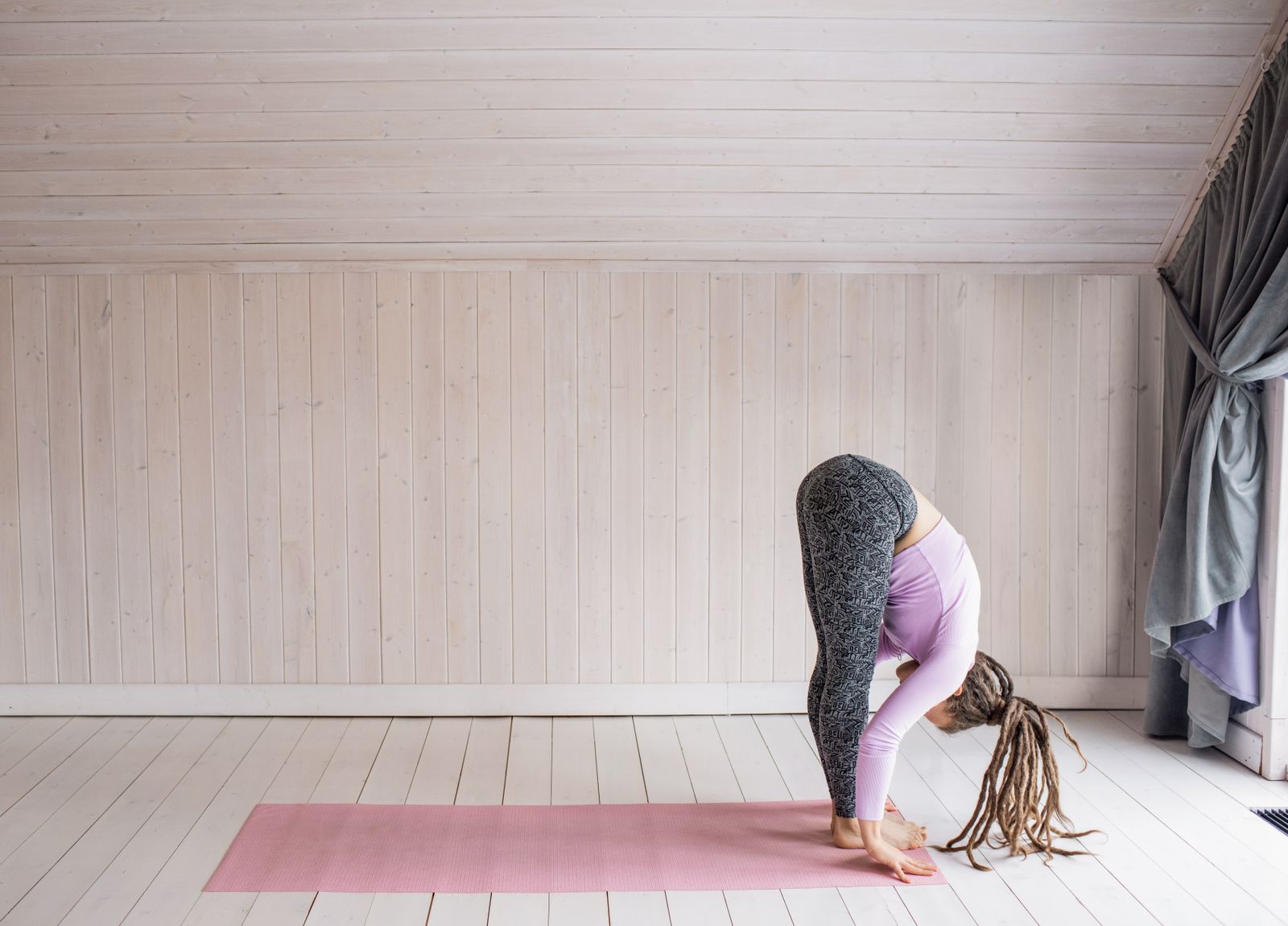
| 7. Supported forward fold | 2 min | Fold forward from the hips, forearms and head resting on a bolster or desk | Back long; skip it if pressure builds |
| 8. Rest | 2 min | Lie on your back with a folded towel under the head, or sit back in the chair | Breathe naturally; keep the lights low |
On a day when a mild headache is already there, do only steps 1, 3 and 8. Practise in a quiet room, drink some water first, and avoid doing it straight after a heavy meal. These neck and shoulder stretches for headache are most useful when done daily, not just when the pain arrives.
Which breathing practices help, and which should you skip?
Slow nasal breathing with a longer exhale, such as inhaling for 4 counts and exhaling for 6, is the safest choice for headaches. Skip breath holds and forceful techniques like kapalabhati and bhastrika during a headache, because they can add pressure and dizziness. Practise 3 to 5 minutes, sitting comfortably.
- Dirga (three-part breath): fill the belly, then the ribs, then the upper chest, and empty in the same order. It counters the shallow breathing that goes with stress.
- Bhramari (humming breath): a soft hum on the exhale for 5 rounds. Keep it quiet and skip it if it bothers your ears or sinuses.
- Nadi shodhana (alternate nostril breathing): use a light touch and no holds. Skip it if your nose is blocked.
If you have a heart or lung condition, or high blood pressure, check with your doctor before trying pranayama for headache.
Myth: head-down poses cure headaches by sending blood to the head
This idea is common and not reliable. Headstand, shoulder stand, plough and long hanging forward folds can add pressure in the head, strain the neck and cause dizziness, which is the opposite of what a headache needs. While you have a headache, keep your head at or above heart level.
Even legs-up-the-wall is a mild inversion, so we suggest skipping it during an active headache. If you try it on a headache-free day, use a bolster, keep it to a few minutes and come out slowly. Leg elevation also raises its own questions, for example for people with vein problems, which we cover in yoga for varicose veins.
At your desk: a 3-minute reset for screen headaches
Once an hour, stand up and look at something far away for 20 seconds. Slide your chin straight back a little, as if making a gentle double chin, without tilting the head. Roll the shoulders 8 times, do the ear-to-shoulder stretch once per side, and take 5 long exhales. Raise your screen to eye level so the neck stops working overtime.
Desk posture feeds directly into neck tension, so our guides on yoga for posture and yoga for back pain pair well with this routine.
A week of practice, mapped out
| Day | Focus | Time |
|---|---|---|
| Monday | Full 15-minute routine | 15 min |
| Tuesday | Breathing plus desk resets | 8 to 10 min |
| Wednesday | Full 15-minute routine | 15 min |
| Thursday | Easy walk, shoulders relaxed | 20 to 30 min |
| Friday | Full 15-minute routine | 15 min |
| Saturday | Restorative or gentle class | 20 to 30 min |
| Sunday | Rest, or breathing only | 5 min |
Keep this up for four to six weeks before judging it, and note the date, time and likely trigger of each headache in a simple diary. If the pattern does not improve, or gets worse, take the diary to your doctor. Once you feel comfortable, you can widen your practice, for instance with the routines in yoga for weight loss.
Why do you get a headache after yoga?
A headache after yoga usually comes from dehydration, an empty stomach, a hot room, holding head-down poses too long, straining the neck in plough or deep backbends, or holding the breath through hard poses. Most of these are fixable with technique, water and an easier pace.
- Skipping breakfast or your usual chai or coffee before an early class can trigger one by itself.
- Looking up hard in backbends compresses the back of the neck; keep the gaze level.
- Clenched teeth and raised shoulders carry headache tension straight onto the mat.
- Hot or fast classes make dehydration and breath holding more likely.
If headaches keep following practice despite these changes, stop and speak to your doctor.
Choosing a style that suits a headache-prone body
Slow, supported styles are the better fit. Hatha yoga at a moderate pace leaves time to watch alignment and breathing, and restorative yoga uses props and long, easy holds. Fast vinyasa, power yoga and hot classes are better left until your headaches are settled. Our overview of types of yoga compares pace and intensity, and yoga at home covers a safe set-up. If you prefer live feedback, see our guide to online yoga classes.
Daily habits that support the mat
Sip water through the day, eat at regular times, keep caffeine steady, sleep and wake at similar hours, and take screen breaks. None of these is a cure, but irregular habits are common headache triggers and they are easy to fix.
Questions people ask about yoga for headache
How long does it take for yoga to help a headache?
For a mild tension headache, some people feel easier within 10 to 15 minutes of slow breathing and gentle stretches. For prevention, judge results after four to six weeks of regular practice. Severe or unusual headaches need medical advice, not a timer.
Can I do yoga while I have a headache?
If the headache is mild and familiar, slow breathing, shoulder rolls and a supported rest are reasonable. Avoid inversions, forceful breathing, heat and fast movement. If the headache is severe, sudden or comes with red-flag symptoms, do not practise; seek medical care.
Is yoga for tension headache different from yoga for migraine?
Yes. Tension-type headaches often respond to neck and shoulder release, while migraine calls for calm, low-stimulation practice between episodes and is not something yoga treats. Our yoga for migraine guide covers that approach.
Which yoga poses should I avoid when I have a headache?
Avoid headstand, shoulder stand, plough, long hanging forward folds, deep backbends and hot or fast classes. Also skip breath holds and forceful breathing such as kapalabhati. Choose seated, supported and slow movements instead.
Can beginners follow this routine at home?
Yes, the routine uses only a chair, a cushion or bolster and a towel, and every move is small. Start with steps 1, 3 and 8 for a week, then add the rest. Stop at any pain, and have a doctor check recurring headaches.
If you would rather be guided than guess, book a session in Fitstrot’s online yoga classes and ask the instructor for a gentle neck-and-shoulder routine.


