
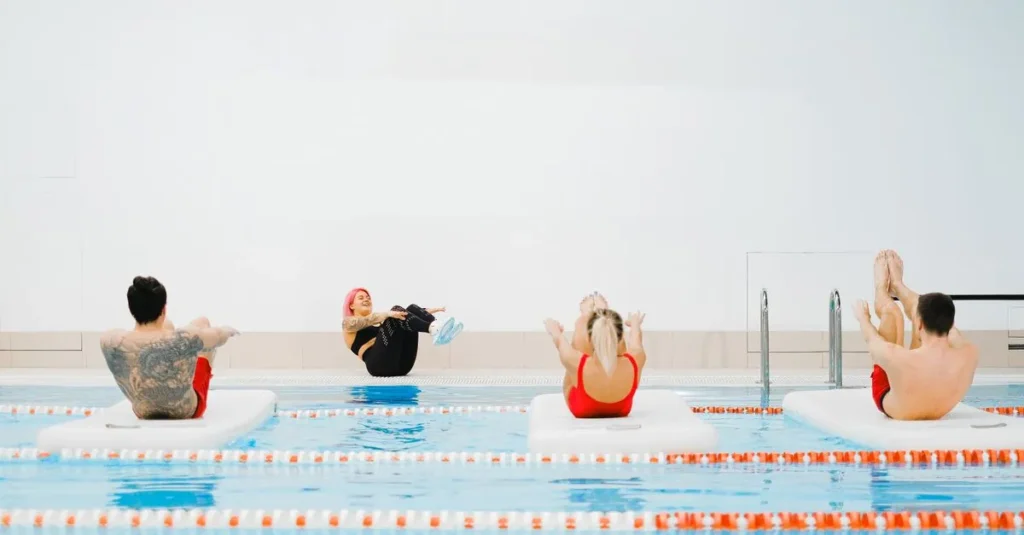
Swimming for weight loss works, but not always for the reason people expect. An hour in the pool burns roughly 300 to 700 kcal depending on stroke, pace and body weight, and it is gentle on knees, hips and back. The catch is appetite and effort: the water keeps you cool, so a swim can feel easier than it is, and a hungry post-swim snack can quietly cancel the session. Below you will find the calorie numbers, a four-week plan, what to eat around a swim, and the mistakes that stall progress.
How many calories does swimming burn in an hour?
A 70 kg adult burns about 350 to 450 kcal in an hour of easy swimming and roughly 550 to 700 kcal at a vigorous, sustained pace. Heavier swimmers burn more and lighter swimmers burn less. Stroke choice, how often you rest at the wall and how efficient your technique is all change the total.
| Activity | Easy pace (kcal per hour) | Vigorous pace (kcal per hour) | Best used for |
|---|---|---|---|
| Freestyle (front crawl) | 350-450 | 550-700 | Steady laps, the main stroke for fat loss |
| Breaststroke | 350-450 | 500-650 | Beginners and head-up swimmers |
| Backstroke | 300-400 | 450-550 | Easy recovery laps with simpler breathing |
| Butterfly | Not sustainable | 600-800 | Single-length bursts only, technique heavy |
| Water walking or aerobics (chest-deep) | 250-350 | 350-450 | Non-swimmers, recovery days, heavier bodies |
These are estimates for a 70 kg adult. Take off about 15 percent if you weigh 60 kg and add about 15 percent at 80 kg. Treat them as ranges, not promises: no pool app or watch knows your exact stroke efficiency.
The bigger gap is between time in the pool and time actually swimming. A 45-minute visit with long chats at the wall may hold only 25 to 30 minutes of real swimming. Count the minutes you are moving, not the minutes you are wet, when you work out calories burned swimming.
Is swimming better than walking, running or cycling for weight loss?
Swimming burns more than brisk walking and about the same as moderate cycling or jogging at a matched effort, so it is not a shortcut. Its real advantage is comfort: water carries your weight, so people with sore joints or a higher body weight can train longer and more often. The best exercise is the one you will keep repeating.
For a 70 kg adult, brisk walking at 5 to 6 km/h burns roughly 250 to 350 kcal an hour, cycling at a steady 16 to 19 km/h roughly 400 to 550, and jogging at about 8 km/h roughly 550 to 700. A vigorous swim sits in the same band as jogging, without the pounding.
One quirk matters: water cools you, so you do not feel hot or breathless the way you would on a treadmill. Many swimmers therefore under-push. Use the talk test instead. At the wall you should manage a short sentence but not a full conversation.
If the pool is closed or far away, our guide on elliptical trainer vs treadmill for weight loss covers another joint-friendly way to keep the habit going.
Why am I not losing weight with swimming?
The usual reasons are eating back more than you burned, resting too long between laps, and expecting the pool to outwork the plate. A 45-minute swim burns roughly 300 to 450 kcal, which one vada pav or a sweetened lassi can erase. Track your food honestly for two to three weeks, then adjust portions.
Work through this checklist before blaming the pool.
- Post-swim hunger. Many swimmers report being hungrier after the pool than after a walk. Plan the meal before you get in, so you are not choosing at the canteen counter.
- The “I earned it” effect. A double-sized breakfast or an extra evening snack is easy to justify after 40 minutes of laps. It is also easy to out-eat the session by 200 to 300 kcal.
- Too relaxed a pace. Slow, head-up breaststroke with frequent chatting sits at the bottom of the table above. Add intervals or longer continuous stretches.
- Same routine for months. As you get fitter, the same 30 laps cost you less effort and fewer calories. Add distance or fast lengths every two to three weeks.
- Scale noise. In the first weeks of any new exercise, muscles hold extra water and the scale can wobble by about a kilogram. Judge progress over four weeks, not four days, and add waist and clothing-fit checks.
Do the arithmetic once. A kilogram of body fat is roughly 7,700 kcal. Four swims a week at about 400 kcal each is 1,600 kcal, which on its own is only around 0.2 kg of fat a week. A realistic pace is roughly 0.25 to 0.5 kg a week, and the rest of that deficit has to come from food. Anyone promising 5 kg in a week is not describing healthy fat loss.
A 4-week swimming workout for weight loss
This plan assumes you can swim at least a couple of lengths without stopping and use a 25 m pool. If yours is shorter, double the lengths. Start each session with a few minutes of easy swimming and finish with an easy cool-down.
| Week | Sessions | Session structure | Rest | Form cue |
|---|---|---|---|---|
| 1 | 3 (20-25 min) | 8 x 1 length, easy freestyle or breaststroke | 30-40 s at the wall | Breathe out slowly underwater; keep the kick small |
| 2 | 3 (30 min) | 6 x 2 lengths at a steady pace | 20-30 s | Count strokes per length and try to reduce the count |
| 3 | 4 (30-35 min) | 5 min easy, 8 x 1 length brisk, 10 min steady, 5 min easy | 30 s after each brisk length | Lengthen the stroke before you speed it up |
| 4 | 4 (40-45 min) | 5 min easy, 20 min continuous, 6 x 1 length fast, 5 min easy | 40 s after each fast length | Keep hips high and head still; kick from the hip |
On non-swim days, do a brisk walk or two short strength sessions. Swimming trains the upper body and core, but it does not load the bones and leg muscles the way squats, lunges and rows do. A couple of resistance sessions a week helps you keep muscle while the fat comes off. If you want those sessions guided, 1-on-1 personal training can build them around your pool schedule.
Technique pays back quickly. Beginners often burn energy fighting the water with a high head and a splashy kick. Use a kickboard for a few lengths, breathe to the side with your head low, and ask a lifeguard or coach to watch one session. Better technique lets you swim farther at the same effort, which is where the calories come from.
Food before and after a swim: portions that suit Indian meals
Swimming on an empty stomach often leaves early-morning swimmers flat by the tenth minute. A full lunch before an evening swim brings sluggishness and cramps. Aim for something light 30 to 45 minutes before, and a planned protein-led meal within about an hour after. All figures below are approximate.
| Timing | Food | Portion | About kcal | Note |
|---|---|---|---|---|
| Before | Banana | 1 medium (about 120 g) | 100-110 | Light, quick energy, easy to carry |
| Before | Poha with peanuts | 1 katori cooked (about 150 g) | 200-250 | Eat 45 minutes ahead, not at the poolside |
| After | Boiled eggs with multigrain toast | 2 eggs plus 1 slice | about 220 | Roughly 15 g protein |
| After | Paneer sandwich | 50 g paneer, 2 brown bread slices | about 300 | Roughly 15 g protein |
| After | Curd with roasted chana | 200 g curd, 30 g chana | about 230 | Roughly 12-13 g protein, no cooking needed |
| Watch out | Vada pav from the stall outside | 1 piece | 300-350 | Can match a whole easy swim |
| Watch out | Sweet lassi | 250 ml | 200-250 | Liquid sugar; choose plain chaas instead |
Hydration is easy to miss in the water because you do not feel the sweat. Keep a bottle at the poolside and take a few sips during rests, roughly 300 to 500 ml across a 45-minute session. If you want portions matched to your own weight and meal pattern, an online nutritionist consultation is the quickest way to set them.
Myths about swimming and fat loss
Myth: swimming burns belly fat specifically. It does not. Your body decides where fat leaves first, and swimming cannot pick the waist. What swimming and a calorie deficit do is lower overall body fat, and the belly shrinks along with everything else, usually more slowly than people hope. The same holds for legs: strong kicks do not melt thigh fat, which is why our thigh weight loss guide focuses on total fat loss plus leg strength.
Myth: cold water burns far more fat. Your body does spend some extra energy staying warm, but the effect is small compared with simply swimming harder or eating less. Pool temperature is not a fat-loss tool.
Myth: if you swim daily you can eat whatever you want. Even a hard hour of laps is about 600 kcal, which is roughly two samosas. Exercise supports a deficit; it rarely creates the whole thing.
Who should choose swimming, and who should check with a doctor first?
Swimming suits people with knee or back discomfort, a higher body weight, or a dislike of high-impact workouts. Check with a doctor first if you have a heart condition, uncontrolled blood pressure, epilepsy, chlorine-triggered asthma, recurring ear infections or open wounds, or if you are pregnant or recovering from surgery. Beginners should never swim alone.
If you cannot swim yet, do not practise in deep water on your own. Learn the basics from a qualified coach, and use water walking in chest-deep water in the meantime. It is still low-impact cardio, and it builds comfort in the water.
Stop and get checked if you feel chest pain, dizziness, unusual breathlessness or numbness during a session. Weight loss should never come at the cost of safety, and no plan can guarantee a specific result.
Swimming in India: pool access, chlorine and backup plans
Pool access is the practical barrier most guides skip. Some outdoor pools shut or cut their hours during the monsoon, good lap pools can be crowded after office hours, and the nearest decent one may be a long commute. Early morning slots tend to be quieter. A cleaner, better-maintained pool is worth a slightly longer trip.
Chlorine quietly ends many swimming habits. Dry hair and itchy skin are common complaints. Rinse straight after swimming, apply a little oil to your hair beforehand as a light barrier, wear a snug silicone cap and moisturise afterwards. Small steps like these keep you coming back.
When the pool is closed, keep moving instead of pausing for months. Rope work is cheap and effective, as covered in skipping for weight loss. Dance cardio fits a small room, so see Zumba for weight loss, and yoga for weight loss keeps mobility and recovery on track between swims.
Frequently asked questions
How many calories does swimming burn in 30 minutes?
A 70 kg adult burns about 175 to 225 kcal in 30 minutes of easy swimming and roughly 275 to 350 kcal at a vigorous pace. Resting at the wall reduces the total, so count only the minutes you are actually swimming. Lighter swimmers burn less; heavier swimmers burn more.
Can swimming reduce belly fat?
Swimming cannot target belly fat, because fat leaves the body from several places at once. Swimming three to four times a week with a modest calorie deficit lowers overall body fat, and your waist usually shrinks as part of that. Expect gradual changes over many weeks, not days.
How often should you swim to lose weight?
Three to four sessions a week of 30 to 45 minutes is a sensible target for most beginners. Build up slowly from two or three shorter swims. Add one or two strength sessions on non-swim days, and keep at least one full rest day so your shoulders recover.
Does swimming make you hungrier than other exercise?
Many people report feeling hungrier after swimming than after walking or cycling, though it varies from person to person. The risk is eating back more than the roughly 300 to 450 kcal a 45-minute swim burns. Plan a protein-led post-swim meal of 250 to 350 kcal ahead of time.
How long does it take to see weight loss from swimming?
With three to four swims a week and a sensible diet, you may notice better stamina within two to three weeks. Visible fat loss usually takes six to eight weeks, at roughly 0.25 to 0.5 kg a week. Progress varies with diet, sleep, starting weight and consistency.
Want swimming to fit a plan built around your weight, schedule and pool access? A FitStrot online weight loss trainer can set your weekly sessions, food targets and backup workouts for the weeks the pool is closed.


