
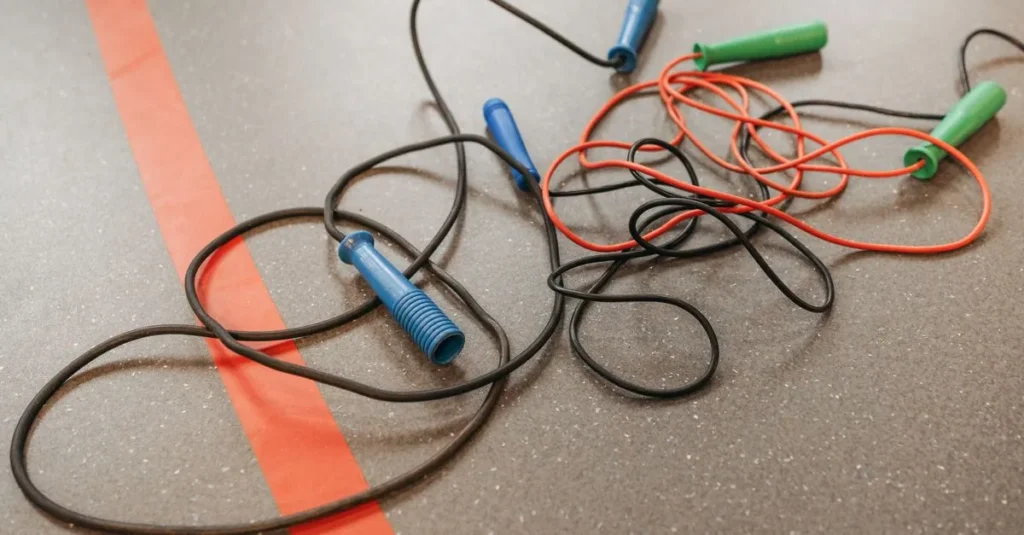
Using a skipping rope for weight loss is cheap, quick and fits in a corner of any Indian flat, but only if the basics are right. The wrong length, a heavy landing or an over-ambitious first week sends many beginners to the physiotherapist instead of the weighing scale. This guide covers what a rope can realistically burn, how to choose and size one, form fixes that protect your shins, a four-week plan, and the home-setup details most guides skip.
Does skipping rope work for weight loss?
Yes, as one part of a calorie deficit. Skipping burns roughly 10 to 12 kcal a minute for a 70 kg adult at a moderate pace, so a 20-minute interval session uses about 120 to 160 kcal. Fat loss still depends on eating a little less than you burn across the week, not on the rope alone.
The appeal of jump rope for weight loss is practical: it works calves, thighs, shoulders and core together and needs about two square metres of floor.
Now the honest arithmetic. One kilogram of body fat holds roughly 7,700 kcal. Four interval sessions a week add up to about 500 to 650 kcal, which is less than 0.1 kg of fat a week from the rope itself. A sensible overall pace for most adults is around 0.5 kg a week, and the rest of that gap comes from food, daily steps and strength work. An online nutritionist consultation is the fastest way to get a deficit that suits your body.
How many calories does a skipping rope burn?
A skipping rope burns about 8 to 10 kcal a minute at 55 kg, 10 to 12 kcal at 70 kg and 12 to 14 kcal at 85 kg, at a moderate pace. Those skipping rope calories assume continuous work. A beginner who rests half the time will land well below the hourly figures.
Heavier bodies burn more because they move more mass with every jump. Non-stop moderate skipping for an hour would burn roughly 600 to 720 kcal at 70 kg, but almost nobody manages that. A realistic beginner session of 30 seconds on and 30 seconds off for 20 minutes gives only 10 minutes of real skipping. Wrist trackers often misjudge skipping, so judge progress by waist measurement and how long you can skip without a break.
Which is the best skipping rope for weight loss?
For most beginners, a lightly weighted PVC or beaded rope is the best skipping rope for weight loss. It gives clear feedback on where the rope is, so you learn rhythm faster. Move to a thin speed cable rope once you can skip 60 seconds without tripping. Heavy ropes are an add-on, not a starting point.
| Rope type | How it feels | Best for | Watch out for |
|---|---|---|---|
| PVC (plastic) | Light, slightly springy | First 4 to 8 weeks, indoors or outdoors | Kinks if stored tightly coiled |
| Beaded | Medium, you feel each turn | Learning rhythm | Beads chip on rough terrace floors |
| Speed (thin cable) | Very light and fast | Fast intervals, double-unders later | Stings on contact, tangles easily |
| Weighted rope or handles | Noticeably heavier | Adding arm and shoulder work once form is steady | Arms tire before legs; wrist strain if started early |
| Cotton or cloth | Soft, slow | Very first practice sessions | Frays quickly on rough floors |
A weighted skipping rope looks like a shortcut, but the extra load mostly fatigues your shoulders, so you may skip fewer minutes overall. Whatever you pick, choose comfortable handles, check that the rope spins freely and make sure the length is adjustable.
What length skipping rope do you need?
Stand on the middle of the rope with one foot and pull both handles straight up. They should reach your armpits, or just below. As a starting guide, about 7 ft suits heights under 150 cm, 8 ft suits 150 to 165 cm, 9 ft suits 165 to 180 cm, and 9 to 10 ft suits taller people.
| Your height | Starting rope length (about) | Quick check |
|---|---|---|
| Under 150 cm | 7 ft (roughly 210 cm) | Handles at armpit level |
| 150 to 165 cm | 8 ft (roughly 245 cm) | Handles at armpit or 2 to 3 cm below |
| 165 to 180 cm | 9 ft (roughly 275 cm) | Handles at armpit or 2 to 3 cm below |
| Over 180 cm | 9 to 10 ft (roughly 275 to 305 cm) | Handles at armpit; trim only after test jumps |
The armpit test is the final judge, because arm length and shoe soles shift things by a few centimetres. A rope that is too long makes a wide, lazy loop that snags your feet. One that is too short forces higher jumps and hunched shoulders. Trim a little at a time and test after each change.
How to skip rope for beginners: a five-step walkthrough
To skip rope correctly, keep your elbows close to your ribs, turn the rope from your wrists, jump only 2 to 3 cm off the floor and land softly on the balls of your feet. Aim for roughly 100 to 120 skips a minute while breathing normally and keeping your chest tall.
- Set your posture. Stand tall, shoulders relaxed, core lightly braced. Look at a spot on the wall instead of your feet.
- Place your hands. Hold the handles near hip height, elbows tucked, hands about 15 to 20 cm out to the sides.
- Turn from the wrists. Make small circles. Big arm swings tire your shoulders long before your legs get a workout.
- Jump low. Clear the rope by 2 to 3 cm. Higher jumps cost energy and add impact without adding useful work.
- Land softly. Use the balls of your feet with a small knee bend. Landing flat or on your heels sends the shock into shins, knees and lower back.
Practise shadow skipping first: jump with your hands circling and no rope for 30 seconds. It builds rhythm and shows whether you are jumping too high.
Three skipping rope myths that slow progress
Myth: higher jumps burn more fat. They mostly wear out your calves and increase impact. A low, quick bounce is more efficient and far kinder to joints.
Myth: skipping melts thigh or belly fat. Your body decides where fat comes off, not the muscles you use. Skipping helps total fat loss alongside a calorie deficit, and thighs slim down as overall body fat drops. Our guide to thigh weight loss explains this further.
Myth: more skips is always better. Chasing 1,000 jumps in one go leads to tripping and sore shins. Count time and quality first. For the wider weekly structure, see our skipping for weight loss guide.
A 4-week skipping rope workout plan for beginners
Start every session with 3 to 5 minutes of warm-up (marching, ankle circles, easy calf raises) and finish with two minutes of calf stretching. If you are still sore from the last session, repeat the week.
| Week | Days | Skipping rope workout | Real skipping time |
|---|---|---|---|
| 1 | Mon, Wed, Fri | 10 rounds of 30 seconds skipping, 30 seconds rest. Basic bounce only. | About 5 minutes |
| 2 | Mon, Wed, Fri | 10 rounds of 40 seconds skipping, 20 seconds rest. Alternate-foot steps in the last 3 rounds. | About 7 minutes |
| 3 | Mon, Tue, Thu, Sat | 8 rounds of 60 seconds skipping, 30 seconds rest. Mix bounce and alternate-foot steps. | About 8 minutes |
| 4 | Mon, Tue, Thu, Sat | 10 rounds of 60 seconds skipping, 30 seconds rest. Add 5 high-knee rounds if comfortable. | About 10 minutes |
On the other days, walk briskly for 30 to 45 minutes or lift weights twice a week. A 1-on-1 personal training session can check your form on camera and build strength days around your skipping. A gentle yoga for weight loss routine suits rest days, and Zumba for weight loss is a fun alternate-day cardio option.
After week 4, change only one thing at a time: either add a minute per round or shorten the rest, never both. Shin splints and calf strains usually come from jumping from beginner to hard intervals in a week or two instead of taking three to four weeks per stage.
Troubleshooting: shin pain, sore calves, tripping and wrist ache
Shin pain. Usually too much, too soon, on a hard floor or in thin shoes. Halve your volume, switch to a mat and wear cushioned shoes. If the pain is sharp, sits on the bone or lasts beyond a week or two, stop and see a doctor or physiotherapist.
Constant tripping. Check rope length first, then jump height. Slow down, lower your hands to waist level and shorten the rope slightly.
Wrist or forearm ache. Loosen your grip, keep elbows tucked and avoid heavy handles until the motion feels automatic.
Skipping at home in India: marble floors, terraces and ceiling fans
Marble and vitrified tile have almost no give and are slippery in socks or worn soles. A thin exercise mat or a folded cotton dhurrie cushions your landing and stops your feet sliding. Wear closed training shoes with some cushioning, never bare feet or house slippers.
Ceiling fans are the hidden hazard. Switch the fan off and make sure your rope’s arc clears it with room to spare. If your ceiling is low, skip near an open area or outdoors.
Terraces give more headroom, but walk the surface first. Look for cracks, drainage slopes, loose gravel and, in monsoon, moss or wet patches. Keep away from the parapet edge. Early morning and after sunset are the practical windows, because exposed tiles heat up quickly and midday sun raises the risk of dehydration. Drink water before and after, and a glass of nimbu pani with a pinch of salt afterwards is a reasonable choice in hot weather. In an apartment, a mat over a rug cuts the thud for neighbours below.
Who should go easy on skipping rope?
People with knee, ankle, shin or lower-back pain, a recent injury, pregnancy or a lot of extra body weight should talk to a doctor before skipping. The safer version is low-impact: brisk walking, cycling, swimming or gentle yoga, with shadow skipping to practise rhythm.
Get a medical check before interval work if you have a heart condition or high blood pressure, and stop at once if you feel chest pain, dizziness or unusual breathlessness.
Food still decides most of the result
One samosa and a sweet chai can cancel a 20-minute session. Build each meal around protein such as dal, paneer, eggs, curd or chicken, add vegetables, and keep rice and roti portions steady rather than cutting them to zero. Eat a light snack like a banana or a small bowl of poha 45 to 60 minutes before skipping, and avoid skipping within two hours of a heavy meal. An online weight loss trainer can combine your diet, steps and skipping into one weekly structure.
Frequently asked questions
How many minutes of skipping rope a day to lose weight?
Beginners can start with 5 to 10 minutes of real skipping time inside a 20-minute interval session, three days a week. Over four to eight weeks, build towards 10 to 15 minutes, four to five days a week, with rest days between harder sessions. Pair it with a modest calorie deficit.
Is a weighted skipping rope better for weight loss?
Not for beginners. A weighted rope adds shoulder and forearm work, but it tires your arms before your legs and can strain wrists while your form is still developing. A standard PVC or beaded rope lets you skip longer with better technique, which usually burns more in total.
Can I use a skipping rope every day?
Most beginners do better with three to four days a week, because calves, shins and ankles need time to adapt to impact. Once you are fit, short daily sessions of 5 to 10 minutes can work, provided nothing hurts and you vary the intensity.
Does skipping rope reduce belly fat?
Only as part of overall fat loss. You cannot burn fat from one body part by exercising it. Skipping three to four times a week, eating in a modest calorie deficit, sleeping well and adding strength training gradually reduces waist size for most people.
Is skipping rope better than running for weight loss?
Per minute, moderate skipping burns roughly as many calories as a steady jog at about 8 to 10 km/h, and it needs less space. It is harder on calves and ankles, so beginners often cannot sustain it as long. The better choice is the one you can repeat safely.
Get a skipping plan that fits your body
If you want rope sessions, meals and rest days planned around your height, weight and schedule, book an online weight loss coaching plan with a Fitstrot trainer.


