

Working out with sore muscles is fine most of the time. The dull, stiff ache you feel a day or two after a hard session is delayed onset muscle soreness (DOMS), and mild to moderate DOMS is not a reason to skip the gym or your living-room workout. What matters is the type of soreness. Sharp, joint-centred or swelling pain means stop. This guide shows you how to tell the difference, what to train on sore days, and how to recover faster.
Is it okay to train when your muscles are sore?
Yes, if the soreness is a mild or moderate dull ache in the belly of the muscle and you still have full range of movement. Train a different muscle group, or do the sore one at about 50 to 70 percent of your usual load. Avoid training through sharp, joint or swelling pain.
Soreness after exercise is mostly caused by unfamiliar effort, especially the lowering phase of a movement, such as coming down into a squat or lowering a dumbbell in a curl. Tiny strains in the muscle fibres trigger repair, and that repair is part of how you get stronger. DOMS usually starts 12 to 24 hours after training, peaks around 24 to 72 hours, and fades within roughly 3 to 5 days.
Light movement tends to make a sore muscle feel better, not worse. The first few minutes of a warm-up may feel stiff, then the ache eases as blood flow rises. A proper warm-up before your workout is the simplest way to find out which case you are in.
Soreness scale: train, modify or rest
Use this table as a quick filter before every session. If you land between two rows, pick the gentler one. Losing one hard session costs you very little. Turning a strain into an injury can cost you weeks.
| Soreness level | What it feels like | Train it? | What to do today |
|---|---|---|---|
| Mild | Dull ache you notice mainly when you press or stretch the muscle | Yes | Warm up for 8 to 10 minutes and train as planned |
| Moderate | Stiff on stairs or getting up from a chair, but full range of motion | Yes, with changes | Cut weight by 20 to 30 percent, or train a different muscle group |
| Severe | Hard to straighten or bend the limb, ache even at rest, tender to light touch | Not that muscle | Easy walk, light mobility work, or rest day |
| Sharp or joint pain | Stabbing, pinching, clicking with pain, swelling, or one-sided pain around a joint | No | Stop, rest the area, and get it checked if it lasts more than a few days |
How can you tell soreness from an injury?
Soreness is widespread, dull, appears hours after training, and improves with gentle movement. An injury is usually sharp, local, starts during the exercise, and worsens with movement. Swelling, bruising, a pop at the moment of effort, or pain on one side only point towards injury, not DOMS.
Use these checks when you are unsure:
- Timing. Soreness arrives the next day. Injury pain often begins mid-set.
- Location. Soreness sits in the muscle belly. Injury pain often sits near a joint, tendon or the exact spot where you felt a twinge.
- Trend. Soreness improves by day 3 to 5. Pain that stays the same or worsens after a week is not DOMS.
When to see a doctor
See a doctor or physiotherapist if you have swelling or bruising, pain that wakes you at night, numbness or tingling, pain that is not clearly better after a week, or a joint that feels unstable. Seek medical care the same day if extreme muscle pain and swelling after a very hard session come with unusually dark urine, because that can signal serious muscle breakdown. If you have a medical condition, are pregnant, or are recovering from surgery, ask your doctor what level of exercise is safe for you before you train through any discomfort.
Myth check: three things people get wrong about sore muscles
Myth 1: No soreness means a wasted workout. Soreness is a poor scoreboard. Experienced lifters often get little DOMS and still progress. Judge a programme by whether your weights, reps or stamina improve over weeks, not by how much you ache.
Myth 2: Lactic acid is why you are sore two days later. Lactate clears from your muscles within an hour or so of exercise, long before DOMS shows up. The next-day ache comes from the muscle-repair process, not from leftover acid.
Myth 3: You must rest until the soreness is completely gone. Waiting for zero soreness is how people stop training for weeks, then get sore all over again when they return. The better rule is to rest the sore muscle and keep the rest of your body moving.
What can you train when one muscle group is sore?
Train the muscles that are not sore. After a heavy leg day, work upper body, core or easy cardio. After a hard back and biceps day, do legs or a brisk walk. Spread the same muscle group across at least 48 hours between hard sessions, so each one gets time to recover.
This is why split routines work so well for consistency. You keep the habit alive and give each area its recovery window. Our workout plan guide shows how to spread muscle groups through the week.
| If this is sore | Good choices today | Skip or go lighter |
|---|---|---|
| Quads and glutes (after squats, lunges) | Upper body, planks, 20 to 30 minutes of easy walking | Heavy squats, jump squats, long runs |
| Hamstrings (after deadlifts, RDLs) | Chest, shoulders, arms, easy cycling | Deadlifts, sprints, deep stretching |
| Chest, shoulders and triceps | Legs, back, core, brisk walk | Push-ups, bench press, overhead press |
| Back and biceps | Legs, core, light mobility, yoga flow | Rows, pull-ups, heavy curls |
| Full-body soreness (new programme) | 20 to 40 minutes of walking, mobility, gentle yoga | Any heavy or high-intensity session |
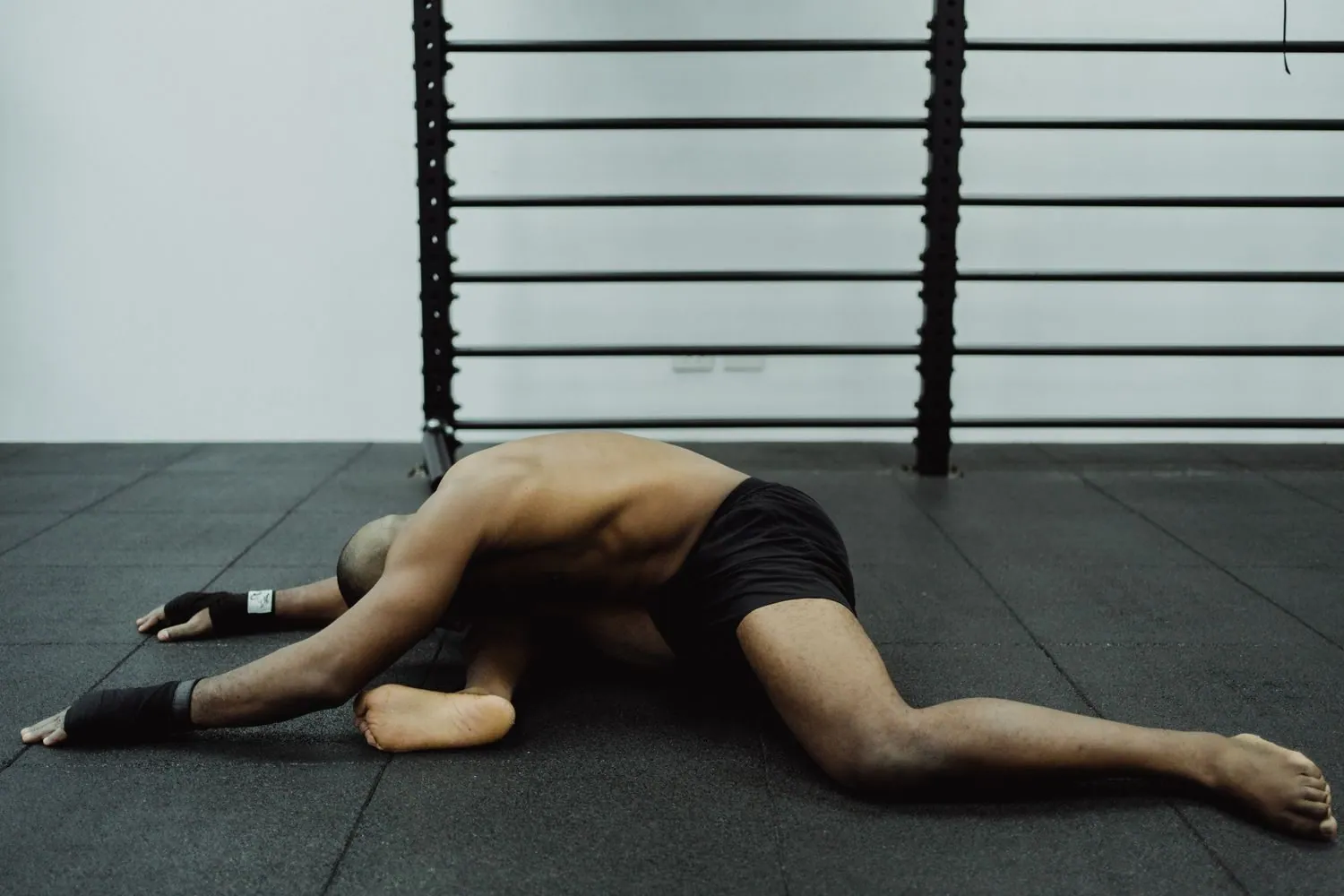
How to ease sore muscles faster: a five-step walkthrough
Nothing removes soreness instantly, but a few basics shorten it. Move gently, drink enough water, sleep 7 to 9 hours, eat protein through the day, and stretch lightly. Together these can take the edge off within a day or two and help you keep training consistently.
- Move lightly for 10 to 20 minutes. A walk, easy cycling or a mobility circuit raises blood flow to the sore area. Keep the effort conversational.
- Drink water through the day. Most adults do well with about 2.5 to 3 litres a day, more in a hot Indian summer or after a sweaty session. Pale yellow urine is a simple guide.
- Protect your sleep. Muscle repair happens largely while you sleep. Aim for 7 to 9 hours, and keep a regular bedtime.
- Eat enough protein. Active adults usually do well with roughly 1.2 to 1.6 grams of protein per kg of body weight daily, spread over 3 to 4 meals. For a 65 kg person that is about 80 to 105 grams.
- Stretch gently, do not force it. Easy stretching can make the muscle feel looser, but it will not erase DOMS. Our guides to stretching after a workout and cool-down stretches give you routines to follow.
Foods matter less than total protein and calories, so use what you already eat. The table below shows about how much protein common Indian foods give, so you can build up to your daily target without relying only on powders. Wondering about powders? See whether you can take whey protein without a workout.
| Food | Typical serving | Protein (about) |
|---|---|---|
| Egg | 1 whole egg | 6 g |
| Paneer | 100 g | 18 g |
| Dahi (curd) | 1 bowl, 150 g | 5 to 6 g |
| Milk | 1 glass, 250 ml | 8 g |
| Cooked dal | 1 katori, 150 g | 6 to 8 g |
| Soya chunks (dry) | 50 g | about 26 g |
| Chicken breast (cooked) | 100 g | about 30 g |
| Roasted chana | 30 g, a small handful | about 6 g |
A day with 2 eggs, a glass of milk, a katori of dal at lunch and dinner, a bowl of curd and 100 g of paneer or chicken already lands you at roughly 60 to 70 grams. Add soya chunks or a second serving of paneer or chicken and you reach your target.
What does a sensible week around soreness look like?
A sensible week gives each major muscle group a hard session once or twice, with at least 48 hours between them, and uses lighter days for walking, mobility or yoga. Four strength days plus two active-recovery days works well for most beginners and intermediates.
Here is a simple example you can adapt:
- Monday: lower body strength (squats, lunges, glute bridges)
- Tuesday: upper body push and pull, plus core
- Wednesday: active recovery, a 30-minute walk or gentle yoga
- Thursday: lower body, lighter and focused on form
- Friday: upper body, plus a short cardio finisher
- Saturday and Sunday: one easy session such as dance or a brisk walk, and one full rest day
If Thursday arrives and your legs are still severely sore, swap in upper body and push leg day to Friday. A plan should bend to your body.
Who needs to be extra careful with sore muscles?
Beginners. Your first 2 to 3 weeks are the soreness peak. Start with 2 to 3 sets per exercise, stop 2 to 3 reps short of failure, and avoid doing everything in one day.
People returning after a break. Start at about half your old weights.
Women during periods. Tiredness and cramps can make soreness feel stronger. Light training is usually fine if you feel up to it. Our guide on whether you should workout during periods covers this in detail.
Anyone with a medical condition. If you have heart, kidney, blood pressure, diabetes or joint conditions, or you take regular medication, talk to your doctor before increasing exercise intensity. Do not change any medication because of soreness or exercise.
People training in heat. In peak Indian summer, dehydration can make cramps and stiffness feel worse. Train in the cooler hours, and drink water before, during and after.
Not sure how hard to push? A coach can read your history and set the load for you. Our 1-on-1 personal training sessions adjust your plan each week based on how your body is responding. An online nutritionist consultation can help you set protein and meal timing that suit your routine.
Frequently asked questions
Should I workout with sore muscles?
Yes, if the soreness is mild or moderate and you still move freely. Train a different muscle group or lower the load on the sore one. Do not train through sharp, joint or swelling pain, or soreness so severe that you cannot move the limb normally. When unsure, choose a light walk or mobility session.
How long does muscle soreness last?
DOMS typically starts 12 to 24 hours after training, peaks at 24 to 72 hours, and fades within about 3 to 5 days. New exercises or a big jump in volume can last a little longer. If strong pain continues beyond a week, or comes with swelling, get it checked.
Is it better to rest or exercise when sore?
For mild to moderate soreness, light activity is usually better than complete rest because it keeps blood flowing and you stay in routine. Rest the sore muscle for 48 hours or until it feels normal, and train other areas. Take a full rest day when soreness is severe or you are exhausted.
Does soreness mean my workout was effective?
Not necessarily. Soreness shows you did something your muscles were not used to, but it is not a reliable measure of progress. Better signs are lifting a little more weight, doing extra reps, recovering faster between sets, and feeling stronger over several weeks.
Can I do cardio or yoga with sore muscles?
Yes, easy cardio and gentle yoga are good options for mild to moderate soreness. Keep the effort comfortable, such as a 20 to 30 minute brisk walk, and avoid deep or forced stretches into painful muscles. Skip high-impact work like jumping or sprinting if your legs are very sore.
Soreness is information, not an order to stop. If you would like a plan that adjusts to how your body feels each week, book a 1-on-1 personal training session with Fitstrot and get a schedule built around your recovery, not against it.


