
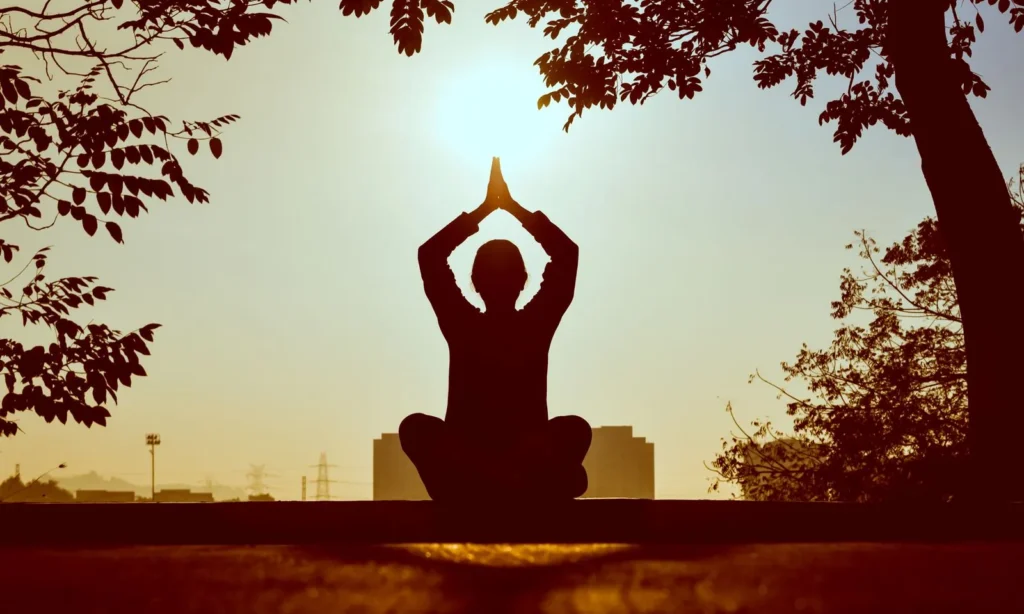
Samadhi is the eighth and final limb of yoga in Patanjali’s Yoga Sutras: a state of complete absorption in which the meditator, the act of meditating and the object of meditation stop feeling like three separate things. It is not a posture or a technique you perform. Texts describe samadhi as something that arises when attention becomes steady enough, which is why it is better understood as a direction of practice than a goal for next week.
This guide explains what samadhi means, how the tradition describes its stages, how the word is used in other contexts, and how an ordinary daily meditation practice relates to it. We are a fitness and yoga platform, not a spiritual authority, so we stay with what the classical texts say and are plain about what nobody can promise.
What is samadhi in yoga?
Samadhi is a state of deep, undivided absorption, built from Sanskrit roots meaning “together” and “to place or hold”. Yoga Sutra 3.3 describes it as the state in which only the object of meditation shines, as though the mind had lost its own form. In practice, it is the far end of concentration, not a mood.
Patanjali defines yoga itself in the second sutra as the stilling of the movements of the mind. Samadhi is where that stilling becomes complete and stable. Our guide to chitta vritti explains those movements of the mind in detail, and it is worth reading first if the term is new.
Many people have touched a faint echo of absorption without any yoga training: lost in music, a long walk or a task where hours vanished. That is a useful comparison but not the same thing. Classical samadhi is described as deliberate, stable and repeatable, built over years, not an accident of mood.
How is samadhi different from dharana and dhyana?
Dharana is effort to hold attention on one object, dhyana is attention flowing toward it without breaks, and samadhi is absorption so complete that the sense of “I am meditating” fades. The three are described as one continuous deepening, not separate exercises. You can train dharana directly; dhyana and samadhi are said to follow.
| Feature | Dharana (concentration) | Dhyana (meditation) | Samadhi (absorption) |
|---|---|---|---|
| Effort | Active; you keep bringing attention back | Little effort; attention stays | Effortless; no one “doing” it |
| Sense of “I” | Strong: “I am focusing” | Softer, still present | Described as dissolved or transparent |
| Object of focus | Clearly separate: breath, flame, mantra | Continuous contact with the object | Only the object, or awareness itself, remains |
| Can you train it directly? | Yes, in minutes a day | Partly, by deepening dharana | No; it is said to arise, not be forced |
| Realistic for beginners? | Yes | Brief glimpses at best | Not an expectation |
What are the stages of samadhi?
In the Yoga Sutras, samadhi unfolds in stages. With an object, it moves from gross to subtle: savitarka and nirvitarka (gross objects), then savichara and nirvichara (subtle objects). Beyond them lie states with only bliss or the sense of “I am”, and finally a seedless samadhi where no object remains.
| Stage (Sanskrit) | Object of attention | How tradition describes it |
|---|---|---|
| Savitarka | A gross object such as a form or deity image | Absorption still mixed with words, meaning and thought about the object |
| Nirvitarka | The same gross object | Words and associations drop away; only the object appears |
| Savichara | A subtle object, such as a feeling or principle | Absorption with subtle reflection |
| Nirvichara | The same subtle object | Reflection settles; clarity and calm are said to deepen |
| Ananda and asmita | Bliss, then the bare sense of “I am” | Subtler states that still involve some content |
| Asamprajnata (seedless) | None | Even the impressions that would restart mental activity are said to be quieted |
Sutras 1.42 to 1.44 name the first four of these, and the lists of samprajnata (with an object) and asamprajnata (without one) appear in sutras 1.17 and 1.18. Commentators and lineages vary in how they read these stages, so treat the table as a map of the general shape, not a checklist you can tick off.
You will also see “savikalpa” and “nirvikalpa” samadhi online. Those terms come mainly from Advaita Vedanta commentary, not from Patanjali’s text. Roughly, savikalpa means absorption with a trace of the observer left, and nirvikalpa means absorption with no such division. Both are sometimes used loosely alongside Patanjali’s terms.
What does samadhi mean in other traditions and everyday Indian usage?
The word travels widely. In Hindu philosophy it means absorption; in Buddhism, it usually means concentration; and in everyday Indian usage, a “samadhi” is often a memorial shrine over a saint’s resting place. The same word can therefore describe a meditation state, a skill or a place, so context decides the meaning.
| Term | Where you meet it | What it usually means |
|---|---|---|
| Samadhi (yoga) | Yoga Sutras | Eighth limb; absorption leading toward liberation (kaivalya) |
| Samadhi (Buddhism) | Buddhist teaching on concentration | One of the three trainings (ethics, concentration, wisdom); steady meditative focus |
| Sahaja samadhi | Several Indian traditions | A natural, effortless state said to continue in ordinary life |
| Mahasamadhi | Indian spiritual communities | A realised teacher’s final departure from the body; in everyday use, a revered teacher’s passing |
| Samadhi (shrine) | Everyday Indian speech | A memorial or shrine built at a saint’s resting place |
Courses with “samadhi” in their name also exist. Two examples are Siddha Samadhi Yoga and Sahaj Samadhi Meditation, and they are separate programmes with different methods. Before enrolling in any of them, ask what exactly is taught and who teaches it, and be wary of anyone who sells a guaranteed experience.
What does samadhi feel like, and how do you know it is real?
Descriptions repeat a few themes: dissolving separation between you and the object, much less mental noise, a sense of timelessness and quiet contentment that does not depend on circumstances. But these are reports, not tests. Nobody outside can verify them, and plain relaxation or sleepiness is easy to mistake for something deeper.
Classical teachers are cautious on this point. They advise against striving for a particular experience, since the striving itself is agitation, and the sutras treat unusual experiences on the path as distractions, not proof of progress. A useful practical measure is not what you felt in meditation but how you behave afterwards: whether you are steadier, kinder and less reactive in ordinary life.
The Bhagavad Gita describes the same inner steadiness in the person of steady wisdom, who stays level through pleasure and pain. Our article on the Bhagavad Gita and yoga explores that ideal, and it is a more reachable everyday target than a formal samadhi.
Which myths about samadhi should you drop?
Most confusion comes from five myths: that samadhi is a trance or unconsciousness, that a weekend course can deliver it, that it can be bought, that feeling very relaxed means you have reached it, and that you need it to benefit from yoga. None of them matches how the classical texts describe the path.
- “It is a trance or blackout.” The texts describe heightened, not reduced, awareness.
- “A retreat or course will give it to me.” Teaching can guide you, but traditional accounts describe years of steady practice.
- “A bigger fee means a deeper state.” Price says nothing about the quality of instruction or about your experience.
- “A calm session means samadhi.” Calm is valuable, but it is not the same as the stages above.
- “Without it, yoga is incomplete.” Better sleep, calmer reactions and steadier attention are worthwhile in their own right.
How does a daily meditation practice relate to samadhi?
A daily practice builds the conditions the tradition associates with samadhi: a steady seat, quieter breathing and the ability to hold attention on one object. Start with 10 minutes a day: 2 minutes settling, 6 minutes on the breath at the nostrils, 2 minutes sitting quietly. Expect restlessness for weeks. That is normal training, not failure.
- Weeks 1 to 4: Aim for consistency. Notice how often the mind wanders and return gently. A count of breaths from 1 to 10 helps.
- Weeks 5 to 12: Stretch to 15 or 20 minutes if it feels natural. Spend a little less effort and a little more ease.
- Beyond three months: Moments of unbroken attention may become longer. Do not chase them; keep the routine the same.
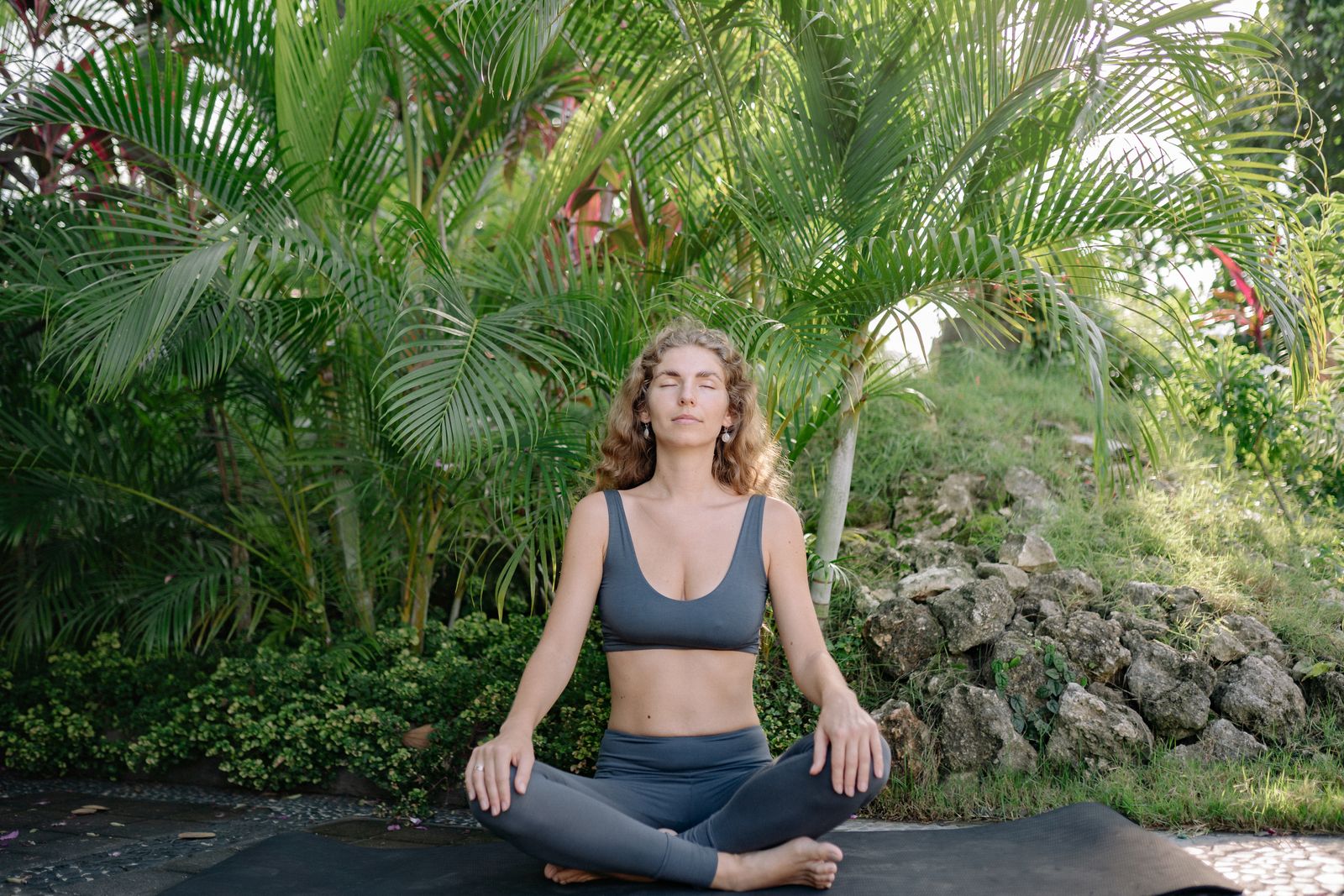
The body matters too, because an aching hip ends a sit early. A gentler style such as hatha yoga or restorative yoga prepares the hips, spine and breath for sitting. Reading about the kleshas (ignorance, ego, attachment, aversion and fear of loss) and the gunas in yoga also helps explain why the mind is restless on some days and sleepy on others.
Why does meditation feel stuck, restless or sleepy?
Usually the cause is ordinary: too long a session, a poor seat, a full stomach, a tired body or too much effort. Shorten the sit, raise your hips on a cushion, meditate before dinner or in the morning, and ease your grip on the object. Sleepiness often means you need rest, not more discipline.
- Mind racing: Count breaths, or breathe out for a little longer than you breathe in for a minute before starting.
- Falling asleep: Sit upright, open your eyes slightly or move your session earlier in the day.
- Body discomfort: Sit on a chair or against a wall. Comfort is not cheating.
- Boredom or doubt: Keep sessions short but regular, and avoid comparing yourself with accounts of dramatic experiences.
Meditation is not right for everyone at every moment. If it brings on strong anxiety, intrusive memories, a feeling of being detached from yourself or a low mood that lingers, pause and talk to a doctor or a mental health professional. A trained teacher can adjust the practice, and online sessions such as our online yoga classes can supply a gentler structure.
Frequently asked questions about samadhi
Is samadhi the same as enlightenment?
Not exactly. In Patanjali’s system, samadhi is the means that leads toward kaivalya, or liberation. Some traditions use the two words almost interchangeably, while others treat samadhi as a state that must be stabilised before lasting liberation. The usage differs by lineage.
How long does it take to reach samadhi?
The texts give no fixed timeline. Traditional accounts describe years of steady practice across all the limbs, not weeks. A sensible expectation is to judge progress by steadier attention and calmer reactions in daily life, not by reaching a named state.
Can beginners experience samadhi?
Beginners can have brief moments of deep absorption, but these are generally distinguished from the stable, cultivated samadhi in the texts. Treat any such moment as a pleasant side effect, not a goal, and keep your practice simple and regular.
What is the difference between savikalpa and nirvikalpa samadhi?
Savikalpa samadhi is absorption in which a trace of the observer or distinction remains, while nirvikalpa samadhi has no such distinction. These terms come mostly from Advaita Vedanta, whereas Patanjali uses samprajnata and asamprajnata for a similar contrast.
What does mahasamadhi mean?
Mahasamadhi refers, in Indian spiritual communities, to a realised teacher’s final, conscious departure from the body. In everyday speech it is also used respectfully for the passing of a revered teacher, and the place of rest may be called a samadhi shrine.
Where to go from here
You do not need to reach samadhi to gain from the path toward it. Begin with a 10-minute daily sit and two or three gentle yoga sessions a week, then join a live class where a teacher can correct your seat and breathing. Explore FitStrot’s online yoga classes to start.


