
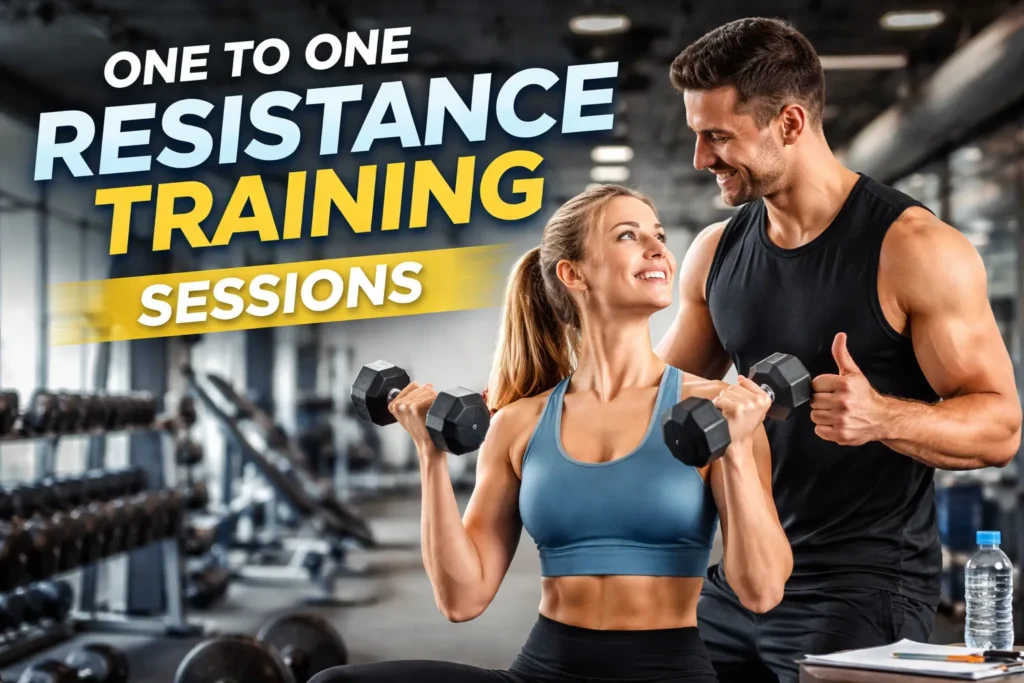
One to one resistance training sessions put a coach’s full attention on your lifting, your joints and your goals for 45 to 60 minutes at a time. Online, that happens over live video from your living room, with dumbbells, bands or just bodyweight. This guide shows what a session looks like minute by minute, how form is coached through a screen, and what a realistic 12-week progression looks like, so you know what to expect before you book.
What are one to one resistance training sessions?
One to one resistance training sessions are private strength workouts where a single coach designs and supervises everything you do: exercise choice, load, reps, rest and technique. Using dumbbells, bands, kettlebells or bodyweight, a typical session lasts 45 to 60 minutes and is adjusted live to how you move and feel that day.
The key word is “one to one”. In a group class the instructor teaches the room. Here the plan is built around your starting point, your schedule and any niggles you have, and it changes as you get stronger. If you are curious about the wider service, see our 1-1 personal training page.
Inside a 60-minute session: the structure
Most well-run sessions follow the same arc. The minutes below are a guide, not a rule, and a 45-minute session simply trims the accessory work.
| Segment | Time | What happens | What your coach watches |
|---|---|---|---|
| Check-in | 3 to 5 min | Sleep, soreness, energy, any pain since last time | Whether to push, hold or reduce today’s load |
| Warm-up | 8 to 10 min | Light cardio, joint circles, activation with a band | Range of motion, stiff hips or shoulders |
| Main lifts | 20 to 25 min | 2 to 3 compound moves, such as squat, push and row | Bar path, depth, back position, tempo |
| Accessory work | 10 to 15 min | Single-joint or core moves, such as curls, lateral raises and planks | Control, not momentum |
| Cool-down | 5 min | Easy stretching and slow breathing | Heart rate settling, notes for next session |
Compound lifts come first because that is when you are freshest and form matters most. Rest between sets is usually 60 to 90 seconds for moderate work and 2 to 3 minutes for heavy sets, so a session feels active without being a rushed circuit.
How form coaching works over live video
Good online coaching is mostly about setup. These steps make a screen nearly as useful as being in the room.
- Place the camera side-on at hip height. A side view shows back angle, squat depth and hip hinge, which a front view hides.
- Clear 2 metres of floor. You need room to step back and move freely.
- Start with light loads. The first week is for learning positions, with weights you could lift 3 to 4 more times.
- Expect one cue at a time. A good coach corrects the biggest fault first, not ten at once.
- Film a set if asked. A short clip lets the coach review at slow speed and send notes before the next session.
Plan on a few sessions before the coach can trust what they see, and do not be surprised if early sessions feel more like teaching than training. That is the part that lowers injury risk later.
Form cues for common lifts
Here are the coaching points that come up most often. Your coach may use different wording, but the principles are standard.
| Movement | Key cue | Common fault | Simple fix |
|---|---|---|---|
| Bodyweight or goblet squat | Knees track over toes, chest tall | Heels lifting, knees collapsing in | Widen stance slightly, push the floor apart |
| Hip hinge or Romanian deadlift | Push hips back, soft knees, flat back | Rounding the lower back | Reduce the range and keep the weight close to your legs |
| Push-up (incline if needed) | Body in one line, elbows about 45 degrees | Sagging hips, flared elbows | Raise your hands on a table or sofa arm |
| Dumbbell row | Pull the elbow to the hip, shoulder down | Twisting and shrugging | Support one hand on a chair and lighten the load |
| Overhead press | Ribs down, glutes tight, press slightly back | Arching the lower back | Press from a seated position with back support |
A 12-week progression: how it can look
Progression means gradually asking your body to do slightly more, through added reps, load, sets or better control. A typical beginner path might run like this. Treat the numbers as a template, since your coach will change them based on how you recover.
| Weeks | Sets x reps | Rest | Load and effort | Main focus |
|---|---|---|---|---|
| 1 to 2 | 2 x 12 to 15 | 60 to 90 sec | Light, 3 to 4 reps left in reserve | Learning movement patterns |
| 3 to 6 | 3 x 10 to 12 | 60 to 90 sec | Add weight once you hit the top of the rep range on all sets | Building a base, steady tempo |
| 7 to 10 | 3 to 4 x 8 to 10 | 90 sec to 2 min | Moderately heavy, 1 to 2 reps left | Strength and muscle growth |
| 11 to 12 | Easy week, then retest | As needed | About 60 to 70 percent of normal volume | Recovery, review and a new plan |
This is called double progression: stay in a rep range, and once you can complete every set at the top of it with good form, increase the weight slightly and start again at the bottom. Progress will be uneven, and one slow week is normal.
Before your first session: a short checklist
- Tell the coach everything relevant. Old injuries, surgeries, pain, medication and conditions such as high blood pressure all affect exercise choice. If in doubt, ask your doctor first.
- Test your space and connection. Check lighting, camera angle and Wi-Fi ten minutes early so no session time is lost.
- Eat lightly 1 to 2 hours before. A banana, a small bowl of poha or curd with fruit works well; avoid a heavy meal right before lifting.
- Note a few baselines. Write down your weight, a waist measurement, how many bodyweight squats or incline push-ups you can do with good form, and how you feel.
- Set one clear goal for 12 weeks. For example, “do 10 full push-ups” or “carry grocery bags without back strain”. Specific goals are easier to coach than “get fit”.
How progress is tracked between sessions
A coach will usually keep a simple log of exercises, loads, reps and how hard each set felt on a scale of 1 to 10. Every 4 weeks, you repeat the baselines from your first week. Strength numbers tend to improve before the scale or the mirror changes, so a rising log is a better early signal than weight alone. If numbers drop for two sessions in a row, your coach may reduce volume, adjust rest days or look at sleep and food instead of simply pushing harder.
Myth check: five things people believe about strength training
- “Lifting will make me bulky.” Building large muscle takes years of heavy training and plenty of food. Most people, women especially, get firmer and stronger, not bulky.
- “I need heavy weights.” Not at the start. Bands, bottles filled with sand or light dumbbells work when the effort is right.
- “More sessions mean faster results.” Muscle adapts during recovery. Two to four sessions a week suits most beginners.
- “Soreness means a good session.” Some soreness is normal early on, but it is not a score. Sharp or joint pain is a signal to stop and tell your coach.
- “Spot-reducing works.” Doing ab or arm work does not burn fat from that area. Overall fat loss comes from diet, activity and time.
Troubleshooting: when progress stalls or something hurts
- Weights feel the same for 3 or more weeks. Check sleep and protein first, then ask your coach to change the rep range or tempo.
- Knee pain on squats. Reduce depth, check your foot angle and use a box to sit back to. Persistent pain needs a doctor’s opinion.
- Lower back tightness on hinges. Usually a form or range issue. Shorten the range and slow down rather than pushing through.
- Wrist discomfort in push-ups. Use dumbbell handles or knuckle-neutral grips and keep the elbows closer.
- You keep missing sessions. Shorten sessions to 30 to 40 minutes. A short session you attend beats a perfect one you skip.
For fuel, many strength trainees aim for roughly 1.2 to 1.6 g of protein per kg of body weight daily from dal, curd, paneer, eggs, chicken or fish, ideally split across meals. For help with that, you can talk to an online nutritionist.
What you need at home
You can start with very little. A pair of light dumbbells or a set of loop bands, a mat, a sturdy chair and a clear patch of floor is enough for the first 6 to 8 weeks. Add heavier dumbbells or an adjustable pair as you outgrow the first set. Wear flat shoes or go barefoot for stable footing, and keep water nearby. Tell your coach about the gear you actually have so they can write the plan around it.
Who gets the most out of one to one sessions?
Beginners get safe technique from day one. Busy professionals get a fixed, efficient 45 minutes without commuting. People returning after a break or injury get gradual loading, though anyone with a medical condition, pain or recent surgery should check with their doctor first. Teenagers need supervised, age-appropriate plans; see our guide to 1-on-1 training for teens. Weight-loss clients benefit because muscle helps preserve strength while eating less, and our online weight loss trainer pairs strength work with food guidance.
Is one to one training worth it compared with group classes?
One to one training is worth it if you want custom programming, form correction and accountability, and group classes are better if you want a low cost and a social energy. Private sessions usually cost more per hour, so many people mix both, using private coaching for strength and group classes for variety.
If you already enjoy dance fitness, strength work complements it well; read Zumba and strength training and Zumba for cross-training for ideas on balancing them. To compare coaching styles, see our personalized 1-on-1 training program guide.
Frequently asked questions about one to one resistance training sessions
Are one to one resistance training sessions suitable for beginners?
Yes. Beginners often benefit most, because a coach teaches positions with light loads and corrects small faults early. Expect the first two weeks to focus on technique, with simple movements and low volume.
How many sessions a week do I need?
Two to three sessions a week is a good range for most beginners, with at least one rest day between hard sessions. Some people do one coached session and one self-led workout per week to manage cost.
Can I do resistance training at home without gym equipment?
Yes. Bodyweight moves, resistance bands and a pair of dumbbells cover all major muscle groups. Your coach can adapt each exercise to your available equipment and space.
How long before I notice results?
Many people feel stronger and more confident within 3 to 4 weeks, while visible changes in shape usually take around 8 to 12 weeks. Results depend on consistency, food, sleep and your starting point, so there are no guarantees.
Is online one to one training as effective as in-person?
It can be, when the setup is good. A side-on camera, clear verbal cues and recorded clips let a coach check form closely. Heavy barbell lifting is harder to supervise remotely, which is why home programs lean on dumbbells, bands and bodyweight.
Book a first session
If you want a coach to build your first four weeks, start with Fitstrot’s 1-1 personal training and tell us your equipment, schedule and any injuries.


