
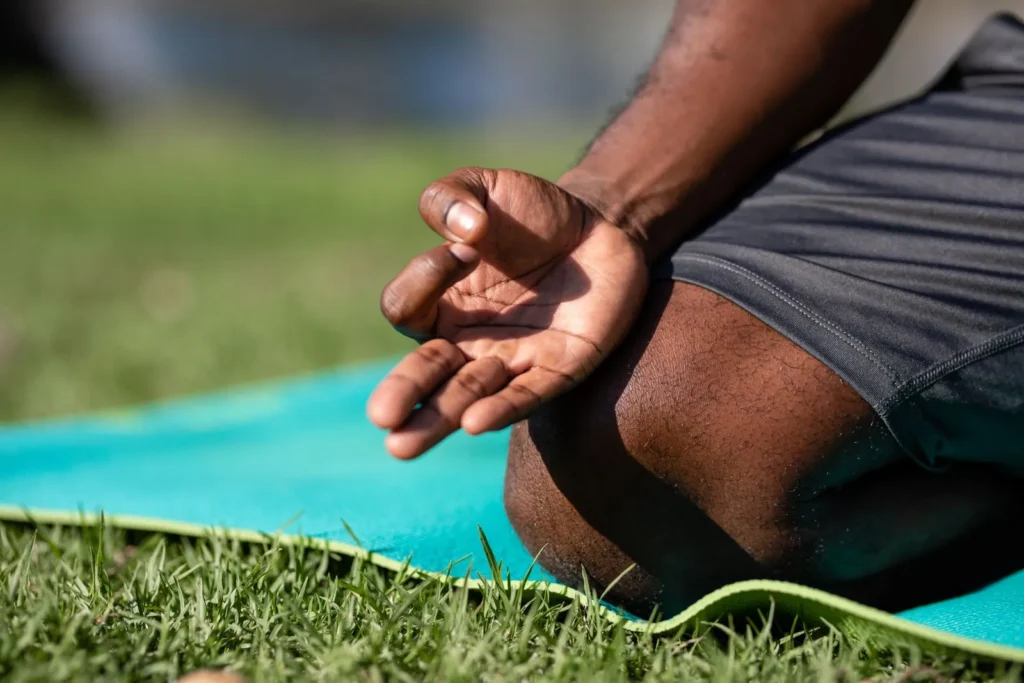
Practising mindfulness and zumba together works better than most people expect, because Zumba already hands you a loud, steady anchor: the beat. Mindfulness is simply the habit of noticing what is happening while you move, such as the floor under your feet, the count in the music and the breath in your chest. You do not need to slow down, close your eyes or sit still. You only need to point your attention at the dance instead of at your inbox.
Below you get five things to notice, a phase-by-phase way to use them, a simple breathing pattern and fixes for a wandering mind, written for online classes at home.

What does mindfulness and zumba mean in a real class?
Mindfulness and Zumba together means keeping your attention on the class itself: the beat, your footing, your breath and the instructor’s cues. You still dance at full energy. Only the location of your attention changes, which turns the session into a form of moving meditation instead of a workout you endure while thinking about something else.
Picture two people in the same class, with the same song and the same steps. One is replaying a morning meeting while their feet follow the instructor. The other notices the heel landing, the hip stretching and the shoulders creeping up towards the ears. Both are dancing. Only the second is practising mindful dancing, which you may also see called mindful movement or mindful exercise.
Signs of autopilot: you finish a song and cannot recall it, you check the clock constantly, or you only discover a clenched jaw when class ends. That is not failure, just the cue to return to one anchor.
Zumba suits this practice for three reasons. The music gives you an outside rhythm to come back to. The choreography repeats in short phrases, so you can notice the same move several times in a row. And the instructor’s verbal cues about footing, posture and count work as built-in attention prompts. In Fitstrot’s online classes, taught by Yash Pathak, our lead Zumba trainer (ZIN Licensed, ACE Certified, Strong Nation Certified), treat a cue such as “soft knees” or “tall chest” as an invitation to check in, not as background chatter.
Five attention anchors you can use in any Zumba class
An anchor is one thing you can return to whenever your mind drifts. Choose one per song; tracking all five at once is just another distraction.
| Anchor | What to notice | Cue to repeat silently | Best moment to use it |
|---|---|---|---|
| Feet | Pressure moving from heel to ball of foot, the quiet landing on each step | “Soft knees, quiet feet” | Warm-up and steady salsa basics |
| Beat | The count of 8 and the strong downbeat on “one” | “Land on one” | Any time you lose the choreography |
| Breath | Whether it is shallow and rushed or steady and audible | “Out on the big move” | Between phrases and in the cool-down |
| Hips and spine | Rotation, stretch and how tall you are standing | “Tall spine, loose hips” | Hip circles, cumbia sways, merengue turns |
| Face and shoulders | A clenched jaw, raised shoulders, a frown of concentration | “Drop the shoulders” | Fast tracks or tricky new steps |
If you only ever use one anchor, make it the beat. It is loud, it never stops, and it is the easiest to find again after you stumble.
Myth check: four things people get wrong about mindful dancing
Myth: it means slow and quiet. Intensity and attention are separate dials. A fast reggaeton track can be danced mindfully, and a slow track can be danced while your mind is somewhere else. Mindful dancing is about where your attention sits, not how hard you move.
Myth: you must feel calm first. You do not. Most people arrive with a busy head, and noticing that busyness without arguing with it is already the practice.
Myth: it burns fewer calories. Calorie burn follows effort, body weight and duration, not your mental focus. An hour of Zumba burns about 300 to 500 kcal for many adults, and paying attention to your breath does not meaningfully change that number.
Myth: you need dance skill. Beginners often have an edge here. Unfamiliar steps demand attention, while a move your body knows by heart can slide into autopilot. Learning fresh sequences also keeps your working memory busy, a theme our guide to Zumba and cognitive health explores in more depth.
Walkthrough: a mindful Zumba class from first beat to cool-down
This template works for any class length. It describes where to put your attention at each stage, not a timetable for a particular class.
| Phase | Roughly how long | Attention focus | What to do |
|---|---|---|---|
| Before the music | 30 to 60 seconds | Breath and intention | Stand with both feet flat, take about five slow breaths, and set one small intention such as “I am here to move, not to plan” |
| Warm-up | First song or two | Feet and joints | Feel each joint loosen: ankles, knees, hips, shoulders. Match your steps to the beat without chasing perfection |
| Learning new steps | Whenever the instructor introduces a move | Cue and count | Listen to the cue, then feel the move. If you miss it, return to the beat and rejoin on the next “one” |
| High-energy peaks | Middle of class | Face, shoulders and breath | Check for a clenched jaw or raised shoulders, then let them drop while you keep moving |
| Between songs | 10 to 20 seconds | Whole-body check-in | Sip water if needed, and notice your heartbeat and your breathing before the next track starts |
| Cool-down | Final song or two | Breath and stretch | Lengthen each exhale, feel each stretch, and let your eyes soften |
| After class | About one minute | Body scan | Stand still and notice your feet, legs, hips, shoulders and breath before reaching for your phone |

The body scan in the last row takes about ten seconds and also works mid-class without stopping. Start at your feet and notice the contact with the floor. Move to your hips and feel the rotation in that exact moment. Check your shoulders: raised and tense, or relaxed and down? Finish with your breath. Is it rushed, or is it settling into the rhythm? That is present-moment awareness threaded through choreography you are already doing.
How do you breathe during Zumba without overthinking it?
Breathe through your nose, mouth or both, whichever feels natural, and never hold your breath. A simple pattern is to exhale on the bigger or sharper move in each 8-count phrase and let the inhale happen by itself. If you cannot speak a short sentence, lower the intensity for a few counts until you can.
That is all the technique you need. The aim of breathing while dancing is awareness, not control: notice when the breath turns shallow, then let it deepen on its own.
If you feel dizzy, lightheaded or short of breath beyond normal exertion, stop, sit down and sip water. If that happens repeatedly, speak to your doctor before continuing. Mindfulness is never a reason to push through warning signs.
Different rhythms also pull your attention in different directions. Use this as a quick guide to what to anchor on.
| Rhythm | How it tends to feel | Where to anchor your attention |
|---|---|---|
| Salsa | Steady, with clear weight shifts from side to side | The transfer of weight through your feet |
| Merengue | Quick, marching and bouncy | The count and an easy exhale, with relaxed shoulders |
| Cumbia | Rolling and swaying | Hips and spine, staying tall while the hips move |
| Reggaeton | Heavy bass with sharp, grounded moves | The bass pulse, plus checking your jaw and shoulders |
Troubleshooting: when your mind keeps leaving the room
A wandering mind is the normal state, not a sign that you are bad at this. The practice is the return, again and again. These are the common snags and the quickest fix for each.
- Racing thoughts after work: Use the 30 to 60 seconds before the music. Name one intention, then take five slow breaths. Trying to force focus once the music is loud rarely works.
- Self-consciousness about how you look: Move your attention inward, towards sensation, such as the stretch in your hips or the weight in your feet. This eases with a few sessions as the habit builds.
- Comparing yourself with others: Fix your eyes on the instructor or one point ahead instead of scanning the room. Online, this is easy: your screen is your point.
- Losing the choreography: Drop the steps and keep the beat. March, sway or tap until you hear “one”, then rejoin. Missed steps are part of every class.
Practising at home: what changes when your class is online
Online classes remove some distractions and add others: no commute, but a doorbell, family and a phone within reach. A few set-up choices help.
- Clear your space. Leave about an arm’s length around you in every direction so you are not guarding against a table edge while you dance.
- Silence notifications. Put your phone on do-not-disturb and out of reach. A buzzing screen can pull your attention away within seconds.
- Use the screen as your focal point. Watching the instructor gives your eyes a steady anchor and keeps comparison with other people out of the picture.
If you want a calm landing after class, a few minutes of stretching or seated breathing fits well. Our guide to combining Zumba and yoga shows how the two practices complement each other, and Fitstrot’s online yoga classes are there if you want guided stillness alongside your dance sessions. To compare formats and see how online sessions work, start with our overview of online Zumba classes.
What mindful Zumba can and cannot do
Being honest about limits makes the practice more useful. Mindful dancing can make a class more enjoyable, help you notice your body’s signals earlier and give your mind a break from rumination for an hour. It can also help you notice tight shoulders or a complaining ankle sooner.
It cannot guarantee a particular mood, weight or fitness result, and it is not a treatment for any mental or physical health condition. If you are dealing with persistent low mood, anxiety, panic or trouble sleeping, please speak with a doctor or a qualified mental health professional. Dance can sit alongside professional care, never in place of it. If you have a heart condition, joint problem, are pregnant or are returning after an injury, check with your doctor before starting a new exercise routine.
If your main hope is winding down after a hard day, our guide to Zumba for stress relief covers that angle. For the wider picture of what regular classes can do for your body, see the health benefits of Zumba. Results depend on how consistently you show up, and most people find that a few weeks of regular practice makes staying present feel easier. That is a pattern, not a promise.
Try it in your next class
Pick one anchor from the table, the beat is a good start, and use it for a single song. Then join an online Zumba class with Fitstrot and practise the pre-music minute and the one-minute body scan afterwards.
Frequently asked questions about mindfulness and Zumba
Is mindful dancing the same as meditation?
Not exactly, but it uses the same core skill. Seated meditation typically uses stillness and the breath as the anchor for attention. Mindful dancing uses movement, rhythm and sensation as the anchor instead, which is why it is often described as moving meditation. Many people use both, and each supports the other.
Can you practise mindfulness during high-intensity Zumba?
Yes. Effort and attention are independent. During a fast track, use a simple anchor such as the beat or your shoulders, because complex body scans are harder at speed. Keep your breathing steady, and ease off if you cannot speak a short sentence. Mindfulness should never push you past a comfortable effort.
Does mindful Zumba burn fewer calories?
No. Calorie burn depends on how hard and how long you move, along with your body weight, not on your mental focus. An hour of Zumba burns about 300 to 500 kcal for many adults. Mindfulness changes how the class feels, not the physical work your body does.
Do I need dance experience to practise mindfulness and zumba?
No. This is about the quality of your attention, not the quality of your steps. A complete beginner who misses half the choreography can still notice breath, feet and rhythm. Unfamiliar movement naturally asks for more attention, so beginners often find the practice comes quickly.
What if my mind keeps wandering during class?
That is normal and expected. Every mindfulness practice, seated meditation included, involves the mind drifting and being gently brought back to an anchor, such as the beat or your feet. The returning is the practice, not a sign of failure. Most people find it feels more natural after a few weeks of regular classes.


