

A good lunges workout trains one leg at a time, which is exactly why it exposes weaknesses that squats and leg presses hide. One side wobbles, one knee drifts inward, one hip tires first. Below: seven variations, the muscles each hits, what research says about knee load, and a four-week plan you can run at home with a staircase, a backpack or a pair of dumbbells.
This is for healthy adults. With a diagnosed knee, hip or back condition, or pain lasting a day or more after training, see a physiotherapist or doctor before adding load.
What does a lunges workout actually train?
A lunges workout mainly trains the quadriceps and gluteus maximus, with the gluteus medius, adductors, hamstrings and calves working as stabilisers. A 2025 study of 20 adults lunging with a 12-rep-max load found high to very high activity in the quadriceps, gluteus maximus and gluteus medius, and moderate activity in the hamstrings, calves and adductors.
That finding comes from an electromyography (EMG) study published in the Journal of Functional Morphology and Kinesiology in 2025. The same study showed two practical things: a long step produced more quadriceps, hamstring, calf, adductor and glute activity than a short step, and lunges that involved stepping out and pushing back produced more glute activity than stationary “up and down” split squats.
Muscles worked in lunges, in plain terms
- Quadriceps: straighten the front knee as you stand. Short steps and an upright torso bias them.
- Gluteus maximus: extends the hip. A longer step and slight forward lean shift work here.
- Gluteus medius: stops the knee caving and the pelvis dropping — the reason lunges feel wobbly.
- Adductors (inner thigh): work hard in side and curtsy lunges.
- Hamstrings, calves and core: assist and stabilise rather than lead.
Types of lunges compared: which one should you pick?
There is no single “best” lunge. Each variation changes direction, balance demand and where the load lands. The prescriptions below suit people who already train; beginners should start at the lower end.
| Variation | Main target | Best for | Sets × reps (per leg) | Rest | Key form cue |
|---|---|---|---|---|---|
| Forward lunge | Quads, glutes | Learning the pattern, deceleration strength | 2–3 × 8–10 | 60–90 s | Land heel-first, then drop the back knee straight down |
| Reverse (back) lunge | Glutes, quads | Beginners, sensitive knees | 3 × 8–12 | 60–90 s | Step back far enough that the front shin stays roughly vertical |
| Walking lunge | Glutes, quads, gluteus medius | Conditioning, coordination | 3 × 10–12 steps | 90 s | Pause briefly at the top of each step; don’t rush |
| Side (lateral) lunge | Adductors, glutes, quads | Hip mobility, sport movements | 2–3 × 8 | 60 s | Sit the hips back; keep the straight leg’s foot flat |
| Curtsy lunge | Gluteus medius, adductors | Hip stability | 2–3 × 8–10 | 60 s | Keep hips square to the front; don’t twist |
| Bulgarian split squat | Quads, glutes | Strength and muscle with light weights | 3 × 6–10 | 90–120 s | Most weight on the front foot; back foot only balances |
| Jump lunge | Quads, glutes, calves | Power, athletic training | 3 × 5–6 | 90–120 s | Land softly and quietly; stop when landings get loud |
How to do a forward lunge without wrecking your knees
- Set up. Stand tall, feet hip-width apart, hands on hips or holding a chair back for balance.
- Step. Take a step forward roughly 60–90 cm long (about two of your own foot-lengths plus a little more). Keep the feet hip-width apart as if on railway tracks, not on a tightrope.
- Lower. Bend both knees and let the back knee drop straight down towards the floor until it’s a few centimetres above it. The front knee should track over the second and third toes.
- Drive back. Push through the whole front foot, heel and big toe together, and return to standing.
- Breathe. Inhale on the way down, exhale as you push up.
Most problems come from a step so short the front heel lifts, or a knee that collapses inward. Step longer, slow down, and think “knee over the little toes”.
Walking lunges: the same pattern, moving forward
Instead of returning to the start, bring the back foot through into the next step. Walking lunges add a coordination and balance challenge and, because you keep pushing forward, tend to recruit the glutes more, in line with the 2025 EMG finding that lunges with a stride increased gluteus maximus and medius activity. A corridor or your building’s terrace is enough space.
Bulgarian lunges: the variation that makes light weights feel heavy
The Bulgarian split squat, often called Bulgarian lunges, puts your back foot up on a bench, bed edge or sturdy chair about knee height. Because the back leg can’t help much, the front leg does nearly all the work. That makes it ideal for home training where heavy weights aren’t available.
Your torso angle changes the target. A 2025 study in BMC Sports Science, Medicine and Rehabilitation of 21 trained female athletes found that leaning the trunk forward increased activity in the gluteus maximus, biceps femoris (a hamstring) and rectus femoris compared with staying upright. So: stay tall to bias the quads, hinge forward slightly from the hips to bias the glutes.
Stand about one long stride in front of the bench, lower until the front thigh is roughly parallel, and hold a door frame for balance for the first two weeks.

Back lunges exercise: why the reverse lunge is kinder to most knees
The reverse lunge usually loads the front knee less than the forward lunge. A 2021 study of 20 women found that the forward lunge produced greater quadriceps force, patellofemoral (kneecap) joint force and a faster loading rate than the backward lunge, making the reverse version the more knee-friendly starting point.
That Physical Therapy in Sport (2021), result makes sense: a forward lunge must brake your body weight as the foot lands, while in reverse lunges the front foot stays planted. The authors noted people with kneecap pain still need direct study, so treat this as a sensible start, not a cure.
How to do it: stand tall, step one foot back 60–90 cm, land on the ball of the back foot, lower the back knee towards the floor, then push through the front heel to return. Keep about 70–80% of your weight on the front leg.

Side lunges exercise and curtsy lunges: training the direction most people skip
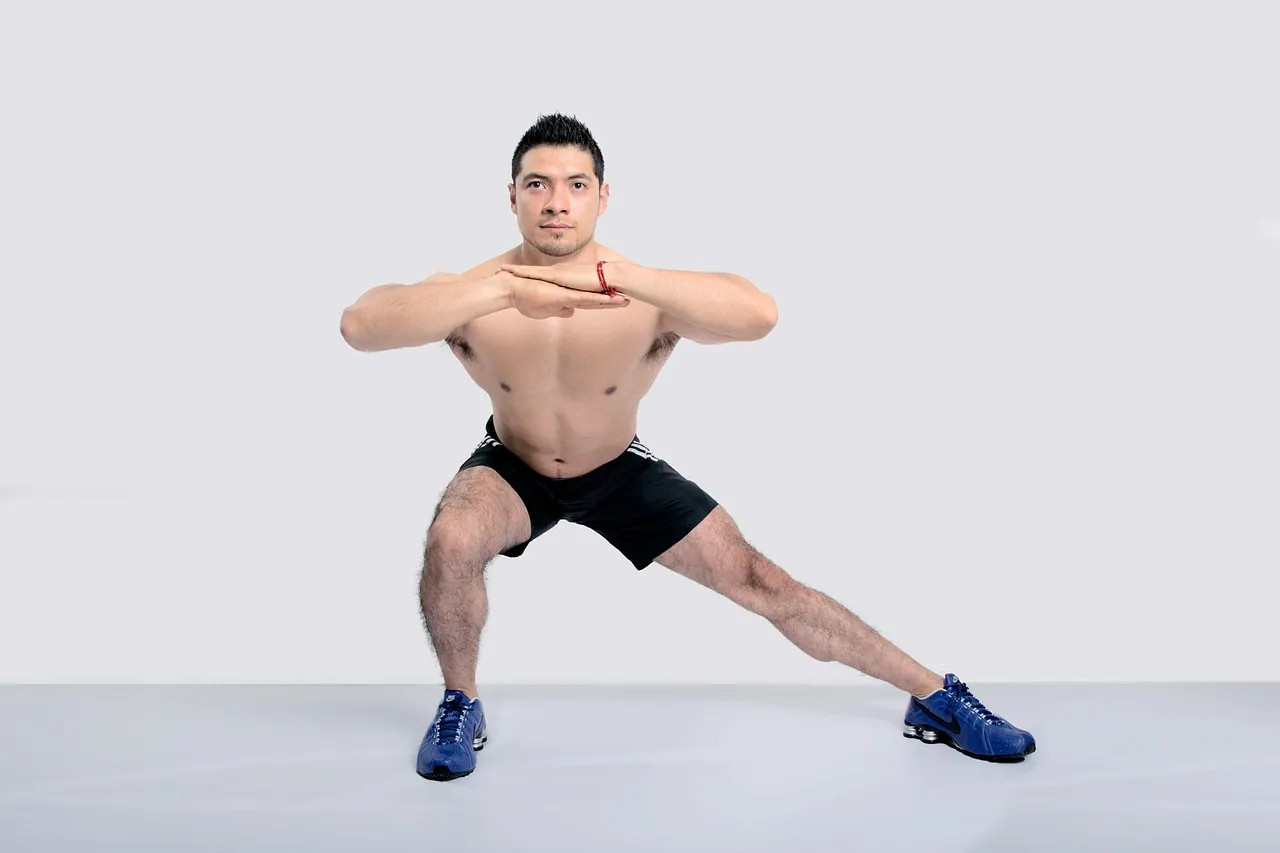
Most leg training is front-to-back, but badminton, cricket and dodging a scooter are not. Side and curtsy lunges load the inner thighs and gluteus medius in that missing direction.
Side (lateral) lunge
Stand with feet together, take a wide step to the side, sit the hips back over the stepping leg, and keep the other leg straight with its foot flat. Push back to the start. Expect a stretch in the inner thigh of the straight leg.
One caution: deep side lunges are not automatically gentler on the knee. An International Journal of Sports Physical Therapy study (2022) of 16 participants found kneecap joint force and stress were higher in the side lunge than the forward lunge between 40° and 100° of knee bend. If your knees are sensitive, keep the side lunge shallow at first.
Curtsy lunges
Step one leg diagonally behind the other, as in a curtsy, and lower both knees. Keep the hips facing forward; twisting the pelvis turns the exercise into a balance trick instead of a glute exercise. Use them as a finisher, not a heavy main lift.
Myth: “Your knee must never go past your toes”
This gym rule is an oversimplification. Some forward knee travel is normal, and forcing the shin vertical just moves stress elsewhere.
The clearest evidence comes from a squat study rather than a lunge study, but the mechanics carry over. In a 2003 study in the Journal of Strength and Conditioning Research, seven weight-trained men squatted with and without a barrier stopping their knees from passing their toes. Blocking the knees cut knee torque from about 150 N·m to 117 N·m, roughly 22% less, but hip torque rose from about 28 N·m to 303 N·m, and the lifters leaned their trunks further forward. The authors concluded that restricting the knees probably shifts force to the hips and lower back.
What actually matters for your knees:
- Direction: the knee should point in the same direction as the toes, not cave inward.
- Heel contact: the whole front foot stays down. A lifting heel is the real sign that your step is too short.
- Dosage: how deep, how heavy and how often. Kneecap load rises as the knee bends further, so depth is the dial you turn gradually.
Knee pain with lunges? Troubleshoot it before you quit
Mild discomfort while learning is common. Sharp pain, swelling, locking, giving way, or pain lasting into the next day needs a professional assessment. For ordinary niggles, use this table.
| What you feel or see | Likely cause | What to try |
|---|---|---|
| Ache at the front of the knee | Too deep, too fast, or forward lunges only | Switch to reverse lunges; reduce depth to a comfortable range; slow the lowering phase to 2–3 seconds |
| Front knee caves inward | Weak gluteus medius or fatigue | Reduce reps; add side lunges; cue “knee over little toes” |
| Front heel lifts | Step too short | Lengthen the step until the whole foot stays down |
| Wobbling or losing balance | Feet on a “tightrope” line | Keep feet hip-width apart; hold a wall or chair |
| Back knee bangs the floor | Dropping without control | Place a folded towel or yoga mat under the knee; lower more slowly |
| Lower back aches | Arching the back, especially with dumbbells | Brace the stomach, tuck the ribs down, lighten the load |
| Hip flexor strain on the back leg (Bulgarian) | Front foot too far from the bench | Move the front foot closer; lower the bench height |
For a gradual return, a 2022 Journal of Applied Biomechanics study suggested progressing the forward lunge in stages: first a shallow bend (0–30°), then a moderate bend (0–60°), then a long step with a deep bend. Kneecap load generally rose as knee bend increased, which is why depth, not load, is the first thing to build.
Dumbbell lunges exercise and jump lunges: adding load and power
Once 3 sets of 12 controlled bodyweight reps per leg feel easy, add weight for strength or speed for power.
Dumbbell lunges
Hold a dumbbell in each hand at your sides. This is the most stable way to load a lunge because the weight hangs close to your centre of gravity. No dumbbells? A backpack loaded with a 5 kg or 10 kg bag of atta, or two filled water bottles, does the job for bodyweight-plus training.
How much weight? Pick a load you can lift for your target reps with one or two reps “left in the tank”. When you can do one or two reps more than the target on every set, increase the weight. That’s the progressive overload principle, and it’s the core recommendation of the American College of Sports Medicine’s 2026 position stand, which reviewed 137 systematic reviews covering more than 30,000 people.

Jump lunges
From the bottom of a split stance, jump and switch legs in the air, landing softly in the opposite lunge. Jump lunges are a plyometric exercise: they train power and raise your heart rate quickly, but landing forces are high. Reserve them for people who already do weighted lunges pain-free, and stop the set when landings get loud.
How many lunges should you do each week?
For most adults, 2–3 lunge sessions a week of 2–3 sets per exercise is enough. The WHO recommends muscle-strengthening work for all major muscle groups on at least 2 days a week, and the 2026 ACSM position stand linked strength gains to 2–3 sets and at least 2 sessions a week, and muscle growth to 10 or more weekly sets per muscle.
The first figure comes from the WHO Guidelines on Physical Activity and Sedentary Behaviour (2020), which also recommend 150–300 minutes of moderate aerobic activity a week. The ACSM review found strength improved most with heavier loads, a full range of motion, 2–3 sets, doing the exercise early in the session and training at least twice a week. Training to failure did not consistently help. For a deeper look at weekly volume across all muscle groups, see our guide to how many sets per workout you need.
Lunges rarely need to be your only leg exercise. If you train in a gym, pair them with a squat or leg press and a hip hinge; our leg workouts at the gym guide shows how they fit into a full session.
A 4-week lunges workout plan
Run this twice a week with at least one rest day between sessions. Warm up with 5 minutes of brisk walking or spot marching, plus 10 bodyweight squats and 10 leg swings each side. All reps are per leg.
| Week | Session A | Session B | Rest between sets | Focus cue |
|---|---|---|---|---|
| 1 | Reverse lunge 3 × 8 (bodyweight, hold a chair) Side lunge 2 × 6 (shallow) |
Split squat (stationary) 3 × 8 Glute bridge 2 × 12 |
60 s | Slow 3-second lowering; whole foot down |
| 2 | Reverse lunge 3 × 10 Side lunge 3 × 8 |
Walking lunge 3 × 10 steps Curtsy lunge 2 × 8 |
60–75 s | Knee tracks over toes; no caving |
| 3 | Dumbbell or backpack reverse lunge 3 × 8 Side lunge 3 × 8 |
Bulgarian split squat 3 × 6–8 (bodyweight) Walking lunge 2 × 12 steps |
75–90 s | Add load only if week 2 felt controlled |
| 4 | Dumbbell reverse lunge 3 × 10 Curtsy lunge 2 × 10 |
Bulgarian split squat 3 × 8–10 (light dumbbells) Jump lunge 2 × 5 (optional, pain-free only) |
90 s | 1–2 reps in reserve on every set |
After week 4, repeat with slightly heavier weights or new variations.
Lunges exercise at home: no gym, no problem
Lunges stay challenging without equipment. Useful home swaps:
- Bench: the edge of a sturdy bed, a sofa or the second step of a staircase for Bulgarian split squats.
- Weights: a backpack with atta, rice or books; a 10-litre water can (about 10 kg) held at the chest.
- Tempo: a 4-second lowering phase makes bodyweight lunges far harder without any weight.
- Space: reverse lunges need only about 1.5 metres of floor, so they suit small flats better than walking lunges.
Benefits of lunges, and what they won’t do
The real benefits of lunges are practical: stronger legs one side at a time, better balance, and movement that resembles climbing stairs, getting up from the floor, or running. Because each leg works independently, lunges also reveal and help reduce left-right strength differences.
Honest limits:
- They won’t spot-reduce thigh fat. Fat loss depends on overall energy balance, not on which muscle you train.
- They aren’t the fastest way to lift maximum weight. For pure heavy strength, bilateral lifts such as squats and deadlifts let you load more.
- They don’t replace glute-specific work entirely. For glute size, many people also benefit from hip thrusts; see our hip thrust workout guide.
Who should modify a lunges workout?
- Complete beginners: start with stationary split squats holding a chair, then reverse lunges. Skip jump lunges for at least the first 6–8 weeks.
- Adults over 50: valuable for balance and stairs; use support and moderate depth at first.
- People with knee osteoarthritis or kneecap pain: get individual advice from a physiotherapist. Reverse lunges to a shallow depth, or step-ups onto a low step, are often better tolerated than deep forward or side lunges.
- Pregnant or postpartum women: check with your obstetrician. Balance changes in pregnancy, so hold a support and avoid jumping variations.
If you’d rather have a coach watch your form in real time, Fitstrot’s 1-on-1 personal training runs live over video, so a trainer can correct your knee position and choose the right variation.
Lunges workout FAQ
Are lunges better than squats?
Neither is better overall. Squats let you lift heavier loads with both legs; lunges train each leg separately, challenge balance and expose left-right imbalances. Most well-designed leg programmes include both, typically a squat pattern first and a lunge variation second.
How many lunges should I do a day?
You don’t need lunges every day. Two to three sessions a week of 2–3 sets of 8–12 reps per leg is enough for most adults, in line with WHO advice to do muscle-strengthening work on at least 2 days a week. Rest days let the muscles recover.
Which type of lunge is best for beginners?
The reverse lunge. The front foot stays planted, balance is easier, and a 2021 study found it put less load on the kneecap joint than the forward lunge. Start with bodyweight, hold a chair for balance, and do 2–3 sets of 8 per leg.
Is it bad if my knee goes past my toes during a lunge?
Not by itself. Some forward knee travel is normal. A 2003 study showed that blocking the knees from moving forward reduced knee torque by about 22% but increased hip torque roughly tenfold. Focus instead on keeping the knee in line with the toes and the whole foot on the floor.
Do lunges work the glutes?
Yes. Lunges work the gluteus maximus strongly, especially with a longer step, a slight forward lean, or walking lunges. The gluteus medius also works hard to keep the knee and pelvis stable.
Can I do a lunges workout at home without weights?
Yes. Reverse lunges, Bulgarian split squats on a bed or staircase, and slow 4-second lowering phases keep bodyweight lunges challenging. A backpack filled with atta or books is an easy way to add load.
Why do lunges hurt my knees?
Usually it’s a step that’s too short, a knee caving inward, going too deep too soon, or doing only forward lunges. Try reverse lunges at a shallower depth with slower reps. If pain is sharp, causes swelling, or lasts into the next day, see a physiotherapist or doctor.
Start with week 1 of the plan this week: two short sessions of reverse and side lunges. If you want a trainer to check your form live, book a 1-on-1 session with Fitstrot.


