
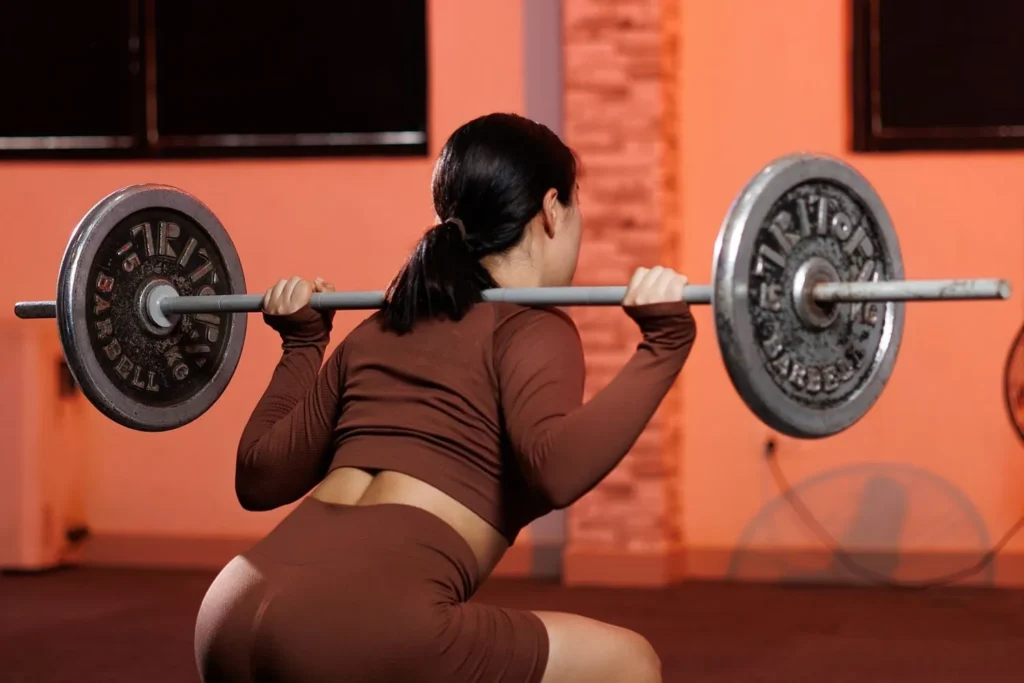
A lower body workout trains everything from your hips down: quads, hamstrings, glutes, calves and the core muscles that keep your spine steady under load. Done well, one 45 to 60 minute session covers a squat, a hip hinge, one single-leg exercise and a little isolation work, and you repeat it twice a week. This guide covers how the session fits into your week, how to build it, what to fix when something feels wrong, and how to run it at a gym or at home in India. For a leg-only deep dive on machines and accessories, our leg workouts at the gym guide goes further than we do here.
What Counts as a Lower Body Workout, and What Should It Include?
A lower body workout trains the quads, hamstrings, glutes, calves and hips in one session. A solid one has five parts: a squat pattern, a hip hinge, a single-leg movement, a hamstring or calf isolation exercise and a short core finisher. That is roughly 5 to 6 exercises and 12 to 18 working sets in 45 to 60 minutes.
Each part has a job, and skipping one leaves a gap that shows up later:
- Squat pattern (back squat, goblet squat, leg press): builds quads and glutes.
- Hip hinge (Romanian deadlift, hip thrust): builds hamstrings and glutes, the muscles most people undertrain.
- Single-leg work (lunges, split squats, step-ups): evens out left-right differences.
- Isolation (leg curl, calf raise): adds volume without taxing your lower back.
- Core finisher (plank, hanging knee raise): a short trunk block to finish.
Keep the five slots fixed and change the exercise inside a slot every 6 to 8 weeks.
A Sample Lower Body Workout: Sets, Reps, Rest and Form Cues
This is a gym version you can run twice a week. No loads are listed, because the right weight leaves you about 2 reps short of failure on every set. If you are new, start with the lower end of the sets.
| Exercise | Sets x reps | Rest | Form cue |
|---|---|---|---|
| Barbell back squat | 4 x 6-8 | 2-3 min | Brace before you descend, knees follow the line of your toes, drive up through mid-foot |
| Romanian deadlift | 3 x 8-10 | 2 min | Soft knees, push hips back, bar stays close to your thighs, stop when hamstrings stretch |
| Walking lunge | 3 x 10-12 per leg | 90 sec | Long stride, torso tall, front knee tracks over the middle toes |
| Leg press or leg curl | 3 x 10-12 | 90 sec | Control the lowering for 2 to 3 seconds, do not lock out knees, keep hips on the pad |
| Standing calf raise | 3 x 12-15 | 60 sec | Pause one second at the top, lower slowly until you feel a full stretch |
| Plank or hanging knee raise | 3 x 30-45 sec or 12-15 reps | 45 sec | Ribs down, glutes squeezed, no swinging |

Swap freely inside each slot: a front squat or hack squat for the back squat, a trap bar deadlift or hip thrust for the hinge. The pattern matters more than the machine.
How Do You Run a Lower Body Session Step by Step?
Spend 8 to 10 minutes warming up, do 2 to 3 lighter ramp-up sets of your first lift, then work through the heavy lifts before the lighter accessories. Rest 2 to 3 minutes between heavy sets and 60 to 90 seconds between accessories. Finish with core work and 5 minutes of easy stretching.
- Warm up (8-10 minutes). Brisk walking or cycling, then bodyweight squats, hip bridges and leg swings. You should feel warm, not tired.
- Ramp up. Do 2 to 3 lighter sets of your first lift before the working sets.
- Heavy compound first. Squat or leg press while fresh, stopping each set with 1 to 2 reps in reserve.
- Hinge second. Keep reps controlled and never round your lower back to squeeze out an extra rep.
- Single-leg and isolation work. Lighter, higher reps, clean form.
- Core, then cool down. Finish with 3 to 5 minutes of easy walking and gentle stretches.
How Many Sets, Reps and Days a Week for a Lower Body Workout?
Most people do well with 12 to 18 working sets per session, trained twice a week. Use 5 to 8 reps on the heavy compound lift, 8 to 12 on the hinge and single-leg work, and 12 to 15 on calves and curls. Beginners can start at 8 to 10 total sets per session.
Many lifters progress with roughly 10 to 20 hard sets a week per major lower body muscle, and splitting that across two days is easier to recover from than one marathon session. For general fitness or fat loss, 8 to 12 reps on most exercises and consistency beat chasing heavy singles.
When you hit the top of the rep range on every set with good form, add the smallest jump your gym offers, usually 2.5 kg on a barbell, and start again at the bottom of the range.
Upper/Lower, Full Body or Leg Day: Which Split Fits Your Week?
The right split depends on how many days you can actually train. Three days a week points to full body, four to upper/lower, and five or six allows a dedicated leg day. Each distributes the same weekly volume differently, so choose the one you can keep up for at least 8 weeks.
| Split | Days a week | Lower sessions a week | Best for | Watch out for |
|---|---|---|---|---|
| Full body | 3 | 3 (lighter) | Beginners and busy schedules | Sessions can run long if you add too many lifts |
| Upper/lower | 4 | 2 | Most intermediate lifters | Two hard lower days need real recovery between them |
| Push/pull/legs | 3 or 6 | 1 or 2 | People who like shorter, focused sessions | At 3 days, legs get only one weekly hit |
| Dedicated leg day in a 5-day split | 5 | 1 | Experienced lifters who enjoy long sessions | One big session carries all the volume and leaves you very sore |
If three days is all you can manage, a full body workout usually beats forcing two lower days into the week. On four days, pair this session with our upper body workout guide and leave at least one rest day between the two lower days.
Myth Check: Soreness, Bulk and Spot Reduction
Myth: if you can barely walk the next day, it was a great session. Soreness mostly means the movement was new or the volume jumped. Aim for training you can repeat.
Myth: squats and deadlifts make women bulky. Visible muscle gain takes years of heavy training and a calorie surplus. At normal gym loads, most women get stronger, firmer legs and glutes.
Myth: lower body day burns fat from the thighs. Training a muscle strengthens it; it does not remove fat from that spot. Fat comes off across the body as your overall calorie balance allows.
Troubleshooting: Knee Pain, a Rounding Back and One Weak Leg
When a lift feels wrong, change one thing at a time: the load, the depth, the foot position or the exercise. Most problems come from too much weight or rushed reps.
- Knees cave inward: lower the weight, widen your stance slightly and push your knees out over your toes.
- Front of the knee aches on lunges: shorten the stride and swap walking lunges for split squats or low step-ups.
- Lower back rounds at the bottom of a squat: reduce depth to where your back stays flat, brace harder and work on hip and ankle mobility.
- Lower back tires on Romanian deadlifts: keep the bar close and stop at mid-shin until the hamstring stretch, not your back, limits you.
- One leg is weaker: start every set with the weaker side and match the stronger side to it.
- Heels lift off the floor: stretch your calves daily and try a small plate under your heels.
Mild muscle fatigue is normal. Sharp or pinching joint pain lasting more than a few days, night pain, or numbness or tingling down a leg is a reason to stop and see a doctor or physiotherapist.
Lower Body Workout at Home, for Beginners and for Women: How to Adjust
You can run the same five-slot structure at home with bodyweight, a pair of dumbbells or a resistance band. For a lower body workout at home, pick one exercise per slot, do 3 sets each, and progress by slowing the lowering phase to 3 seconds before adding weight.
| Gym exercise | Home swap | How to make it harder |
|---|---|---|
| Barbell back squat | Goblet squat with one dumbbell, or bodyweight squat | 3-second lowering, 2-second pause at the bottom |
| Romanian deadlift | Dumbbell RDL, or single-leg bodyweight RDL | Hold heavier dumbbells, or slow the lowering to 3 seconds |
| Walking lunge | Reverse lunge or split squat | Hold dumbbells, elevate the back foot on a sturdy chair |
| Leg press | Step-up onto a stable bench or a strong sofa edge | Higher step, slower return |
| Leg curl | Glute bridge, then single-leg bridge | Add a dumbbell on the hips, hold the top for 2 seconds |
| Standing calf raise | Single-leg calf raise on a stair edge | Hold a dumbbell, 3-second lowering |
For beginners: start with 2 sessions a week and 2 to 3 sets per exercise. Learn the goblet squat and dumbbell Romanian deadlift before touching a barbell, and keep the first two weeks easy after any long break.
For women: the programme is the same, since a squat has no separate version. Extra glute work such as hip thrusts and step-ups is a fine preference. If you are pregnant, postpartum or managing a pelvic floor issue, check exercise choices with your doctor first.
Our home workout guide has more equipment-free options, and online yoga classes help the hip and ankle mobility squats depend on.
What to Eat Around a Lower Body Day (Indian Meal Structure)
Lower body sessions use a lot of energy, so eat a carbohydrate-and-protein meal 1.5 to 2 hours before, and another within a couple of hours after. Aim for roughly 1.2 to 2 g of protein per kg of body weight across the day. For a 65 kg person, that is about 80 to 130 g.
- Before training: poha with peanuts, a banana with milk, or whole-wheat toast with eggs or paneer. Keep it light if heavy squats on a full stomach make you queasy.
- After training: roti or rice with dal and sabzi, plus curd, paneer, eggs, chicken or fish.
- Rest of the day: spread protein across 3 to 4 meals. A katori of cooked dal gives roughly 7 to 9 g, an egg about 6 g and 100 g of paneer roughly 18 to 20 g.
- Water and sleep: sip water through the day and aim for 7 to 8 hours of sleep.
If fat loss is the goal, eat slightly less than you burn, but not so little that your main lifts get weaker. A Fitstrot online nutritionist can build an Indian meal plan around your training days, and an online weight loss trainer can add a weekly schedule. If you have diabetes, a kidney condition or another diagnosis, check protein and calorie targets with your doctor or registered dietitian first.
Frequently Asked Questions
How often should you do a lower body workout?
Twice a week is a good target for most people, with at least 48 hours between sessions. Beginners can start with one or two lighter sessions a week and build up. If you only train three days a week, a full body plan that includes legs each day is usually the better fit.
Can beginners do a lower body workout at home?
Yes. Start with bodyweight or goblet squats, glute bridges, reverse lunges and calf raises, doing 2 to 3 sets of 10 to 15 reps. Add a dumbbell or a slower tempo once all sets feel clean.
How long should a lower body workout take?
A focused lower body workout takes about 45 to 60 minutes, including an 8 to 10 minute warm-up. If you are pressed for time, a 30-minute version with a squat, a hinge and one single-leg exercise still gives you a useful session.
Should you do cardio before or after a lower body workout?
Do strength work first, then add 10 to 20 minutes of easy cardio afterwards if you want it. Heavy cardio before squats tires your legs and makes lifts weaker and less safe.
How is a lower body workout different from leg day?
The exercises overlap. A lower body day is usually one of two weekly lower sessions, so it is tighter and includes core work. A leg day in a five or six day split is often the only weekly leg session and runs longer.
Want a lower body day built around your schedule, your knees and the equipment you have? Book a 1-on-1 personal training session with a Fitstrot coach and get a split you can actually follow.


