
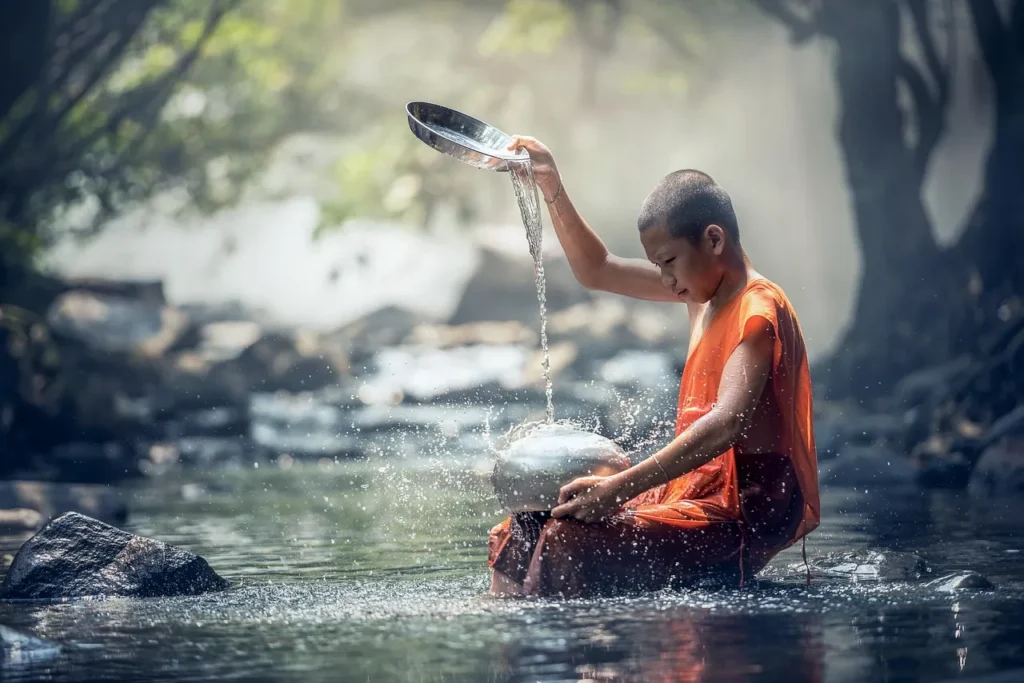
Most people meet yoga through the body: a sun salutation, a stretch, a breathing count. Jnana yoga starts somewhere else entirely. It is the yoga of knowledge, the path in Hindu philosophy that asks one question and keeps asking it until the answer holds: who am I, really? There are no poses to master and nothing to buy. The tools are listening, thinking and sustained contemplation, practised under the guidance of a teacher and a small set of classical texts.
Below: what the word means, how it compares with the other three classical paths, the four qualifications, the three stages, the Gita chapters to read first, and a realistic four-week way to start.
What Is Jnana Yoga?
Jnana yoga is the path of self-knowledge in Hindu philosophy. Its aim is liberation (moksha) through a correct understanding that one’s real self (Atman) is not the body or mind but pure awareness, identical with Brahman. It is practised in three stages: hearing the teaching (shravana), reflecting on it (manana) and contemplating it (nididhyasana).
That is the working definition of jnana yoga you will find across Vedanta. Psychiatrist Matcheri Keshavan, writing in the Indian Journal of Psychiatry in 2020, summarised its goal as freeing oneself “from the limited view of the individual ego” and noted that it is the first concept Krishna teaches in the Gita, in chapter 2.
What makes it unusual: its end point is understanding, not an experience, and it treats meditation, ritual and service as preparation that steadies the mind so the understanding can land.
Jnana Yoga Meaning: What the Sanskrit Actually Says
The jnana yoga meaning rests on one Sanskrit word. Jñāna (ज्ञान) comes from the root jñā, “to know”. It shares that root with the English word know. In Hindi it is spoken as gyaan, which is why you will also see “gyan yoga” or “gyana yoga” on Indian sites. Yoga here means a disciplined path or method, not a posture class.
The “knowledge” meant is not information. Knowing the dates of the Upanishads is not jnana. Vedanta separates two kinds of knowing:
- Apara vidya: lower knowledge, facts about the world.
- Para vidya: higher knowledge, settled clarity about the self that removes avidya (ignorance).
The standard teaching image is the rope and the snake. In dim light a man sees a snake and panics. A bystander points out it is a rope, and the fear ends at once. Nothing about the rope changed, only his knowledge of it. Psychiatrist S. Rajagopal uses exactly this analogy in a 2024 Indian Journal of Psychiatry essay on Advaita to explain how Vedanta sees suffering: as mistaken identity, corrected by knowledge, not by changing the outside world.
On pronunciation: North Indians usually say “gyaan”, Marathi speakers “dnyaan”. Both are accepted.
Bhakti Yoga, Karma Yoga, Jnana Yoga and Raja Yoga: The Four Paths Compared
Swami Vivekananda’s lectures in the 1890s popularised the idea of four main yogas, each suited to a temperament. They overlap more than they compete.
| Path | Main faculty used | Core practice | Key text | Suits people who are… | Common pitfall |
|---|---|---|---|---|---|
| Jnana yoga (knowledge) | Intellect, discrimination | Shravana, manana, nididhyasana; self-inquiry | Upanishads, Brahma Sutras, Gita ch. 2 & 13 | Analytical, questioning, drawn to philosophy | Dry intellectualism; “knowing” words without change |
| Bhakti yoga (devotion) | Emotion, love | Prayer, kirtan, japa, surrender | Gita ch. 12, Narada Bhakti Sutra | Emotionally expressive, relational | Sectarianism; devotion without reflection |
| Karma yoga (action) | Will, activity | Duty done without attachment to results | Gita ch. 3 | Active, practical, service-minded | Busyness mistaken for selflessness |
| Raja yoga (meditation) | Attention, mind control | Patanjali’s eight limbs, ending in dhyana and samadhi | Yoga Sutras of Patanjali | Methodical, experience-oriented | Chasing meditative states as the goal |
If raja yoga interests you, our guide to ashtanga yoga and Patanjali’s eight limbs covers that path in depth. The key difference: raja yoga treats a stilled mind as the goal; jnana yoga treats it as the condition for seeing clearly.

Where Does Jnana Yoga Sit in Hinduism?
In Hinduism, jnana yoga belongs to the Jnana Kanda, the knowledge portion of the Vedas that ends in the Upanishads, also called Vedanta. Its best-known school is Advaita (non-dual) Vedanta, systematised by Adi Shankara, which holds that the individual self and Brahman are one and that knowledge alone liberates.
To place jnana yoga in Hinduism, it helps to know how each Veda is divided. Rajagopal’s 2024 essay describes the first portion as Karma Kanda (ritual) and the second as Jnana Kanda, the spiritual teaching whose self-contained texts are the Upanishads.
The Upanishads compress their teaching into four Mahavakyas (“great sayings”), one from each Veda. Two are quoted most often:
- Tat tvam asi: “You are That”. Chandogya Upanishad 6.8.7, from the Sama Veda.
- Aham brahmasmi: “I am Brahman”. Brihadaranyaka Upanishad 1.4.10, from the Yajur Veda.
Advaita is not the only Vedanta school. Ramanuja’s Vishishtadvaita and Madhva’s Dvaita put devotion to a personal God at the centre, with jnana supporting bhakti. Most modern teachers, though, mean the Advaita approach when they say “jnana yoga”. The Internet Encyclopedia of Philosophy’s entry on Advaita Vedanta is a reliable, scholar-written overview if you want the full philosophical picture.
Jnana Yoga in the Bhagavad Gita: Which Chapters to Read First
Jnana yoga in the Bhagavad Gita is taught mainly in chapter 2 (the nature of the imperishable self), chapter 4 (Jnana Karma Sannyasa Yoga, where verse 4.38 says nothing purifies like knowledge) and chapter 13 (the field and the knower of the field). The Gita has 18 chapters and about 700 verses.
The Gita is the easiest door in. A 2013 Indian Journal of Psychiatry review counts 18 chapters and 701 verses and reads Arjuna’s collapse as distorted thinking that Krishna corrects, much as a therapist might. The knowledge teaching is densest here:
- Chapter 2, verses 11 to 30: Krishna begins by separating the self from the body. Verse 2.20 says the self is never born and never dies. Rajagopal notes that verse 2.11 is treated as especially important in the Advaita tradition.
- Chapter 2, verses 54 to 72: the sthitaprajna, the person of steady wisdom.
- Chapter 4, verses 33 to 39: knowledge is placed above ritual sacrifice. Verse 4.34 tells the student to learn “by humble reverence, by inquiry and by service” from those who have seen the truth. Verse 4.38: na hi jñānena sadṛśaṁ pavitram iha vidyate, “there is nothing in this world as purifying as knowledge”.
- Chapter 13: kshetra (the field: body, mind, senses) and kshetrajna (the knower of the field). This is the Gita’s most systematic analysis of what counts as “me”.
Read the endpoint too. In verse 18.73 Arjuna says his delusion is gone and his memory restored. A 2012 paper in the Indian Journal of Psychological Medicine reads this verse as the dissolution of anxiety, guilt and doubt.
Sadhana Chatushtaya: The Four Qualifications Most Guides Skip
Traditional Vedanta does not let just anyone start. According to the Internet Encyclopedia of Philosophy, Shankara set out a fourfold discipline, sadhana chatushtaya, and wrote in his Brahma Sutra commentary that inquiry into Brahman should begin only once these are in place. Most modern teachers treat them as a mirror rather than a gate.
| # | Sanskrit | Meaning | What it looks like today | Honest self-check |
|---|---|---|---|---|
| 1 | Viveka | Discrimination between the permanent (nitya) and the impermanent (anitya) | Noticing which worries will matter in five years and which won’t | Can I name what in my life is actually lasting? |
| 2 | Vairagya | Dispassion towards the fruits of action, here and hereafter | Enjoying a promotion or a new phone without your peace depending on it | Does losing small comforts wreck my day? |
| 3 | Shat sampatti | The six treasures: shama (calm mind), dama (sense restraint), uparati (withdrawal from excess), titiksha (endurance), shraddha (trust in teacher and teaching), samadhana (focused mind) | A regular sleep time, limited scrolling, tolerating heat or a delayed train without spiralling, finishing one text before starting another | Can I sit with one idea for 20 minutes without reaching for my phone? |
| 4 | Mumukshutva | Intense desire for liberation | The question “who am I?” feels urgent, not academic | Am I studying this to be free, or to sound interesting? |
The six treasures are listed identically in Bihar School of Yoga teaching and in the Vivekachudamani, a text traditionally attributed to Shankara. Notice how physical the list is: shama and dama depend heavily on sleep, food and screen habits, which is where a regular yoga and pranayama routine supports the path of knowledge.
What Is Included in Jnana Yoga Stages?
Jnana yoga has three stages. Shravana is hearing the teaching from a qualified teacher and the texts. Manana is reflecting on it until every doubt is resolved. Nididhyasana is sustained contemplation until the understanding becomes second nature. The sequence comes from Brihadaranyaka Upanishad 2.4.5.
In that verse the sage Yajnavalkya tells his wife Maitreyi that the self “should be heard of, reflected on and meditated upon” (shrotavyo mantavyo nididhyasitavyah). Rajagopal’s 2024 essay gives a clear modern gloss on each of these jnana yoga stages:
1. Shravana: hearing
Listening to the teaching of the guru, the scriptures and the commentaries. The emphasis is on hearing, because a teacher answers your specific confusion. Recorded lectures from one lineage count; random clips from ten teachers do not.
2. Manana: reflection
Testing the teaching against your own experience until no objections are left. Write one claim at the top of a page (“I am not the body”), list every honest objection, then take them back to the teacher or commentary.
3. Nididhyasana: contemplation
Staying with the understanding until it is no longer something you remember but something you live from. Rajagopal describes it as “solidifying” the knowledge “so that it remains enduring for the rest of one’s life”. Practically it looks like quiet sitting, but the object of attention is a teaching you have already understood, not the breath or a mantra.
A key Advaita point, again from Rajagopal: meditation and ritual “are useful preliminary means for purifying and stabilizing the mind”, but on their own they are “not sufficient” for liberation. The stages build on one another. Nididhyasana without shravana is just sitting quietly.

How to Practice Jnana Yoga: A Four-Week Starter Plan
A gentle structure for someone with a job and a family, not a replacement for a teacher: about 30 minutes a day, ideally in the early-morning slot many Indian homes already keep for puja.
| Week | Shravana (10 min) | Manana (10 min) | Nididhyasana (10 min) | End-of-week check |
|---|---|---|---|---|
| 1 | Gita 2.11–2.30 with one commentary | Write: “What in me has stayed the same since childhood?” | Sit and notice that thoughts appear to you | Can you explain the body/self distinction in 3 sentences? |
| 2 | Gita 2.54–2.72 (the person of steady wisdom) | Pick one trait; note when you lost it that day | Rest as the one who watches reactions | Did you catch one reaction as it happened? |
| 3 | Ramana Maharshi’s short text Who Am I? (Nan Yar) | List what “I” refers to: body, name, role, mood. Test each: is it constant? | Ask “to whom does this thought arise?” and rest in the answer “to me” | Which of your “I”s disappeared in deep sleep? |
| 4 | Opening verses of Gita chapter 13 (field and knower of the field) | Review weeks 1–3 notes; write open doubts | Sit with the one idea that felt most true | Take your doubts to a teacher or study group |
Anyone new to sitting still can borrow techniques from our guide to meditation techniques for the first two weeks, then gradually swap the object of attention from the breath to the teaching itself.
A realistic expectation: four weeks makes you familiar with the method. Traditional students spent years on shravana alone. Anyone promising “enlightenment in 30 days” is selling something.
Myth Check: Are There Jnana Yoga Poses?
No. There are no jnana yoga poses. Jnana yoga is a path of study and contemplation, not a posture system. Images labelled “jnana yoga poses” online usually show ordinary seated meditation postures or the gyan mudra hand gesture, which belong to hatha and meditation practice, not to jnana yoga itself.
The confusion is understandable. The US government’s National Center for Complementary and Integrative Health notes that yoga began as a spiritual practice rooted in Indian philosophy, but as practised in the United States it typically emphasises physical postures, breathing and meditation. The share of US adults practising it rose from 5.0% in 2002 to 15.8% in 2022.
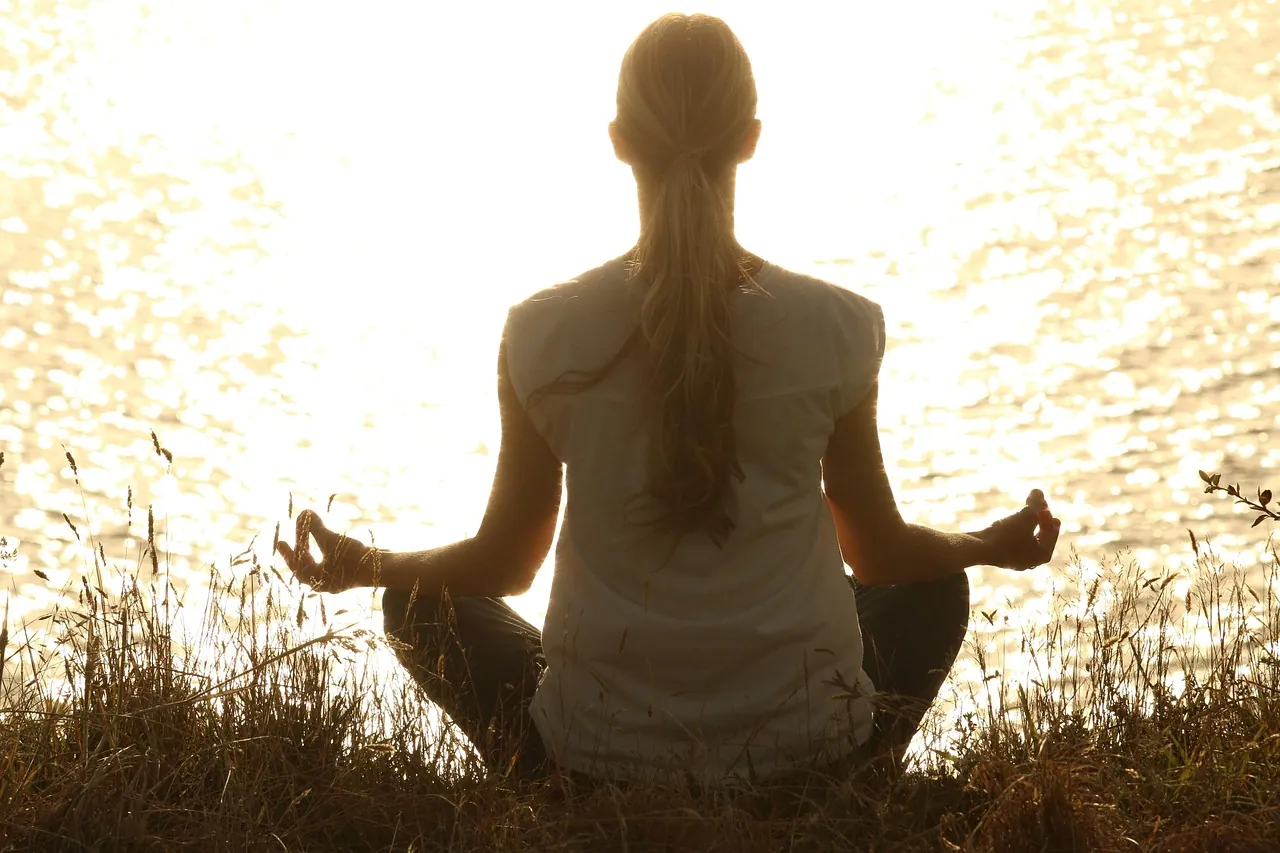
The body still matters: a seated posture such as sukhasana, held still for 10 to 20 minutes, makes nididhyasana possible, and the gyan mudra is a fine hand position during contemplation. Just don’t mistake the gesture for the path.

When Self-Inquiry Turns Into Overthinking
Jnana yoga is a thinking path, and thinking has a failure mode. Psychology draws a useful line here. In a 2011 study of 121 college students, Harrington and Loffredo found that insight was the only positive predictor across all six dimensions of psychological well-being they measured, while rumination predicted lower well-being on three of them. Self-focus helps when it produces clarity and hurts when it circles. Watch for:
- Circling instead of concluding. If the same doubt returns daily for weeks, take it to a teacher. Manana resolves doubts; it does not rehearse them.
- Detachment that feels like numbness. Vairagya should feel light, not flat. Losing interest in food, people or work for weeks can be a sign of low mood; speak to a doctor.
- Using “it’s all Maya” to avoid duties. The Gita was spoken to stop Arjuna abandoning his.
- Intellectual pride. If study makes you more argumentative, something is off. In Gita chapter 13, humility (amanitvam) is the first item in the list of qualities Krishna calls knowledge.
An important boundary: jnana yoga is not therapy. If you are living with anxiety, depression or trauma, a qualified clinician should come first. Philosophy can sit alongside that care, never replace it. For the mind’s movements themselves, see our explainer on chitta vritti covers from the Yoga Sutra side.
Jnana Yoga Books: A Reading Ladder From First Book to Classical Text
The usual mistake with jnana yoga books is starting at the top. Classical Advaita study follows the prasthana traya, the “three foundations”: the Upanishads, the Brahma Sutras and the Bhagavad Gita. Adi Shankara wrote commentaries on all three. They are the destination, not the entry point.
| Level | Text | Author / source | Why read it |
|---|---|---|---|
| 1. Start | Jnana Yoga | Swami Vivekananda (lectures, 1890s) | Plain-English lectures that made the path accessible to modern readers |
| 1. Start | Who Am I? (Nan Yar) | Ramana Maharshi | A short question-and-answer text on direct self-inquiry |
| 2. Foundation | Tattva Bodha | Traditionally attributed to Adi Shankara | A short primer that defines sadhana chatushtaya and core terms |
| 2. Foundation | Bhagavad Gita, chapters 2, 4, 13 | Vyasa (Mahabharata) | 18 chapters and about 700 verses. The most accessible of the three foundations |
| 3. Deepening | Vivekachudamani | Traditionally attributed to Adi Shankara | Detailed treatment of the qualifications and discrimination |
| 3. Deepening | Principal Upanishads: Isha, Kena, Katha, Mandukya | Vedic | Short, dense, and best read with a commentary |
| 4. Classical | Brahma Sutras with Shankara’s commentary | Badarayana (tradition identifies him with Vyasa) | 555 aphorisms that systematise the Upanishads. Study this with a teacher |
The 555-aphorism count comes from Rajagopal’s 2024 essay. For translations, Indian publishers such as Advaita Ashrama, Gita Press and the Ramakrishna Math publish affordable editions of most of these texts. Choose a bilingual Sanskrit-English or Sanskrit-Hindi edition.

Who Suits the Path of Knowledge, and Who Might Start Elsewhere
Jnana yoga suits you if you ask “but why?” one more time than everyone else, find philosophy energising, and can sit alone with a text.
It may not be the best first path if:
- Your mind is very scattered right now (exams, a new baby, a stressful job). Start with breath-based practice; shama and dama come before inquiry for a reason.
- You feel pulled more to emotion than analysis. Bhakti may open up faster, and jnana can follow.
- You mainly want fitness, flexibility or stress relief. Those are real, worthwhile goals, and a hatha or pranayama class meets them more directly.
Keshavan’s 2020 paper argues that the jnana habit of stepping back from a narrow “I” towards a wider “we” is a useful resilience skill, while noting that more empirical research is needed. The benefits of jnana yoga that people describe, such as calmer reactions and less identification with passing moods, are plausible but have not been tested in clinical trials.
Jnana Yoga FAQs
What is jnana yoga in simple words?
Jnana yoga is the yoga of knowledge. You study, question and contemplate the Upanishads and the Bhagavad Gita until you clearly understand that your true self is awareness, not the body or mind.
What is included in jnana yoga stages?
Three stages: shravana (hearing the teaching from a teacher and the texts), manana (reflecting until doubts are resolved) and nididhyasana (sustained contemplation until the knowledge is steady). They come from Brihadaranyaka Upanishad 2.4.5 and are practised in that order.
Which chapter of the Bhagavad Gita is about jnana yoga?
Chapter 4 is titled Jnana Karma Sannyasa Yoga, and verse 4.38 says nothing purifies like knowledge. Chapter 2 introduces the imperishable self, and chapter 13 analyses the field and the knower of the field. Most teachers start with chapter 2.
Do you need a guru for jnana yoga?
Tradition says yes. Gita 4.34 tells the seeker to learn from those who have seen the truth, and shravana means hearing from a teacher. Books prepare you; a teacher resolves doubts you cannot see yourself.
Is jnana yoga the same as Advaita Vedanta?
Not exactly. Advaita Vedanta is a philosophical school; jnana yoga is the practice path it emphasises. Dvaita and Vishishtadvaita value knowledge too but centre devotion to a personal God.
Which jnana yoga books should a beginner read first?
Start with Swami Vivekananda’s Jnana Yoga lectures and Ramana Maharshi’s short Who Am I?, then read Bhagavad Gita chapters 2, 4 and 13 with a commentary. Leave the Brahma Sutras for later, ideally with a teacher.
Want to prepare your body and breath for the path of knowledge? Book a trial session of Fitstrot’s live online yoga classes and build the steady seat and calm mind that jnana yoga asks of you.


