

A full week workout plan gives every one of the seven days a job: which days you lift, which day you walk, and which day you do nothing at all. For most adults the sweet spot is 3 to 5 training days, one or two easy days and at least one full rest day, with each muscle trained roughly twice a week. Below is a complete 7 day workout plan with sets, reps and rest times, shorter 3-day and 4-day versions, a simple progression rule, and fixes for the weeks when real life gets in the way.
How many days a week should you workout?
Most healthy adults get the best return from 3 to 5 hard training days a week, plus one or two easy days. Three full-body sessions suit beginners and packed schedules. Four or five sessions suit people with a few months of steady training behind them. Training hard on all seven days leaves too little time to recover.
Here is how the numbers usually land:
- Just starting out (first 3 months): 3 days of full-body work, with a rest day between sessions, such as Monday, Wednesday and Friday. A 3 day a week workout is enough to learn the lifts and build a habit.
- Some experience (3 to 12 months): 4 days, split into two upper-body and two lower-body sessions, plus a walk or an easy class on a fifth day.
- Consistent for a year or more: 5 days, where one session is lighter conditioning rather than heavy lifting.
- Six or seven hard days: only for athletes or people who sleep well, eat enough and manage fatigue carefully.
If you are unsure, start at 3 and add a day only after three or four steady weeks. A smaller plan you follow beats a bigger one you abandon by the second Thursday.
The 7-day template at a glance
This weekly workout plan uses an upper and lower split, so every major muscle gets trained twice with at least two days between hard sessions for the same area. It has four lifting days, one conditioning day, one active recovery day and one full rest day.
| Day | Session | Time needed | Effort |
|---|---|---|---|
| Monday | Lower body A (squat focus) | 50-60 min | Hard |
| Tuesday | Upper body A (press focus) | 50-60 min | Hard |
| Wednesday | Active recovery: walk and mobility | 30-40 min | Easy |
| Thursday | Lower body B (hip hinge focus) | 50-60 min | Hard |
| Friday | Upper body B (pull focus) | 50-60 min | Hard |
| Saturday | Conditioning and core | 30-45 min | Moderate |
| Sunday | Full rest | 0 min | None |
The order is deliberate. The heaviest leg and press days sit early in the week, when energy and motivation are highest. Wednesday’s walk stops fatigue piling up, and Saturday is the easiest session to shorten or swap. If you want a closer look at how to place sessions around office hours and sleep, our weekly workout schedule guide covers timing, and the Monday workout plan shows how to open the week well.
Session by session: sets, reps, rest and form cues
Use these numbers as a starting point. Heavy compound lifts work well at 3 to 4 sets of 6 to 10 reps with 2 to 3 minutes of rest. Smaller accessory moves work at 2 to 3 sets of 10 to 15 reps with 60 to 90 seconds of rest. Stop each set with roughly 1 to 3 reps left in the tank, not at total failure.
| Day | Exercise | Sets x reps | Rest | Form cue |
|---|---|---|---|---|
| Mon | Goblet or barbell squat | 3-4 x 6-10 | 2-3 min | Chest up, knees track over toes, push through the whole foot |
| Mon | Walking lunge or split squat | 2-3 x 10-12 per leg | 90 sec | Upright torso, front heel flat, lower with control |
| Mon | Standing calf raise | 3 x 12-15 | 60 sec | Full stretch at the bottom, one-second pause at the top |
| Tue | Dumbbell or barbell bench press | 3-4 x 6-10 | 2-3 min | Shoulder blades pinched back, feet planted, forearms vertical |
| Tue | One-arm dumbbell row | 3 x 8-12 per side | 90 sec | Pull the elbow towards your hip, keep the torso still |
| Tue | Triceps pushdown | 2-3 x 10-15 | 60 sec | Elbows pinned to your sides, no swinging |
| Thu | Romanian deadlift | 3 x 8-10 | 2 min | Soft knees, hips travel back, weight slides along the thighs |
| Thu | Hip thrust or glute bridge | 3 x 8-12 | 90 sec | Ribs down, chin tucked, squeeze hard at the top |
| Fri | Standing overhead press | 3 x 6-10 | 2 min | Squeeze glutes, ribs down, press straight over the ears |
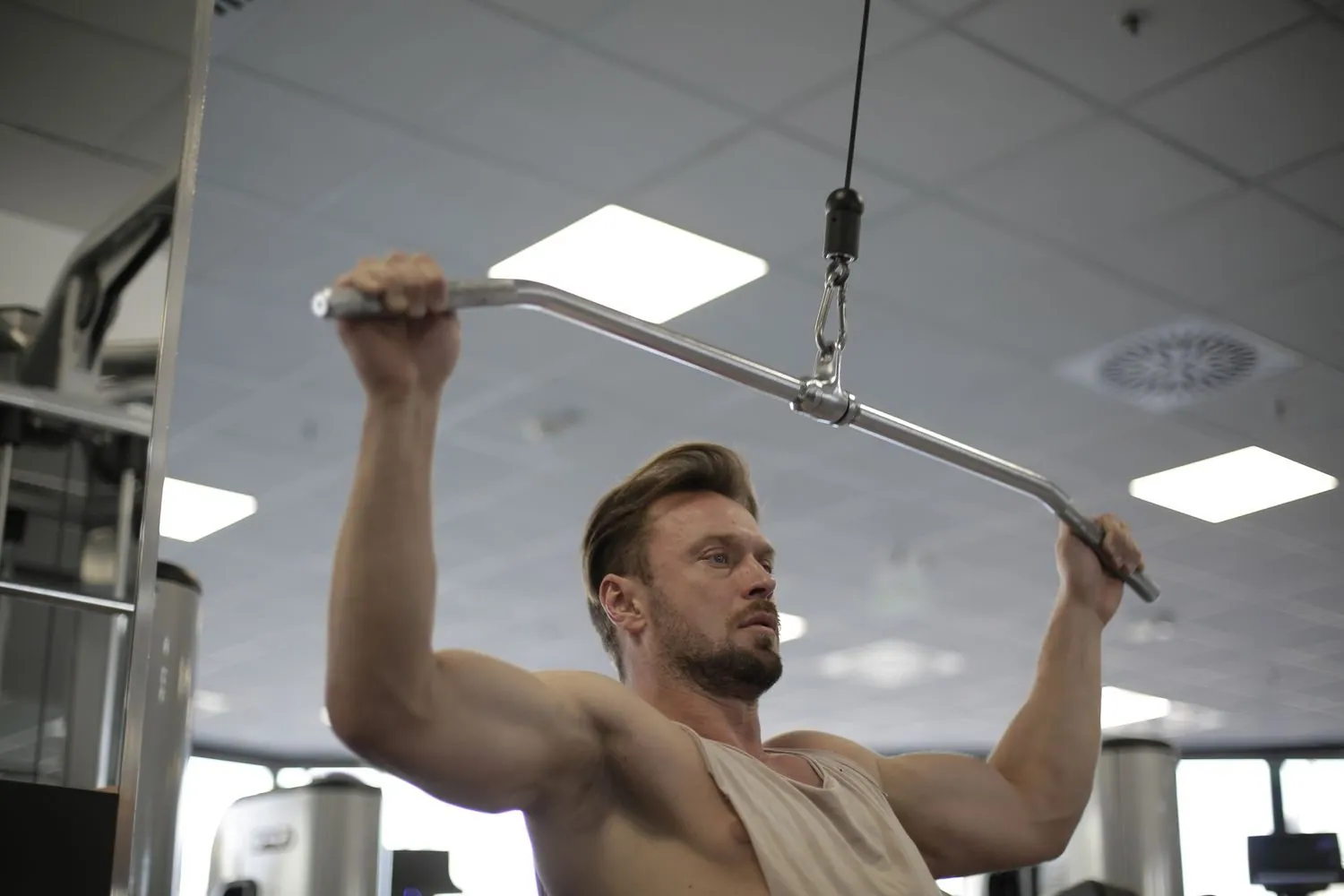
| Fri | Lat pulldown or assisted pull-up | 3 x 8-12 | 90 sec | Pull elbows towards your ribs, no leaning back |
| Fri | Plank | 3 x 20-40 sec | 45-60 sec | Straight line from head to heels, glutes tight |
Saturday is flexible. Pick one: 20 to 30 minutes of intervals on a bike or treadmill (1 minute hard, 2 minutes easy), a brisk 45-minute walk, or a lively dance class. A gentle online yoga class on this day is also a solid way to work on mobility while keeping effort low.
Warm up for 5 to 8 minutes before every lifting day with easy cardio and one or two light sets of your first exercise.
What if you only have 3 or 4 days?
A 3-day week should be full body: one squat or hinge, one push, one pull and some core work per session, with a rest day between each. A 4-day week uses two upper and two lower sessions. Both give every muscle two weekly exposures, which is enough for steady progress in the first year.
| Version | Layout | Best for | Session length | Rest or easy days |
|---|---|---|---|---|
| 3 days | Mon, Wed, Fri: full body A, B, A (swap next week) | Beginners, busy workweeks | 45-60 min | 4 days, with walks on 2 of them |
| 4 days | Mon and Thu lower; Tue and Fri upper | Intermediate, 3-12 months in | 50-60 min | 3 days, 1 with a walk |
| 5 days | The 7-day template above | Consistent for a year or more | 40-60 min | 2 days: 1 easy, 1 full rest |
To choose between layouts or to see how different goals change exercise selection, read our best workout routine guide. For the single-session mechanics behind each day, the workout plan article breaks down how to order exercises inside one workout.
Myth check: more training days always means faster results
Muscle is built when you recover from the work, not during the session itself. Three myths are worth clearing up.
- Myth: a rest day is a lost day. A rest day is part of the plan, because sleep and food are where your body adapts. Aim for roughly 7 to 9 hours of sleep on most nights.
- Myth: you must train one body part per day. Hitting each muscle only once a week usually leaves progress on the table, especially for beginners. Two exposures a week tends to work better for most people.
- Myth: a whole week workout plan must be perfect to work. Missing one session changes very little; missing three weeks changes a lot.
Honest note on results: no plan guarantees a specific kilo or centimetre outcome by a deadline. Body changes depend on food, sleep, stress, genetics and how long you stay consistent. Judge the plan over 8 to 12 weeks, not 8 to 12 days.
How do you progress your plan week to week?
Pick a rep range, such as 8 to 12, and a weight you can lift 8 times with 1 to 3 reps in reserve. Add one rep per set each week until you reach 12 on every set. Then add roughly 2 to 5 percent more weight, about 1 to 2.5 kg, and drop back to 8 reps.
The method is called double progression, and it gives you a clear target each session. Write down your weight, reps and sets in a notebook or phone note. Without a log, most people repeat the same workout for months and wonder why nothing changes.
Every 6 to 8 weeks, run an easier week. Keep the same exercises, but cut the sets by about a third and leave 3 to 4 reps in reserve. Then change one or two exercises, say barbell squat to leg press, so the plan stays fresh.
Troubleshooting: when the week falls apart
- You missed Monday. Do not double up on Tuesday. Shift the week by one day, or simply skip the session and carry on. Two heavy lower-body days back to back is the real cost of catching up.
- You are very sore on a training day. Mild soreness is fine; warm up and see how the first sets feel. If the muscle is stiff and weak, train the other half of the body instead.
- You only have 30 minutes. Do the first two exercises from the session, 3 sets each. A short session with the main lifts beats no session.
- Travel, festival or exam weeks. Drop to 2 or 3 short full-body sessions plus walking. Treat it as a maintenance week.
- Strength has stalled for 3 weeks. Check sleep, food and whether you are logging weights. If all three look fine, run an easier week, then restart your rep-range progression.
Stop training and see a doctor if you feel chest pain, unusual breathlessness, dizziness or sharp joint pain. If you have a heart, joint or blood pressure condition, or you are returning after surgery or injury, speak with your doctor before following any new weekly plan.
Adjusting the week for your goal and your life
The skeleton stays the same. What changes is the emphasis, the food around it, and how much you push each day.
- Fat loss: Keep all the lifting days to protect muscle, add a daily walking target (many people aim for roughly 7,000 to 10,000 steps), and keep Saturday as moderate cardio. A weight loss trainer can set your calorie and activity targets for your body.
- Muscle gain: Stay with 4 or 5 days, raise accessory sets to 3 or 4, and eat enough overall. Our muscle workout plan covers the exercise side in more depth, and the workout and diet plan guide shows how to match your meals to training days.
- Home or limited equipment: Replace barbell lifts with dumbbells, backpack-loaded squats, push-ups, resistance bands and step-ups. The structure stays the same, and our home workout plan lists the swaps.
- Long desk hours and tired evenings: Train in the morning if you can, or right after work before dinner, and use Wednesday for a proper walk.
- Complete beginners: Start with the 3-day version for 6 to 8 weeks and use lighter weights than you think you need.
Food matters on lifting and recovery days alike. A typical Indian plate with dal, curd, paneer or eggs, some sabzi and a measured portion of roti or rice covers the basics for most people. For anything more specific, an online nutritionist removes the guesswork.
A one week workout plan is a starting draft, not a permanent contract. For a version built around your timetable and equipment, our guide to a personalized workout plan explains what a tailored version includes.
Frequently asked questions
What is a good full week workout plan?
A good full week workout plan covers all seven days, trains each major muscle about twice, includes at least one full rest day and one active recovery day, and fits your real schedule. For most people that means 3 to 5 training days with progressive overload.
How many days a week should you workout to see results?
Three days a week is enough for beginners to see steady strength and fitness changes over a few months. Four to five days suits people with more training experience. Consistency over 8 to 12 weeks matters more than the exact number of days.
Do I need a rest day in a weekly workout plan?
Yes. Plan at least one full rest day per week, plus an easy active recovery day if you train 4 or more days. Recovery is when muscles repair and adapt, and skipping it often leads to stalled lifts, poor sleep and low motivation.
Can I follow a full week workout plan at home?
Yes. Keep the same upper and lower structure, and swap machines and barbells for dumbbells, bands, bodyweight moves and loaded backpacks. Use the same rep ranges, rest times and progression rule, and increase difficulty by adding reps, slowing the lowering phase or using heavier weights.
When should I change my weekly workout plan?
Change the plan every 6 to 8 weeks, or sooner if you are bored, stuck on the same weights for three weeks, or your schedule has changed. Swap one or two exercises, adjust the sets, and keep the weekly structure the same.
Next step: if you would rather have a coach build and adjust this week around your timetable, book a session with our 1-on-1 personal training team and bring your current schedule with you.


